
1. Background
Psychological problems are common among emergency ambulance workers, who serve as one of the most critical pillars in healthcare services and provide pre-hospital treatment to patients (1). Ambulance workers are often under immense pressure during emergencies, making them more susceptible to mental health disorders. They are vulnerable to psychological illnesses not only due to their exposure to patients but also because they often work in traumatic situations, such as accident scenes, deaths, burns, and natural disasters.
As the emergency service acted as the first link between patients and pre-hospital treatment and action, the ambulance workers demanded an accurate understanding of the patient's problem to treat them professionally (2). Therefore, episodes of stress-causing situations that can hurt the patient can occur and lead to anxiety among the workers.
Various factors, including insomnia, sleep disturbances, work duration, irregular breaks due to work shifts, separation from family, increased workloads, and involvement in patient care, have been identified as predictors for increased stress, depression, and anxiety (3-5). Healthcare providers often struggle with the life and death of their patients, which can further exacerbate these issues. It is crucial to note that poor psychological health can have a significant impact on an individual's quality of life and may lead to poorer performance (5). Consequently, this can also affect the quality of patient care and safety (6, 7).
2. Objectives
Identifying factors associated with stress at work is essential in managing and preventing psychological disorders. Thus, the current study was designed to determine the predictors of depression, anxiety, and stress among emergency ambulance staff. The Depression, Anxiety, and Stress Scale (DASS) is one of the most widely used tools in medical practice for identifying psychological issues such as depression, anxiety, and stress. The study's outcomes will provide valuable data to enhance understanding of psychological health factors.
3. Methods
3.1. Study Design
This cross-sectional study was conducted at the emergency department in ten government hospitals in Kelantan.
The ethical approval was obtained from the Human Research Ethics Committee, Universiti Sains Malaysia (USM), and the Medical Research and Ethics Committee, Ministry of Health.
3.2. Participants
All emergency medical services (EMS) personnel, including assistant medical officers (AMOs) and nurses, who were proficient in English reading and writing and provided informed consent, were included in the study. The respondents who had psychological problems before the study and did not complete or return the questionnaires were excluded.
The researcher elected one representative, whether senior AMO or senior staff nurse, from each of the ten hospitals to facilitate the data collection process. An English version of the self-administered questionnaire was given to the representatives, and they distributed it to the study subjects who fulfilled the inclusion and exclusion criteria under his or her supervision.
Detailed information about the study was provided in the respondents' information sheet. Eligible subjects who voluntarily entered the study were requested to fill in an informed consent form and sign it. Participants had 10 to 15 minutes to answer all the questions. Once completed, the questionnaires were collected by the corresponding representative and submitted to the researcher. All information was kept confidential, and individual data did not identify the respondents.
3.3. Data Collection
A set of English questionnaires consisting of a demographic profile form and a 21-item Depression Anxiety and Stress Scale (DASS-21) was developed by Antony et al. (8) and was used for data collection. DASS-21 is predominantly aimed at assessing the perceived severity of symptoms related to depression, anxiety, and stress (9). Each scale consisted of seven items and each item used a four-point response scale. A rating scale of 0 indicated "did not apply to me at all - (never)", a scale of 1 indicated "applied to me to some degree, or some of the time – (sometimes)", a scale of 2 indicated "applied to me to a considerable degree or a good part of the time – (often)", and a scale of 3 indicated "applied to me very much or most of the time – (almost always)."
The DASS-21 is a shorter form of the original version of DASS-42. Several studies have been published on its reliability and validity worldwide, all showing that DASS-21 is a well-established instrument to measure symptoms of depression, anxiety, and stress in both clinical and non-clinical samples of adults (8, 10-14).
The following cut-off scores for depression were 0 to 4 for no depression; 5 to 6 for mild depression; 7 to 10 for moderate depression; 11 to 13 for severe depression, and more than 14 for extremely severe depression. The following cut-off scores for anxiety were 0 to 3 for no anxiety; 4 to 5 for mild anxiety; 6 to 7 for moderate anxiety; 8 to 9 for severe anxiety, and more than 10 for extremely severe anxiety, whereas the following cut-off points for stress were:0 to 7 for no stress; 8 to 9 for mild stress; 10 to 12 for moderate stress; 13 to 16 for severe stress and more than 17 for extremely severe stress. The final scores for DASS-21 in depression, anxiety, and stress were summed up and multiplied by two to fit with the original 42 items before being categorized according to their respective severity (15).
However, in the current study, the authors classified those five categories into yes and no only. Yes, include moderate, severe and extremely severe, while no include normal and mild.
3.4. Statistical Analysis
Data were analyzed using IBM SPSS Statistics for Windows, version 27.0 (SPSS Inc., Chicago, III., USA). The chi-square test was used to analyze the association between demographic profiles with depression, anxiety, and stress. Logistic regression analyses were used to analyze the significant predictors of depression, anxiety, and stress. Results are presented as the crude and adjusted odd ratios (OR), 95% confidence interval (CI), and P-value. The P-value < 0.05 was considered statistically significant.
4. Results
4.1. Individual and Work-Related Characteristics
A total of 143 ambulance workers participated in the study. The respondents' age ranged from 23 to 59 years old, with a mean (SD) age was 38.27 (7.27) years. Half of the respondents were in the age group of 30 to 39 years (51.0%). Male workers were 91 (63.6%), and female workers were 52 (36.4%). The majority of respondents were married individuals (92.3%), non-smokers (79.0%), and duration of working for more than ten years (37.7%).
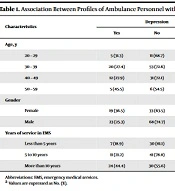
Table 1 shows the association between the profiles of ambulance personnel with depression, anxiety, and stress. There is a significant association between years of services and depression (P = 0.008), gender and stress (P = 0.035), and years of services in EMS and stress (P = 0.008).
Table 1.
Association Between Profiles of Ambulance Personnel with Depression, Anxiety, and Stress (n = 143) a
| Characteristics | Depression | Anxiety | Stress | ||||||
|---|---|---|---|---|---|---|---|---|---|
| Yes | No | χ2 | Yes | No | χ2 | Yes | No | χ2 | |
| Age, y | 0.664 | 0.296 | 0.157 | ||||||
| 20 – 29 | 5 (31.3) | 11 (68.7) | 11 (63.7) | 5 (38.8) | 1 (6.3) | 15 (93.7) | |||
| 30 – 39 | 20 (27.4) | 53 (72.6) | 32 (43.8) | 41 (56.2) | 12 (16.4) | 61 (83.6) | |||
| 40 – 49 | 12 (27.9) | 31 (72.1) | 19 (44.2) | 24 (56.8) | 11 (25.6) | 32 (74.4) | |||
| 50 – 59 | 5 (45.5) | 6 (54.5) | 6 (54.5) | 5 (45.5) | 4 (36.4) | 7 (63.6) | |||
| Gender | 0.155 | 0.137 | 0.035 | ||||||
| Female | 19 (36.5) | 33 (63.5) | 29 (55.8) | 23 (44.2) | 15 (28.8) | 37 (71.2) | |||
| Male | 23 (25.3) | 68 (74.7) | 39 (42.9) | 52 (57.1) | 13 (14.3) | 78 (85.7) | |||
| Years of service in EMS | 0.008 | 0.159 | 0.008 | ||||||
| Less than 5 years | 7 (18.9) | 30 (81.1) | 13 (35.1) | 24 (64.9) | 2 (5.4) | 35 (94.6) | |||
| 5 to 10 years | 11 (21.2) | 41 (78.8) | 25 (48.1) | 27 (51.9) | 9 (17.3) | 43 (82.7) | |||
| More than 10 years | 24 (44.4) | 30 (55.6) | 30 (55.6) | 24 (44.4) | 17 (31.5) | 37 (68.5) | |||
Abbreviations: EMS, emergency medical services.
a Values are expressed as No. (%).
4.2. Predictors of Depression, Anxiety, and Stress
Table 2.
Predictors of Depression Among Emergency Ambulance Personnel (n = 143)
| Variables | Simple Logistic Regression | Multiple Logistic Regression | ||||
|---|---|---|---|---|---|---|
| b | Crude Odd Ratio (95% CI) | P-Value | b | Adjusted Odd Ratio (95% CI) | P-Value | |
| Years of service in EMS | ||||||
| Less than 5 years | - | 1.00 | - | - | 1.00 | - |
| 5 to 10 years | 0.14 | 1.15 (0.40, 3.31) | 0.796 | 0.14 | 1.15 (0.40, 3.31) | 0.796 |
| More than 10 years | 1.23 | 3.43 (1.28, 9.16) | 0.014 | 1.23 | 3.43 (1.28, 9.16) | 0.014 |
Abbreviations: b, regression coefficient; CI, confidence interval; EMS, emergency medical services.
Table 3.
Predictors of Anxiety Among Emergency Ambulance Personnel (n = 143)
| Variables | Simple Logistic Regression | Multiple Logistic Regression | ||||
|---|---|---|---|---|---|---|
| b | Crude Odd Ratio (95% CI) | P-Value | b | Adjusted Odd Ratio (95% CI) | P-Value | |
| Years of service in EMS | ||||||
| Less than 5 years | - | 1.00 | - | - | 1.00 | - |
| 5 to 10 years | 0.54 | 1.71 (0.72, 4.07) | 0.225 | 0.78 | 2.17 (0.86, 5.49) | 0.100 |
| More than 10 years | 0.84 | 2.31 (0.97, 5.47) | 0.057 | 1.48 | 4.41 (1.54, 12.60) | 0.006 |
| Low back pain | ||||||
| No | - | 1.00 | - | - | 1.00 | - |
| Yes | 0.47 | 1.60 (0.80, 3.21) | 0.186 | 0.78 | 2.17 (1.01, 4.66) | 0.047 |
Abbreviations: b, regression coefficient; CI, confidence interval; EMS, emergency medical services.
Table 4.
Predictors of Stress Among Emergency Ambulance Personnel (n = 143)
| Variables | Simple Logistic Regression | Multiple Logistic Regression | ||||
|---|---|---|---|---|---|---|
| b | Crude Odd Ratio (95% CI) | P-Value | b | Adjusted Odd Ratio (95% CI) | P-Value | |
| Gender | ||||||
| Male | - | 1.00 | - | - | 1.00 | - |
| Female | 0.89 | 2.43 (1.05, 5.63) | 0.035 | 0.97 | 2.64 (1.10, 6.38) | 0.030 |
| Years of service in EMS | ||||||
| Less than 5 years | - | 1.00 | - | - | 1.00 | - |
| 5 to 10 years | 1.30 | 3.66 (0.74, 18.01) | 0.111 | 1.08 | 3.64 (0.73, 18.22) | 0.115 |
| More than 10 years | 2.08 | 8.04 (1.73, 37.37) | 0.008 | 1.52 | 8.57 (1.81, 40.56) | 0.007 |
Abbreviations: b, regression coefficient; CI, confidence interval; EMS, emergency medical services.
More than ten years of service in EMS was a predictor of depression (adjusted OR: 3.43; 95% CI: 1.28, 9.16), P = 0.014), anxiety (adjusted OR: 4.41; 95% CI: 1.54, 12.66, P = 0.006) and stress (adjusted OR: 8.57; 95% CI: 1.81, 40.56, P = 0.007).
Had low back pain (LBP) (adjusted OR: 2.17; 95% CI: 1.01, 4.66, P = 0.047) was a predictor of anxiety, while female gender (adjusted OR: 2.64; 95% CI: 1.10, 6.38, P = 0.030) was a predictor of stress.
5. Discussion
Emergency medical professionals often encounter stressful situations while dealing with patients, predisposing them to psychiatric disturbances. The findings discovered that longer working in the emergency department is associated with psychological health among ambulance workers in Kelantan. Ambulance workers were believed to be more depressed, anxious, and stressed due to job tasks and experience. They experienced tons of work and had to make quick decisions under pressure as they were the first contact person in the pre-hospital system and carried a significant burden of responsibility.
The female was found to experience more anxiety and stress compared to their counterparts. Female workers are more prone to psychological distress compared to male workers due to the possibility of osteoporosis, hormonal changes that occur during pregnancy, postpartum, and postmenopausal periods, menstruation, or due to lack of support from their partner or family, or possibly because women were more willing to report psychological symptoms rather than male (16).
However, this finding contradicts the previous studies that showed male staff was significantly more anxious than female staff. The differences in the outcomes are probably due to the female staff might receive better social support from their surrounding rather than male (17). One reason why male ambulance workers experience higher psychological distress than their female counterparts is due to the increased responsibility and expectations placed on them (18, 19). The feminization of medicine also contributed to psychological distress. As many females dominate the working environment, it might lead to hidden emotional discomfort in males as they need to take orders from female staff.
Low back pain also contributes to anxiety among ambulance workers. Workers who had LBP experienced more anxiety when providing pre-hospital treatment, particularly if they lacked experience. Anxiety can drastically increase muscle tension, which in turn increases pain. The back contains muscles that are known to tense up during periods of stress, which can result in pain in both the upper and lower back. Anxiety can cause ambulance staff to quickly adjust their posture, especially as they need to provide pre-hospital treatment to patients in the ambulance with a small space.
Changes in posture can cause the muscles to be in uncomfortable positions and ultimately lead to back pain. Anxiety can cause back pain due to muscle tension and posture changes that worsen back pain. While it may not have been initially caused by anxiety, anxiety contributed to the back pain cycle. These feelings and emotions can deteriorate the condition of the back pain (20).
The current study had several limitations, including limited data collection since it only involved the government ambulance service and hospital. Other ambulance services, both governmental and non-governmental, include St. John Ambulance and the Fire and Rescue Department. Further studies should include larger sample size and more ambulance service centers in Kelantan. In addition, ordinal logistic regression should be analyzed, as the current study includes five categories: normal, mild, moderate, severe, and extremely severe. However, because there are only a small number of cases in each category, it is not possible to run ordinal regression.
5.1. Conclusions
The predictors of psychological distress among ambulance workers are being female, having more years of service in EMS, and experiencing LBP. The hospital should pay more attention to the sources of depression, anxiety, and stress experienced by ambulance staff and take appropriate measures to address them. Future research should be conducted to better understand the factors that affect psychological health, especially concerning LBP, a preventable disease that can be controlled. Therefore, this can prompt authorities and health organizations to develop strategic plans to address this situation.