Fulltext
Fulltext is availale in the PDF.
Zahedan Journal of Research in Medical Sciences
The Official Journal of Zahedan University of Medical Sciences
Image Credit:Zahedan J Res Med Sci
Authors
Background: Today, within creased substance, type of substance used has changed. Therefore, drug abuse in population of crack to the stimulant drugs (amphetamine) particularly crystal is expanding and increasing. Therefore, the purpose of the present study was the comparison of attentional bias and difficulty of emotional states regulation and their correlation with craving severity in drug abuser methamphetamines and crack.
Materials and Methods: Type of research was descriptive analytical correlation. Population was total of users with methamphetamines and crack in summer and fall 2011 at the city of Isfahan, and 34 users with crystal with daily at least one year were selected on the basis of the snow ball sampling and 31 users with crack with daily at least one year were selected on the basis of the sample sampling. The difficulties emotion regulation scale (DERS), Stroop test and OCDUS were used as the outcome measures. For findings used of descriptive statistics and multivariate analysis of covariance (MANCOVA) and regression analysis were used.
Results: The results of analysis of variance showed that between drug abuser crystal and crack significantly differed of attentional bias and difficulty of emotional states regulation. The greatest differences to components of a lack of transparency, lack of emotional awareness, limit emotional states regulation strategies and of emotional responses. But, only the variable non-acceptance negative emotional of subscale of the difficulty of emotional states regulation was able to craving (as an important indicator of durable use substance) in of both crack and crystal predicted. This variable is only 13% of the variance craving in drug abuser crack and crystal can be explained. Other findings showed that although there is no difference between the two groups in the intensity of craving, but attentional bias among drug abuser crack and crystal was a significant difference.
Conclusions: Overall, can be said the difference in difficulty of emotional states regulation, attentional bias and craving among abusers of amphetamines (crystal) substance opiate (crack), two groups of abusers requires different approaches to interventions.
© 2014, Author(s). This open-access article is available under the Creative Commons Attribution 4.0 (CC BY 4.0) International License (https://creativecommons.org/licenses/by/4.0/), which allows for unrestricted use, distribution, and reproduction in any medium, provided that the original work is properly cited.
Mohajerin B, Dolatshahi B, Pour Shahbaz A, Farhoudian A. Differences Between Expressive Suppression and Cognitive Reappraisal in Opioids and Stimulant Dependent Patients. Int J High Risk Behav Addict. 2013;2(1):8-14. doi: https://doi.org/10.5812/ijhrba.8514
Tayyebi K, Abolghasemi A, Mahmood Alilu M, Monirpoor N. The Comparison of Self-regulation and Affective Control in Methamphetamine and Narcotics Addicts and Non-Addicts. Int J High Risk Behav Addict. 2013;1(4):172-177. doi: https://doi.org/10.5812/ijhrba.8442
Alemikhah M, Faridhosseini F, Kordi H, Rasouli-Azad M, Shahini N. Comparative Study of the Activity of Brain Behavioral Systems in Methamphetamine and Opiate Dependents. Int J High Risk Behav Addict. 2016;5(1):e25075. doi: https://doi.org/10.5812/ijhrba.25075
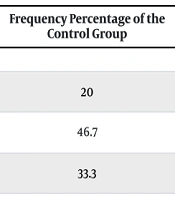
Seyedbeigi S, Mansouriyeh N. The Effectiveness of Emotion Regulation Training on the Recognition of Emotional States and Social Cognition in Methamphetamine Abusers. Int J High Risk Behav Addict. 2025;14(2):e158470. doi: https://doi.org/10.5812/ijhrba-158470
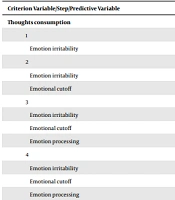
Rigi Kooteh B, Dolatshahi B, Bakhshani N, Naderi Rajeh Y. The Common and Specific Role of Emotional Factors in Current Cravings and Thoughts-Imagination of Consumption in Opioid Dependent Patients. Int J High Risk Behav Addict. 2021;10(4):e115515. doi: https://doi.org/10.5812/ijhrba.115515
Last Update: 1 week ago
Last Update: 1 week ago
Last Update: 1 week ago
Last Update: 7 hours ago
Last Update: 10 hours ago
Last Update: 5 days ago