
1. Background
Opioids contain compounds that can interact with opioid receptors in the brain. Prolonged and unsupervised (abuse) use can lead to opioid dependence and other health problems (1). The opioid epidemic is a significant public health concern in the world. In recent years, the use of opioids with non-medical prescriptions has been increasing worldwide, which sets the stage for further risks (2).
Addiction is always closely related to human emotions, which helps to better understand the causes of abuse, maintenance, and relapse (3). Emotions, emotional states, and emotional-physiological responses are classics that are interpreted based on the history of the organism and the context (4). There is a connection between the opioid system of the brain and human emotions. Stimulation of approach-oriented emotions (anger and pleasure), avoidance-oriented emotions (fear and sadness), social bonding, and dependency behavior are influenced by the opioid system of the brain (5).
Emotions are influential in many important concepts in substance abuse research, such as trait anxiety, inhibition, reaction to environmental cues, cognitive regulation, mood, and behavioral motivation (6). Negative emotions trigger addictive behavior. Negative emotions such as sadness, anxiety, and negative mood increase the use of addictive substances and, in case of sadness, can inadvertently increase cravings (7). Emotion regulation, as an emotional component, predicts addictive behaviors such as alcohol and drug use, gambling, video game addiction, and problematic Internet use and is useful for preventive and curative interventions (8). Uncontrolled anger is also a stimulus for re-use and relapse among opioid-dependent patients (9, 10).
Drug addicts suffer from rejection of emotional responses, difficulty performing purposeful behaviors, difficulty controlling impulses, limited access to emotion regulation strategies, and lack of emotional clarity, and this provides the basis for continued use (11). Emotional factors are actually risk factors for drug use, and chronic drug use can lead to more emotional disorders with an effect on the reward system, motivation, and stress. On the other hand, perturbations in these systems lead to emotional processing of drug-related symptoms in exchange for natural rewards that maintain addictive behavior by increasing cravings (12).
2. Objectives
Considering the importance of emotions in relapse and craving, this study investigated the specific and common role of emotional factors with craving and its thoughts and fantasies in opioid dependent patients in Zahedan, Iran.
3. Patients and Methods
The design of present study is descriptive-correlational, and the research variables are measured Concurrently. The statistical population of the study included all opioid dependents in Zahedan living in medium-term accommodation centers (camps) in 2018. All subjects were male with an age range of 20 - 44 years. Sampling was done in several stages. First, sampling was done randomly. Thus, at first, the residential centers licensed by the Welfare Organization of Sistan and Baluchestan Province (Zahedan city) were identified by referring to the welfare office in the city. A total of 12 accommodation centers were selected from 21 accommodation centers. Then, purposeful sampling was performed, so that by referring to the patients’ records in the accommodation center and the type of drugs used and the criteria for entering and leaving the research, the sample was determined. Finally, out of 700 opium-dependent patients in 21 accommodation centers, 243 samples were identified according to Morgan and Freeman’s table.
Inclusion criteria were diagnosis of opioid addiction, male gender, age range of 20 - 44 years, and being literate (read and write). Exclusion criteria were concomitant use of methadone maintenance therapy, diagnosis of other substance use disorders, having physical pain, history of hospitalization in a psychiatric hospital, schizophrenia, and receiving antipsychotic drugs, and unwillingness to participate in the research.
3.1. Desires for Drug Questionnaire
This 14-item questionnaire assesses the current craving (13) and is scored by a seven-point Likert scale. Internal consistency for the three test subscales calculated by Cronbach’s alpha is 0.81, 0.84, and 0.79, respectively (13). The total Cronbach’s alpha value for Iranian opium users was 0.96. (14).
3.2. Measuring the Craving to Use Drugs
3.3. The Emotion Regulation Difficulty Scale
The components of this 36-item scale (16) include emotional rejection, difficulty in performing purposeful behavior, difficulty in controlling impulse, lack of emotional awareness, limited access to emotional regulation strategies, and lack of emotional clarity (17). Cronbach’s alpha for this questionnaire was 0.92 in Iran.
3.4. The Emotion Regulation Questionnaire
3.5. The Positive and Negative Emotion Scale
This scale has 20 items (20). Cronbach’s alpha coefficient of the positive emotion subscale was 0.88, and a negative emotion was 0.87. The reliability of the eight-week retest was reported to be 0.68 for the positive emotion subscale and 0.71 for the negative emotion.
3.6. The Emotional Processing Scale
3.7. The Emotional Intelligence Questionnaire
3.8. The Scale of Emotional Arousability
3.9. Emotional Reactivity Subscale
In the study by Skowron and Schmitt (25), the reliability of the revised form with Cronbach’s alpha for the whole scale was 0.92, and the homogeneity coefficient for the emotional response subscale was 0.89.
3.10. The Emotional Cutoff Subscale
This tool is one of the subscales of the Differentiation Questionnaire. It was first designed and executed in 1998 by Skowron and Friedlander with 43 items. It was then revised in 2003 by Skowron and Schmitt, and the questionnaire was designed by Jackson with 46 terms and four factors based on Bowen’s theory (25). The reliability of the questionnaire obtained by Skowron and Schmitt (25) for the emotional separation subscale was 0.84. In Rafi’s research (26), the value of the whole scale reliability was 0.90.
Statistical analysis was performed at both descriptive and inferential levels. Statistical indicators such as mean, standard deviation, frequency, etc. were used to evaluate descriptive data, and Pearson correlation coefficient test and stepwise multivariate regression were used for inferential data.
4. Results
The job status of participants was freelancer (n = 168, 69.1%), unemployed (n = 57 23.5%), and employees (n = 13, 5.3%). In terms of marital status, 49.8% (n = 121) were single and 45.3% (n = 110) were married. Regarding education status, the highest frequency was related to under diploma (n = 149, 61.3%), and the lowest frequency was related to postgraduate and higher education (n = 2, 0.8%). The average age of the participants was 30.16 years, with a standard deviation of 5.92. The age range of the subjects was 18 - 44 years.
According to Table 1, there was a direct relationship between emotional factors and current cravings in opioid-dependent patients.
Table 1.
Pearson Correlation Coefficient Between Emotional Factors and Current Craving in Opioid-Dependent Patients
| Variable | Affection | Emotion Regulation | Emotion Intelligence | Emotion Processing | Emotion Irritability | Cognitive Emotion Regulation | Emotional Reactivity | Emotional Cutoff |
|---|---|---|---|---|---|---|---|---|
| Current cravings | 0.05 | -0.03 | -0.05 | 0.13 a | 0.14 a | 0.03 | 0.06 | -0.04 |
a Significant correlation at the level of 0.05.
As Table 2 shows, there was a significant relationship between all emotional factors (except emotion regulation, emotion intelligence, and emotional reactivity) with current craving. Stepwise regression was used to investigate the predictive role of emotional factors in the current cravings of opioid-dependent patients.
Table 2.
Pearson Correlation Coefficient Between Emotional Factors and Consumption Thoughts in Opioid-Dependent Patients
| Variable | Affection | Emotion Regulation | Emotion Intelligence | Emotion Processing | Emotion Irritability | Cognitive Emotion Regulation | Emotional Reactivity | Emotional Cutoff |
|---|---|---|---|---|---|---|---|---|
| Thoughts consumption | 0.20 a | 0.03 | -0.02 | 0.27 a | 0.28 a | 0.23 a | 0.11 | 0.18 a |
a Significant correlation at the level of 0.01.
According to the results of Table 3, emotional irritability could only predict 0.020 of the changes related to current consumption cravings, and other emotional factors did not have such explanatory power and did not enter the equation.
Table 3.
Regression Analysis of Emotional Factors in Relation to Current Craving for Use in Opioid-Dependent Patients a
| Criterion Variable | Step | Predictive Variable | R | R2 | R2 Adjust | F | P | B | Beta | P |
|---|---|---|---|---|---|---|---|---|---|---|
| Current cravings | 1 | Emotion irritability | 0.14 | 0.02 | 0.01 | 4.93 | 0.02 | 0.33 | 0.142 | 0.027 |
a Predictors: (fixed), emotional irritability.
Stepwise regression was also used to investigate the predictive role of emotional factors in the thoughts and fantasies of opioid-dependent patients.
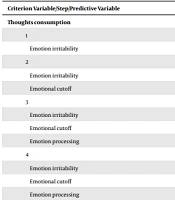
Regression analysis of emotional factors in relation to opioid consumption thoughts have been presented in Table 4.
Table 4.
Regression Analysis of Emotional Factors in Relation to Opioid Consumption Thoughts
| Criterion Variable/Step/Predictive Variable | R | R2 | R2 Adjust | F | P | Beta | P |
|---|---|---|---|---|---|---|---|
| Thoughts consumption | |||||||
| 1 | |||||||
| Emotion irritability | 0.28 | 0.08 | 0.07 | 21.6 | 0.001 | 0.28 | 0.001 |
| 2 | |||||||
| Emotion irritability | 0.37 | 0.11 | 0.1 | 15.1 | 0.001 | 0.27 | 0.001 |
| Emotional cutoff | 0.01 | 0.005 | |||||
| 3 | |||||||
| Emotion irritability | 0.37 | 0.13 | 0.12 | 12.8 | 0.001 | 0.2 | 0.002 |
| Emotional cutoff | 0.16 | 0.006 | |||||
| Emotion processing | 0.18 | 0.007 | |||||
| 4 | |||||||
| Emotion irritability | 0.39 | 0.15 | 0.14 | 11.1 | 0.001 | 0.16 | 0.015 |
| Emotional cutoff | 0.16 | 0.007 | |||||
| Emotion processing | 0.18 | 0.006 | |||||
| Affection | 0.14 | 0.023 | |||||
| 5 | |||||||
| Emotion irritability | 0.41 | 0.17 | 0.15 | 9.9 | 0.001 | 0.13 | 0.045 |
| Emotional cutoff | 0.12 | 0.037 | |||||
| Emotion processing | 0.23 | 0.17 | 0.007 | ||||
| Affection | 0.14 | 0.018 | |||||
| Emotion regulation | 0.16 | 0.13 | 0.036 |
5. Discussion
The results of the present study showed that emotional factors can predict the current craving for consumption and the related thoughts and fantasies. Emotional factors predicted most consumption thoughts and fantasies and had the most relationship. Results are consistent with previous studies (27, 28).
Craving has always been influenced by several factors (29). Etiology of cravings also emphasizes various other factors such as interpersonal, behavioral, psychological, and bio-genetic factors (16).
In addition to these factors, we can mention the factors of mindfulness, cognition, behavior, and emotion in the discussion of craving (30). Therefore, emotion and related factors can explain only part of the variance, and other factors can play a role. This was one of the reasons that emotional factors had less predictive power in the present study. Substance abuse and addiction is a complex disorder associated with biological, psychological, social, and spiritual causes. The complexity of biological, psychological, social, economic, political, and cultural factors has made this problem one of the most complex individual, family, and social problems (31). People with addiction have difficulty expressing their emotions due to their inability to properly recognize the emotions on the faces of others and their limited capacity to empathize with the emotional states of others (32).
According to our results, there was a direct and significant relationship between emotional irritability and current cravings and consumption thoughts. The association between aggressive behaviors, aggression, and emotional irritability with substance abuse has been repeatedly demonstrated. Accordingly, the component of emotional irritability and aggression is strongly associated with heavy alcohol and drug use (33). Based on the adaptive position-trait response model in the discussion of substance abuse, a person who is irritable and has negative emotions uses drugs as a way to relieve unpleasant states (34).
Negative emotion regulation strategies such as inability to control impulse, lack of emotional awareness, limited access to emotion regulation strategies, lack of emotional clarity, repression, and avoidance are significantly associated with increased consumption thoughts and fantasies (35). According to Koole (36), addicted people try to regulate their emotions with the aim of increasing pleasure and reducing suffering. Therefore, these patients regulate their emotions by using drugs, trying to prevent suffering and fatigue caused by their negative emotions. In the emotional model of user craving and bowling (2014), craving is known as a state of excitement that regulates it as a type of emotion regulation that directly reduces substance use.
Another finding of the study is that there is a significant relationship between negative and positive emotions and consumption thoughts. Positive and negative emotions are often referred to as predictors, consequences, and a definite feature of craving (37). Negative emotion develops in the form of feelings of guilt and anxiety in people who are actively trying to control drug use (38). Positive emotion can also enhance drug-related images and be more effective with strong and negative hybrid effects (39). In fact, positive emotion, as a motivational-appetite stimulant, shares the common feature of the pleasurable elements of drug use, while at the same time leading to the activation or sensitivity of the brain’s reward nervous systems.
Finally, impairment of emotional processing is a predictor of current cravings and thoughts and fantasies of consumption in opioid-dependent patients. Defects in emotion processing are actually related to the extent and severity of dependence as defects in reassessment (12).
5.1. Conclusions
The present study showed that, in general, there is a significant relationship between emotional components and craving. Therefore, the findings emphasize that the study of emotional factors related to the tendency of people to addiction is of particular importance, and in the field of substance abuse prevention, educating people to improve emotion regulation can be helpful. Hence, simultaneous attention to biological, psychological, and social dimensions can be very effective in preventing substance abuse.