
1. Introduction
Khat (Catha edulis) is an evergreen shrub widely cultivated in East Africa and the Arabian Peninsula. Its fresh leaves contain cathinone, a psychoactive compound with amphetamine-like properties; when the leaves are chewed, cathinone produces stimulant effects, including increased alertness, mild euphoria, and reduced fatigue (1). Globally, khat chewing is most prevalent in Yemen, Ethiopia, Somalia, Kenya, and Djibouti, where it is a deeply embedded sociocultural practice (1, 2).
In Yemen, khat chewing is widely normalized and socially integrated across demographic and socioeconomic groups (3). Despite this cultural acceptance, growing evidence suggests that khat chewing is associated with multiple adverse health outcomes. Recent studies and systematic reviews have linked khat chewing to cardiovascular complications, such as hypertension and ischemic heart disease, as well as to gastrointestinal, oral, and genitourinary disorders (4-6). In addition, neurocognitive effects, including impaired attention, reduced working memory, and decreased cognitive flexibility, have been reported, raising concerns about the potential impact of khat on learning and academic functioning (4, 7-9).
Beyond its effects on individual health, khat chewing has broader social and economic implications. Prolonged chewing sessions, often lasting several hours daily, may reduce productivity and impose financial burdens on users (10). These effects are particularly relevant in low-income and conflict-affected settings such as Yemen, where economic instability and limited access to health care may exacerbate the consequences of substance use (9, 11).
Khat chewing has been increasingly reported among university students. Its prevalence varies widely across settings, ranging from approximately 6% to 33% among Ethiopian university students, whereas higher rates have been reported in Yemen, including approximately 48% among students at Aden University (12-14). A frequently cited reason for use among students is the belief that khat enhances concentration and supports prolonged studying. However, the existing evidence does not consistently support this assumption, and stimulant-induced alertness may not translate into improved academic performance (15-17).
The determinants of khat chewing among students are multifactorial. Male gender, peer influence, family exposure, and concurrent tobacco use have been consistently identified as key risk factors (9, 18-20). Parental education, particularly maternal education, has also been suggested as a potential protective factor, although findings remain inconsistent across studies and settings (16, 17, 21, 22).
The relationship between khat chewing and academic performance remains unclear. Although some studies have reported negative associations with academic achievement and cognitive performance, others have found no significant relationship (3, 15-17, 23). These inconsistencies may reflect differences in study populations, methodological approaches, and residual confounding.
Medical students are a particularly important group in which to examine substance use behaviors, as they are future health care providers whose personal habits may influence their professional attitudes and patient counseling practices. Despite this importance, data on khat chewing among medical students in Yemen remain limited, particularly with respect to objectively measured academic performance.
2. Objectives
Therefore, this study aimed to determine the prevalence of khat chewing among final-year medical students at Ibb University, Yemen; to identify associated sociodemographic factors; and to examine the relationship between khat chewing and academic performance using official academic records. The findings are expected to add to the limited literature on substance use among medical students in Yemen and to inform targeted educational and preventive interventions.
3. Methods
3.1. Study Design and Setting
This cross-sectional study was conducted between March and August 2024 at the Faculty of Medicine, Ibb University, Yemen. This design was chosen to estimate the prevalence of khat chewing and to examine its associations with academic performance at a single point in time. No causal inference can be drawn from this design.
3.2. Study Population and Eligibility Criteria
The study population comprised all final-year medical students enrolled during the 2023 – 2024 academic year (N = 118). Final-year students were selected because they had completed most academic requirements, which allowed reliable access to their cumulative grade point average (GPA) records. Students were eligible if they were officially enrolled and available during the data collection period. Exclusion criteria were refusal to participate, absence during data collection, or incomplete academic records.
3.3. Sample Size and Sampling Procedure
The sample size was calculated using a single population proportion formula with the following assumptions: an expected prevalence of 50%, a 95% confidence level (Z = 1.96), and a 5% margin of error. Because the target population was small (N = 118), a finite population correction was applied, yielding a required sample size of 91 participants. A simple random sampling technique was used. Participants were selected from the official student registry using computer-generated random numbers, ensuring an equal probability of selection and minimizing selection bias.
3.4. Data Collection Instrument and Variables
Data were collected using a structured, pretested, self-administered questionnaire adapted from instruments validated in previous studies (9, 20, 24). Minor modifications were made to ensure cultural and contextual relevance without altering the core constructs. The questionnaire consisted of three sections: 1) sociodemographic variables (age, sex, residence, marital status, smoking status, parental education, and family income); 2) khat chewing behavior (current use, frequency, duration, and motivations for use); and 3) academic performance (cumulative grade point average [GPA] obtained from official university records).
Current khat chewing was defined as chewing khat at least once within the past 30 days. Academic performance was analyzed as (i) a continuous variable (GPA score) and (ii) a categorical variable based on institutional grading criteria: “Good” (65 – 74.9) and “Very Good” (≥ 75).
3.5. Validity and Reliability
Content validity was assessed by experts in public health, psychiatry, and medical education. The questionnaire was translated into Arabic and back-translated into English to ensure conceptual equivalence. A pilot study was conducted with 15 students to assess clarity and feasibility; pilot data were excluded from the final analysis. Internal consistency was acceptable (Cronbach’s alpha = 0.80), and test–retest reliability indicated good stability (intraclass correlation coefficient = 0.85).
3.6. Data Collection Procedure
Data were collected by trained research assistants who were not affiliated with the university, to reduce social desirability bias. After providing written informed consent, participants completed the questionnaires anonymously in a private setting. Academic GPA data were obtained directly from official university records and linked using unique identifiers. All identifiers were removed after data linkage to ensure confidentiality.
3.7. Statistical Analysis
Data were analyzed using IBM SPSS Statistics version 27. Descriptive statistics were used to summarize participant characteristics. Categorical variables were presented as frequencies and percentages, whereas continuous variables were summarized as means and standard deviations with 95% confidence intervals. Associations between categorical variables were assessed using chi-square tests or Fisher’s exact tests when expected cell counts were < 5. Independent-samples t tests were used to compare mean GPA between groups. Effect sizes were reported using Cramér’s V for categorical variables and Cohen’s d for continuous outcomes. Multivariable logistic regression was performed for the outcome of academic performance (“Very Good” GPA) to adjust for potential confounders, including sex, residence, marital status, and maternal education. Results were presented as adjusted odds ratios (AORs) with 95% confidence intervals. To account for multiple comparisons in the academic performance analyses, a Bonferroni-adjusted significance threshold (P < 0.005) was applied. All tests were two-tailed, and both statistical significance and effect sizes were considered in the interpretation of the results.
3.8. Missing Data Handling
Missing data were minimal (< 2%). A complete-case (listwise deletion) approach was applied. One participant had missing data on the frequency of khat chewing and was excluded from analyses involving that variable. No data were missing for the primary exposure or outcome variables.
3.9. Ethical Considerations
Ethical approval was obtained from the Institutional Review Board of the Faculty of Medicine, Ibb University (IRB MED IBB 2024 – 017). The study was conducted in accordance with the Declaration of Helsinki. Written informed consent was obtained from all participants. Participation was voluntary, and confidentiality was strictly maintained. Students were informed of their right to withdraw at any time without consequence.
4. Results
4.1. Participant Flow
Of the 118 eligible final-year medical students, 91 participated (response rate, 77.1%). Of the 27 nonparticipants, 18 declined because of time constraints, 5 were absent throughout the data collection period, and 4 did not provide consent. No incomplete academic records were identified (Figure 1).
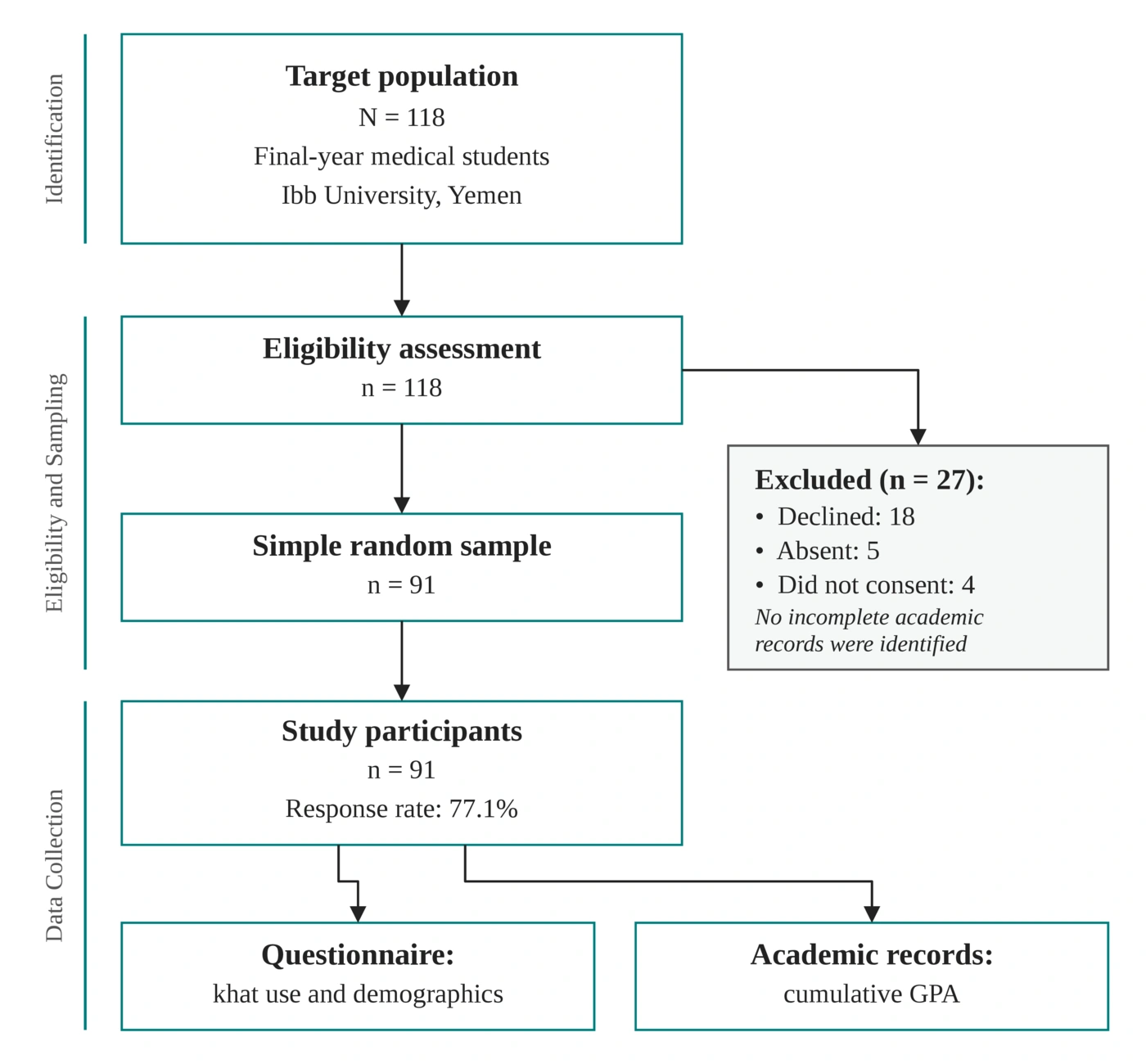
Figure 1.
Participant flow diagram. Flow diagram of participant recruitment among final-year medical students at Ibb University, Yemen. Of 118 eligible students, 91 participated (response rate: 77.1%). Reasons for nonparticipation: declined (n = 18), absent (n = 5), and did not consent (n = 4).
4.2. Participant Characteristics and Prevalence of Khat Chewing
The mean age of participants was 23.8 ± 1.9 years. Slightly more than half were male (54.9%), and most were married (85.7%) and resided in urban areas (75.8%). The majority reported a moderate family income (90.1%). The overall prevalence of current khat chewing was 72.5% (66/91; 95% CI: 62.1 – 81.4) (Table 1).
Table 1.
Demographic and Socioeconomic Characteristics of Final-Year Medical Students at Ibb University, Yemen (N = 91) a
| Variables | No. (%) | 95% CI |
|---|---|---|
| Age, y | 23.8 ± 1.9 | 23.4 – 24.2 |
| 21 – 23 | 52 (57.1) | 46.2 – 67.5 |
| 24 – 26 | 33 (36.3) | 26.5 – 47.0 |
| ≥ 27 | 6 (6.6) | 2.5 – 13.8 |
| Gender | ||
| Male | 50 (54.9) | 44.2 – 65.4 |
| Female | 41 (45.1) | 34.6 – 55.8 |
| Residence | ||
| Urban | 69 (75.8) | 65.7 – 84.2 |
| Rural | 22 (24.2) | 15.8 – 34.3 |
| Marital status | ||
| Single | 13 (14.3) | 7.8 – 23.2 |
| Married | 78 (85.7) | 76.8 – 92.2 |
| Family income | ||
| Low | 4 (4.4) | 1.2 – 10.9 |
| Moderate | 82 (90.1) | 82.0 – 95.4 |
| High | 5 (5.5) | 1.8 – 12.4 |
| Smoking status | ||
| Current smoker | 6 (6.6) | 2.5 – 13.8 |
| Nonsmoker | 85 (93.4) | 86.2 – 97.5 |
| Khat chewing status | ||
| Current chewer | 66 (72.5) | 62.1 – 81.4 |
| Nonchewer | 25 (27.5) | 18.6 – 37.9 |
| Academic performanceb | ||
| Mean GPA | 73.8 ± 4.2 | 72.9 – 74.7 |
| Good (65 – 74) | 51 (56.0) | 45.2 – 66.5 |
| Very good (≥ 75) | 40 (44.0) | 33.5 – 54.8 |
a Values are expressed as No. (%) or mean ± SD. Abbreviations: CI, confidence interval; GPA, grade point average.
b Cumulative grade point average at the completion of the fifth academic year.
4.3. Patterns and Motivations of Khat Chewing
Among current khat chewers (n = 66), the median frequency of chewing was 3 days per week (interquartile range: 2 – 5 days). Motivations for use were multifactorial and frequently overlapping. The most commonly reported reason was staying awake to study (58.2%), followed by family influence (36.3%) and seeking happiness or comfort (31.9%). Other reported motivations included social media influence (26.4%), peer influence (24.2%), and stress relief (17.6%). A smaller proportion of participants (16.5%) reported difficulty stopping or experiencing cravings, suggesting perceived dependence. Multiple responses were allowed (Table 2).
Table 2.
Self-Reported Reasons for Khat Chewing Among Current Chewers (N = 66) a
| Reason | No. (%) b | 95% CI |
|---|---|---|
| Stay awake and active for study | 38 (57.6) | 45.2 – 69.4 |
| Family member influence | 24 (36.4) | 25.2 – 48.7 |
| Gives me happiness and comfort | 21 (31.8) | 21.2 – 44.0 |
| Social media influence | 17 (25.8) | 16.2 – 37.3 |
| Influence of peers who chew khat | 16 (24.2) | 14.8 – 35.8 |
| Avoid stress | 12 (18.2) | 10.0 – 29.0 |
| Khat addictionc | 11 (16.7) | 8.9 – 27.0 |
| Other reasons | 6 (9.1) | 3.8 – 18.6 |
a Only current khat chewers (n = 66) were asked about reasons. Values are expressed as No. (%). Abbreviation: CI, confidence interval.
b Multiple responses were allowed; percentages sum to > 100%.
c Reflects continued use due to difficulty stopping or cravings (perceived dependence).
4.4. Factors Associated with Khat Chewing
Khat chewing was significantly associated with sex. Male students reported a substantially higher prevalence than female students (86.0% vs 46.3%; P < 0.001), corresponding to a prevalence ratio of 1.86 (95% CI: 1.36 – 2.54). All current smokers reported khat chewing (100% vs 65.9% among nonsmokers), and this association was statistically significant (Fisher’s exact test, P = 0.003). However, the number of smokers was small (n = 6), which limits interpretability. Maternal education showed a significant inverse association with khat chewing (P for trend = 0.001), indicating a lower prevalence among students with higher maternal educational attainment. No statistically significant associations were observed between khat chewing and marital status, residence, paternal education, or family income (all P > 0.05) (Table 3).
Table 3.
Prevalence of Khat Chewing by Demographic and Socioeconomic Characteristics (N = 91) a
| Variables | Total, No. | Khat Chewers, No. (%) | P-Value | Prevalence Ratio (95% CI) b |
|---|---|---|---|---|
| Gender | < 0.001 c | |||
| Male | 50 | 43 (86.0) | 1.86 (1.36 – 2.54) | |
| Female | 41 | 19 (46.3) | Reference | |
| Marital status | 0.92 c | |||
| Single | 13 | 9 (69.2) | 1.02 (0.68 – 1.54) | |
| Married | 78 | 53 (67.9) | Reference | |
| Residence | 0.28 c | |||
| Rural | 22 | 17 (77.3) | 1.19 (0.87 – 1.62) | |
| Urban | 69 | 45 (65.2) | Reference | |
| Smoking statusd | 0.003 e | |||
| Yes | 6 | 6 (100.0) | Not estimable | |
| No | 85 | 56 (65.9) | Reference | |
| Father’s education | 0.21 f | |||
| Illiterate | 15 | 13 (86.7) | — | |
| Primary/middle | 7 | 4 (57.1) | — | |
| High school | 8 | 4 (50.0) | — | |
| Bachelor’s | 45 | 30 (66.7) | — | |
| Postgraduate | 16 | 11 (68.8) | — | |
| Mother’s educationg | 0.001 h | |||
| Illiterate | 36 | 29 (80.6) | — | |
| Primary/middle | 24 | 14 (58.3) | — | |
| High school | 13 | 8 (61.5) | — | |
| Bachelor’s | 15 | 11 (73.3) | — | |
| Postgraduate d | 3 | 0 (0.0) | — | |
| Family incomed | 0.21 e | |||
| Low | 4 | 4 (100.0) | — | |
| Moderate | 82 | 55 (67.1) | — | |
| High | 5 | 3 (60.0) | — |
a Values are expressed as No. (%). Abbreviation: CI, confidence interval.
b Prevalence ratios are reported where appropriate.
c Chi-square test.
d Estimates based on very small subgroups (n < 10) should be interpreted with caution because of statistical instability.
e Fisher’s exact test.
f Chi-square test (4 degrees of freedom).
g Ordinal variable.
h Chi-square test for trend (χ² = 10.4).
4.5. Khat Chewing and Academic Performance
In the unadjusted categorical analysis, khat chewers were more likely than non-chewers to achieve a “Very Good” GPA (51.6% vs 27.6%), corresponding to an odds ratio of 2.80 (95% CI: 1.08 – 7.28; P = 0.031). However, this association did not remain significant after Bonferroni correction (α ≈ 0.005) (Table 4). When GPA was analyzed as a continuous variable, no significant difference was observed between khat chewers and non-chewers (74.1 ± 4.1 vs 73.1 ± 4.4; P = 0.312), with a small effect size (Cohen’s d = 0.23) (Figure 2).
Table 4.
Factors Associated with Very Good Academic Performance (GPA ≥ 75): Unadjusted Analyses a
| Variables | Good GPA (65 – 74), No. (%) | Very Good GPA (≥ 75), No. (%) | P-Value | Cramer’s V | Unadjusted OR (95% CI) |
|---|---|---|---|---|---|
| Gender | 0.20 b | 0.134 | |||
| Male | 25 (50.0) | 25 (50.0) | 1.73 (0.76 – 3.96) | ||
| Female | 26 (63.4) | 15 (36.6) | Reference | ||
| Marital status | 0.10 b | 0.172 | |||
| Single | 10 (76.9) | 3 (23.1) | 0.40 (0.10 – 1.57) | ||
| Married | 41 (52.6) | 37 (47.4) | Reference | ||
| Residence | 0.51 b | 0.069 | |||
| Rural | 11 (50.0) | 11 (50.0) | 1.38 (0.53 – 3.63) | ||
| Urban | 40 (58.0) | 29 (42.0) | Reference | ||
| Smoking statusc | 0.59 d | 0.057 | |||
| Yes | 4 (66.7) | 2 (33.3) | 0.62 (0.11 – 3.58) | ||
| No | 47 (55.3) | 38 (44.7) | Reference | ||
| Khat chewing statuse | 0.031 b | 0.226 | |||
| Current chewer | 30 (48.4) | 32 (51.6) | 2.80 (1.08 – 7.28) | ||
| Nonchewer | 21 (72.4) | 8 (27.6) | Reference | ||
| Father’s education | 0.39 b | 0.213 | |||
| Illiterate | 7 (46.7) | 8 (53.3) | — | ||
| Primary/middle | 2 (28.6) | 5 (71.4) | — | ||
| High school | 6 (75.0) | 2 (25.0) | — | ||
| Bachelor’s | 27 (60.0) | 18 (40.0) | — | ||
| Postgraduate | 9 (56.3) | 7 (43.8) | — | ||
| Mother’s educationc | 0.22 b | 0.252 | |||
| Illiterate | 21 (58.3) | 15 (41.7) | — | ||
| Primary/middle | 14 (58.3) | 10 (41.7) | — | ||
| High school | 8 (61.5) | 5 (38.5) | — | ||
| Bachelor’s | 5 (33.3) | 10 (66.7) | — | ||
| Postgraduate c | 3 (100.0) | 0 (0.0) | — | ||
| Family incomec | 0.53 b | 0.118 | |||
| Low | 2 (50.0) | 2 (50.0) | — | ||
| Moderate | 45 (54.9) | 37 (45.1) | — | ||
| High | 4 (80.0) | 1 (20.0) | — |
a Values are expressed as No. (%). Abbreviations: GPA, grade point average; OR, odds ratio; CI, confidence interval.
b Chi-square test (P-values rounded to two decimal places for presentation; exact values used in interpretation).
c Estimates based on very small subgroups (n ≤ 5) should be interpreted with caution.
d Fisher’s exact test.
e The unadjusted association for khat chewing (OR = 2.80, P = 0.031) did not survive Bonferroni correction for 10 independent tests (adjusted α = 0.005). Analysis of mean GPA as a continuous variable found no significant difference between chewers and nonchewers (74.1 vs 73.1, P = 0.312).
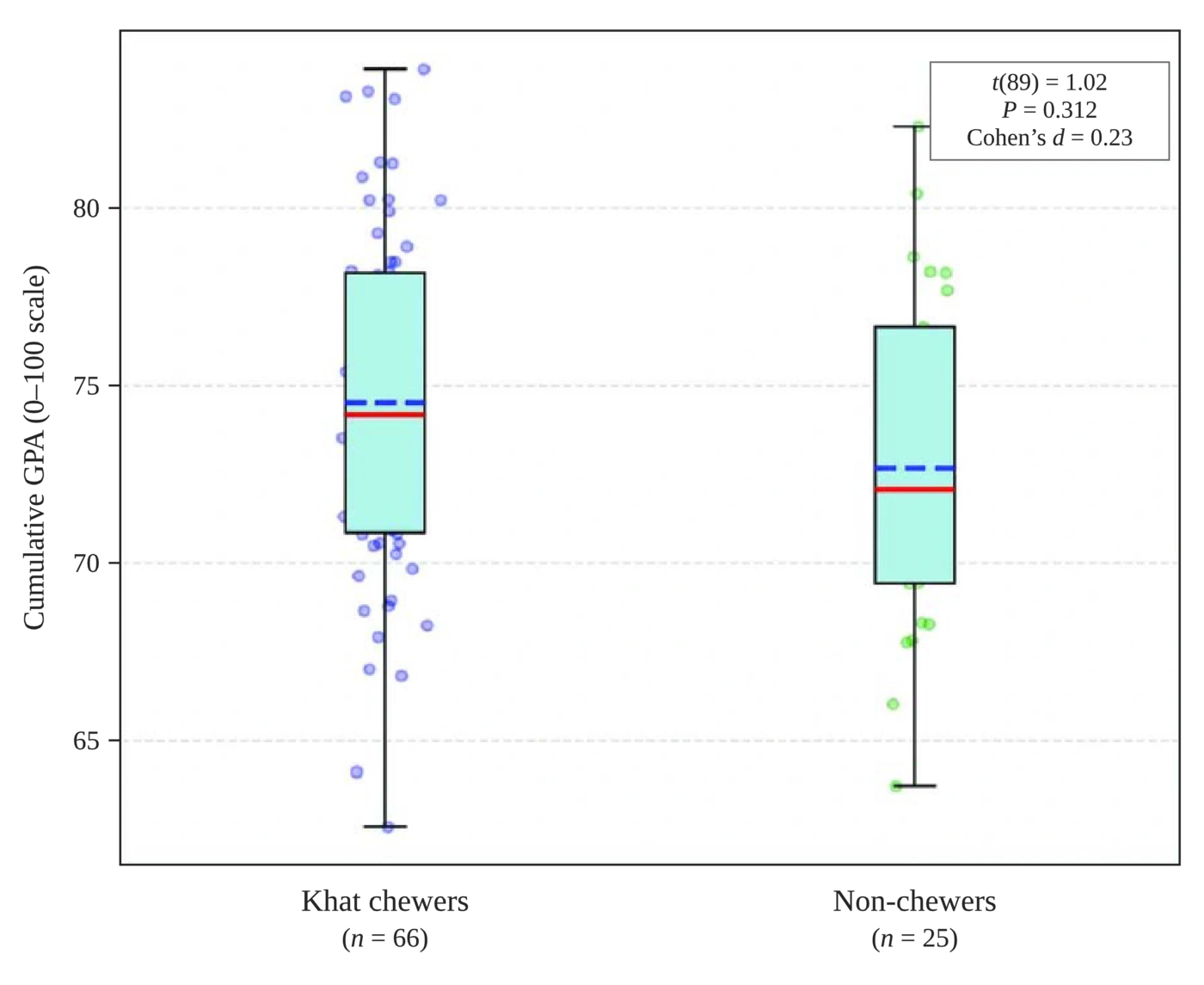
Figure 2.
Comparison of cumulative grade point average (GPA) by khat chewing status. Boxplot of cumulative GPA in khat chewers versus nonchewers. The central line is the median, the box shows the interquartile range, and the whiskers indicate the range. No significant difference was observed between groups (t(89) = 1.02, P = 0.312; Cohen’s d = 0.23).
4.6. Multivariable Analysis
After adjustment for sex, marital status, residence, and maternal education, khat chewing was not independently associated with achieving a “Very Good” GPA (AOR = 1.68, 95% CI: 0.60 – 4.72; P = 0.322). Maternal education also showed no statistically significant independent association (AOR per level increase = 0.74, 95% CI: 0.48 – 1.12; P = 0.158). Overall model fit was modest (Nagelkerke R² = 0.09), and calibration was acceptable (Hosmer–Lemeshow P = 0.620). Smoking was excluded from the regression analysis because of sparse data (n = 6) (Table 5).
Table 5.
Multivariable Logistic Regression for Predictors of Very Good GPA (≥ 75) a
| Variables | AOR | 95% CI | P-Value |
|---|---|---|---|
| Khat chewing | |||
| Yes | 1.68 | 0.60 – 4.72 | 0.322 |
| No | Reference | — | — |
| Gender | |||
| Male | 1.36 | 0.55 – 3.35 | 0.502 |
| Female | Reference | — | — |
| Marital status | |||
| Single | 0.58 | 0.13 – 2.60 | 0.474 |
| Married | Reference | — | — |
| Residence | |||
| Rural | 1.22 | 0.43 – 3.49 | 0.707 |
| Urban | Reference | — | — |
| Mother’s educationb | |||
| Per one-level increase c | 0.74 | 0.48 – 1.12 | 0.158 |
a GPA categorized as very good (≥ 75) vs good (65 – 74.9) in this model. Model fit: Nagelkerke R² = 0.09; Hosmer–Lemeshow P = 0.620. Smoking was excluded from the model because of sparse data (n = 6) to avoid model instability. Wide confidence intervals reflect the limited sample size; estimates should be interpreted cautiously. Abbreviations: AOR, adjusted odds ratio; CI, confidence interval; GPA, grade point average.
b Maternal education coded ordinally as: 1 = no formal schooling, 2 = primary, 3 = secondary, 4 = university.
c AOR < 1 indicates lower odds of very good GPA with higher maternal education, but the confidence interval includes 1.
5. Discussion
This study examined the prevalence, determinants, and academic correlates of khat chewing among final-year medical students at Ibb University in central Yemen. The prevalence was 72.5%, indicating that khat chewing is highly common in this academic population. In bivariate analysis, khat chewing was associated with male gender, smoking, and lower maternal education; however, after adjustment, no independent association was observed with academic performance. Similarly, no meaningful difference in GPA was found when it was analyzed as a continuous variable, supporting the overall absence of a measurable academic effect.
The prevalence observed in this study is higher than previously reported estimates among Yemeni university students, which have ranged from approximately 35% to 63%, and than the estimate of 42% among adolescents (9, 13, 20, 25). It also exceeds estimates from Ethiopia (23%) and from pooled multinational analyses (14.16%) (3, 12). These differences likely reflect variation in population characteristics, study design, and sociocultural context. Notably, earlier Yemeni studies were conducted before the escalation of conflict in 2014, whereas the present study reflects a post-conflict setting characterized by increased psychosocial stress, economic instability, and reduced coping resources, which may contribute to higher reliance on khat chewing among students.
Khat chewing is deeply embedded in Yemeni sociocultural traditions but has historically been more common among economically independent adults and less socially acceptable among students (3). However, the current findings suggest that these boundaries may be shifting. Academic pressure, combined with prolonged conflict-related stress, may have increased the use of khat as a coping strategy among younger populations, including medical students (25-27).
Consistent with previous studies (9, 12, 20, 28, 29), khat chewing was significantly more common among male students. This likely reflects sociocultural norms that discourage khat use among females rather than biological differences, indicating that khat chewing remains socially regulated within this population.
A strong overlap between khat chewing and smoking was observed, as all smokers reported khat use. This finding is consistent with previous reports (23, 27, 28). However, smoking was relatively uncommon overall, and only a small proportion of khat chewers were smokers. This pattern suggests a clustering of risk behaviors rather than a direct causal relationship, likely driven by shared environmental and behavioral determinants.
Multiple motivations for khat chewing have been reported, including improving concentration, peer influence, relaxation, stress relief, and socialization (30-33). In the present study, the predominant reason was staying awake to study, suggesting that khat use is perceived primarily as a functional response to academic demands. However, despite these perceived benefits, only a minority of participants reported features suggestive of dependence, indicating that most users do not perceive their use as compulsive.
Although motivational factors often coexisted, they may also reflect unmeasured psychological distress. However, symptoms of anxiety and depression were not directly assessed in this study; therefore, no causal inference can be made. Comparable patterns have been reported in regional studies of students: Teni et al. in Gondar, Ethiopia, reported that 62.3% of college chewers sought to improve study concentration, while a survey in Jazan noted that mood change (47.0%), stress (10.1%), and anxiety (5.4%) were common drivers (30, 34). Overall, khat use among students appears to be influenced by various factors, including academic pressures and personal motivations (17). Nevertheless, further research is needed to fully understand the relationships between khat consumption, anxiety, and depression.
Maternal education showed an inverse association with khat chewing in the unadjusted analysis; however, this association was not significant after adjustment. Given the small numbers in the higher education categories, these findings should be interpreted cautiously. Previous literature on parental education and substance use is inconsistent. Some studies suggest a protective effect of higher parental education owing to improved health literacy and parenting practices, whereas others report no clear association (27, 35, 36). Overall, the relationship appears to be context-dependent and potentially nonlinear.
Contrary to the widespread belief that khat enhances academic performance, this study found no robust association between khat chewing and GPA. The apparent advantage observed in the unadjusted categorical analysis did not persist after correction for multiple testing and was not supported by the continuous GPA analysis, indicating that the initial finding likely reflects statistical variation rather than a true effect.
These results are consistent with prior studies reporting null or negative associations. Previous work by Ayana and Mekonen showed higher GPA among non-chewers (24), and more recent evidence from Tesfa et al. demonstrated lower academic performance and higher failure rates among khat users (17). Similarly, studies by Abdeta et al. (23), Kassa et al. (16), and Gebrie et al. (3) linked khat chewing to absenteeism and poorer academic outcomes. Together, these findings contrast with the common perception that khat improves concentration and support our observation that perceived benefits are not reflected in objective academic measures.
Several factors may explain the absence of an association. Stimulant-induced alertness may not translate into sustained academic benefit, and reverse causality is plausible, with students using khat in response to academic pressure (37). Residual confounding and limited statistical power may have obscured small effects. In addition, restricting the sample to final-year students may have introduced survivor bias, potentially leading to an underestimation of adverse outcomes.
Overall, our findings align with the broader literature and provide no evidence of an academic advantage associated with khat chewing. The co-occurrence of khat use and smoking likely reflects shared behavioral determinants rather than causation (28). Given the cross-sectional design, causal inference is not possible. Collectively, these results indicate that the perceived cognitive benefits of khat use are not supported by measurable academic outcomes.
5.1. Clinical and Educational Implications
The high prevalence of khat chewing among medical students highlights an important public health concern in medical education. The findings do not support the perceived academic benefits of khat and underscore the need to address misconceptions regarding stimulant use. Medical curricula should integrate evidence-based learning strategies, including active recall, spaced repetition, and structured time management, alongside stress management interventions such as sleep hygiene and coping skills training (38). Given the clustering of khat chewing with smoking, preventive strategies should address substance use as a broader behavioral pattern rather than as isolated behaviors (39).
5.2. Limitations
This study has several limitations. The cross-sectional, single-center design limits causal inference and generalizability. The sample size may have reduced the statistical power to detect modest associations. Self-reported behavioral data may have introduced reporting bias despite anonymity. Residual confounding, including that from unmeasured variables such as baseline academic ability, sleep patterns, and other substance use, cannot be excluded. Smoking was excluded from the multivariable regression because of sparse data (n = 6), and findings related to smoking should therefore be interpreted with caution. The restriction of the sample to final-year students may have introduced survivor bias, as students most affected by khat chewing may have dropped out earlier. Longitudinal, multicenter studies are needed to clarify temporal relationships and to assess whether khat chewing is associated with academic delay or dropout beyond GPA alone.
5.3. Conclusions
Khat chewing is highly prevalent among final-year medical students in Yemen and is associated with male gender and smoking. Despite its widespread use, driven largely by perceived academic needs, no independent or consistent association was observed between khat chewing and academic performance. These findings do not support the perception that khat enhances academic achievement. Instead, khat chewing appears to reflect behavioral responses to academic pressure and sociocultural influences rather than a performance-enhancing practice. Given its high prevalence and the lack of demonstrated academic benefit, targeted educational interventions are needed to address misconceptions regarding stimulant use among students and to promote healthier coping strategies. Further longitudinal, multicenter studies are required to clarify temporal relationships and to assess the long-term academic and professional consequences of khat chewing, including potential effects on academic progression and dropout.