1. Background
Stimulants are one of the main concerns in Iran since they result in frequent health problems and require treatment (1, 2). In other words, such medications are a major health concern among the Iranian population. Opium was a drug with a longest history of consumption in Iran (3). However, stimulants and hallucinogens such as crystal and methamphetamine have been used in Iran for over a decade, and their prevalence is growing (4). Young individuals, especially university students, are increasingly prone to consume such medications as such this is a serious threat to the community (5-7). A study in Babol, northern Iran, showed that the prevalence of Ritalin and amphetamine use among students was 6.5 and 2.5%, respectively, and that more than one-fourth of students started the consumption of stimulants and hallucinogens during the last year (8). Another study on students in Kerman also revealed that the prevalence rates of methamphetamine and LSD use during the last year were 0.1 and 2.3%, respectively (9). Among medical students in Tehran, the prevalence rates of crystal and ecstasy consumption were 1.4 and 0.9%, respectively (7). Accordingly, the vulnerability of the Iranian society to stimulants and hallucinogens seems to be increased due to specific geographical conditions and the dominance of young population in Iran. While maintaining their curiosity, today's young individuals strive to integrate with the social changes of the world and spare their efforts to find their own identity. They accept the risks and dangers of such changes and mistakenly try to relieve the pressures and problems of substance use, especially stimulants and hallucinogens (10).
Substance abuse (addiction) is usually a three-step process: (1) familiarization stage; (2) desire for more; and (3) addiction (sickness). Like a silent earthquake, narcotic drugs and psychotropic substances threaten educational settings such as schools and universities (10, 11). Students are motivated to use such substances due to misconceptions such as recreation, relaxation, and memory enhancement (8, 12). According to a study, young people, especially students, have tendency and desire to use hallucinogens because of their ignorance or misinformation about the hallucinogens and stimulants and their side effects (13). Moreover, if individuals were aware of the adverse effects of stimulants and hallucinogens on their physical, mental, psychological, and social health, they would be less likely to seek such substances. Accordingly, it is helpful to provide sufficient information and training for different groups of individuals regarding the dangers and adverse effects of substance use (14). Planning and preventive interventions in universities seems necessary due to the following factors: (1) increasing prevalence of stimulant and hallucinogen use among university students and their resulting problems; (2) lack of information about students' tendency to use medications and the methods and patterns of use; (3) the limited number of relevant studies; (4) lack of reliable and basic statistical information; and (5) the relationship between substance use and student problems such as academic demotivation, academic failure, physical and mental illness, suicide, and so on (10, 11). In other words, the necessary prerequisite for any planning is to know the current situation and detect the existing status of substance use and awareness among students.
2. Objectives
The present study aimed to evaluate the knowledge, attitude, and performance of students from the Ilam University of Medical Sciences regarding stimulants.
3. Methods
This cross-sectional study encompassed the students from the Ilam University of Medical Sciences in 2019. According to a study by Babaei Heydarabadi et al. (15) and regarding 10% attrition, the standard deviation of σ = 2.13, the accuracy of d = 0.2, and α = 0.05, the sample size of the study was estimated to be 510 persons. The two-stage stratified sampling method was adopted to select the participants. Proportional to the number of students in each faculty (namely dentistry, paramedical, health, nursing, and midwifery), an appropriate number of students were first selected. In the second stage, the concerned number of students was selected regarding the number of male and female students in each faculty. After selecting students and obtaining written consent, the questionnaires were submitted to them by using the simple random sampling method. In this study, the participants self-reported the use of stimulants. The participants in this study were undergraduate students, and postgraduate students were excluded.
In addition to a researcher-made checklist addressing the participants’ demographic information (namely age, gender, marital status, field of study, level of education, faculty, and place of residence), ASQ (16), and Questionnaire of Knowledge, Attitude, and Performance, developed by the Health Modeling Research Center and HIV/AIDS Education and Training Center of the Kerman University of Medical Sciences were also used in this research (17).
ASQ consisted of 50 two-option questions (yes/no) with scores ranging from 0 to 50. A high score on this test indicates high susceptibility to addiction, and a low score indicates non-susceptibility to addiction. In other words, the closer the score is to 50, the more susceptible the person is to addiction, and the closer it is to zero, the less susceptible the person is. The questionnaire contained the following 10 subscales: (1) inner dissatisfaction, (2) risk performance, (3) non-reliability, (4) show-off, (5) positive thoughts about substance, (6) dissatisfaction with family, (7) low faith and spirituality, (8) deviation from norms, (9) self-centeredness, and (10) risky relationships with friends with factor loadings between 0.30 and 0.80. The reliability of the questionnaire was estimated to be 0.68 - 0.83 (16).
Questionnaire of Knowledge, Attitude, and Performance regarding opiates, stimulants, and alcohol in Iranian adults measured the participants’ knowledge, attitude, and performance. This questionnaire was developed by the Health Modeling Research Center of the Kerman University of Medical Sciences. Cronbach’s alpha coefficients were 0.90 for awareness, 83% for attitude, and 87% for performance. The content validity index (CVI) was estimated to be about 0.8, thereby confirming the validity of this questionnaire. In the first section of the questionnaire, the participants’ awareness of opioids and stimulants was assessed by 20 questions with three possible answers (true, false, and I do not know). In the second section, with 24 questions scored based on a five-point Likert scale, the students’ attitudes were assessed. The questions dealt with attitudes towards legalization and social, cultural, and religious contexts. The third section was dealing with the practice of stimulants. We asked the participants: "did you use stimulants in your lifetime, during the last year, during the last six months, or during the last month?" The stimulants encompassed ecstasy, methamphetamine, amphetamine, cocaine, Ritalin, and LSD (17).
After completing the questionnaires, the extracted data were imported into Stata software version 15. In this study, P < 0.05 was set as the significance level. Descriptive statistics for quantitative variables were reported as mean ± standard deviation, and the qualitative variables were reported as frequency (percentage). Chi-square test, analysis of variance (ANOVA), and independent-samples t-test were used to examine the relationship among the research variables.
Informed written consent was obtained from all participants, and the study was approved by the Research Ethics Committee of the Ilam University of Medical Sciences (No. IR.MEDILAM.REC.1398.046).
4. Results
Of 451 students participating in the study, 55.5% were women. The response rate of the participants in this study was 88%. About 59 questionnaires were discarded due to incomplete information.
The students’ age was 24.4 ± 5.2 years, and only 16% of the participants were married. A majority of the participants (> 60%) were undergraduates, followed by medical students (33%) and students with an associate’s degree (5%). Compared to the other fields of study, the participation rate of medical (34%) and nursing (24.2%) students was higher, and the students of laboratory science (4%) and occupational health (2%) had the lowest participation rate. More than half of the students were living in dormitories, and only 12% were living with their families. Furthermore, 31% of non-native students were living in student houses.
Moreover, 40 and 32% of the students had low and acceptable levels of knowledge. The participants’ mean score of attitude was 16, and more than two-thirds of the students reached the score 26. Regarding the attitude subscales, the level of internal dissatisfaction was higher than the other subscales. Only 8% of the students reported a lifetime history of stimulant use (Table 1).
Table 1.Frequency of Medical University Students' Knowledge Levels, Attitude Scores, and Performance Regarding Stimulants in 2019
| Variables | Values a |
|---|---|
| Knowledge levels | |
| Low | 177 (39.25) |
| Moderate | 129 (28.6) |
| Acceptable | 145 (32.15) |
| Attitude | |
| Total score | 16 ± 11.6 |
| Inner dissatisfaction | 2.68 ± 2.28 |
| Risky behaviors | 1.83 ± 1.82 |
| Non-reliability | 1.81 ± 1.59 |
| Show-off | 1.87 ± 1.53 |
| Positive thoughts about substance | 0.76 ± 1.1 |
| Dissatisfaction with family | 0.76 ± 1.2 |
| Low faith and spirituality | 1.46 ± 1.46 |
| Deviation from norms | 1.67 ± 1.49 |
| Self-centeredness | 1.47 ± 1.24 |
| Risky relationships with friends | 1.97 ± 1.5 |
| Performance | |
| Use | 37 (8.28) |
| Nonuse | 410 (91.72) |
a Values are expressed as No. (%) or mean ± SD.
There was a significant relationship between the students' knowledge with their age, marital status, faculty, and level of education (Table 2). In 42% of the students aged below 24 years, the knowledge level was acceptable; however, 48% of the students aged above 24 years had low levels of knowledge. The married individuals had a higher level of knowledge compared to the single. Moreover, the knowledge levels of students in faculties of health and nursing were low. However, a moderate to a high level of knowledge was reported in 40% of the students from the faculties of medical sciences and in 60% of the students from the faculties of paramedical sciences (including operating room, anesthesia, and laboratory students). Moreover, there were a low level of knowledge among students with an associate’s degree, an average level of knowledge among medical students, and an acceptable level of knowledge among undergraduate students (Table 2).
There was a significant relationship between faculty and the level of education. Students from the faculties of health and medicine were holding more positive attitudes towards stimulants than other students. Furthermore, students with an associate’s degree had a negative attitude (with low attitude scores); however, medical students were holding a more positive attitude (with high attitude scores) (Table 2).
Table 2.Relationship Between Knowledge Levels, Attitude Score, and Performance of Stimulant Use with the Demographic Characteristic of Students from Ilam University of Medical Sciences in 2019 a
| Variables | Knowledge Levels | P-Value b | Attitude Score | P-Value c | Performance | P-Value b | |||
|---|---|---|---|---|---|---|---|---|---|
| Low | Moderate | Acceptable | Use | Nonuse | |||||
| Age group (y) | 0.001 | 0.3 | 0.02 | ||||||
| < 24 | 110 (35.95) | 69 (22.55) | 127 (41.50) | 15.81 ± 11.3 | 19 (6.27) | 284 (93.73) | |||
| > 24 | 67(47.52) | 60 (42.55) | 14 (9.93) | 17.16 ± 12.4 | 18 (12.86) | 122 (87.14) | |||
| Gender | 0.15 | 0.06 | 0.61 | ||||||
| Male | 69 (34.85) | 65 (32.83) | 64 (32.32) | 17.46 ± 12.1 | 18 (9.14) | 179 (90.86) | |||
| Female | 106(42.91) | 64 (25.91) | 77 (31.17) | 15.2 ± 11.12 | 19 (7.79) | 225 (92.21) | |||
| Marital status | 0.001 | 0.52 | 0.11 | ||||||
| Single | 134(39.3) | 88 (25.81) | 119 (34.9) | 16.1 ± 11.2 | 23 (6.82) | 314 (93.18) | |||
| Married | 35 (42.17) | 35 (42.17) | 13 (15.66) | 17.06 ± 12.85 | 10 (12.05) | 73 (87.95) | |||
| Faculty | < 0.001 | 0.0006 | 0.007 | ||||||
| Health | 31 (47.69) | 20 (30.77) | 14 (21.54) | 19.29 ± 14.4 | 1 (1.54) | 64 (98.46) | |||
| Medicine | 57 (39.58) | 57 (39.58) | 30 (20.83) | 18.85 ± 11.03 | 20 (13.89) | 124 (86.11) | |||
| Nursing and midwifery | 67 (42.68) | 39 (24.84) | 51 (32.48) | 14.42 ± 12.3 | 8 (5.23) | 145 (94.77) | |||
| Paramedical | 9 (16.07) | 10 (17.86) | 37 (66.07) | 13.4 ± 10.2 | 6 (10.71) | 50 (89.29) | |||
| University degree | 0.002 | 0.0005 | 0.002 | ||||||
| Associate | 9 (42.86) | 4 (19.05) | 8 (38.1) | 8.9 ± 7.6 | 3 (15) | 17 (85) | |||
| Bachelor | 100(37.17) | 67(24.91) | 102 (37.92) | 15.4 ± 11.9 | 12 (4.51) | 254 (95.49) | |||
| Doctor of medicine | 57 (39.58) | 57 (39.58) | 30 (20.83) | 18.8 ± 11.03 | 20 (13.89) | 124 (86.11) | |||
| Place of residence | 0.33 | 0.77 | 0.07 | ||||||
| Family house | 18 (40) | 12 (26.67) | 15 (33.33) | 16.1 ± 11.5 | 5 (11.11) | 40 (88.89) | |||
| Dormitory | 80 (40.4) | 60 (30.3) | 58 (29.29) | 15.1 ± 11.5 | 12 (6.12) | 184 (93.88) | |||
| Student house | 42 (36.84) | 25 (21.93) | 47 (41.23) | 16.37 ± 11.5 | 4 (3.57) | 108 (96.43) | |||
| Others | 7 (43.75) | 6 (37.5) | 3 (18.75) | 17.35 ± 9.6 | 3 (18.75) | 13 (81.25) | |||
| Attitude | 15.1 (11.3) | 18.3 (12.1) | 15.6 (11.3) | 0.07 | - | - | - | - | - |
| Performance | 0.31 | 0.0002 | - | ||||||
| Use | 18 (48.65) | 11 (29.73) | 8 (21.62) | 23.8 ± 1.54 | - | - | |||
| Nonuse | 158 (38.54) | 116 (28.29) | 136 (33.17) | 15.06 ± 0.6 | - | - | |||
a Values are expressed as No. (%) or mean ± SD.
b P-value based on chi-square test.
c P-value based on one-way ANOVA and independent samples t-test.
As shown in Table 2, there was a significant relationship between students' performance with their age, level of education, faculty, and attitude scores. Among students aged above 24 years, 13% of the individuals experienced the use of stimulants.
Most reports on using medications at least once were expressed by the medical and paramedical students with the prevalence rates of 14 and 11%, respectively. The undergraduates and students with an associate’s degree had the lowest and highest rates of stimulants in their lifetime, with the prevalence rates of 4.5 and 15%, respectively. The results also indicated that students with a history of substance use had a higher attitude score than other students.
Ecstasy and methamphetamine were reported to be the two most commonly used medications during the last year. Moreover, ecstasy was ranked first as the most commonly used drug during the last six months and the last month. It was followed by methamphetamine, and LCD were the most commonly used stimulants during the last month (Figure 1).
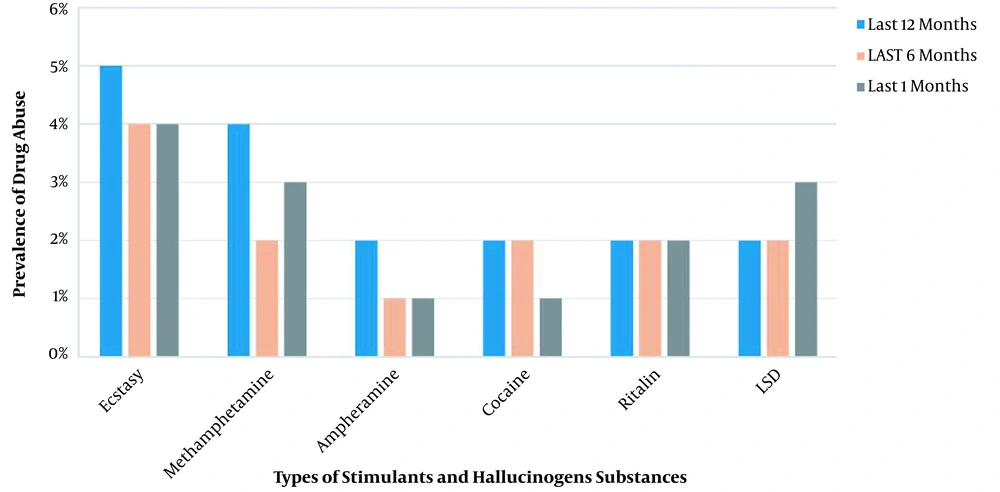
Figure 1.
Prevalence of stimulant use among medical university student
5. Discussion
This study revealed that a majority of students had low knowledge level, which is not in line with the findings of other studies in Iran and London (18-20). The inconsistency of the findings was because, in Iranian studies, the students' knowledge about methamphetamine and ecstasy was at a moderate level, and about 80% of students in studies in London had high level of knowledge about the harmful effects of ecstasy. One of the reasons for the students’ low knowledge level in the present study was that most of the previous studies addressed common stimulants such as ecstasy and methamphetamine; however, we measured the students' knowledge about many stimulants (namely ecstasy, amphetamine, cocaine, LSD, methamphetamine, and Ritalin). Another reason explaining the low knowledge level among our students was insufficient training courses held by the education system on the use of such substances and their disadvantages.
In this study, the mean score of students’ attitude was low, indicating that more than half of the students were holding negative attitudes toward stimulants. This finding is in a similar vein with those of other studies (17-19). Despite the negative attitudes and unwillingness of half of the students, about 8% of the participants reported that they had consumed stimulants during their lifetime. This finding is also consistent with the findings of another study in Iran (17). The ecstasy and methamphetamine use during the last year was also more prevalent than the use of other stimulants. The findings of a cohort study on medical students during 2006 - 2009 showed that the lifetime prevalence and the last-year prevalence of using amphetamine-type stimulants (namely Ritalin, ecstasy, and methamphetamine) were 2.6 and 1.7%, respectively. The reported rates are lower than those found in the present study (21). This inconsistency can be explained by the difference in the circumstances and conditions under which the samples were collected. According to the findings of a review article, most of the stimulant and hallucinogenic substances consumed by Iranian students were ecstasy and methamphetamine by 2015, and there was a 1% prevalence for methamphetamine use during the last year. However, the most commonly used substance among students was Ritalin (22). In line with other studies (10, 18), the participants in the present study confirmed the changing patterns and trends of substance use from traditional to industrial substances and the higher prevalence of substance use among young individuals and students. Since 2010, methamphetamine has been the most common stimulant in the market in the Eastern Mediterranean and western and central Europe; however, amphetamine and methamphetamine use has increased in the Eastern Mediterranean regions (23). Since then, the use of ecstasy has spread to Europe, the US, and Asia. In 2017, the most common substance in the Eastern Mediterranean region was amphetamine, followed by methamphetamine, ecstasy, and cocaine (24).
The present study showed a significant relationship between the knowledge level with age, marital status, and being a medical and paramedical student. The strong relationship between marital status and knowledge can be caused by the older ages of the married participants in the present study, as about 70% of the married students were above 24 years. On the other hand, young individuals gain information from different resources and promote their knowledge because of their curiosity and risk-taking behaviors; however, information about the threats of substance use does not necessarily lead to healthy behaviors and a healthy lifestyle (25). According to Levy's study, about 11% of young individuals using psychotropic substances did not believe that those substances were addictive, and the positive effects following their use led them to use ecstasy (26). In the present study, 30% of the students with a moderate knowledge level reported using stimulants in their lifetime; however, this relationship was not statistically significant. Moreover, there was no significant relationship between attitude and knowledge. Future studies with a larger sample size on students from other regions of the country can reveal much information about substance use patterns and students’ attitudes, which would help us make decisions about this issue.
In this study, students with an associate’s degree and paramedical students were holding more negative attitudes than other students. According to Mohebbi’s et al. study on five cities in Iran, undergraduate students and students at higher levels of education were holding negative attitudes. This finding is not consistent with that of the present study (17). One of the reasons for such an inconsistency may be the lack of differentiation between medical students and non-medical students in their study. In the present study, students with an associate’s degree were emergency medicine students who were mainly familiar with such substances.
In the present study, there was a significant relationship between substance use with age, being a medical student, and attitude. This finding is consistent with a study in Kurdistan (27). Medical students’ positive attitudes appear to be associated with factors such as recreation, curiosity, and peer pressure, increased concentration and energy, improved mood, promoted self-esteem, and smoking (6, 8, 28, 29). This is, while motivation and incentives of substance use were not addressed in this study. A study in Lebanon showed that medical students in higher semesters were overconfident in their ability to control stimulant use; however, such a feeling made them more prone to suicide or self-medication with antidepressants (30). Accordingly, counseling programs need to be continuously held in universities to promote medical students’ knowledge and attitude. Furthermore, students with high-risk behaviors must be referred to a psychiatrist for individual counseling and treatment.
One of the limitations of this study was that the findings may not be generalized to other students since the questions about stimulant use were self-reported.
5.1. Conclusions
In contrast to expectations, the medical students’ knowledge was low, and even higher consumption levels were observed among those at higher levels of education. Accordingly, holding counseling and training programs to promote knowledge and information to nurture a negative attitude towards substance consumption is recommended for medical students and other students.