
1. Background
The association of malignancies and their rheumatologic manifestations (RM) is a complex issue. Occasionally, rheumatologic syndromes are the presenting symptoms of an underlying malignancy (1). Higher age of onset, more prominent systemic manifestations, atypical presentation of the disease, and unresponsiveness to steroids or other classic therapies may suggest a paraneoplastic process (2). Some specific rheumatologic diseases are associated with higher risk of malignancy (3, 4). On the other hand, some malignancies are associated with RM and may present with articular, muscular or soft tissue symptoms (3, 5). Paraneoplastic syndromes are defined as effects of malignancy in locations far from the primary tumor or its metastasis. These syndromes are seen in less than 15 percent of malignancies (6).
RMs include: arthropathy (arthralgia and arthritis), fibromyalgia syndrome, frozen shoulder, hypertrophic osteoarthropathy, lupus-like syndrome, necrotizing vasculitis, polychondritis, and polymyalgia rheumatica as well as palmar fasciitis, dermatomyositis and gout (2, 7). Some rheumatologic diseases are associated with higher risk of malignancies. These diseases include dermatomyositis (DM), polymyositis (PM), rheumatoid arthritis (RA), systemic lupus erythematosus (SLE), Sjogren’s syndrome (SS) and systemic sclerosis (SSc) (7). Out of rheumatologic diseases, DM and to a lesser extent, PM and Scleroderma (SCL) are proved to have association with solid tumors. Chronic autoimmune conditions like SS, RA and SLE are associated with higher risk of lymphoid malignancies (2). On the other hand, some malignancies show paraneoplastic rheumatologic manifestations (PRM) and may be presented by articular, muscular or soft tissue symptoms (7). Predicting factors of malignancy in DM and PM have been reported by Chen et al. (8). Prevalence of vasculitis in patients with underlying malignancy was reported around 8% (9). It was shown that atypical manifestations of polymyalgia rheumatica are associated with underlying malignancy. Kidney, colon and multiple myeloma were the most common associated malignancies (10).
2. Objectives
Diagnosis of paraneoplastic syndromes possesses its importance due to several reasons which reflect the necessity of this research. The main goal was to determine the presence of RM by age, gender, type of solid tumors, and the stage of disease in patients with solid tumors who were admitted to the oncology ward of the hospital.
3. Methods
In this cross-sectional study, 401 patients were studied. Patients with documented solid tumors who referred (during 2010 to 2013), to the Imam Khomeini Hospital, for first time chemotherapy to oncology clinic were studied. A questionnaire containing demographic and specific data including age, gender, type of tumor, history, medication, and rheumatologic diseases was provided. Information was completed with history taking and physical examination. In the case of a positive finding in favor of PRM, additional tests and paraclinical evaluations which are mentioned in the questionnaire were requested. The RM such as arthropathy (arthralgia and arthritis), fibromyalgia syndrome, frozen shoulder, hypertrophic osteoarthropathy, lupus-like syndrome, necrotizing vasculitis, polychondritis and polymyalgia rheumatica, palmar fasciitis, dermatomyositis and gout were evaluated. Patients who took chemotherapy or radiotherapy previously were excluded.
The study protocol was ethically approved by Tehran University of Medical Sciences (code = 481, 89/04/22). The researchers declare their adherence to Helsinki statement principles. Due to gathering information from patients’ files, their names were not recorded to ensure confidentiality of the research. No intervention was done in the process of patients’ evaluation and there is no ethical consideration on this aspect. The full explanation was given to the patients and they were given written informed consent.
3.1. Data Analysis
A questionnaire including all the questions about the patients (demographic, clinical data, type of cancer and paraneoplastic rheumatologic manifestations) were made and the internal consistency was evaluated using Cronbach’s alpha. The Cronbach alpha of the questionnaire was 0.78. All data were collected and analyzed by SPSS software (SPSS 11.5 Inc., Chicago, IL, USA). For quantitative variables, frequency, average, range and standard deviation was calculated. For quantitative comparison of two groups, t-test was used. chi-square test was performed for comparing qualitative variables. Confidence interval was estimated for 95% and the results are presented as diagrams and tables. Quantitative variables were shown as mean ± SD.
4. Results
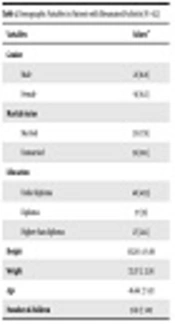
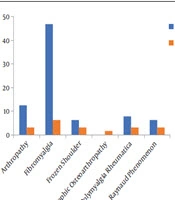
In this study 221 females (mean ages were 51.45 ± 12.58) and 180 males (mean ages were 53.83 ± 13.96) were evaluated. Sixty-four patients (15.69%) of all evaluated patients (401) showed RM as well as solid tumors (Table 1). Demographic, presence of types of cancer and presence of PRM are shown in Table 1. The presence of RM by age group was presented in Table 2. With exception of hypertrophic osteoarthropathy, rheumatic manifestation is more common in female patients (Table 3). The presence of RM based on the stage of disease was as follows: stage II (one patient - 1.6%), stage III (25 patients - 39.1%), stage IV (38 patients - 59.4%). The presence of PRM by gender is presented in Figure 1 and the number of PRM based on cancer type is shown in Figure 2.
Table 1.
Demographic, Types of Cancer and Paraneoplastic Rheumatologic Manifestations of the Patientsa
| Characteristics | Female | Male | Total |
|---|---|---|---|
| Number of patients | 221 (55.1) | 180 (44.9) | 401 (100) |
| Age, y | 51.45 ± 12.58 | 53.83 ± 13.96 | 52.64 ± 13.27 |
| Paraneoplastic rheumatologic manifestations | 51 (79.7) | 13 (20.3) | 64 (15.9) |
| Breast cancer | 31 (100) | 0 (0) | 31 (48.4) |
| Lung cancer | 6 (54.54) | 5 (46.46) | 11 (17.2) |
| Colon cancer | 5 (62.5) | 3 (37.5) | 8 (12.5) |
| Ovary cancer | 5 (100) | 0 (0) | 5 (7.8) |
| Liver cancer | 0 (0) | 2 (100) | 2 (3.1) |
| Testis cancer | 0 (0) | 1 (100) | 1 (1.6) |
| Prostate cancer | 0 (0) | 1 (100) | 1 (1.6) |
| Bone cancer | 2 (40) | 3 (60) | 5 (7.8) |
| Fibromyalgia | 30 (46.9) | 4 (6.3) | 34 (53.1) |
| Arthropathy | 8 (12.5) | 2 (3.1) | 10 (15.6) |
| Polymyalgia rheumatic | 5 (7.8) | 2 (3.1) | 7 (10.9) |
| Raynaud phenomenon | 4 (6.3) | 2 (3.1) | 6 (9.4) |
| Frozen shoulder | 4 (6.3) | 2 (3.1) | 6 (9.4) |
| Hypertrophic osteoarthropathy | 0 | 1 (1.6) | 1 (1.6) |
aValues are expressed as No. (%) or mean ± SE.
Table 2.
Age and Paraneoplastic Rheumatologic Manifestations of the Patientsa
| Paraneoplastic Rheumatologic Manifestations, No. (%) | Age, y | ||||||
|---|---|---|---|---|---|---|---|
| 21 - 30 | 31 - 40 | 41 - 50 | 51 - 60 | 61 - 70 | > 70 | Total | |
| Arthropathy | 0 (0) | 0 (0) | 0 (0) | 4 (6.2) | 3 (4.7) | 3 (4.7) | 10 (15.6) |
| Fibromyalgia | 8 (12.5) | 6 (9.4) | 9 (14.1) | 7 (10.9) | 4 (6.2) | 0 (0) | 34 (53.1) |
| Frozen shoulder | 0 (0) | 0 (0) | 1 (1.6) | 2 (3.1) | 2 (3.1) | 1 (1.6) | 6 (9.4) |
| Hypertrophic osteoarthropathy | 0 (0) | 0 (0) | 0 (0) | 0 (0) | 1 (1.6) | 0 (0) | 1 (1.6) |
| Polymyalgia rheumatic | 0 (0) | 0 (0) | 0 (0) | 1 (1.6) | 4 (6.2) | 2 (3.1) | 7 (10.9) |
| Raynaud’s phenomenon | 0 (0) | 2 (3.1) | 1 (1.6) | 0 (0) | 1 (1.6) | 2 (3.1) | 6 (9.4) |
| Total | 8 (12.5) | 8 (12.5) | 11 (17.2) | 14 (21.9) | 15 (23.4) | 8 (12.5) | 64 (100.0) |
aP value: 0.001.
Table 3.
Paraneoplastic Rheumatologic Manifestations and Types of Solid Tumors in the Patientsa
| Paraneoplastic Rheumatologic Manifestations, No. (%) | Type of Cancer | ||||||||
|---|---|---|---|---|---|---|---|---|---|
| Breast | Lung | Colon | Ovary | Liver | Testis | Prostate | Bone | Total | |
| Arthropathy | 4 (6.2) | 3 (4.7) | 1 (1.6) | 2 (3.1) | 0 (0) | 0 (0) | 0 (0) | 0 (0) | 10 (15.6) |
| Fibromyalgia | 19 (29.7) | 5 (7.8) | 5 (7.8) | 0 (0) | 0 (0) | 0 (0) | 0 (0) | 5 (7.8) | 34 (53.1) |
| Frozen shoulder | 4 (6.2) | 2 (3.1) | 0 (0) | 0 (0) | 0 (0) | 0 (0) | 0 (0) | 0 (0) | 6 (9.4) |
| Hypertrophic osteoarthropathy | 0 (0) | 1 (1.6) | 0 (0) | 0 (0) | 0 (0) | 0 (0) | 0 (0) | 0 (0) | 1 (1.6) |
| Polymyalgia rheumatic | 4 (6.2) | 0 (0) | 2 (3.1) | 0 (0) | 0 (0) | 0 (0) | 1 (1.6) | 0 (0) | 7 (10.9) |
| Raynaud’s phenomenon | 0 (0) | 0 (0) | 0 (0) | 3 (4.7) | 2 (3.1) | 1 (1.6) | 0 (0) | 0 (0) | 6 (9.4) |
| Total | 31 (48.4) | 11 (17.2) | 8 (12.5) | 5 (7.8) | 2 (3.1) | 1 (1.6) | 1 (1.6) | 5 (7.8) | 64 (100.0) |
aP value: 0.02.

Figure 1.
The presence of paraneoplastic rheumatologic manifestation by gender

Figure 2.
The percentage of paraneoplastic rheumatologic manifestation (PRM) patients and types of solid tumors
The most representative age group was 61 - 70 years (23.4%), most rheumatologic manifestation was seen with fibromyalgia (34 patients, 30 females and 4 males, 53.1%).
5. Discussion
Searching in order to detect an association of rheumatic syndromes in cancer patients (with a high prevalence of these complications) can be helpful to detect the underlying neoplasia. The association of malignancies and their RM is a complex issue. Occasionally rheumatologic syndromes are associated with symptoms of an underlying malignancy. Higher age of onset, more prominent systemic manifestations, atypical presentation of the disease, unresponsiveness to steroids or other classic therapies may suggest a paraneoplastic process (1, 2). Some specific rheumatologic diseases are associated with higher risks of malignancy (3, 4). On the other hand, some malignancies show paraneoplastic rheumatologic manifestations and may be presented with articular, muscular or soft tissue symptoms (3, 5).
In this study there were not any significant differences between genders for the presence of RM and age. The highest and lowest numbers of RM in the females was seen with fibromyalgia (46.9%) and hypertrophic osteoarthropathy (HOA) (0%) respectively. However, there was a significant difference based on age for the presence of RM. The most representative age group was 61 - 70 years old. The incidence of fibromyalgia has been seen in the all age group patients under 70 years old. Most rheumatologic manifestation was seen with fibromyalgia (34 patients, 30 females and 4 males, 53.1%).
Agarwala in 1996 reported that paraneoplastic syndromes are seen in less than 15 percent of malignancies (6). In this study, the presence of paraneoplastic syndromes in the patients based on type of solid tumors showed significant differences.
In our study, presence of RM that was based on cancer type, was as follows from most to least: breast, lung, colon, ovary, liver, bone, testis and prostate. In a study by Naschitz et al. in 1997 it was shown that atypical manifestations of polymyalgia rheumatic are associated with underlying malignancy. kidney, colon, and multiple myeloma were the most common associated malignancies (10). Gonzalez-Gay et al. (9) in 2000 have reported that the prevalence of vasculitis in patients with underlying malignancy was around 8%. Gheita et al., 2009 in a study at Egypt have shown that 45 out of 60 patients which were suffering from solid tumors show myalgia, arthralgia, polyarthritis, flexor tenosynovitis, fibromyalgia syndrome, frozen shoulder and hypertrophic osteoarthropathy and 15 patients had hematologic malignancies (7). While in our study, the presence of RM was as follows: fibromyalgia (53.1%), arthropathy (15.6%), polymyalgia rheumatic (10.9%), Raynaud’s phenomenon (9.4%), frozen shoulder (9.4%) and hypertrophic osteoarthropathy (1.6%, Figure 1). Approximately similar results have been reported by Akkaya et al. which shows higher frequency of fibromyalgia in the operated breast cancer patients (11). In the present study, there was no significant difference between the RM and the stage of disease among the patients, but most reports have been seen in stage 4 and 3.
Taken together our results and the results from the Ashouri and Daikh suggests that rheumatic disease might be a kind of component of the spectrum of paraneoplastic manifestations (12).
From the findings, it seems that the most rheumatologic manifestations are gender dependent. The results of this study can be used as a tool for more effective treatment and monitoring clinical studies of RM in patients with solid tumors especially fibromyalgia and breast cancer. It may suggest that: a prospective study for monitoring the patients and their rheumatologic manifestations is needed.
5.1. Suggestions
1- According to the possibility of asynchronous signs of paraneoplastic syndrome, a prospective study is needed.
2- The available studies for PRM screening are not enough and more studies are needed.
3- Rheumatologists must work closely with oncologists to identify the association of RM with malignancy.
5.2. Conclusions
Finding paraneoplastic rheumatic syndromes can enable early disease detection, more precise anatomic location of disease, and assess response to treatment and improvement of quality of life with appropriate treatment. If there is early recognition of the disease, it will lead to timely diagnosis and it is essential to improve outcomes in patients with paraneoplastic syndromes. Therefore, rheumatologists must work closely with oncologists to identify those paraneoplastic syndromes.