
1. Background
Cholesterol plays an important role in many vital functions of the body, including maintenance and integrity of cells, as well as synthesis of steroid hormones and bile acids. However, an abnormal increase in the blood cholesterol level can cause several problems, such as narrowing and blockage of arteries in different parts of the body, particularly coronary arteries. Therefore, it is recognized as one of the leading causes of morbidity and mortality in humans.
In this regard, Freiberg et al. showed that it is possible to predict mortality associated with cardiovascular diseases in the next 30 years by determining the level of cholesterol in the youth and adults (1). Also, there are common risk factors for cardiovascular disease and thrombotic stroke. These diseases are known to be correlated, and the presence of one can increase the risk of another (2). While the increased serum cholesterol level is directly related to the risk of coronary disease, the relationship between cholesterol level and the risk of stroke remains undetermined.
Evidence suggests a significant relationship between hyperlipidemia (HLP) history and poor functional outcomes in patients with hemorrhagic stroke (HS) (3). Some studies have indicated an inverse relationship between the level of total cholesterol (TC) and HS, while a direct association has been found between TC and ischemic stroke (IS) (4). In this regard, Bonaventure et al. studied 8393 men and women during five years and found that triglyceride (TG) level was associated with the increased risk of ischemic events, while a reduction in TG level was associated with the increased risk of HS. Also, a low serum TG level was associated with the doubled risk of HS. Another study indicated a relationship between HS in men and increased blood pressure and reduced cholesterol level (5). Overall, different studies have reported controversial results in this area, and the role of dyslipidemia in stroke is still a subject of debate (6).
2. Objectives
Considering the contradictory results of previous studies and insufficient information regarding the association of serum lipid profile with the type of stroke, the present study was performed in Ali-Ibn Abi-Talib Hospital of Rafsanjan, Iran, to evaluate the serum levels of lipids in patients with IS and HS, admitted to the neurology ward.
3. Methods
In this descriptive study, which was carried out from June 2014 to July 2015, a total of 245 patients with IS, intracerebral hemorrhage (ICH), or subarachnoid hemorrhage (SAH) were assessed on the first day of admission to the neurology ward of Ali-Ibn Abi-Talib Hospital of Rafsanjan, which is the only referral hospital for stroke in this city. In order to recruit samples, the history of patients was collected, and a physical examination was conducted by an expert neurologist in the ward. The sampling method was census sampling of stroke cases. For matching the samples, patients who had used lipid-lowering drugs in the past six months were excluded from the study.
A checklist was provided for each stroke patient, and the required information was collected. Diagnosis of the type of stroke was confirmed by CT scan and brain MRI in the emergency department within 24 hours after the presentation of clinical signs. The serum lipids, including TG, TC, low-density lipoprotein-cholesterol (LDL-C), and high-density lipoprotein-cholesterol (HDL-C), were measured in the fasting state. Our laboratory method for measurement of these lipids was enzymatic photometric method using commercial kits (Pars Azmun, Iran). Total precision according to coefficient variation (CV %) for measuring TC, TG, HDL-C and LDL-C was 1.62, 1.53, 1.24, and 1.2, respectively.
Informed consents were also collected from the patients or their families after obtaining approval from the Ethics Committee.
3.1. Statistical Analysis
Statistical analyses were performed in Microsoft Excel 2013 (Microsoft Corporation, Seattle, WA, USA) and SPSS version 21 (SPSS Inc., Chicago, IL, USA) by measuring descriptive statistics and using complementary statistical methods. Differences between the groups were determined using independent samples t-test and one-way ANOVA, followed by Tukey’s post hoc test. P value less than 0.05 was considered statistically significant.
4. Results
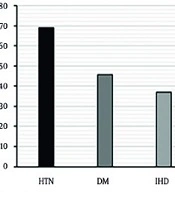
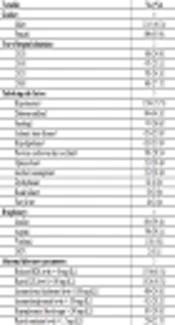
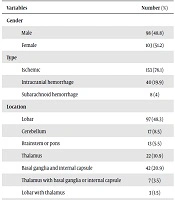
In this study, a total of 201 patients with stroke, who had not recently received treatment with anti-lipid drugs, were selected. Overall, 153 (76.1%) patients were in the IS group, 40 (19.9%) patients were in the ICH group, and 8 (4%) patients were in the SAH group. The baseline characteristics of the patients are presented in Table 1. The results showed that lobar stroke was the most common site of ischemic stroke (48.3%), followed by basal ganglia and internal capsule (20.9%), which were mostly reported in hemorrhagic cases. The least common involvement was detected in the lobar region, along with thalamus involvement.
Table 1.
Demographic and Clinical Variables of Patients with Ischemic and Hemorrhagic Stroke (IS and HS)a
| Variables | Number (%) |
|---|---|
| Gender | |
| Male | 98 (48.8) |
| Female | 103 (51.2) |
| Type | |
| Ischemic | 153 (76.1) |
| Intracranial hemorrhage | 40 (19.9) |
| Subarachnoid hemorrhage | 8 (4) |
| Location | |
| Lobar | 97 (48.3) |
| Cerebellum | 17 (8.5) |
| Brainstem or pons | 13 (5.5) |
| Thalamus | 22 (10.9) |
| Basal ganglia and internal capsule | 42 (20.9) |
| Thalamus with basal ganglia or internal capsule | 7 (3.5) |
| Lobar with thalamus | 3 (1.5) |
| Backgrounds | |
| Hypertension | 128 (63.6) |
| Diabetes | 68 (33.8) |
| Hyperlipidemia | 39 (19.4) |
| Past stroke | 72 (35.8) |
| Atrial fibrillation | 49 (24.3) |
| Ischemic heart disease | 64 (31.8) |
aDistribution of gender, type, location, and background of stroke in patients with ischemic and hemorrhagic stroke is presented as number (percentage).
In terms of gender, 50% of men and 46.6% of women had lobar strokes, while 17.3% of men and 24.3% of women showed basal ganglia and internal capsule involvement. The findings revealed that lobar stroke in men and basal ganglia and internal capsule strokes in women were the most common. There was a significant relationship between gender and the serum levels of TC (P = 0.009), LDL-C (P = 0.024), and HDL-C (P = 0.009); in other words, the serum levels of these parameters were higher in women than men. In addition, higher TG level and age were reported in women compared to men, although the difference was not significant (TG: P = 0.453; age: P = 0.133) (Table 2).
| Variables | Male | Female | P Value |
|---|---|---|---|
| Age (y) | 69.5 ± 14.62 | 72.5 ± 12.93 | 0.133 |
| Total triglyceride (TG) (mg/dL) | 122.07 ± 55.77 | 128.06 ± 57.38 | 0.453 |
| Total cholesterol (TC) (mg/dL) | 175.80 ± 43.10 | 192.4 ± 46.15 | 0.009d |
| LDL-C (mg/dL) | 115.28 ± 38.57 | 128.10 ± 4121 | 0.024c |
| HDL-C (mg/dL) | 36.03 ± 10.17 | 39.90 ± 10.64 | 0.009d |
aValues are expressed as mean ± SD.
bThe groups were compared using independent t-test.
cIndicate a significant difference between the groups (P < 0.05).
dIndicate a significant difference between the groups (P < 0.01).
Comparison of age and serum lipid profile in terms of stroke type is demonstrated in Table 3. The age of patients ranged from 23 to 95 years, indicating no significant difference between the groups. Moreover, the levels of TG and HDL-C were significantly different between patients with IS and ICH (P < 0.01). The TG level was significantly higher in the IS group, compared to the ICH group, while HDL-C level was significantly higher in the ICH group in comparison with the IS group.
| Variables | IS | ICH | SAH | P Value |
|---|---|---|---|---|
| Age(y) | 71.41 ± 13.91 | 71.55 ± 12.54 | 54.75 ± 21.23 | 0.123 |
| Total triglyceride (TG) (mg/dL) | 130.62 ± 59.25 | 101.32 ± 35.63 | 156.75 ± 81.44 | 0.007c |
| Total cholesterol (TC) (mg/dL) | 183.58 ± 46.02 | 184.47 ± 36.63 | 234 ± 82.84 | 0.674 |
| LDL-C (mg/dL) | 121.01 ± 40.25 | 122.80 ± 33.74 | 161.50 ± 90.30 | 0.698 |
| HDL-C (mg/dL) | 36.86 ± 10.22 | 42.55 ± 11.47 | 41.25 ± 6.84 | 0.007c |
Abbreviations: ICH, intracranial hemorrhage; IS, ischemic stroke; SAH, subarachnoid hemorrhage.
aValues are expressed as mean ± SD.
bThe groups were compared using one-way ANOVA.
cIndicate a significant difference between IS and ICH (P < 0.01).
5. Discussion
In the present study, the relationship between the serum lipid profile and type of stroke (IS, ICH, and SAH) was investigated. A total of 201 patients with stroke, who did not receive treatment with anti-lipid drugs, were enrolled in this study after examination by a neurologist, based on the results of CT scan and MRI.
The serum level of TG was significantly higher in the IS group, compared to the ICH group. The findings also showed a significant relationship between the type of stroke and the serum level of HDL-C (Table 3). It has been shown that cholesterol level under 160 mg/dL is associated with a higher risk of ICH or SAH, while there is no association between cholesterol level and lacunar infarction (7). Some studies have indicated an inverse relationship between HDL-C level and transient ischemic attack and minor stroke. It has been also reported that the progression of carotid artery atherosclerosis has a direct relationship with cholesterol and LDL-C levels and an inverse relationship with HDL-C level (8). Generally, previous studies have reported inconsistent results on the role of dyslipidemia in various types of stroke, and the findings remain controversial.
In the present study, regarding the type of stroke and gender, 76.1% of patients had IS, 19.9% had ICH, and 4% had SAH. Also, 80.6% of men and 71.8% of women were diagnosed with IS, while 15.3% of men and 24.3 of women had ICH. In the classification of stroke subtypes in the neurology literature, at least 75% of stroke cases are IS, while 25% are hemorrhagic (9), which is somewhat consistent with our results.
Furthermore, evidence indicates an age-dependent increase in the number of stroke cases. Age is recognized as the strongest risk factor for stroke, which is also uncontrollable (10). In this regard, the results of a study by Ahmadi Ahangar et al. from Babol, Iran, showed that the incidence of stroke almost doubled per decade after the age of 55 years (11). Our findings also showed that the mean age of stroke was 71 years (62.5 years for men and 72.5 years for women).
The mean age of stroke in the Netherlands was reported to be 73.4 years, while the mean age for men and women in Sweden was 73.1 and 79.7 years, respectively (8). In addition, in a study by Iranmanesh et al., the average age of stroke was 70.32 and 64.25 years in women and men, respectively (12); our results are consistent with these reports. According to our study, 52% of patients with stroke were women and 48% were men; this finding is in line with the results of a study by Iranmanesh et al. (55% women and 45% men) (6).
Additionally, Zhang et al. in a study on 3914 patients with stroke (3085 cases of IS, 497 cases of ICH, and 332 cases of SAH) concluded that the low level of HDL-C and high TC-to-HDL-C ratio were associated with the increased risk of IS in both females and males. Also, there was a positive correlation between TC and risk of IS in men. On the other hand, an inverse relationship was found between TC level and ICH in women, while a positive correlation was reported between the TC-to-HDL-C ratio and the increased risk of IS (13).
Based on our literature review, no evidence was found regarding the site of stroke and its association with gender (9). However, the results of the present study showed that there is a significant association between gender and serum levels of TC, LDL-C, and HDL-C in stroke patients; in other words, the serum levels of all three factors were higher in women than men. The serum level of TG and the mean age of stroke events were also higher in women, although the difference was not statistically significant. In this regard, Tohidi et al. showed a gender-dependent relationship between the level of serum lipids and the incidence of IS. The findings showed that the levels of TC, LDL-C, and HDL-C in women with IS had a direct relationship with IS (14).
Furthermore, our results showed a significant association between the serum levels of TG and HDL-C and type of stroke. The serum TG level was significantly higher in the IS group, compared to the ICH group. This finding is in line with the results of a study by Saadatnia et al. (15). In another study by Bonaventure et al., it was reported that the increased level of TG was associated with the increased risk of ischemic events. In contrast, the reduced level of TG was associated with the increased risk of HS, which is consistent with our findings (5).
Additionally, Freiberg et al. revealed a direct relationship between the serum level of TG and IS (1). However, in a study by Willey et al., there was no significant association between IS and the serum levels of TG, HDL-C, and TC (16). According to our results, there was a significant relationship between the serum level of HDL-C and type of stroke. The HDL-C level was significantly higher in the ICH group, compared to the IS group. However, there was no significant relationship between the serum levels of LDL-C and TC and type of stroke.
Saadatnia et al. reported higher serum levels of HDL-C and LDL-C in patients with HS, compared to patients with IS; only the results regarding HDL-C level are consistent with our findings (15). The results of a study by Mortazavi Moghadam et al. on HDL-C level in IS and HS patients are also in line with our findings. Nevertheless, the findings regarding the association between TC level and IS and HS are in contrast to our results. We found no significant association between TC level and type of stroke. The high level of HDL-C and low level of TC in HS patients may indicate the protective role of atherosclerosis in the prevention of HS (17).
Moreover, Uddin et al. noted that elevation of serum TC and LDL-C levels is an alarming risk factor for IS, while the serum level of TG has no effects on IS (18); in our study, no such finding was reported. Also, a study by Sacco et al., which was carried out on 539 patients with IS and 905 control subjects, revealed that the increased level of HDL-C is associated with the reduced risk of IS. In addition, the protective effect of HDL-C on the atherosclerotic type of stroke, compared to the non-atherosclerotic type, was confirmed (19).
5.1. Conclusions
Our findings suggest that a lower TG level may be associated with a higher risk of HS, while a higher level of TG may be related to a higher risk of IS. There was no significant association between the type of stroke and LDL-C or TC level. However, there was a significant relationship between gender and serum lipid profile. In order to validate our findings, a larger number of samples and long-term assessments are necessary.