
1. Background
Rheumatoid arthritis (RA) is a chronic and multi-systemic disease (1) with an unknown origin that is associated with inflammation and impairment of the immune system (2). It affects about half to 1% of the world’s population (3); about 600000 individuals in Iran have RA and the incidence of RA has been estimated at about 0.33 among the community in Iran, in 2014 (4). The incidence of this disease is increasing with age and the prevalence among women is three to four times higher than that of men (3).
The main features of rheumatoid arthritis are inflammation of the cartilage’s synovial membrane, swelling, pain and dysfunction of joints, which can cause damage to the cartilage, as well as cause bone and joint deformity (5); extra-articular complications in this disease can also be referred to cardiac involvement (6). Common cardiovascular disease in patients with rheumatoid arthritis include pericarditis, atherosclerosis, myocarditis, congestive heart failure, cardiac block, and also the risk of valve diseases due to chronic inflammation of the valley (7-11).
Increased cardiovascular risk with vascular wall damage is accompanied with this disease due to accelerating the process of atherosclerosis by mediating inflammatory processes and immune complexes; rheumatoid arthritis itself is known to be an independent risk factor for cardiovascular disease (6). An increased risk of heart disease in RA patients with heart disease is associated with an increase in inflammatory markers, including CRP, erythrocyte sedimentation rate (ESR), rheumatoid factor (RF), anti-citrullinated protein antibodies (ACPAs), and with more active or severe RA (12).
Several studies have been carried out on the identification of risk factors of cardiovascular diseases. Some researchers have pointed to risk factors such as hypertension, type 2 diabetes, smoking, family history of cardiovascular disease, and the level of education; another group emphasize on the role of BMI, weight gain, waist to hip ratio, total cholesterol levels, LDL level, and its relationship with cardiovascular disease in epidemiological studies (13).
Patients with RA usually have various risk factors for heart disease, including a higher incidence of smoking and altered lipid profile, compared to the general population. Lipid profile in RA is characterized by a reduction in total cholesterol and LDL cholesterol levels during a period with high levels of inflammation, with a greater proportion of reduced levels of high density lipoprotein (HDL), the undesirable ratio of total to HDL cholesterol. The level of fat is a contradiction in the risk of CAD in RA patients, since low levels of fat are associated with severe systemic inflammation, which in turn is associated with an increased risk of CAD; inflammation also appears to alter the structure and function of the lipoprotein (12).
Several studies have suggested that cardiovascular disease is the most common cause of mortality in patients with rheumatoid arthritis, and the risk of mortality due to cardiovascular complications is doubling with age (7-9, 14). Several studies suggest that vasculitis may increase the risk of atherosclerosis in RA patients (15, 16); and therefore, control of serum levels of total cholesterol, triglyceride, and lipoproteins can be effective in reducing cardiovascular complications (17).
According to available evidence that there is a high risk of cardiovascular involvement in the course of rheumatoid arthritis and high mortality rates in these patients, any action that can detect cardiovascular injuries before clinical symptoms will be able to take effective steps to reduce mortality and morbidity in these patients (18). In addition, due to the fact that many of the rheumatologic diseases show their true face over the long run, it is therefore recommended that accurate follow up of patients, especially by nursing staff, in order to if in the event of visits, the patient's complaints are added or exacerbated by further and more accurate examination by nurse, the patient is transmitted to the relevant physician; therefore, nurses play a key role in the prevention and control of rheumatic diseases. A study by Garcia-Diaz and Corominas, in Spain, entitled “nursing management for risk factors for cardiovascular disease in rheumatoid arthritis” showed that rheumatologist nurses are in a position well suited to include a routine risk assessment for cardiovascular disease for RA affected people. They are in a position to do well with the usual risk assessment of cardiovascular disease for those with RA referred to the clinic and provide educational interventions to reduce the risk of cardiovascular disease, such as smoking cessation, weight loss, balanced eating, low-fat diet, and regular exercise (19). In fact, although traditional cardiovascular (CV) risk factors are more prevalent in RA than in the general population, they do not adequately account for the increase in CV morbidity and mortality observed in these patients. Conversely, inflammation markers associated with RA appear to contribute to the risk of CV death, probably by increasing the risk of IHD and HF. Nurses can give the patient and patient families the necessary advice on the follow-up and care of rheumatic diseases as well as play an important role in the patient’s examination of the complications of the disease; therefore, given the importance and necessity of proper control of cardiovascular disease in patients with rheumatoid arthritis, measurement of vital cardiovascular indices in RA patients is inevitable.
2. Objectives
The aim of this study was to evaluate cardiovascular parameters in patients with rheumatoid arthritis.
3. Methods
3.1. Design
This study is a descriptive study done on patients with rheumatoid arthritis in 2017 - 2018.
3.2. Setting
In this study, 268 cases of rheumatoid arthritis patients were evaluated at six-months. Of these, 112 patients who were eligible for inclusion criteria were selected. To select the samples in this study, the researcher, with the permission of the relevant authorities, referred to a rheumatology specialist’s clinic and determined the eligible samples so that all patients with rheumatoid arthritis who referred to a rheumatologist’s clinic were evaluated in terms of all inclusion and exclusion criteria; finally, 112 patients were selected and entered the study. After selecting the samples and after explaining the goals to the study units and taking their consent, a questionnaire containing demographic information was filled out by the researcher using the interview.
The inclusion criteria included passed at least six months of diagnosis (rheumatoid arthritis), age range of 30 - 60 years (in 80% of all patients it occurs between the ages of 35 and 50), as well as other underlying criteria. The exclusion criteria included diabetes mellitus, hypertension, thyroid dysfunction, kidney failure, blood lipids disorder and Cushing’s syndrome, hepatitis, cancer, pregnancy, as well as having a diet.
3.3. Measures
Data were collected using a demographic form and checklist for identifying cardiovascular risk factors. The demographic profile included information on age, sex, marital status, duration of occupation, employment status, education, and so on. The checklist for determining the cardiovascular risk factors was also used to determine indicators such as total serum cholesterol, triglyceride, and lipoproteins. Anthropometric measurements included: (1) Weight with minimum coverage and without shoes by digital scales with accuracy of 0.1 kg; (2) height using a height gauge attached to the wall and complying with the conditions of contact between the four areas of the body with the wall (behind the heel, buttocks, scapular and back of head), as well as the right angle of the head with the wall at the reading the numerical value of height without shoes, with an accuracy of 0.1 cm. In addition, the body mass index (BMI) was also measured by dividing the weight (kg) by the square of height (m2); then, 5 mL of fasting venous blood (after 8 - 12 hours of fasting) was taken from patients and all blood samples collected in the laboratory on the same day were examined in terms of serum levels of RF, glucose, triglyceride, total cholesterol, LDL-cholesterol, and HDL-cholesterol. Measurements of serum RF level through IgM isotype, positive-20 ELISA method using the anti-rheumatoid factor IgM ELISA kit of ABCAM Company, serum fasting glucose concentrations using the Pars Promonium kit and using Selectra II, and serum levels of triglycerides, total cholesterol, LDL-cholesterol and serum HDL-cholesterol by colorimetric method with Pars Testem Company’s kits using an auto-analyzer were performed. For instrument reliability, all laboratory tests were measured at the university’s reference laboratory. To increase the accuracy of the digital scale, it was calibrated every day by weighting a standard 2 kg weight.
Subject’s systolic blood pressure (SBP) and diastolic blood pressure (DBP) was also measured by the researcher using the standard mercurial pressure gauge in the right arm in sitting position and under stress less conditions (after 15 minutes rest in sitting position).
It should be noted that all measurements in patients were performed by one of the researchers and by the same blood pressure meter.
3.4. Data Analysis
Data were analyzed by SPSS software version 22. Quantitative data were calculated in the form of mean (standard deviation) and qualitative data in the form of frequency.
4. Results
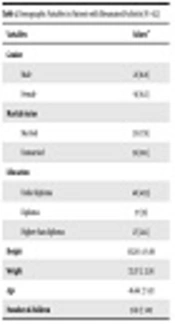
Based on the results of this study, the mean ± SD age of patients was 46.66 ± 9.12 years (minimum 28 and maximum 60 years); most of them (81.3%) were women and married (82.1%) and about half of the patients (42.9%) were under a diploma (Table 1). Other demographic variables are also presented in Table 1.
Table 1.
Demographic Variables in Patients with Rheumatoid Arthritis (N = 112)
| Variables | Valuesa |
|---|---|
| Gender | |
| Male | 21 (18.8) |
| Female | 91 (81.3) |
| Marital status | |
| Married | 20 (17.9) |
| Unmarried | 92 (82.1) |
| Education | |
| Under diploma | 48 (42.9) |
| Diploma | 37 (33) |
| Higher than diploma | 27 (24.1) |
| Height | 162.10 ± 6.98 |
| Weight | 72.87 ± 12.91 |
| Age | 46.66 ± 9.12 |
| Number of children | 3.69 ± 1.85 |
aValues are expressed as No. (%) or mean ± SD
Table 2 shows the mean ± SD of the cardiovascular parameters of the subjects. Based on the mean body mass index (27.58), the patients were overweight; in addition, serum triglyceride levels 159.94 ± 49.63 and HDL 129.28 ± 30.60 were within the normal range and their serum levels of glucose 107.55 ± 38.47, cholesterol 209.90 ± 37.90, blood LDL 129.28 ± 30.60, systolic 145.75 ± 16.23, and diastolic 78.46 ± 11.91 blood pressure were above the normal range (Table 2).
Table 2.
Cardiovascular Parameters in Patients with Rheumatoid Arthritis (N = 112)
| Variable | Mean ± SD | Minimum | Maximum |
|---|---|---|---|
| Cholesterol | 209.90 ± 37.90 | 107 | 345 |
| Triglyceride | 159.94 ± 49.63 | 66 | 365 |
| LDL | 129.28 ± 30.60 | 63 | 265 |
| HDL | 50.49 ± 8.26 | 34 | 90 |
| Systolic blood pressure | 145.75 ± 16.23 | 100 | 186 |
| Diastolic blood pressure | 78.46 ± 11.91 | 132 | 110 |
| Glucose | 107.55 ± 38.47 | 71 | 285 |
| Body mass index (BMI) | 27.98 ± 5.00 | 20.00 | 45.34 |
5. Discussion
In this study, a total of 112 RA patients with a mean age of 46.66 ± 9.12 years were studied. A total of 81.3% of the patients were female and based on the mean body mass index 27.98 (0.005), these patients were overweight. In addition, serum levels of glucose, total cholesterol, LDL, and systolic and diastolic blood pressure did not have a normal distribution in them.
Sajjadi and colleagues showed that although the normal range of body mass index and waist circumference are used to predict the risk factors of cardiovascular disease, it seems that even the lower boundary of these indicators can be a predictive factor (20). A study by Tanaka et al., also found that increased risk for at least one risk factor for cardiovascular disease in men is seen with increasing fat mass (8); in the present study, patients with rheumatoid arthritis were overweight; therefore, it is recommended to provide a proper diet for weight control in these patients due to the fact that increasing body mass index and subsequent obesity can lead to cardiovascular disease in these patients.
The study conducted by Naderi et al., in evaluating the new risk factors of cardiovascular diseases in Isfahan city, showed that serum lipoproteins and blood glucose levels were normal and only serum levels of triglyceride were higher than normal in men and women (9), which is not consistent with the results of this study; perhaps one of the reasons for achieving this different result is the difference in the population studied and the presence of a series of environmental factors such as inappropriate nutrition or lack of mobility.
In the Sadeghi and colleagues’ study on the prevalence of hypertension and its association with other risk factors for cardiovascular disease, the relationship between high prevalence of hypertension and the prevalence of other risk factors for heart disease (11) has also been identified. Similarly, Saadati and colleagues, in the study of cardiac disorders in patients with rheumatoid arthritis without cardiac symptoms, stated the prevalence of cardiovascular disorders, especially elevated pulmonary arterial pressure, diastolic dysfunction, and failure of the mitral valve and mitral valve in rheumatoid arthritis patients is significant (18). Saadati et al., also showed in another study that the prevalence of diastolic dysfunction observed in patients with rheumatoid arthritis, with a duration of illness and at in old age. On the other hand, Li et al., in China, investigated the risk factors for cardiovascular disease in 568 patients with rheumatoid arthritis and revealed cardiovascular problem patients are age-related. The number of extra-articular members involved, platelet count, hyperfibrinogenemia, and CRP levels were not significantly correlated with cardiovascular problems, however, cardiovascular problems were significantly associated with poor treatment response to RA medications and known risk factors were an exacerbating factor (21). In the present study, the risk of cardiovascular problems is posed due to the lack of normal distribution of cardiovascular parameters, including blood pressure and serum glucose, cholesterol, and LDL levels.
One of the limitations of this study is the convenience sampling method of the study that reduces the generalizability of the results; it is suggested that other studies be conducted using random sampling in other areas.
5.1. Conclusions
The probability of developing cardiovascular disorders is significant due to an increase in body mass index, glucose, total cholesterol, LDL, and blood pressure in patients with rheumatoid arthritis; therefore, a training program was introduced for these individuals.
Distinct factors are responsible for cardiovascular events in different chronic inflammatory diseases and such cardiovascular risk reduction strategies need to be disease specific and not standard across these conditions. Thus, early detection of cardiac involvement may reduce the morbidity and mortality due to cardiovascular causes in these patients.