Fulltext
The full text of this article is available on the PDF file.
Zahedan Journal of Research in Medical Sciences
The Official Journal of Zahedan University of Medical Sciences
Image Credit:Zahedan J Res Med Sci
Authors
Background: The superficial layer is a part of the cellular envelop that is seen in bacteria and archaea. This superficial layer is a single layer structure composed of subordinate proteins or glycoproteins. The superficial layer is the outer most cellular structure that is in the exchange and reaction around environment with bacteria. This structure has very diversity in bacteria different types.
Materials and Method: The related articles to superficial layer were extracted of these articles: Pubmed, Elsevier Science, and Yahoo, from 1995 to 2010 years. For this purpose keywords were searched including superficial layer, pathogenesis, pathogen bacteria,
Results: There is consensus in the case of the superficial layer and about the existence of this superficial structure lead to increased pathogenesis in bacteria, in all of the research articles.
Conclusion: S-layers in pathogen bacteria with bacteria protection against bacteriophages and phagocytosis, resistance against low pH, adhesion, stabilisation of the membrane and providing adhesion sites for exoproteins caused pathogenesis, infection resistant and antibiotic resistant in host.
The result of this study shows the prevalence of considerable S-layer in pathogen bacteria and this matter identified the bacteria generator importance of this structure in the laboratory
© 2010, Author(s). This open-access article is available under the Creative Commons Attribution 4.0 (CC BY 4.0) International License (https://creativecommons.org/licenses/by/4.0/), which allows for unrestricted use, distribution, and reproduction in any medium, provided that the original work is properly cited.
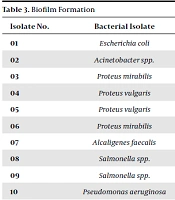
Proma TT, Ahmed T. Evaluation of Drug Resistance Before and After Biofilm Formation of Bacteria Causing Wound Infection and Detection of Their Protease Activity. Int J Infect. 2021;8(3):e108247. doi: https://doi.org/10.5812/iji.108247
najar-peerayeh S, Jazayeri Moghadas A, bakhshi B. Staphylococcus epidermidis virulence factor and ability of macroscopic biofilm production. koomesh. 2016;17(4):e151185. doi:

Khangholi M, Jamalli A. The Effects of Sugars on the Biofilm Formation of Escherichia coli 185p on Stainless Steel and Polyethylene Terephthalate Surfaces in a Laboratory Model. Jundishapur J Microbiol. 2016;9(9):e40137. doi: https://doi.org/10.5812/jjm.40137

Mekni MA, Achour W, Ben Hassen A. Overview of Genetic Background Beyond Polysaccharide Intercellular Adhesion Production in Staphylococcus epidermidis. Jundishapur J Microbiol. 2017;10(1):e36008. doi: https://doi.org/10.5812/jjm.36008
Khaltabadi Farahani R, Ehsani P, Ebrahimi-Rad M, Khaledi A. Molecular Detection, Virulence Genes, Biofilm Formation, and Antibiotic Resistance of Salmonella enterica Serotype enteritidis Isolated from Poultry and Clinical Samples. Jundishapur J Microbiol. 2018;11(10):e69504. doi: https://doi.org/10.5812/jjm.69504
Last Update: 3 weeks ago
Last Update: 3 weeks ago
Last Update: 3 weeks ago
Last Update: 4 hours ago
Last Update: 1 day ago
Last Update: 4 days ago