
A Novel CAT > GAT (H 3311R) Missense Mutation in Exon 30 of the PKD1 Gene in a Patient Affected With Autosomal Dominant Polycystic Kidney

Authors

Atousa Hafizi1, Saeid Reza Khatami1, Hamid Galehdari1, Gholam Reza ShariatiGholam Reza Shariati ORCID2,*, Ali Hossein Saberi3, Mohamad Hamid4
1Department of Genetic, Faculty of Sciences, Shahid Chamran University of Ahvaz, Ahvaz, IR Iran
2Narges Medical Genetics and PND Laboratory, Ahvaz, IR Iran
3Department of Medical Genetics, Ahvaz Jundishapur University of Medical Sciences, Ahvaz, IR Iran
4Department of Molecular Medicine, Biotechnology Research Center, Pasteur Institute of Iran, Tehran, IR Iran
*Corresponding Author: Corresponding author: Gholam Reza Shariati, Narges Medical Genetics and PND Laboratory, Ahvaz, IR Iran. E-mail: Email: [email protected]

Zahedan Journal of Research in Medical Sciences:Vol. 17, issue 5
Published online:May 31, 2015
Article type:Case Report
Received:Jan 26, 2014
Accepted:Mar 15, 2014
How to Cite:Hafizi A, Khatami SR, Galehdari H, Shariati GR, Saberi AH, et al. A Novel CAT > GAT (H 3311R) Missense Mutation in Exon 30 of the PKD1 Gene in a Patient Affected With Autosomal Dominant Polycystic Kidney. Zahedan J Res Med Sci. 2015;17(5):-. doi: https://doi.org/10.17795/zjrms976

Abstract

Introduction:

Autosomal dominant polycystic kidney disease (ADPKD) is one of the most common genetic kidney disorders. Genetic studies have demonstrated an important allelic variability among patients but very few data are known about the genetic variation in Iranian populations.

Case Presentation:

In this study, in order to verify the ADPKD in a patient with some clinical symptoms and study the variations of the PKD1 gene for the first time in Iranian population, the PKD1 gene was entirely sequenced. Coding exons analysis of PKD1 by exon direct sequencing was performed. Molecular genetic testing found a novel mutation in the patient.

Conclusions:

It was a missense mutation CAT > GAT at position 3311 in exon 30 of PKD1. CAT > GAT causes the conversion of amino acids histidine to argenine and change the transmembrane domain and proper function of the polycystin 1 protein.

Highlights

1. Introduction

Autosomal dominant polycystic kidney disease (ADPKD; OMIM ID: 173900) is a monogenic multi-systemic disorder characterized by the development of renal cysts and various extra-renal manifestations. It is the most common inherited renal disease with a prevalence of approximately 1 in 400 to 1 in 1000 live births in all races [1]. This disease accounts for more than 10% of all cases of end-stage renal diseases (ESRD) [2]. ADPKD is characterized by numerous enlarged fluid-filled epithelial cysts typically in both kidneys and in some cases in other organs. Now 2 causal genes, PKD1 (MIM 601313) and PKD2 (MIM 173910), have been identified for ADPKD that are located respectively on chromosome 16 (16p13.3, 46 exons) and chromosome 4 (4q21, 15 exons) [3]. The PKD1 gene mutated in 85% of all ADPKD cases. Polycystin-1 is a receptor protein for cell-cell/matrix interactions which plays crucial roles in the regulation of cell proliferation and apoptosis [4]. In the present study, we report a case of novel mutation discovered from the direct mutation screening of all exons in the PKD1 gene in one Iranian patient with ADPKD.

2. Case Presentation

The patient was a 15-year-old boy, the only child of consanguineous parents. There was no history of ADPKD in this family. On sonography of the abdomen of the patient, the liver was normal in size, but contained multiple simple cysts, the largest was 27 × 27 × 25 mm located in the right lobe. On sonography of the kidneys and bladder, both kidneys were normal in position and however enlarged in size. Ten milliliter of peripheral blood was collected in EDTA containing tube. DNA was extracted by the standard salting out protocol. PKD1 gene-specific PCR primers were synthesized for all exons (a list of the primers used is available on request). The primers for exon 30 amplification was F: 5’-CCATGTTCCCTGGGTCTCT-3’ and R: 5’-GCTGCTCTCTCAACAAGAGGA-3’ The PCR was conducted under the following conditions: 100 ng genomic DNA, 200 μM deoxyribonucleotide triphosphates (dNTPs), 1.5 mm MgCl, 2.5 units supertaq polymerase, and 25 pmol each primer. Amplification was carried out in 25 μL volumes and 35 cycles: 93ºC for 1 min, 60ºC for 30 seconds and 72ºC for 45 seconds. Direct sequencing of the exons was performed using the big dye terminator cycle sequencing ready reaction kit (Applied Biosystems) on an ABI Prism 3700 automated genetic analyzer (Applied Biosystems). The same PCR primers were used for sequencing reactions. Finally, the sequences were compared to the reported gene sequence using the BLASTN program.
Direct sequencing analysis of the patient, after comparison with PKD1 reference sequence, demonstrated a sporadic heterozygous missense mutation CAT > GAT substitution in exon 30 of the PKD1 gene in the patient, which causes an amino acid exchange of histidine to argenine (Figure 1).
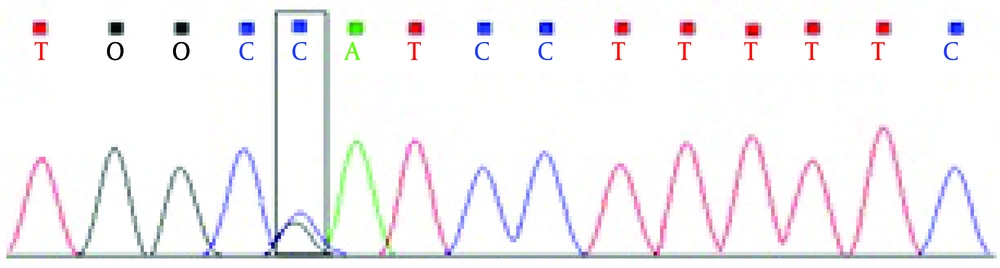
The Result of Genetic Sequencing, Showing the Heterozygous Missense Mutation CAT > GAT in Exon 30 of the Patient’s PKD1 Gene (Sequencing With Forward Primer)
Figure 1.
The Result of Genetic Sequencing, Showing the Heterozygous Missense Mutation CAT > GAT in Exon 30 of the Patient’s PKD1 Gene (Sequencing With Forward Primer)

3. Discussion

PKD1 gene mutations are considered as an important factor causing ADPKD. In 85-90% of patients mutations concern PKD1 gene and PKD2 in 10-15% of cases [5]. A large number of methods have been used to screen for mutations in ADPKD for research and clinical aims, but direct sequencing is still considered the method of choice [6]. We therefore performed systematic screening of the coding region of the PKD1 gene by PCR-direct sequencing method. The present study is the first description of the PKD1 variant in ADPKD patients living in Iran. We analyzed an affected person with polycystic kidney deficiency with PCR and direct sequencing of coding exons of the PKD1 gene. As a result we identified a genetic variant of PKD1 in ADPKD patient. It was a missense mutation CAT > GAT (H 3311R) located in the exon 30 of the PKD1 gene, that changed histidine to argenine in the transmembrane domain of the polycystin1 protein (Figure 2).
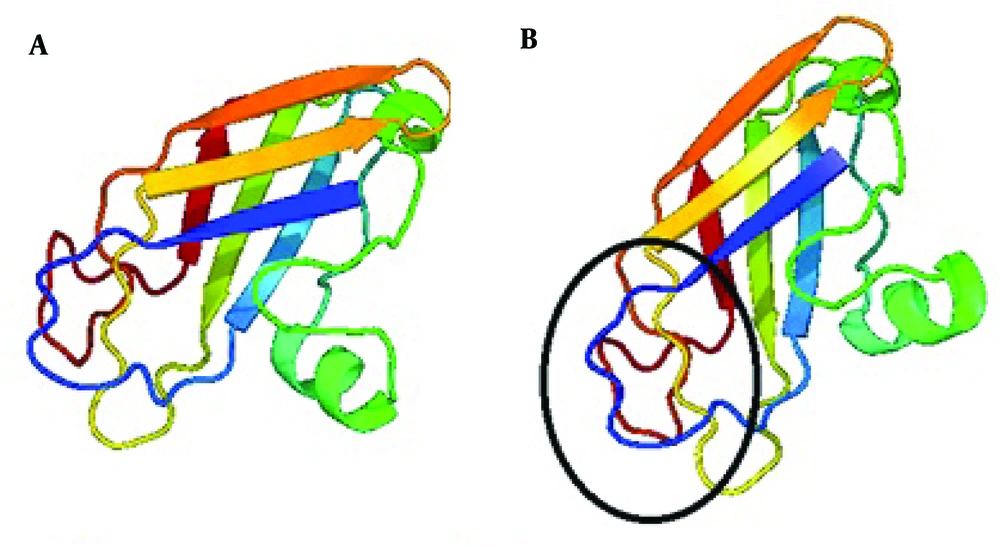
The differences between two protein structures have shown with black circles. Pictures prepared by Phyre2 software.
Figure 2.
The differences between two protein structures have shown with black circles. Pictures prepared by Phyre2 software.
Polycystins are proteins that have been found to play important roles in cell to cell and cell to extracellular matrix interactions. Research into the function of these proteins has also revealed that they play a part in cilia action in the nephrons and calcium channeling [7].
Hydropathy plot and computer-assisted analyses identified 9 to 11 transmembrane regions from amino acid 3075 to 4104 with intervening intracellular and extracellular loops [8]. Our found mutation changes the transmembrane domain and disturbs the polycystin1 proper function. Nevertheless, it is a first step to future multicenter studies for better description of genetic variants in Iranian ADPKD patients.
Acknowledgments

Footnotes

  • Authors’ Contributions:All authors had equal role in design, work, statistical analysis and manuscript writing.

  • Funding/Support:This study was supported in part by grant No.636410 of Shahid Chamran University.

References

  • 1.
    Qi XP, Du ZF, Ma JM, Chen XL, Zhang Q, Fei J, et al. Genetic diagnosis of autosomal dominant polycystic kidney disease by targeted capture and next-generation sequencing: utility and limitations. Gene. 2013;516(1):93-100. [PubMed ID: 23266634]. https://doi.org/10.1016/j.gene.2012.12.060.
  • 2.
    Tan YC, Blumenfeld J, Rennert H. Autosomal dominant polycystic kidney disease: genetics, mutations and microRNAs. Biochim Biophys Acta. 2011;1812(10):1202-12. [PubMed ID: 21392578]. https://doi.org/10.1016/j.bbadis.2011.03.002.
  • 3.
    Mochizuki T, Wu G, Hayashi T, Xenophontos SL, Veldhuisen B, Saris JJ, et al. PKD2, a gene for polycystic kidney disease that encodes an integral membrane protein. Science. 1996;272(5266):1339-42. [PubMed ID: 8650545].
  • 4.
    Goilav B. Apoptosis in polycystic kidney disease. Biochim Biophys Acta. 2011;1812(10):1272-80. [PubMed ID: 21241798]. https://doi.org/10.1016/j.bbadis.2011.01.006.
  • 5.
    Torres VE, Harris PC, Pirson Y. Autosomal dominant polycystic kidney disease. Lancet. 2007;369(9569):1287-301. https://doi.org/10.1016/s0140-6736(07)60601-1.
  • 6.
    Hoefele J, Mayer K, Scholz M, Klein HG. Novel PKD1 and PKD2 mutations in autosomal dominant polycystic kidney disease (ADPKD). Nephrol Dial Transplant. 2011;26(7):2181-8. [PubMed ID: 21115670]. https://doi.org/10.1093/ndt/gfq720.
  • 7.
    Gallagher AR, Hidaka S, Gretz N, Witzgall R. Molecular basis of autosomal-dominant polycystic kidney disease. Cell Mol Life Sci. 2002;59(4):682-93. [PubMed ID: 12022474].
  • 8.
    Polycystic kidney disease: the complete structure of the PKD1 gene and its protein. The International Polycystic Kidney Disease Consortium. Cell. 1995;81(2):289-98. [PubMed ID: 7736581].

Copyright

Copyright © 2015, Zahedan University of Medical Sciences.This is an open-access article distributed under the terms of the Creative Commons Attribution-NonCommercial 4.0 International License (http://creativecommons.org/licenses/by-nc/4.0/) which permits copy and redistribute the material just in noncommercial usages, provided the original work is properly cited.

Similar Articles

30
Mar
2013

A New PKD-1 Mutation Discovered in a Black African Woman With Autosomal Polycystic Kidney Disease

Sidy Mohamed Seck,
Serigne Guèye,
Boucar Diouf

Seck SM, Guèye S, Diouf B. A New PKD-1 Mutation Discovered in a Black African Woman With Autosomal Polycystic Kidney Disease. Nephro-Urol Mon. 2013;5(2):769-72. doi: https://doi.org/10.5812/numonthly.6651

19
Jul
2017

Linkage Analysis of Autosomal Dominant Polycystic Kidney Disease in Iranian Families through PKD1 and PKD2 DNA Microsatellite Markers

Fatemeh Hajizadeh Tafti,
Mohammad Reza Dehghani,
Ehsan Farashahi Yazd,
Maryam Golzadeh,
Mohammad Yahya Vahidi Mehrjardi,
Seyed Mehdi Kalantar

Hajizadeh Tafti F, Dehghani MR, Farashahi Yazd E, Golzadeh M, Vahidi Mehrjardi MY, et al. Linkage Analysis of Autosomal Dominant Polycystic Kidney Disease in Iranian Families through PKD1 and PKD2 DNA Microsatellite Markers. Nephro-Urol Mon. 2017;9(4):e59996. doi: https://doi.org/10.5812/numonthly.59996

30
Apr
2005

A Novel Mutation of SLC26A4 Gene In an Iranian Family with Pendred Syndrome

K Kahrizi,
C Nishimura,
A Naghavi,
Y Riazalhosseini,
RJH Smith,
H Najmabadi

Kahrizi K, Nishimura C, Naghavi A, Riazalhosseini Y, Smith R, et al. A Novel Mutation of SLC26A4 Gene In an Iranian Family with Pendred Syndrome. Int J Endocrinol Metab. 2005;3(2):. doi:

31
Jan
2010

Autosomal Dominant Polycystic Kidney Disease: A Comprehensive Review

Adarsh Vijay1,
Arun Vijay,
Preethy Pankaj

Vijay1 A, Vijay A, Pankaj P. Autosomal Dominant Polycystic Kidney Disease: A Comprehensive Review. Nephro-Urol Mon. 2010;2(1):. doi:

24
Sep
2016

Diagnosis of Autosomal Dominant Polycystic Kidney Disease in the Uterus and Follow up in a Two-Month Old Infant: A Case Report

Mohsen Akhavan Sepahi,
Zahra Movahedi

Akhavan Sepahi M, Movahedi Z. Diagnosis of Autosomal Dominant Polycystic Kidney Disease in the Uterus and Follow up in a Two-Month Old Infant: A Case Report. Jentashapir J Cell Mol Biol. 2016;7(5):e30640. doi: https://doi.org/10.17795/jjhr-30640

More by these authors

Atousa HafiziPubMedScholar
Saeid Reza KhatamiPubMedScholar
Hamid GalehdariPubMedScholar
Gholam Reza ShariatiPubMedScholar
Ali Hossein SaberiPubMedScholar
Mohamad HamidPubMedScholar
Share
Cited by
Metrics