1. Background
Nausea is an unpleasant and subjective experience that is defined as a feeling of the need to vomit that is referred to the epigastrium and abdomen, and vomiting is defined as the ejection of the contents of the stomach from the mouth (1). Today, nausea and vomiting are one of the most common postoperative complications. The risk factors for postoperative nausea and vomiting include female gender, a history of motion disease, smoking, and use of opioids after surgery; the incidence of postoperative nausea and vomiting is related to the number of these factors present in a patient, and the effectiveness of prophylactic treatment depends on the preoperative risk of the patient (2).
Postoperative nausea and vomiting is stressful for patients, surgeons, and anesthesiologists, causing a feeling of distress, confusion, hate, and increased anxiety for the patient, and if the nausea and vomiting continue, they can cause a drop in blood pressure and decreased heart rate, fatigue, abdominal pain, irritability, sleep disorders, fear, damage to the upper gastrointestinal system, intraocular bleeding, increased intracranial pressure, ulcers, and cracking of the skin (3-5). These symptoms can delay a patient’s discharge from the recovery room for 47 - 60 minutes (6), requiring extra care and treatment that increase the cost for the patient and the treatment system. Research has shown that patients are willing to spend much to prevent and treat this condition, even preferring pain to nausea and vomiting (7, 8). Some of the factors affecting the incidence of postoperative nausea and vomiting are unrelated to anesthesia, such as gender, age, obesity, preoperative anxiety, type of surgery, and history of nausea and vomiting while previously under anesthesia, and other factors, including the type of anesthetic drug used, ventilation technique, and the rate of opioid use, are related to anesthesia (9-11).
Prophylactic measures to prevent postoperative nausea and vomiting are clearly more effective than treatment, but some patients need treatment for postoperative nausea and vomiting even after the administration of appropriate prophylactic treatment. The prevention of postoperative nausea and vomiting in at-risk patients, such as obese patients, diabetics, and pregnant women, is of particular importance (12, 13). Various drugs are used for the prevention and treatment of postoperative nausea and vomiting, the most important of which are butyrophenone, benzamides, histamine receptor inhibitors, muscarinic receptor inhibitors, and 5-hydroxytryptamine-3 receptor inhibitors (14).
These drugs are somewhat effective but could not decrease the prevalence of postoperative nausea and vomiting to an acceptable level. Additionally, these drugs impose some complications to the patient and increase hospital costs (15). Recently, the use of drugs to treat nausea and vomiting has decreased, and nonpharmaceutical and alternative traditional medicines are often preferred (16). The use of plant therapy was common in ancient civilizations and is still common today. Plant therapy, including the use of herbal products or their total extracts, is common throughout the world (17).
Therefore, since the majority of aromatic herbs are edible and have been used for thousands of years, there is positive public attention to the use of healing plants, which form the main part of traditional medicine, and the identification and assessment of the effects of these plants, especially their ability to reduce the complications associated with chemical drugs and invasive procedures (18, 19). One of these healing plants is ginger, which is a hot edible vegetable; botanists introduced ginger as an antispasmodic, antivomiting, carminative, analgesic, antimicrobial remedy. Ginger is an appetitive, carminative, antiseptic, antivomiting antidiarrheal stomach tonic (20).
2. Objectives
This study was performed with the aim of determining the effect of ginger on nausea and vomiting following a cesarean section under spinal anesthesia. Since the drug is safe and no side effects or interaction effects have been reported with its use, ginger, which is commercially available, can be used as an effective treatment to reduce the incidence or severity of postoperative nausea and vomiting. However, due to the increasing demand for plant therapy and the low cost of these drugs, study and research in this area is essential and required for the expansion of this type of therapy.
3. Methods
This double-blind randomized clinical trial was conducted in Bojnoord Bentolhoda Hospital in 2014. The subjects included all pregnant women aged 15 - 45 years who were referred to Bojnoord Bentolhoda hospital for delivery (elective patients) and selected spinal anesthesia for cesarean section. The included patients were alert; classified as class I or class II according to the America society of anesthesiology’s physical classification system; did not have any infection, bleeding, or ulcers in the spinal area; and did not have any relative or absolute limitation for spinal anesthesia.
Patients who were referred for cesarean section with a drop in fetal heart rate, placenta detachment, or placenta previa; who weighed over 90 kg, who were diabetic, who had an underlying gastrointestinal disease, who had used antinausea or antivomiting drugs in the 24 hours before the surgery, who were not fasting, who had middle ear disease, who had more than a 20% drop in blood pressure from the baseline after spinal anesthesia, who had gestational hypertension, who had a history of pelvic surgery except caesarean section, or who had a history of nausea and vomiting during the past 24 hours were excluded from the study.
The calculation of the sample size used for the study was based on previous research, an assumption that the incidence of nausea in the control group (as survival failure) was 0.7 and was 0.4 in the intervention group, and use of a first-type error of 0.05 and a test power of 0.8. Based on this calculation, 46 patients were selected for each group.
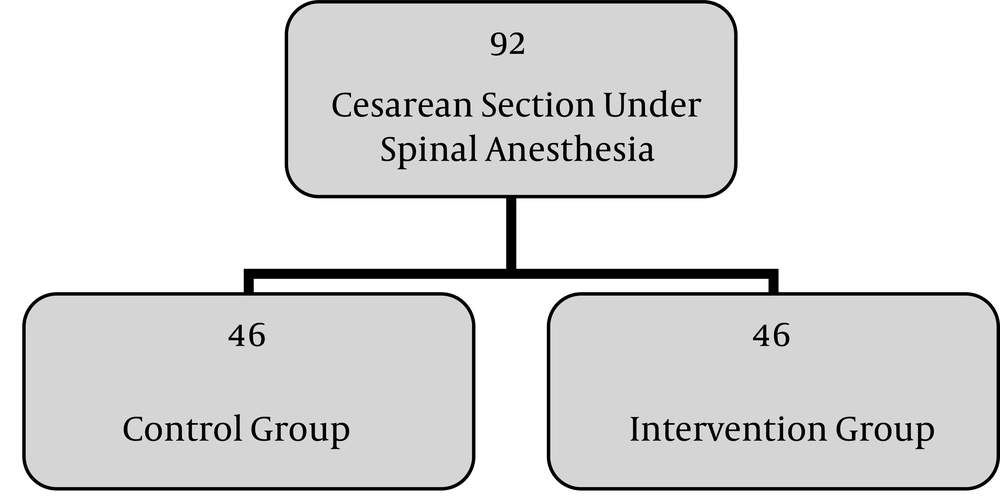
Figure 1.
Demographic
After a full explanation of the project’s methods was given to the patients, written consent was obtained from the patients one hour before the administration of anesthesia for caesarean section. In the intervention group, 25 drops of superginger oral drops containing ginger extract were poured in 30 cc of tap water in a glass and was given to the patients. The control group received 30 cc of tap water in a glass. A questionnaire was fully completed by each patient in both groups.
After entering the operating room, spinal anesthesia was achieved with 75 mg of 5% lidocaine and a size 23 Quinke spinal needle in the L4 - L5 lumbar spine by a skilled anesthesiologist with the patient in a supine position. After laying the patient on the operating bed and achieving precise control of the patient’s blood pressure, the level of anesthesia was determined using cotton soaked in alcohol after complete anesthesia. The amount of fluid required during the operation was also calculated based on each patient's need according to standard methods, and Ringer serum and, if necessary, other serums were used.
During the operation, oxygen with a concentration of six liters per minute and a green mask were applied to the patient. Any nausea or vomiting and their severity were recorded during the surgery and in the recovery room. The visual analogue scale was used to assess the severity of the nausea. This objective tool included a 10-cm ruler that indicated a range of zero to ten that indicated the severity of nausea being experienced by a patient. A patient would indicate a point on the ruler that represented the severity of the nausea she was experiencing. A selection of zero indicated that a patient was experiencing the least possible nausea, and a selection of ten indicated that a patient was experiencing the worst possible nausea. Therefore, the visual analogue scale is a self-report.
Since nausea is a situation experienced by a patient, use of a self-reporting scale is technique that is well suited for measuring the severity of nausea. In addition, such a scale is easily understood by subjects, and learning how to record the results of this measurement is easy. For the purposes of this study, nausea that was rated higher than 7 cm is classified as severe, nausea between 3.5 cm and 7 cm is classified as moderate, and nausea less than 3.5 cm is classified as mild. To assess the severity of vomiting, the frequency of retching or vomiting was counted. More than five instances of retching or vomiting were defined as severe, between three and five instances were defined as moderate, and fewer than three instances were classified as mild vomiting.
After the end of a patient’s surgery, the patient was transferred to the surgery ward, and the existence of nausea and vomiting and the severity and incidence of each were recorded two and four hours after surgery. The patients did not use analgesics postoperatively.
This clinical trial was approved by the ethics committee, and a letter of introduction was presented by the school of nursing and midwifery, Bojnoord University of Medical Sciences to the Bentolhoda obstetrics and gynecology center. Permission to complete this trial was gained from the authorities, and the purpose and methods of the project were explained to the administrators and staff.
Data were analyzed using SPSS software (version 16). To investigate the distribution of quantitative data, the Kolmogorov-Smirnov and Shapiro-Wilk tests were used. To compare the quantitative variables between the two groups, an independent t-test was used if there was a normal distribution of variables. Otherwise, the Mann-Whitney U test was used. A value of P < 0.05 was considered significant.
4. Results
The findings of this study suggested that there was no significant relationship between the two groups in terms of maternal age, duration of fasting, duration of surgery, underlying disease, history of opioid use and smoking, or number of previous deliveries (P > 0.05).
An intergroup comparison during the different stages of assessment (see Table 1) showed that the mean severity score of nausea during cesarean section was 0.8 ± 1.9 in the intervention group and 2.3 ± 2.9 in the control group. The results of an independent intergroup t-test indicated that there was a significant relationship between the two groups in terms of mean nausea severity score during cesarean section (P < 0.05). However, the mean nausea severity score decreased in both groups two and four hours after surgery: The mean nausea severity score in the intervention group was 0.3 ± 1.1 and 0.05 ± 0.3 two and four hours after surgery, respectively, and was 0.8 ± 2.1 and 0.1 ± 0.5 in the control group two and four hours after surgery, respectively. The results of an independent t-test showed no relationship between the two groups in terms of mean severity score of nausea at these stages (P = 0.13 and P = 0.57 two and four hours after surgery, respectively).
Table 1.
Comparison of the Mean Nausea Severity Scores of the Two Groups (Severity of Nausea)
| Stage of Assessment | Mean ± SD | t-Test Resultsa | |
|---|---|---|---|
| t | P | ||
| During cesarean section | 2.86 | 0.005 | |
| Intervention | 0.8 ± 1.9 | ||
| Control | 2.3 ± 2.9 | ||
| Two hours after surgery | 1.51 | 0.13 | |
| Intervention | 0.3 ± 1.1 | ||
| Control | 0.8 ± 2.1 | ||
| Four hours after surgery | 0.56 | 0.57 | |
| Intervention | 0.05 ± 0.3 | ||
| Control | 0.1 ± 0.5 | ||
aIndependent Intergroup.
Table 2 shows that during cesarean delivery, 35 patients in the intervention group and 22 in the control group had no feelings of nausea. Among the pregnant women undergoing caesarean section, 15.2% in the intervention group and 28.3% in the control group had mild feelings of nausea.
Table 2.
Descriptive Statistics of the Incidence of Nausea in Two Groupsa
| Stage of Assessment | Incidence and Severity of Nausea | Total | |||
|---|---|---|---|---|---|
| None | Mild | Moderate | Severe | ||
| During cesarean section | |||||
| Intervention | 35 (76.1) | 7 (15.2) | 2 (4.3) | 2 (4.3) | 46 (100) |
| Control | 22 (47.8) | 13 (28.3) | 6 (13.0) | 5 (10.9) | 46 (100) |
| Two hours after surgery | |||||
| Intervention | 41 (9.1) | 4 (8.7) | 1 (2.2) | 0 (0) | 46 (100) |
| Control | 38 (82.6) | 5 (1.9) | 2 (4.3) | 1 (2.2) | 46 (100) |
| Four hours after surgery | |||||
| Intervention | 46 (100) | 0 (0) | 0 (0) | 0 (0) | 46 (100) |
| Control | 44 (95.7) | 2 (4.3) | 0 (0) | 0 (0) | 46 (100) |
aValues are expressed as No. (%).
Table 3 shows that mean number of retching or vomiting incidents during cesarean delivery was 0.5 ± 1.1 in the intervention group and 1.5 ± 1.9 in the control group. The results of an independent intergroup t-test indicated that there was a significant relationship between the two groups in terms of mean number of retching incidents during cesarean section (P = 0.001). However, two hours after surgery, the number of retching incidents decreased in both groups to 0.6 ± 0.4 in the intervention group and 0.3 ± 0.9 in the control group. The independent t-test results showed no significant relationship between the two groups at this stage (P = 0.157). Four hours after surgery, none of the women in either group had symptoms of vomiting or retching.
Table 3.
Comparison of the Mean Number of Retching Incidents in the Two Groups (Severity of Nausea)
| Stage of Assessment | Mean ± SD | t-Test Resultsa | |
|---|---|---|---|
| t | P | ||
| During cesarean section | 3.29 | 0.001 | |
| Intervention | 0.5 ± 1.1 | ||
| Control | 1.5 ± 1.9 | ||
| Two hours after surgery | 1.4 | 0.157 | |
| Intervention | 0.6 ± 0.4 | ||
| Control | 0.3 ± 0.9 | ||
| Four hours after surgery | 0.00 | 0.00 | |
| Intervention | 0.0 ± 0.0 | ||
| Control | 0.0 ± 0.0 | ||
aIndependent Intergroup
Table 4 shows that during caesarean section, 8 (17.4%) patients in the intervention group and 17 (37%) patients in the control group had a feeling of retching, most of which were of mild severity. At this stage, there was no severe case of retching in the intervention group. There was no feeling of retching in either group four hours after surgery.
Table 4.
Descriptive Statistics of the Number of Retching in Two Groupsa
| Stages of Assessment | Incidence and Severity of Nausea | Total | |||
|---|---|---|---|---|---|
| None | Mild | Moderate | Severe | ||
| During cesarean section | |||||
| Intervention | 35 (76.1) | 8 (17.4) | 3 (6.5) | 0 (0) | 46 (100) |
| Control | 22 (47.8) | 17 (37) | 4 (8.7) | 3 (6.5) | 46 (100) |
| Two hours after surgery | |||||
| Intervention | 45 (97.8) | 1 (2.2) | 0 (0) | 0 (0) | 46 (100) |
| Control | 41 (89.1) | 4 (8.7) | 1 (2.2) | 0 (0) | 46 (100) |
| Four hours after surgery | |||||
| Intervention | 46 (100) | 0 (0) | 0 (0) | 0 (0) | 46 (100) |
| Control | 46 (100) | 0 (0) | 0 (0) | 0 (0) | 46 (100) |
aValues are expressed as No. (%).
5. Discussion
The results of this study showed that nausea and vomiting during cesarean section was significantly lower in the intervention group than the control group. Additionally, the rate of nausea decreased in both groups two and four hours after surgery, but no significant difference in this decrease was observed between the two groups. The frequency of vomiting decreased in both groups two hours after surgery, but no significant difference in this decrease was observed between the two groups. No signs of vomiting were observed in either group four hours after surgery.
The results of previous internal and external studies were comparable with the results of our study. In a study conducted by Apariman et al., the mean nausea score of the patients in both an intervention and control group was lower two hours after surgery than six hours after surgery, which may be due to pain and movement experienced by the patients when they were transferred from recovery to the section two hours after surgery. These factors are believed to cause nausea and vomiting (23).
They also claimed that the use of antipain medications, such as pethidine, two hours after surgery can cause nausea and vomiting. Six hours after surgery, the nausea score of the group that received pethidine was compared with the group that did not receive pethidine. There was no difference in the mean nausea score in the two groups, but the nausea score was significantly lower in the ginger group compared to the placebo group within the group that received pethidine. The researchers also found that ginger was effective for reducing the nausea caused by opioids (24).
According to the results of present study, the prevalence of nausea and vomiting during cesarean delivery was significantly different between the two groups, and ginger was effective for the prevention of nausea and vomiting during cesarean section. Other studies have reported the effects of ginger on the prevention of nausea and vomiting. Flip et al. found that ginger is effective for preventing postoperative nausea and vomiting (25). On the other hand, Visalyaputra et al. and Eberhart et al. reported that ginger had negative effects on nausea and vomiting (26, 27). Notably, there was only one postsurgery assessment in each of these studies, which could affect the results. Leopold et al. and Gan also reported that ginger was not effective for reducing nausea and vomiting, which may be a result of the use of low doses of ginger that did not reach treatment levels (27, 28).
A study conducted by Vutyavanich showed a significant reduction in the early pregnancy nausea severity score of the patients in a group that received ginger biscuits compared with those in a group that received simple biscuits. Additionally, a greater reduction in the frequency of vomiting was found in the ginger group (29). A study conducted by Portnoi showed that the frequency of vomiting significantly decreased in both groups after taking ginger and vitamin B6 during pregnancy, though the severity and frequency of nausea and frequency of vomiting was not significantly different between the groups during treatment (30).
Niebyl showed a significant difference in the nausea scores of the patients in a group that received ginger compared with those in a control group after gynecologic surgeries. Also, nausea was lower in the ginger group compared with the control group 2, 6, 12, and 24 hours after surgery; the frequency and severity of vomiting in patients receiving ginger was lower in the ginger group than in the control group (31).
A Canadian study conducted by Westfall used antinausea plants, including ginger, mint, and cannabis, during pregnancy. Of these plants, only ginger was suggested as an antinausea drug for use during pregnancy, though all three plants have been effective for the treatment of nausea and vomiting for other conditions, such as nausea induced by chemotherapy and postoperative nausea. Westfall also stated that the effectiveness of all three plants has been confirmed by different sources and that there is little clinical evidence of their harmfulness (32). The results of Westfall’s study, which simultaneously compared these three drugs, are consistent with our study.
The main results of previous studies are consistent with the findings of the present study and confirm both that ginger is effective for the prevention of nausea and vomiting during cesarean section and that the use of ginger for this purpose has no risks. Although intravenous analgesics are the main method of pain relief after surgery, they are associated with serious side effects, such as nausea, vomiting, over drugged, and respiratory failure. Herbal medicines are commonly used to relieve pain after the majority of surgeries in modern medicine, and these medicines reduce not only the necessity for the use of drugs but also the incidence of negative side effects. Herbal remedies have long been considered in medicine due the lower incidence of side effects associated with their use, and these remedies are produced and marketed in various forms, especially herbal extracts.
5.1. Conclusion
According to the findings of this research, ginger is effective for the prevention of nausea and vomiting after cesarean section under spinal anesthesia, and no side effects related to this dose of ginger were observed. Ginger can be used as a safe drug to control nausea. As a general rule, the side effects of any drug should be considered, but ginger has produced no noticeable side effects in previous studies or this study.
Future studies should compare the use of ginger with other antinausea drugs in different surgeries, and these studies should employ a higher sample size.