1. Background
Escherichia coli is a Gram-negative bacillus that belongs to the Escherichia genus, which includes species present in the human and other animal intestine. When eliminated in the environment together with feces it contaminates water, soil and food (1-3). Based on the particular present strain, it can provide resistance against pathogenic organisms or can itself be pathogenic, causing diseases at intestinal and extra-intestinal sites (4). Particularly, urban rivers have been often reported as having fecal contamination associated with antibiotic-resistant E. coli which threatens drinking water quality and public health (5-7).
Nowadays the microbial resistance to antibiotics has caused various problems in the process of disinfecting devices and surfaces of the hospitals and in treatment of the patients (8-10). Extensive clinical use of antibiotics in both human and veterinary medicine has been blamed for the rise and spread of antibiotic-resistant (AR) bacteria (11). But, in recent years, several reports have raised concerns that antibacterial drug development will not adequately address the problems posed by antibiotic resistance among important bacterial pathogens (12-15). However, the widespread use of antibiotics in animals as well as human beings has resulted in the frequent detection of antibiotic-resistant bacteria in human waste, meat, fish farms, rivers, and lakes (16, 17).
To date, the relationship between concentration of antibiotics and development of resistance in bacterial pathogens is often unclear (18). Surveillance data show that resistance in E. coli is consistently the highest to antimicrobial agents that have been in use the longest time in human and veterinary medicine (19).
2. Objectives
The present study was designed to isolate E. coli strains from patients to assess the susceptibility and resistance patterns to some selected antimicrobials during 2006 – 2007.
3. Materials and Methods
This descriptive study was performed on 300 samples with positive cultures of E. coli during 2006-2007 at the Central Laboratory and the Pasteur hospital in Bam city. Standard methods were used for isolation, identification and biochemical confirmation (indole, methyl-red, Voges-Proskauer and Simmons citrate tests) of E. coli isolates (20).
The antibiotic resistance was determined by a standard disc diffusion technique using Mueller-Hinton agar (Merck, Germany) according tothe recommendations of National Commitee for Clinical Laboratory Standards (NCCLS 2008) (21). The antimicrobial drugs were tested and their sensidisk concentrations were: Nalidixic acid (NA, 30 μg), Ceftizoxime (CT, 30μg), Gentamicin (GM, 10μg), Ciprofloxacin (CP, 5μg), Ceftriaxone (CEF, 30 μg), Cotrimoxazole (SUT, 25 μg) (The Antibiotic discs were made by Oxoid Company, South Australia, http://www.oxoid.com/UK/blue/contacts/contacts.asp?compType=0). Within 15 min of the application of the discs, the plates were inverted and incubated at 37 °C. After 24h of incubation, the plates were examined, and the diameters of the zones of complete inhibition to the nearest whole millimeter were measured. The zone diameter for individual antimicrobial agents was then translated into sensitive, intermediate and resistant categories.
The sample types included urine, blood and feces (50 blood samples, 105 urine and 145 fecal samples). Finally, the information was recorded in the Excel program and analyzed using the SPSS software and chi-square statistical method.
4. Results
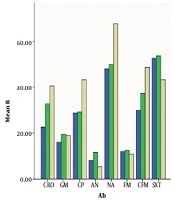
During the study period, 300 culture-positive results were investigated for E. coli. The results related to the sensitivity rate of the bacteria culture-positive samples based on gender in the case of Ciprofloxacin included 178 sensitive cases (59.3%), 49 (16.3%) semi-sensitive and 73 resistant cases (24.3%). In Ceftriaxone, 109 cases (36.3%) were sensitive, 105 cases (35%) semi-sensitive and 86 cases (28.7%) resistant. In Ceftizoxime, 81 cases (27%) were sensitive, 134 cases (44.7%) semi-sensitive and 85 cases (28.3%) resistant. In Co-trimoxazole, 68 cases (22.7%) were sensitive, 113 cases (37.7%) semi-sensitive and 119 cases (39.7%) resistant. In Nalidixic Acid, 46 cases (15.3%) were sensitive, 75 cases (25%) semi-sensitive and 179 cases (59.7%) resistant. In Gentamicin, 34 cases (11.3%) were sensitive, 109 cases (36.3%) semi-sensitive and 157 cases (52.3%) resistant. The results based on gender regarding Ciprofloxacin, Ceftriaxone, Nalidixic acid, Cotrimoxazole and Gentamicin weren’t significant with P value = 0. 367،P value=0.987،P value = 0.353، P value = 0.347 and P value = 0.104 respectively but the result was significant in Ceftizoxime with P value = 0.042.
The results related to the sensitivity rate of the bacteria culture-positive samples based on blood, urine and feces samples in the case of Ciprofloxacin included the highest sensitivity to stool culture (62.8%) and the highest resistance to urine culture (31.4%). In Ceftriaxone, the highest sensitivity and resistance were to urine culture (37.1%) and stool culture (31.7%), respectively. In Ceftizoxime, the highest sensitivity and resistance were related to blood culture (46%) and stool culture (33.1%), respectively. In Co-trimoxazole, the highest sensitivity and resistance were related to blood culture (34%) and stool culture (45.5%), respectively. In Nalidixic Acid, the highest sensitivity and resistance were related to urine culture (18.1%) and (63.8%), respectively. In Gentamicin, the highest sensitivity and resistance were related to stool culture (12.4%) and (56.2%), respectively.
The results based on blood, urine and feces samples in Ciprofloxacin, Ceftriaxone, Nalidixic acid and Gentamicin weren’t significant with P value = 0.209، P value = 0.56،P value = 0.205 and P value = 0.430, respectively but this result was significant in ceftizoxime and Co-trimoxazole with P value = 0.07 and P value = 0.015,respectively. Overall in this study, the highest sensitivity and the highest resistance were related to Ciprofloxacin, Ceftriaxone and Nalidixic acid, Gentamicin, respectively (Table 1).
Table 1.
Distribution Pattern of E. coli Resistance to Various Antibiotics in This Study
| Sensitive | Semi-sensitive | Resistant | |
|---|---|---|---|
| Antibiotics | No. (%) | No. (%) | No. (%) |
| Ciprofloxacin | 178 (59.3) | 49 (16.3) | 73 (24.3) |
| Ceftriaxone | 109 (36.3) | 105 (35) | 86 (28.7) |
| Ceftizoxime | 81 (27) | 134 (44.7) | 85 (28.3) |
| Co-trimoxazole | 68 (22.7) | 113 (37.7) | 119 (39.7) |
| Nalidixic Acid | 46 (15.3) | 75 (25) | 179 (59.7) |
| Gentamicin | 34 (11.3) | 109 (36.3) | 157 (52.3) |
5. Discussion
Antibiotics and resistant bacteria have been considered as emerging pollutants worldwide. Infectious diseases caused by antibiotic-resistant bacteria have been a serious concern in local hospitals and clinics. The spread of antibiotic-resistant bacteria is an emerging worldwide problem that increasingly threatens the successful treatment of infectious diseases. Antibiotic-resistant Gram-negative bacteria such as E.coli are the emerging problems that infection control practitioners, hospital epidemiologists, clinicians, and hospital administrators are struggling to control. Therefore, the present study was conducted to determine the antimicrobial resistance of E. coli isolated from patients in Bam.
A study investigated microbial species isolated from patients with urinary tract infection (UTI) and evaluated their in vitro susceptibility patterns to commonly used antimicrobial agents in Karaj, Iran. E. coli isolates, the predominant cause of UTIs, showed high resistance to Gentamicin (73.69%). These isolates, the predominant cause of UTIs, showed high resistance to Gentamicin, Ampicillin and Cephalothin, and higher sensitivity to Imipenem, Ciprofloxacin, Nitrofurantoin, and Ceftizoxime (22). The difference between this study and the present study was that in the current study was found to be most susceptible to Ciprofloxacin (59.3%). Also, in the current study the highest resistances were to Nalidixic acid (59.7%) and Gentamicin (52.3%), respectively.
Another study was performed to determine the frequency and antimicrobial susceptibility of E. coli pathotypes obtained from children with acute diarrhea. The in vitro antibiotic susceptibility pattern of E. coli strains showed that 36.4% of isolates were found to be resistant to Nalidixic acid. Also, 89.9%, 88.9% and 79.8% of isolates were resistant to tetracycline, Chloramphenicol, and Ampicillin, respectively (23). The difference between this study and the present study was that in the current study was found to be most resistance to Nalidixic acid (59.7%).
A study was conducted to estimate the presence of E. coli in sea foods in the landing centers and local market and their antibiotic resistance was tested with 15 antibiotics for the benefit of the consumers. This study revealed that 91.2% of E. coli isolates were susceptible to Ciprofloxacin (24). This study revealed that Amikacin, Ciprofloxacin and Chloramphenicol are the best antibiotics to treat E. coli infection. Results of the current study also proved high susceptibility to Ciprofloxacin (59.3%).
A study was conducted to determine the presence or absence of bacterial infections in tracheal tubes and determination of their antimicrobial susceptibility patterns specially E.coli. The results showed that 67.3% of E. coli isolates were resistant to Nalidixic acid (25). The similarity between this study and the present study was that in the current study was found to be most resistance to Nalidixic acid (59.7%). Therefore, it proved the results of the current study.
Another study was conducted to determine the rate of resistance to antibiotics by E. coli strains isolated from cultures of different clinical specimens received from pediatric patients in Jordan. The high resistance rate was observed to Ampicillin (84%), followed by Amoxicillin-clavulanic acid (74.3%), Cotrimoxazole (71%), Nalidixic acid (47.3%), Cephalothin (41%). Lower resistance rates were observed Toamikacin (0%) followed by Cefotaxime (11%), Ceftriaxone (11.7%), Ciprofloxacin (14.5%), Norfloxacin (16.5%), Gentamicin (17.3%), Cephalexin (20.9%), Ceftazidime (22.5%), cefixime (29.6%), and Cefaclor (32.8%) (26). The current study also proved high susceptibility to Ciprofloxacin (59.3%) and the highest rate of resistance was against Nalidixic acid (59.7%).
In another study, antibiotic susceptibility test was performed for all the isolates in Nepal. Results indicated that out of 3,460 urine samples 680 (19.7%) showed the significant bacteriuria. The most common isolated pathogens were E. coli 75.7% followed by Klebsiellapneumoniae 10.7%, Acinetobacter spp. 5.5%,Proteus spp. 3.5% and Pseudomonas aeruginosa 1.2%. The most susceptible antibiotics were Amikacin, Ceftriaxone and Ciprofloxacin for most of the isolates. E. coli which was the main isolate was found to be most susceptible to Amikacin 96.1%, Nitrofurantoin 91.3% and Gentamicin 77.7% followed by Ceftriaxone 65.8% and Ciprofloxacin 64.1% (27). The difference between this study and the present study was that in the current study was found to be most susceptible to Ciprofloxacin 59.3%.
According to the above studies, the investigation of bacterial resistance against antibiotics is essential and the present study was performed on E. coli. Results of the current study revealed that the highest resistances were to Nalidixic acid and Gentamicin. In addition, it was proved that the highest susceptibilities were to Ciprofloxacin and Ceftriaxone. Therefore, Ciprofloxacin is an alternative antibiotic in E.coli infections.