
1. Introduction
Cholecystitis affects 2 – 4% of gallstone patients, who are usually asymptomatic. Symptomatic cholelithiasis, acute or chronic cholecystitis, and selected benign gallbladder polyps are now treated with laparoscopic cholecystectomy (1-5). Although LC is less invasive than open surgery, it often causes abdominal pain, referred shoulder pain, and PONV (2-5). CO₂ pneumoperitoneum causes abdominal pain through visceral manipulation, trocar-site damage, and peritoneal distension and irritation (2, 5, 6). Age, sex, BMI, operating time, and previous abdominal surgery affect pain severity (2, 6). Nearly 20% of patients require parenteral opioids, and one-third experience severe pain within 24 hours (1, 5). Poor analgesia delays mobilization, slows healing, and lowers patient satisfaction (2, 5, 7, 8).
Laparoscopic patients experience referred shoulder pain in 35 – 80% of cases, with pain worsening between 12 and 48 hours (2, 5). About 30% of general surgical patients and 52 – 80% of patients undergoing laparoscopic cholecystectomy without targeted prophylaxis experience PONV (9, 10). PONV can delay breastfeeding, cause hemorrhage, wound dehiscence, and pulmonary aspiration, and lower maternal satisfaction (11, 12).
Opioids and nonopioids are used to tailor postoperative analgesia, along with regional or neuraxial approaches (8). Post-laparoscopic discomfort is multifaceted; therefore, therapies should target multiple pathways (13). Pain and PONV prolong hospitalization and contribute to readmission; therefore, improving their management is clinically essential (14).
2. Objectives
In this randomized experiment, we evaluated the effects of intraperitoneal bupivacaine–dexamethasone and a pulmonary recruitment technique on stomach pain, referred shoulder pain, and postoperative nausea and vomiting (PONV) after laparoscopic cholecystectomy (LC).
3. Methods
3.1. Study Design, Ethics Approval, and Trial Registration
From October 2025 to February 2026, this prospective, four-arm, parallel-group, patient- and assessor-blinded randomized study was conducted at Imam Khomeini Hospital, Mazandaran University of Medical Sciences, Sari, Iran. The study, which complied with the Declaration of Helsinki, received ethical approval (IR.MAZUMS.REC.1404.302). IRCT registration (IRCT20251007067533N1; October 19, 2025) preceded enrollment, which began on October 22, 2025. Each subject provided written informed consent.
3.2. Participants and Eligibility
Eligible patients undergoing elective LC for benign illness were aged 18 – 60 years, had an American Society of Anesthesiologists (ASA) class of I-II, a BMI < 40 kg/m², and an anticipated operation duration of < 2 hours (5, 10, 13, 15). Patients were excluded if they refused participation, had PRM contraindications, a history of open abdominal or shoulder surgery, severe nonbiliary pain, regular Non-Steroidal Anti-Inflammatory Drugs (NSAID)/opioid/systemic corticosteroid use, substance or alcohol misuse, relevant drug allergies, pregnancy or lactation, or major systemic comorbidities (5, 7, 15, 16). Anaphylaxis, severe bronchospasm, conversion to open surgery, and difficult intubation were prospectively recorded as protocol deviations and safety events; affected patients remained in ITT analyses (5) (Figure 1).
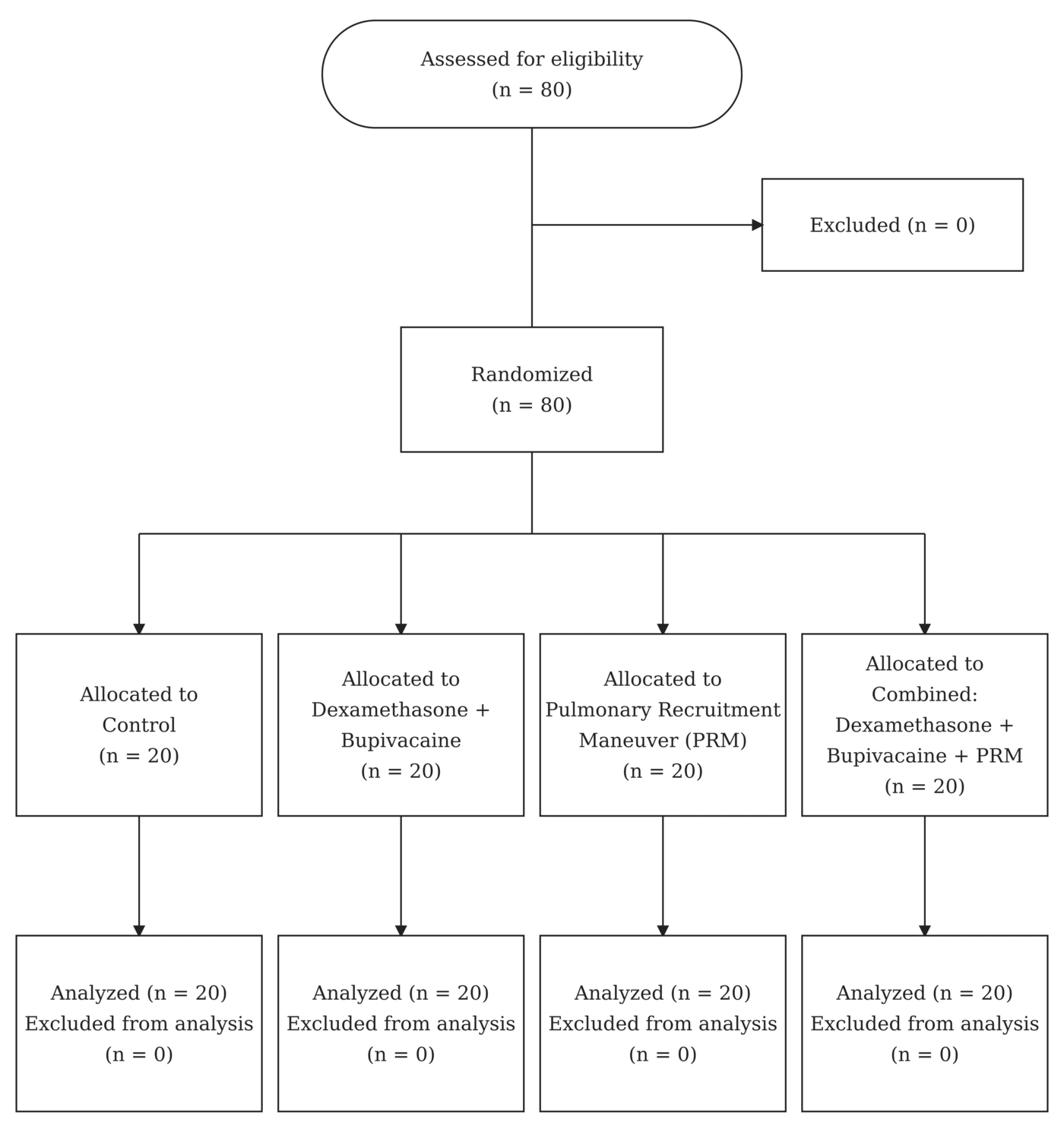
Figure 1.
CONSORT flow diagram of the study participants.
3.3. Blinding, Randomization, and Allocation Concealment
A computer-generated blocked sequence from Sealed Envelope (London, UK) was used to randomize 80 participants evenly to four groups (17). Allocation was concealed in sequentially numbered, opaque, sealed envelopes handled by an independent coordinator who was not involved in clinical care or assessment. After eligibility was verified in the operating room, circulating staff opened the next envelope and informed the surgical and anesthetic teams. Participants and the outcome assessor were blinded during the 48-hour follow-up, whereas intervention administration prevented blinding of the surgeon and anesthesiologist.
3.4. Perioperative and Study Intervention Standardization
All patients received uniform general anesthesia and four-port LC from the same surgical and anesthesia teams after an 8-hour fast. Intravenous induction included midazolam (0.02 mg/kg), fentanyl (2 µg/kg), propofol (2 mg/kg), and atracurium (0.5 mg/kg). Anesthesia was maintained with isoflurane (1.0 – 1.2 Minimum Alveolar Concentration (MAC)) in oxygen–air and volume-controlled ventilation. CO₂ pneumoperitoneum was maintained at 12 – 14 mmHg with the patient in a 15 – 20° reverse Trendelenburg position with leftward tilt. Gallbladder extraction, hemostasis, and irrigation/suction were followed by the intervention.
• Group A (Pulmonary Recruitment Maneuver [PRM]): After cholecystectomy, the patient was repositioned supine, and the trocar valves were opened for passive deflation, followed by five manual inflations at 40 cmH2O for 5 seconds to actively clear subdiaphragmatic CO2 before port closure (5).
• Group B (Intraperitoneal Bupivacaine with Dexamethasone): The surgeon applied 44 mL (40 mL of 0.25% bupivacaine and 4 mL of dexamethasone [16 mg]) to the gallbladder bed after extraction and before desufflation (15). The table was immediately changed from reverse Trendelenburg to 15° – 20° for 10 minutes to enhance subdiaphragmatic dispersion (15).
• Group C (Combined Intervention): Patients received the intraperitoneal injection and posture change used in Group B, followed by the lung recruitment technique used in Group A.
• Group D (Standard Care Control): Patients received standard LC without posture adjustments or intraperitoneal injections.
3.5. Postoperative Analgesic/Antiemetic Protocol
Nurses blinded to group allocation standardized postoperative care. Paracetamol (Apotel, 1 g in 100 mL normal saline over 15 minutes) was given intravenously every 6 hours for VAS ≥ 4 and every 12 hours for VAS < 4. Rescue intravenous ondansetron (4 mg) was given every 12 hours for emesis scores > 1, but not for scores 0. Group-specific paracetamol administration every 6 hours and ondansetron administration every 12 hours were recorded at each evaluation.
3.6. Outcome Measures and Safety Monitoring
Age, sex, BMI, and surgery time were recorded. Postoperative outcomes were measured at 2, 6, 12, 18, 24, and 48 hours.
The 48-hour abdominal pain trajectory and adjusted mean intensity were the primary outcomes. Secondary outcomes included the shoulder pain trajectory and time-specific pain comparisons. Both were evaluated using a validated 10-cm VAS (0 = no pain; 10 = worst imaginable pain; test–retest ICC = 0.97) and categorized as absent = 0, mild = 1 – 3, moderate = 4 – 6, or severe = 7 – 10 (18).
Secondary assessments of PONV used a four-point scale (0 = none, 1 = nausea, 2 = retching, 3 = vomiting) (19). Severity scores and symptom-specific and total incidence were assessed at each time point. Scores ≥ 1 prompted ondansetron rescue.
3.7. Calculating Sample Size and Statistics
The a priori VAS calculation (means: 1.4 vs 2.2; SDs: 0.6 and 0.9; α = 0.05; power = 90%) indicated that 80 participants, evenly distributed among four groups, were needed, with no attrition (5). Intention-to-treat analyses were conducted using SPSS 21.0. Age- and BMI-adjusted RM-ANCOVA with group, time, and interaction effects, Greenhouse–Geisser correction, and Bonferroni comparisons was used to assess longitudinal outcomes. Adjusted means, differences, 95% CIs, and partial η² were presented. ANOVA or χ² tests were used for baseline and binary outcomes, whereas Kruskal-Wallis tests with Bonferroni-adjusted Mann-Whitney U tests and additional ANOVA with Tukey/Bonferroni comparisons were used for time-specific comparisons. A two-sided P < 0.05 indicated significance.
4. Results
4.1. Participant Flow and Baseline Features
All 80 patients undergoing elective laparoscopic cholecystectomy were randomized equally across four groups and completed the 48-hour follow-up without losses or exclusions. The intention-to-treat efficacy and safety analyses included all participants (Figure 1).
The baseline demographic and operative characteristics are shown in Table 1. Although sex distribution and operative length did not differ substantially between groups, age (P < 0.001) and BMI (P = 0.029) exhibited baseline imbalances. Repeated-measures ANCOVA was used to adjust the longitudinal analyses for age and BMI to avoid confounding.
Table 1.
Baseline Demographic and Clinical Characteristics of Study Participants a
| Variables | Group | P-Value b | |||
|---|---|---|---|---|---|
| Group A: PRM (n = 20) | Group B: Injection (n = 20) | Group C: Combination (n = 20) | Group D: Control (n = 20) | ||
| Age (y) | 54.65 ± 7.12 | 40.90 ± 8.26 | 54.80 ± 8.09 | 44.80 ± 9.78 | < 0.001 |
| Sex, No. (%) | 0.397 | ||||
| Male | 12 (60) | 8 (40) | 10 (50) | 7 (35) | |
| Female | 8 (40) | 12 (60) | 10 (50) | 13 (65) | |
| BMI (kg/m²) | 24.51 ± 1.74 | 22.50 ± 2.57 | 23.00 ± 2.61 | 22.62 ± 2.25 | 0.029 |
| Surgery duration (min) | 94.5 ± 17.61 | 88.5 ± 18.14 | 97.5 ± 21.49 | 82.5 ± 19.15 | 0.073 |
a Values are expressed as mean ± SD unless otherwise indicated. Abbreviations: Group A, pulmonary recruitment maneuver (PRM); Group B, intraperitoneal bupivacaine plus dexamethasone injection; Group C, combined intervention; Group D, standard care control; BMI, body mass index; SD, standard deviation.
b P-values were calculated using one-way ANOVA for continuous variables and Pearson's chi-square test for categorical variables.
4.2. Postoperative Abdominal Pain
Groups showed significant differences in postoperative abdominal discomfort across all six measures (P < 0.001; Table 2). Age- and BMI-adjusted analyses revealed significant group (F = 140.91, P < 0.001, partial η² = 0.851) and group × time effects (F = 7.79, P < 0.001, partial η² = 0.240). Group C had the lowest adjusted mean VAS score, followed by groups B, A, and D.
Table 2.
Longitudinal Abdominal Pain Scores (VAS 0 – 10) Across Study Groups a
| Time Point | Group | P-Value | |||
|---|---|---|---|---|---|
| Group A: PRM | Group B: Injection | Group C: Combination | Group D: Control | ||
| 2 hours | 7.55 ± 0.60 (8.0 [7.0 – 8.0]) | 6.30 ± 0.57 (6.0 [6.0 – 7.0]) | 5.20 ± 1.01 (5.0 [4.0 – 6.0]) | 7.75 ± 0.44 (8.0 [7.25 – 8.0]) | < 0.001 |
| 6 hours | 7.15 ± 0.93 (7.0 [6.25 – 8.0]) | 5.55 ± 0.76 (5.5 [5.0 – 6.0]) | 4.80 ± 0.77 (5.0 [4.0 – 5.0]) | 8.00 ± 0.73 (8.0 [7.25 – 8.75]) | < 0.001 |
| 12 hours | 6.75 ± 0.72 (7.0 [6.0 – 7.0]) | 4.95 ± 0.76 (5.0 [4.0 – 5.75]) | 4.25 ± 0.64 (4.0 [4.0 – 5.0]) | 7.40 ± 0.50 (7.0 [7.0 – 8.0]) | < 0.001 |
| 18 hours | 6.15 ± 0.75 (6.0 [6.0 – 6.75]) | 4.20 ± 0.95 (4.0 [3.25 – 5.0]) | 3.70 ± 0.73 (4.0 [3.0 – 4.0]) | 7.05 ± 0.60 (7.0 [7.0 – 7.0]) | < 0.001 |
| 24 hours | 5.80 ± 0.77 (6.0 [5.0 – 6.0]) | 3.40 ± 0.82 (3.0 [3.0 – 4.0]) | 3.00 ± 0.65 (3.0 [3.0 – 3.0]) | 6.45 ± 0.51 (6.0 [6.0 – 7.0]) | < 0.001 |
| 48 hours | 5.05 ± 0.76 (5.0 [4.25 – 6.0]) | 2.30 ± 0.86 (2.0 [2.0 – 3.0]) | 2.10 ± 0.91 (2.0 [1.0 – 3.0]) | 5.95 ± 0.60 (6.0 [6.0 – 6.0]) | < 0.001 |
| Adjusted mean (95% CI)b | 6.37 (6.09 to 6.65) | 4.50 (4.21 to 4.78) | 3.81 (3.53 to 4.09) | 7.12 (6.86 to 7.39) | < 0.001 |
a Values are expressed as mean ± SD (median [IQR]) unless otherwise indicated. Abbreviations: VAS, Visual Analog Scale; PRM, pulmonary recruitment maneuver; SD, standard deviation; IQR, interquartile range; CI, confidence interval.
b Overall longitudinal marginal means adjusted for baseline age (48.79 years) and BMI (23.16 kg/m²) via RM-ANCOVA (Group F = 140.91, P < 0.001; Time × Group F = 7.79, P < 0.001).
4.3. Postoperative Referred Shoulder Pain
Referred shoulder pain differed significantly between groups at each assessment (P = 0.004 at 2 hours; P < 0.001 afterward; Table 3). After adjustment for age and BMI, significant effects of group and group × time were found (F = 92.78, P < 0.001, partial η² = 0.790, F = 19.23, P < 0.001, partial η² = 0.438). Group C had the lowest adjusted mean VAS score, followed by Groups A, B, and D. Mean scores decreased gradually in Groups A and C but climbed in Groups B and D before dropping around 48 hours.
Table 3.
Longitudinal Referred Shoulder Pain Scores (VAS 0 – 10) Across Study Groups a
| Time Point | Group | P-Value | |||
|---|---|---|---|---|---|
| Group A: PRM | Group B: Injection | Group C: Combination | Group D: Control | ||
| 2 hours | 4.85 ± 0.67 (5.0 [4.0 – 5.0]) | 5.30 ± 0.47 (5.0 [5.0 – 6.0]) | 4.55 ± 0.69 (4.0 [4.0 – 5.0]) | 5.05 ± 0.69 (5.0 [5.0 – 5.75]) | 0.004 |
| 6 hours | 4.65 ± 0.67 (5.0 [4.0 – 5.0]) | 5.25 ± 0.44 (5.0 [5.0 – 5.75]) | 4.50 ± 0.61 (4.0 [4.0 – 5.0]) | 5.60 ± 0.60 (6.0 [5.0 – 6.0]) | < 0.001 |
| 12 hours | 4.50 ± 0.95 (4.5 [4.0 – 5.0]) | 5.60 ± 0.60 (6.0 [5.0 – 6.0]) | 3.75 ± 0.55 (4.0 [3.0 – 4.0]) | 6.55 ± 0.76 (6.5 [6.0 – 7.0]) | < 0.001 |
| 18 hours | 4.35 ± 0.49 (4.0 [4.0 – 5.0]) | 5.65 ± 0.67 (6.0 [5.0 – 6.0]) | 3.65 ± 0.49 (4.0 [3.0 – 4.0]) | 6.70 ± 0.73 (7.0 [6.0 – 7.0]) | < 0.001 |
| 24 hours | 3.70 ± 0.73 (4.0 [3.0 – 4.0]) | 5.25 ± 0.85 (5.0 [5.0 – 6.0]) | 3.10 ± 0.64 (3.0 [3.0 – 3.75]) | 6.60 ± 0.60 (7.0 [6.0 – 7.0]) | < 0.001 |
| 48 hours | 2.60 ± 0.88 (3.0 [2.0 – 3.0]) | 4.25 ± 0.79 (4.0 [4.0 – 5.0]) | 2.05 ± 0.76 (2.0 [1.25 – 3.0]) | 5.80 ± 0.70 (6.0 [5.0 – 6.0]) | < 0.001 |
| Adjusted mean (95% CI)b | 4.05 (3.83 to 4.27) | 5.28 (5.05 to 5.51) | 3.56 (3.34 to 3.78) | 6.08 (5.87 to 6.30) | < 0.001 |
a Values are expressed as mean ± SD (median [IQR]) unless otherwise indicated. Abbreviations: VAS, Visual Analog Scale; PRM, pulmonary recruitment maneuver; SD, standard deviation; IQR, interquartile range; CI, confidence interval.
b Overall longitudinal marginal means adjusted for baseline age (48.79 years) and BMI (23.16 kg/m²) via RM-ANCOVA (Group F = 92.78, P < 0.001; Time × Group F = 19.23, P < 0.001).
4.4. Rescue Medication with Postoperative Nausea and Vomiting
A significant group effect on PONV severity over time was observed (F = 69.35, P < 0.001, partial η² = 0.738). Compared with the control group, Group C had substantially lower adjusted mean scores (AMD: −1.07; 95% CI: −1.29 to −0.85; P < 0.001). Group C had the most favorable outcomes for vomiting incidence at 2 hours and complete PONV resolution at 48 hours (both P < 0.001; Table 4).
Table 4.
Postoperative Nausea and Vomiting (PONV) Ordinal Severity Scores and Binary Event Incidence Across Study Groups a
| Time Point | Group | P-Value | |||
|---|---|---|---|---|---|
| Group A: PRM | Group B: Injection | Group C: Combination | Group D: Control | ||
| 2 hours | 3.0 [3.0 – 3.0] (20 [100]) | 2.0 [2.0 – 3.0] (20 [100]) | 2.0 [2.0 – 2.0] (20 [100]) | 3.0 [3.0 – 3.0] (20 [100]) | < 0.001 |
| 6 hours | 2.0 [2.0 – 2.75] (20 [100]) | 2.0 [2.0 – 2.75] (20 [100]) | 2.0 [1.0 – 2.0] (20 [100]) | 3.0 [3.0 – 3.0] (20 [100]) | < 0.001 |
| 12 hours | 2.0 [2.0 – 2.75] (20 [100]) | 2.0 [2.0 – 2.0] (20 [100]) | 1.0 [1.0 – 2.0] (17 [85]) | 3.0 [2.0 – 3.0] (20 [100]) | < 0.001 |
| 18 hours | 2.0 [2.0 – 2.0] (20 [100]) | 1.0 [1.0 – 2.0] (20 [100]) | 1.0 [1.0 – 1.0] (19 [95]) | 2.0 [2.0 – 2.0] (20 [100]) | < 0.001 |
| 24 hours | 1.0 [1.0 – 1.0] (20 [100]) | 1.0 [1.0 – 1.0] (16 [80]) | 1.0 [1.0 – 1.0] (16 [80]) | 2.0 [2.0 – 2.0] (20 [100]) | < 0.001 |
| 48 hours | 1.0 [0.25 – 1.0] (15 [75]) | 1.0 [0.0 – 1.0] (13 [65]) | 0.0 [0.0 – 1.0] (6 [30]) | 1.0 [1.0 – 2.0] (20 [100]) | < 0.001 |
| Adjusted mean (95% CI)b | 1.86 (1.75 to 1.98) | 1.59 (1.47 to 1.71) | 1.24 (1.13 to 1.36) | 2.31 (2.21 to 2.42) | < 0.001 |
a Values are expressed as median [IQR] (No. [%] with emesis score ≥ 1) unless otherwise indicated. Emesis scores were evaluated on a 4-point ordinal scale (0 = none, 1 = nausea, 2 = retching, 3 = vomiting). Abbreviations: PRM, pulmonary recruitment maneuver; IQR, interquartile range; CI, confidence interval.
b Overall longitudinal marginal means adjusted for baseline age and BMI via RM-ANCOVA (Group F = 69.35, P < 0.001; Time × Group F = 2.29, P = 0.004).
4.5. Safety, Adverse Events
None of the 80 patients experienced intraoperative problems or underwent conversion to open surgery. Local anesthetic systemic toxicity, PRM-related hemodynamic instability or barotrauma, corticosteroid-associated hyperglycemia, and wound infection were not observed during the 48-hour monitoring period. No adverse events occurred in any group.
5. Discussion
This study examined intraperitoneal bupivacaine–dexamethasone, the Pulmonary Recruitment Maneuver (PRM), and their combinations for postoperative pain and postoperative nausea and vomiting (PONV) after laparoscopic cholecystectomy. Group C had the lowest 48-hour adjusted abdominal, shoulder, and PONV scores. These data imply that combining pharmaceutical and mechanical interventions may improve symptom control.
Peritoneal inflammation, tissue damage, and pneumoperitoneum-induced distension cause postlaparoscopic abdominal pain (2, 6). Local anesthetic and anti-inflammatory effects may explain Group B’s lower abdominal pain scores than those in Group A, which received PRM alone. Dexamethasone improved postoperative analgesia in previous studies, but its independent impact was not examined in this study (20, 21). Eslamian et al. also found that bupivacaine–dexamethasone reduced pain scores, although their preperitoneal delivery differed from our intraperitoneal technique (20). In an observational study, Jain found decreased early pain scores with intraperitoneal levobupivacaine–dexamethasone, although this finding was not consistent (22). Although the data were directionally consistent, differences in delivery route, anesthesia, and assessment timing prevented direct comparison.
Laparoscopy-induced diaphragmatic irritation via phrenic nerve afferents causes shoulder pain (23, 24). Lower shoulder pain scores in Group A compared with Group B may be due to PRM-assisted CO₂ evacuation and less diaphragmatic irritation (14, 23, 25). The conflicting abdominal and shoulder pain data suggest that the therapies may target separate pain components, explaining Group C's wider benefit.
Groups B and C had lower adjusted PONV severity than the control group, consistent with dexamethasone’s antiemetic effects (11, 26). Bupivacaine–dexamethasone reduced nausea and vomiting in Eslamian et al. (20), although the delivery method differed. The positive outcomes in Group C may have been due to reduced residual CO₂ and peritoneal distension, but these mechanisms were not specifically examined (14, 27). Because some Group C patients still experienced nausea at 48 hours, the observed benefit was symptom reduction rather than complete prevention.
5.1. Limitations
This study has multiple limitations. Residual confounding remains after covariate adjustment for age and BMI imbalances. Assessment of PONV and pain may be subjective. The single-center design, limited sample size, and 48-hour follow-up restrict generalizability and the evaluation of long-term and infrequent unfavorable outcomes. Functional recovery, length of stay, and patient satisfaction were not evaluated. Larger, multicenter trials evaluating these outcomes and cost-effectiveness are needed.
5.2. Conclusions
During the first 48 hours after laparoscopic cholecystectomy, the combination of intraperitoneal bupivacaine–dexamethasone and the pulmonary recruitment technique controlled abdominal and shoulder symptoms and PONV better than either intervention alone or conventional care. The results indicate possible benefits of combining the techniques, although synergy was not achieved. Although no adverse events were observed during follow-up, safety has not been established. Larger multicenter studies are required to confirm these findings and evaluate safety before widespread implementation.