
1. Introduction
Laparoscopic cholecystectomy is widely recognized as the standard minimally invasive treatment for symptomatic gallstone disease. Compared with open surgery, it is associated with smaller incisions, reduced postoperative morbidity, shorter hospital stays, and faster recovery (1, 2). However, acute postoperative pain remains a significant clinical concern after laparoscopic cholecystectomy and may delay mobilization or discharge. Many patients continue to require opioid analgesia during the early postoperative period (3, 4). Postoperative nausea and vomiting (PONV) also frequently impedes satisfactory recovery, particularly when perioperative opioid exposure is elevated.
Postoperative pain after laparoscopic cholecystectomy is multifactorial. Somatic pain originates from trocar and abdominal wall incisions, visceral pain results from surgical manipulation and peritoneal irritation, and referred shoulder pain is associated with residual carbon dioxide and diaphragmatic irritation (3, 5). These distinct mechanisms support the use of multimodal and preemptive analgesia. Recent evidence has examined nonsteroidal anti-inflammatory drugs, COX-2 inhibitors, dexamethasone, local anesthetic infiltration, regional blocks, pneumoperitoneum-related strategies, and intraperitoneal techniques to reduce postoperative pain and opioid requirements (6-8).
Dexmedetomidine is a highly selective alpha-2 adrenergic receptor agonist that exhibits sedative, anxiolytic, sympatholytic, and analgesic-sparing properties, with minimal respiratory depression. Intravenous dexmedetomidine can attenuate catecholamine-mediated responses to laryngoscopy, intubation, pneumoperitoneum, and extubation. The magnitude and direction of cardiovascular effects are influenced by dose and administration rate (9). In the context of laparoscopic cholecystectomy, systemic infusion and intraperitoneal administration have both been investigated as components of opioid-sparing and enhanced recovery strategies (10, 11). Low-dose infusion has been linked to reduced hemodynamic stress and decreased postoperative analgesic requirements (12).
Beyond laparoscopic cholecystectomy, randomized clinical trials have evaluated dexmedetomidine in other perioperative settings. Pakniyat et al. investigated its preemptive effects on postoperative pain after appendectomy (13), Jarineshin et al. compared it with lidocaine for the prevention of fentanyl-induced cough during elective surgery (14), and Adiban et al. studied its prophylactic use against shivering during spinal anesthesia for inguinal herniorrhaphy (15). These studies illustrate the range of perioperative applications of dexmedetomidine, although differences in populations and outcomes do not establish the optimal intravenous dose for pain or postoperative nausea and vomiting after laparoscopic cholecystectomy.
The method of dexmedetomidine administration may influence perioperative outcomes. Chilkoti et al. compared low-dose intravenous bolus dexmedetomidine with intraperitoneal administration and found similar postoperative analgesic efficacy (16). Ye et al. demonstrated that both the dose and administration strategy of dexmedetomidine can affect intraoperative hemodynamics, recovery profiles, and postoperative pain (17). Choi et al. reported that an intraoperative bolus reduced early postoperative pain after laparoscopic cholecystectomy, although it did not consistently decrease PONV (18). Collectively, these findings indicate that the dose, timing, route, and speed of dexmedetomidine administration may alter its clinical effects.
Evidence regarding PONV supports a potential role for dexmedetomidine in opioid-sparing anesthesia protocols. An updated meta-analysis by Zhao et al. found reduced PONV with dexmedetomidine during general anesthesia (19), while Altamimi et al. observed favorable effects on both postoperative pain and PONV in bariatric surgery (20). A recent systematic review and meta-analysis by Sun et al. also demonstrated opioid-sparing analgesic effects and reductions in postoperative pain and PONV, with manageable hemodynamic adverse effects (21). Additional clinical studies have explored the potential impact of dexmedetomidine on perioperative inflammatory responses in laparoscopic cholecystectomy (22).
The broader perioperative literature emphasizes the importance of multimodal and opioid-sparing analgesia (23-25), clinically meaningful postoperative pain assessment (26, 27), and evidence-based risk assessment and prevention of postoperative nausea and vomiting (PONV) (28, 29). However, direct comparisons of intravenous dexmedetomidine doses of 1 µg/kg and 0.1 µg/kg, both administered over 10 minutes, remain scarce. Because these doses differ by a factor of ten, this study design does not allow the effects of administration mode to be isolated from those of the administered dose.
2. Objectives
This randomized trial compared postoperative pain intensity, rescue analgesic use, PONV incidence, hemodynamic variables, recovery characteristics, adverse events, and patient satisfaction associated with these two distinct dexmedetomidine dosing regimens. The rationale for evaluating the lower total dose was to determine whether adequate analgesia could be achieved with reduced drug exposure and potentially fewer dose-related episodes of bradycardia or hypotension. Although reduced drug consumption may offer a cost advantage, economic outcomes were not assessed in this study.
3. Methods
3.1. Study Design and Setting
This single-center, two-group randomized controlled clinical trial was conducted at Alzahra Hospital in Isfahan, Iran, and included adult patients scheduled for laparoscopic cholecystectomy. The study adhered to the Declaration of Helsinki, and written informed consent was obtained from all participants.
3.2. Participants and Eligibility Criteria
Patients aged 19 – 65 years with American Society of Anesthesiologists (ASA) physical status I or II were eligible. Patients with a known allergy to the study medications, psychological disorders that could compromise pain assessment, a history of opioid or substance use, or an inability to use the visual analogue scale (VAS) reliably were excluded. Conversion from laparoscopic to open surgery or a major change in the planned anesthetic technique constituted post-enrollment exclusion criteria.
3.3. Sample Size and Randomization
The protocol specified 44 participants per group (88 total), based on a standardized effect size of 0.5, two-sided α = 0.05, 80% power, a within-participant correlation of 0.5, and one baseline plus nine repeated measurements, allowing for approximately 10% attrition. Repeated-measures ANOVA was prespecified for longitudinal postoperative VAS analysis. No clinically acceptable noninferiority or equivalence margin was prospectively defined. Therefore, any retrospective assertion that the study was powered to demonstrate dose equivalence would be inappropriate. The allocation sequence was generated using Random Allocation Software with simple randomization. Following enrollment, the admission nurse assigned participants in order of entry according to the computer-generated list. Allocation concealment was not documented in the study records.
3.4. Interventions and Anesthetic Management
Designated nursing or medication-preparation personnel prepared and coded the study medication. Patients, treating anesthesiologists, outcome assessors, and the statistician were blinded to group assignments. In the higher-dose group, the total intravenous dose was 1 µg/kg; in the lower-dose group, it was 0.1 µg/kg. Both doses were diluted with 0.9% normal saline to a final volume of 20 mL, supplied in identical coded syringes, and administered over 10 minutes beginning 15 minutes before surgery. The protocols differed by a factor of ten in cumulative drug exposure. After administration of midazolam 2 mg IV, induction consisted of fentanyl 2 µg/kg IV, propofol 2.5 mg/kg IV, and cisatracurium 0.15 mg/kg IV for endotracheal intubation, followed immediately by morphine 0.1 mg/kg IV. Anesthesia was maintained with isoflurane at approximately 1 minimum alveolar concentration (MAC). No additional intraoperative opioid was administered. Supplemental cisatracurium 0.1 mg/kg IV was permitted for inadequate muscle relaxation at the treating anesthesiologist’s discretion; cumulative dose and frequency were not systematically recorded. At the conclusion of surgery, all patients received neostigmine 0.04 mg/kg IV and atropine 0.02 mg/kg IV. Extubation was performed after confirmation of adequate spontaneous ventilation, clinically satisfactory tidal volume, command following, and the ability to raise and sustain an arm. Quantitative train-of-four monitoring was not routinely employed.
3.5. Postoperative Analgesia and Antiemetic Rescue
Postoperative pain was assessed using a 0 – 10 visual analogue scale (VAS). When the VAS score exceeded 4, rescue treatment consisted of a single rectal diclofenac suppository (100 mg); a second dose was not routinely provided within 24 hours. If diclofenac was contraindicated or insufficient, pethidine 0.5 mg/kg IV was administered. Rescue antiemetic therapy consisted of ondansetron 4 mg IV after at least three episodes of vomiting or when nausea was considered clinically severe based on reports from the patient and the treating clinician; no standardized nausea-severity instrument was used. The occurrence of nausea and vomiting, ondansetron use, and rescue analgesic administration were recorded.
3.6. Outcome Measures
The prespecified primary outcome was postoperative pain measured using the visual analogue scale (VAS) over the first 24 hours; the protocol specified repeated-measures ANOVA. Baseline postoperative VAS was recorded immediately upon admission to the post-anesthesia care unit (PACU) and before any postoperative rescue analgesia. Subsequent VAS measurements were obtained at 15, 30, 45, 60, and 75 minutes during recovery and at 2, 6, 12, and 24 hours after ward entry. Additional recorded outcomes included nausea and vomiting, rescue medication use, heart rate, mean arterial pressure (MAP), oxygen saturation, a recorded anesthesia-time variable, extubation time, PACU stay, and patient satisfaction. Extubation time was defined as the interval from discontinuation of isoflurane to removal of the endotracheal tube, and surgery duration as the time from initial incision to final skin suture. PACU stay was measured from PACU entry to actual exit. PACU discharge readiness was determined using a Modified Aldrete Score of at least 9 out of 10 and documented only at discharge. Patient satisfaction was assessed 24 hours after surgery using a five-point ordinal Likert scale (1, very dissatisfied; 5, very satisfied). Pain subtypes were not recorded separately, and individual first-ambulation times were not measured, although mobilization at approximately 8 hours was encouraged. Hemodynamic events were defined as hypotension (MAP > 20% below baseline), hypertension (MAP > 20% above baseline), bradycardia (heart rate < 60 beats/min), and tachycardia (heart rate > 100 beats/min). Clinically significant bradycardia, when symptomatic or accompanied by hypotension, was treated with intravenous atropine 0.01 mg/kg. Hypotension requiring intervention was managed with weight-adjusted intravenous 0.9% saline; the exact administered volumes were not recorded. For clinically significant hypertension with bradycardia, a 50 µg intravenous nitroglycerin bolus was administered. If the heart rate was ≥ 70 beats/min, a 5 mg intravenous labetalol bolus was administered; intermediate heart rates were managed at the clinician’s discretion. Tachycardia requiring intervention could be treated with intravenous labetalol; isolated numerical tachycardia did not necessitate medication. The number of patients receiving event-specific interventions could not be determined from the available data.
The protocol specified longitudinal VAS analysis using repeated-measures ANOVA. Covariateadjusted models accounting for baseline imbalances in age, sex, weight, and height were
performed as exploratory, non-prespecified sensitivity analyses.
The original research proposal supports the primary outcome and the prespecified repeated-measures approach. Post hoc covariate-adjusted models were conducted to evaluate robustness to baseline imbalances in age, sex, weight, and height; these analyses should not be presented as prospectively planned.
The VAS is a 10-cm horizontal scale anchored by “no pain” and “worst pain imaginable” and is widely used to assess clinical pain. Published evidence supports its validity and reliability for pain measurement (30), and Iranian data have also demonstrated strong agreement with established pain assessment instruments and high reliability (31).
3.7. Statistical Analysis
The initial analyses used SPSS version 27 and included repeated-measures F tests, independentsamples tests, and categorical comparisons. Additional exploratory covariate-adjusted analyses were performed on individual-patient data from 88 patients using Python statsmodels 0.14.6. For postoperative VAS scores at 15, 30, 45, 60, and 75 minutes in recovery and at 2, 6, 12, and 24 hours after transfer to the ward, a population-averaged Gaussian GEE was fitted with participant as the clustering unit, an exchangeable working correlation, categorical visit, treatment group, a treatment-by-visit interaction, and age, female sex, weight, height, and baseline VAS as covariates. The principal adjusted contrast was the equally weighted average of the between-group mean differences across the nine postoperative visits. Treatment-by-visit terms were jointly assessed using an eight-degree-of-freedom robust Wald test. Equivalent seven-visit GEE models (without a baseline outcome covariate) evaluated HR, MAP, and SpO₂. Binary outcomes with sufficient events were analyzed using binomial generalized linear models with the same four demographic covariates and HC3 robust standard errors; adjusted odds ratios were reported (and are not directly comparable with unadjusted risk ratios). Rare adverse events with zero or very few observations per arm were not submitted to unstable, fully adjusted models. Continuous recovery outcomes were fitted using OLS with HC3 robust standard errors. Satisfaction was analyzed using proportional-odds ordinal logistic regression. Conditional outcomes measured only after rescue treatment were considered exploratory and subject to selection bias. Two-sided nominal 95% confidence intervals are reported; no multiplicity adjustment was applied. These analyses represent post-review sensitivity analyses and were not documented as prespecified primary analyses.
Rare adverse events, including hypotension, hypertension, tachycardia, bradycardia, and other adverse events, occurred only 0 – 4 times in at least one study arm. Consequently, four-covariate logistic adjustment was considered unreliable because of sparse data or data separation. Therefore, unadjusted counts and exact tests are presented descriptively. In addition, the absence of event-specific source records precludes reliable adjusted analyses of adverse-event severity and intervention.
4. Results
4.1. Participant Flow and Baseline Characteristics
Eighty-eight patients scheduled for laparoscopic cholecystectomy were enrolled and randomized to two equal groups. Forty-four patients received 1 μg/kg intravenous dexmedetomidine
(higher-dose group), and 44 received 0.1 μg/kg (lower-dose group); both regimens were administered over 10 minutes. All randomized participants completed follow-up and were included in the final analysis; no participants were lost to follow-up or excluded after randomization (Figure 1).
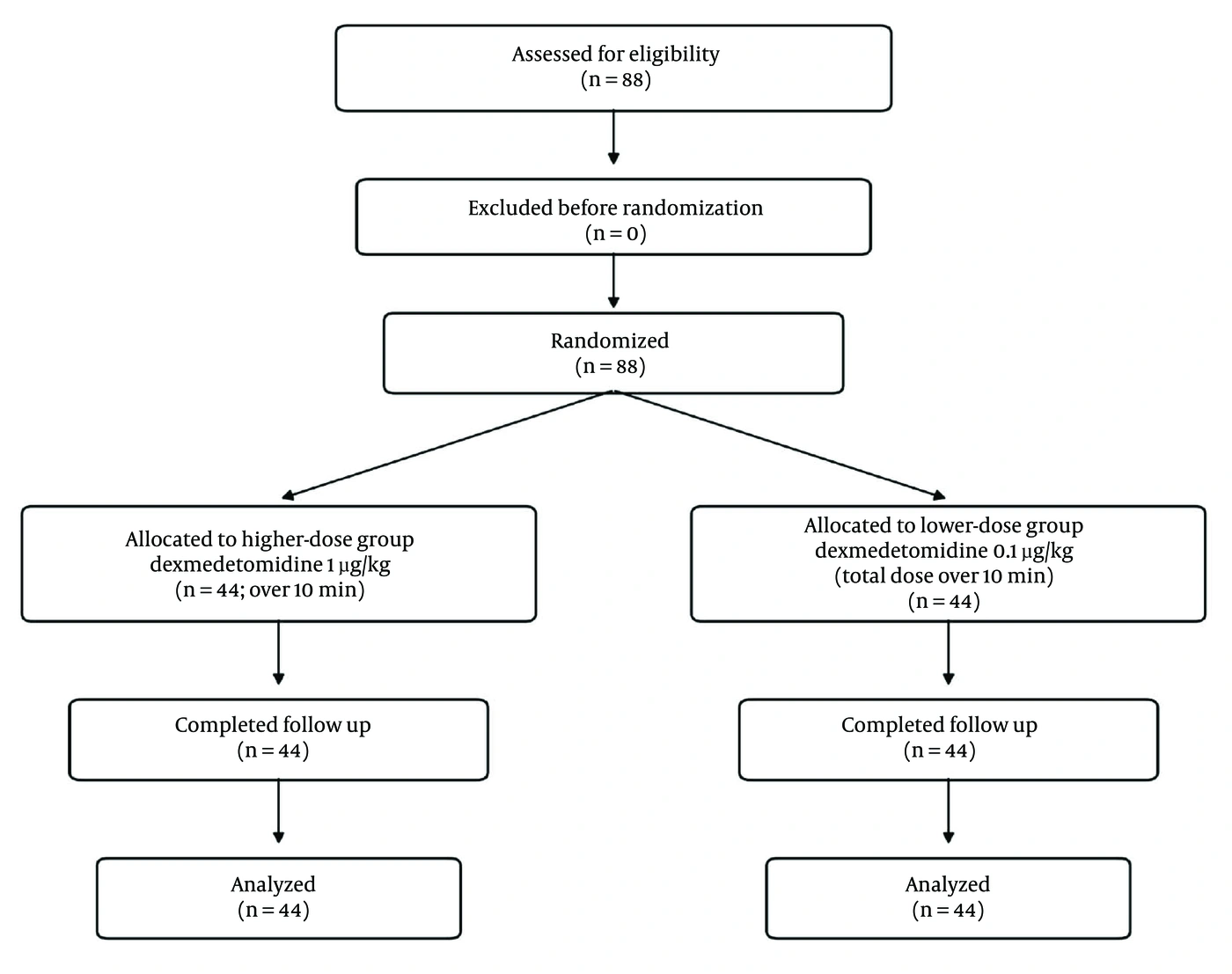
Figure 1.
CONSORT flow diagram of enrollment, randomization, allocation, follow-up, and analysis.
Baseline demographic and clinical characteristics are presented in Table 1. Despite randomization, clinically relevant between-group imbalances were observed with respect to age (54.8 vs 50.8 years), female sex (11.4% vs 61.4%), weight (76.5 vs 66.3 kg), and height (174.2 vs 166.4 cm); these differences may affect the precision and interpretation of unadjusted outcomes. No statistically significant differences were reported for BMI, ASA physical status, or underlying disease, although nonsignificance does not demonstrate baseline equivalence.
Table 1.
Baseline demographic and clinical characteristics a
| Variables | Group | P-Value | |
|---|---|---|---|
| 1 µg/kg (n = 44) | 0.1 µg/kg (n = 44) | ||
| Age (years), mean ± SD | 54.8 ± 6.9 | 50.8 ± 9.4 | 0.025 b |
| Sex | < 0.001 b | ||
| Female | 5 (11.4) | 27 (61.4) | |
| Male | 39 (88.6) | 17 (38.6) | |
| Weight (kg), mean ± SD | 76.5 ± 11.5 | 66.3 ± 7.7 | < 0.001 b |
| Height (cm), mean ± SD | 174.2 ± 10.2 | 166.4 ± 7.3 | < 0.001 b |
| BMI (kg/m²), mean ± SD | 25.3 ± 4.3 | 24.0 ± 2.7 | 0.078 |
| ASA physical status | 0.241 | ||
| Class I | 44 (100.0) | 41 (93.2) | |
| Class II | 0 (0.0) | 3 (6.8) | |
| Underlying disease | 11 (25.0) | 19 (43.2) | 0.115 |
a Values are expressed as No. (%) unless otherwise indicated. Baseline P-values are descriptive and do not indicate success or failure of randomization. Abbreviations: SD, standard deviation; BMI, body mass index; ASA, American Society of Anesthesiologists.
b Nominal P < 0.05.
Because of notable differences in patient characteristics between randomized arms, exploratory post-review analyses were conducted, controlling for age, sex, weight, and height, as well as baseline VAS in the pain model involving nine postoperative visits. These analyses are detailed in the Statistical Analysis section and Table 2. These additional analyses supplement, but do not replace, the prespecified longitudinal analysis.
Table 2.
Exploratory post-review, patient-level reanalysis: unadjusted versus covariate-adjusted estimates a
| Outcomes (Low Dose vs High Dose) | Unadjusted Result (95% CI) | Adjusted Result (95% CI) | Adjusted P-Value |
|---|---|---|---|
| Postoperative VAS: mean diff across 9 visits (0 – 10) | 0.13 (−0.43 to 0.70) | 0.20 (−0.28 to 0.68) | 0.422 |
| VAS: difference at 24 hours (0 – 10) | 0.52 (−0.32 to 1.37) | 0.59 (−0.19 to 1.37) | 0.141 |
| Rescue analgesia: RR / adjusted OR | 0.68 (0.41 to 1.13) | 0.46 (0.16 to 1.35) | 0.157 |
| Nausea: RR / adjusted OR | 0.67 (0.39 to 1.13) | 0.51 (0.16 to 1.64) | 0.255 |
| Vomiting: RR / adjusted OR | 1.00 (0.35 to 2.86) | 0.54 (0.07 to 4.05) | 0.551 |
| Ondansetron recorded: RR / adjusted OR | 0.83 (0.60 to 1.16) | 0.52 (0.18 to 1.53) | 0.234 |
| Heart rate: mean diff, beats/min | −3.84 (−8.11 to 0.42) | −1.53 (−7.18 to 4.12) | 0.596 |
| MAP: mean diff, mmHg | 3.84 (0.48 to 7.21) | 3.53 (−0.30 to 7.35) | 0.071 |
| SpO₂: mean diff, percentage points | 0.06 (−0.14 to 0.27) | 0.07 (−0.23 to 0.37) | 0.634 |
| Anesthesia-time field: mean diff, minb | 1.70 (0.76 to 2.65) | 2.30 (0.99 to 3.60) | 0.001 |
| Time to extubation: mean diff, min | 4.91 (1.08 to 8.74) | 9.36 (3.76 to 14.97) | 0.001 |
| Surgery duration: mean diff, min | 12.73 (−0.71 to 26.16) | 24.36 (8.22 to 40.51) | 0.003 |
| PACU stay: mean diff, min | −1.32 (−6.19 to 3.56) | 0.59 (−7.24 to 8.42) | 0.883 |
| Satisfaction: proportional odds OR | 1.54 (0.66 to 3.59) | 2.14 (0.70 to 6.58) | 0.184 |
| Rare adverse events: adjusted multivariable effect | See Table 5 | Not reliably estimable | — |
a Values are the lower-dose (0.1 µg/kg) minus higher-dose (1 µg/kg) contrasts or lower-dose relative risks/odds ratios. Adjusted models include age, sex, weight and height; VAS additionally includes recorded baseline VAS. Continuous longitudinal results are Gaussian GEE estimates (exchangeable working correlation, robust covariance; 9 postoperative visits for VAS, 7 visits for HR/MAP/SpO₂). Adjusted binary effects are odds ratios from HC3 binomial GLM; original binary estimates are risk ratios and must not be interpreted as the same measure. Continuous recovery effects use HC3 OLS; satisfaction uses ordinal logistic regression. All P-values are nominal; exploratory models were not prospectively prespecified. Abbreviations: VAS, visual analog scale; RR, risk ratio; OR, odds ratio; CI, confidence interval; HR, heart rate; MAP, mean arterial pressure; SpO₂, oxygen saturation; PACU, post-anesthesia care unit; GEE, generalized estimating equation; GLM, generalized linear model; OLS, ordinary least squares.
b The anesthesia-time variable lacked a documented operational definition.
4.2. Postoperative Pain and Rescue Analgesic Requirement
Pain was assessed at nine postoperative time points and at the recorded baseli. The initial longitudinal analysis identified a significant time effect (F = 14.38, P < 0.001), whereas neither the group effect (F = 0.18, P = 0.675) nor the group-by-time interaction (F = 1.33, P = 0.217) reached statistical significance. In the patient-level reanalysis, the adjusted generalized estimating equation (GEE) mean difference between the 0.1 and 1 µg/kg groups, averaged across nine postoperative visits, was 0.20 points on the visual analogue scale (VAS) (95% CI −0.28 to 0.68; P = 0.422). No statistically significant adjusted group-by-visit heterogeneity was observed (robust Wald χ²(8) = 9.55; P = 0.298). The adjusted between-group difference at 24 hours was 0.59 points (95% CI −0.19 to 1.36; P = 0.141). These results do not support equivalence (Figure 2.
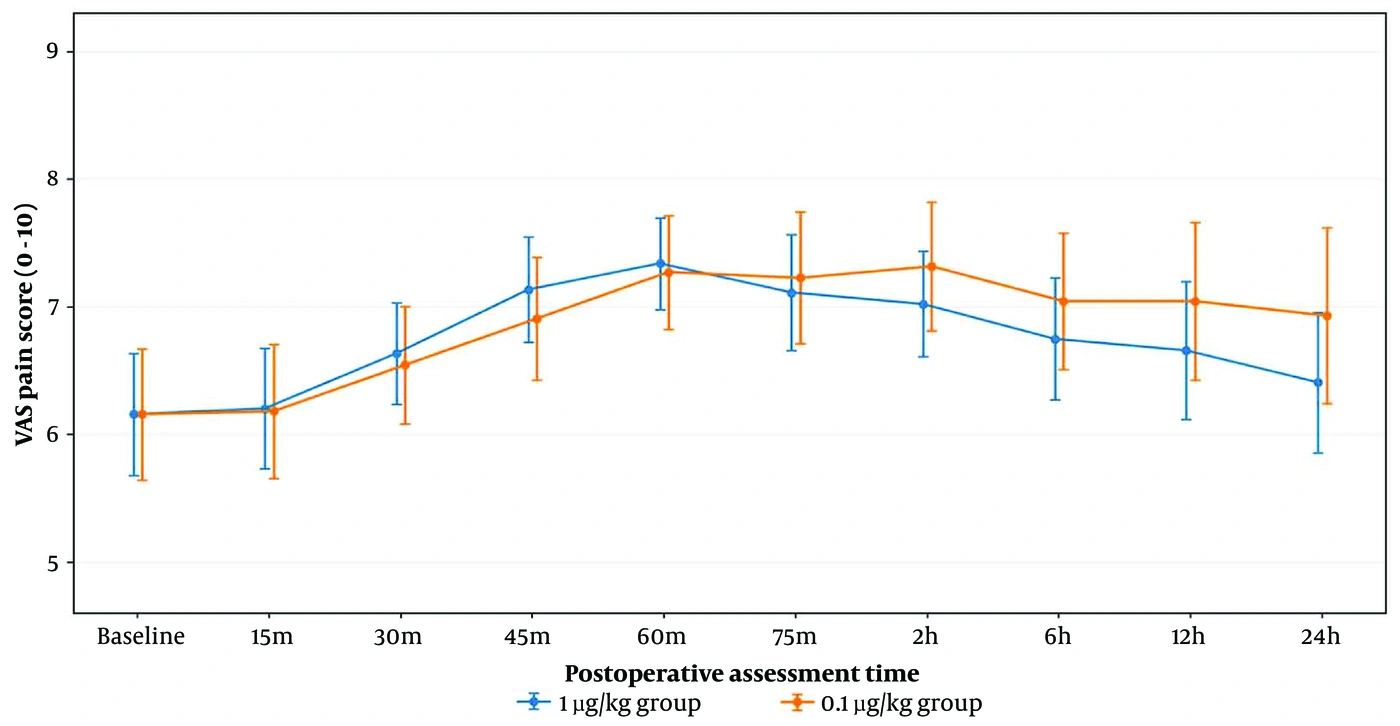
Figure 2.
Unadjusted mean VAS scores (0 – 10) with pointwise 95% confidence intervals at each assessment. Error bars were computed using the t distribution from n=44 participants per group at each time point. The timing of the source “baseline” assessment remains under author verification. Adjusted longitudinal GEE contrasts are provided in Table 2.
Table 3.
Postoperative pain scores and rescue medication outcomes a
| Outcomes | Group | P-Value | |
|---|---|---|---|
| 1 µg/kg (n = 44) | 0.1 µg/kg (n = 44) | ||
| VAS pain score (0 – 10) | |||
| Baseline | 6.2 ± 1.6 | 6.2 ± 1.7 | 1.000 |
| Recovery 15 min | 6.2 ± 1.5 | 6.2 ± 1.7 | 0.942 |
| Recovery 30 min | 6.6 ± 1.3 | 6.5 ± 1.5 | 0.973 |
| Recovery 45 min | 7.1 ± 1.4 | 6.9 ± 1.6 | 0.552 |
| Recovery 60 min | 7.3 ± 1.2 | 7.3 ± 1.5 | 0.983 |
| Recovery 75 min | 7.1 ± 1.5 | 7.2 ± 1.7 | 0.575 |
| 2 h after ward entry | 7.0 ± 1.4 | 7.3 ± 1.7 | 0.217 |
| 6 h after ward entry | 6.8 ± 1.6 | 7.0 ± 1.8 | 0.392 |
| 12 h after ward entry | 6.7 ± 1.8 | 7.0 ± 2.0 | 0.315 |
| 24 h after ward entry | 6.4 ± 1.8 | 6.9 ± 2.3 | 0.228 |
| Rescue analgesia, No. (%) | 22 (50.0) | 15 (34.1) | 0.195 |
| Rescue analgesic dose (mg)b | 29.3 ± 7.0 (n = 22) | 28.0 ± 7.3 (n = 15) | 0.522 |
| Time to first rescue analgesia (min)b | 39.2 ± 13.5 (n = 22) | 43.2 ± 12.5 (n = 15) | 0.366 |
| Time to first ondansetron (min)c | 37.6 ± 17.2 (n = 8) | 34.5 ± 10.5 (n = 8) | 0.667 |
a Values are expressed as mean ± SD unless otherwise indicated. "After ward entry" refers to time after ward transfer as reported in the Methods. Original longitudinal VAS model (as reported): time F = 14.38, P < 0.001; group F = 0.18, P = 0.675; time × group F = 1.33, P = 0.217. Reanalysis (post-review): adjusted GEE robust Wald χ²(8) = 9.55, P = 0.298 for group-by-time interaction; averaged adjusted contrast 0.20 (95% CI −0.28 to 0.68), P = 0.422. Original repeated-measures F-test degrees of freedom were not recoverable. Abbreviations: VAS, visual analog scale; SD, standard deviation; min, minutes; GEE, generalized estimating equation; CI, confidence interval.
b Calculated only among patients who received rescue analgesia.
c Calculated only among patients who received ondansetron.
The adjusted GEE model incorporated 792 repeated VAS observations from 88 patients, accounted for participant-level clustering, applied an exchangeable working correlation structure, and used robust sandwich covariance estimation. The model included nine categorical postoperative visits, eight treatment-by-visit interaction terms, and the specified baseline demographic covariates in addition to baseline VAS. The robust Wald interaction degrees of freedom were 8. The manuscript did not report the denominator degrees of freedom for the original F-test.
Rescue analgesia was required in 22 of 44 patients (50.0%) in the 1 μg/kg group and 15 of 44 patients (34.1%) in the 0.1 μg/kg group (RR = 0.68; 95% CI, 0.41 – 1.13; P = 0.195). The confidence interval includes both a potentially meaningful reduction and little or no difference. Among patients who received rescue analgesia, neither the recorded mean rescue dose nor the time to the first rescue request showed a statistically significant difference. Similarly, the time to the first ondansetron administration did not differ significantly among the patients who received it. Because the time and dose analyses were restricted to participants with these events, they were conditional and exploratory rather than intention-to-treat comparisons of all randomized patients. Postoperative pain and rescue medication outcomes are presented in Table 3.
4.3. Postoperative Nausea and Vomiting
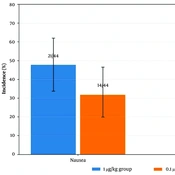
Nausea occurred in 21/44 patients (47.7%) in the 1 μg/kg group and 14/44 (31.8%) in the 0.1 μg/kg group (RR = 0.67; 95% CI, 0.39 – 1.13; P = 0.191). Vomiting occurred in 6/44 patients (13.6%) in each group (RR = 1.00; 95% CI, 0.35 – 2.86; P = 1.000; Figure 3).
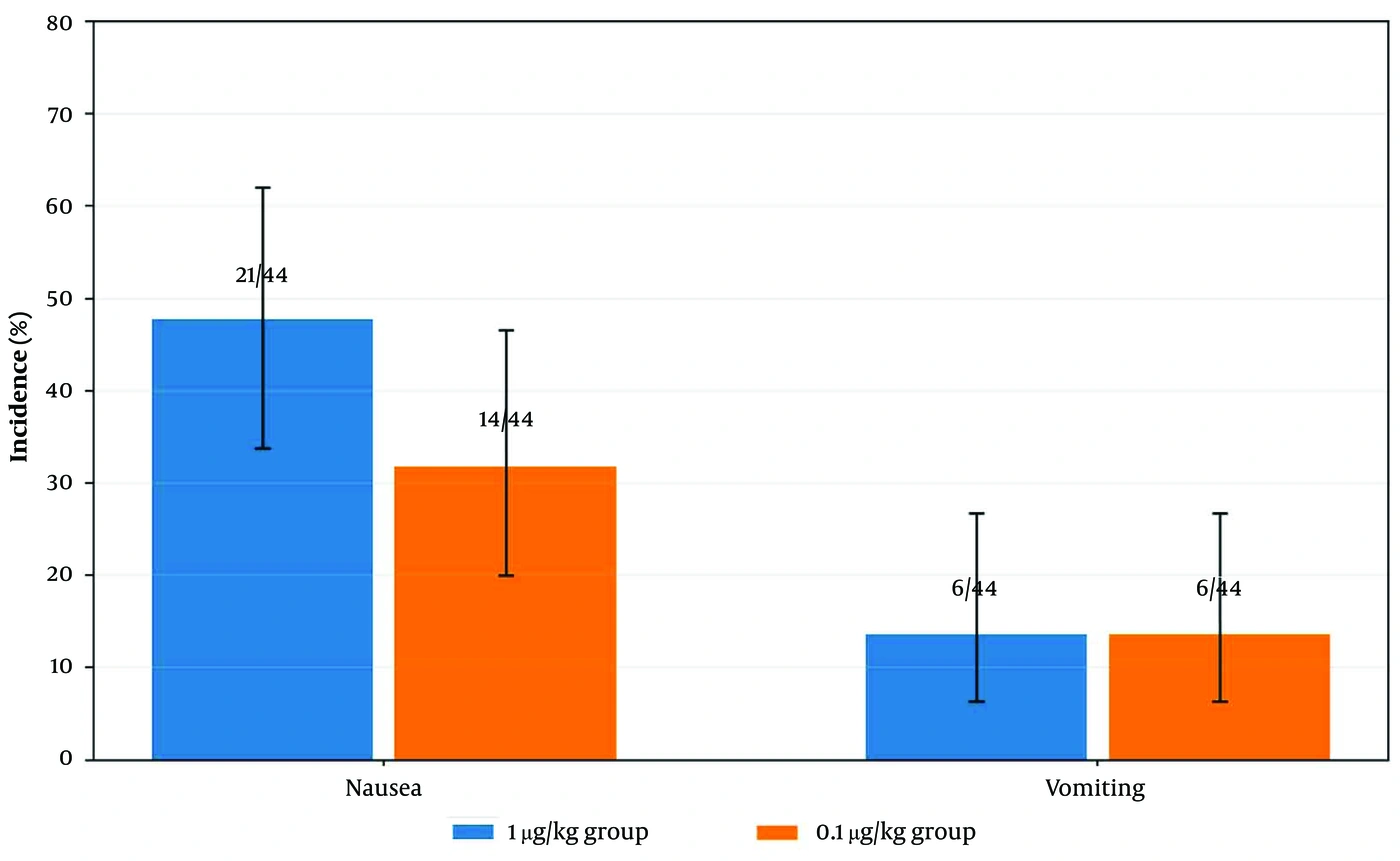
Figure 3.
Observed nausea and vomiting incidence with pointwise 95% Wilson binomial confidence intervals for each proportion (n=44 per group). The unadjusted risk ratio for nausea (0.1 μg/kg compared with 1 μg/kg) was 0.67 (95% CI 0.39 – 1.13) and for vomiting was 1.00 (95% CI 0.35 – 2.86). Adjusted odds ratios are shown in Table 2.
The unadjusted risk ratio for nausea (infusion compared with bolus) was 0.67 (95% CI, 0.39 – 1.13), whereas the risk ratio for vomiting was 1.00 (95% CI, 0.35 – 2.86). In both instances, the confidence intervals include the possibility of no relative difference (RR = 1.0), indicating that these comparisons are inconclusive and do not demonstrate equivalent antiemetic efficacy.
4.4. Hemodynamic Outcomes, Adverse Events, and Recovery
The original unadjusted repeated-measures analysis identified a significant overall group effect for MAP (P = 0.030), with no significant group-by-time interaction (P = 0.866; Table 4). Pointwise differences in MAP at 30 minutes and in HR at 120 minutes were nominal and exploratory. In the post-review adjusted generalized estimating equation (GEE) analysis, the between-dose mean MAP contrast averaged across seven assessments was 3.53 mmHg (95% CI, −0.30 to 7.35; P = 0.071), the HR contrast was −1.53 beats/min (95% CI, −7.18 to 4.12; P = 0.596), and the SpO₂ contrast was 0.07 percentage points (95% CI, −0.23 to 0.37; P = 0.634). Adjusted treatment-by-visit interactions were not significant for MAP (Wald χ²(6) = 3.54, P = 0.739), HR (χ²(6) = 8.16, P = 0.227), or SpO₂ (χ²(6) = 5.30, P = 0.506). The differences between the original and reanalysis results are attributable to variations in model and covariate specifications.
Table 4.
Effect estimates and longitudinal model results a
| Outcomes | Analysis | Effect Estimate | 95% CI | P-Value |
|---|---|---|---|---|
| VAS trajectory | Mixed/repeated-measures model | Group effect: — | — | 0.675 |
| VAS time × group interaction | Mixed/repeated-measures model | Interaction: — | — | 0.217 |
| Rescue analgesia | Risk ratio | 0.68 | 0.41 – 1.13 | 0.195 |
| Nausea | Risk ratio | 0.67 | 0.39 – 1.13 | 0.191 |
| Vomiting | Risk ratio | 1.00 | 0.35 – 2.86 | 1.000 |
| MAP overall group effect | Repeated-measures model | Group effect: — | — | 0.030 |
| MAP time × group interaction | Repeated-measures model | Interaction: — | — | 0.866 |
| Induction time | Mean difference (0.1 μg/kg − 1 μg/kg), min | 1.7 | 0.78 – 2.62 | < 0.001 |
| Time to extubation | Mean difference (0.1 μg/kg − 1 μg/kg), min | 4.9 | 1.11 – 8.69 | 0.021 |
a Table 4 reproduces selected original unadjusted results for comparison; Table 2 reports exploratory post-review unadjusted and covariate-adjusted analyses on the supplied patient-level dataset. The original repeated-measures F-test model details remain unverified. Abbreviations: VAS, visual analog scale; MAP, mean arterial pressure; CI, confidence interval; RR, risk ratio.
Observed adverse-event counts remained uncommon (Table 5). Fully adjusted logistic regression models could not be robustly estimated for each rare hemodynamic adverse event because of sparse or zero event counts in one arm. In exploratory covariate-adjusted HC3 ordinary least squares (OLS) analysis, the low-dose minus higher-dose mean difference was 2.30 minutes (95% CI, 0.99 to 3.60; P = 0.001) for the recorded anesthesia-time variable,, 9.37 minutes (95% CI, 3.76 to 14.97; P = 0.001) for time to extubation, 24.36 minutes (95% CI, 8.22 to 40.51; P = 0.003) for surgery duration, and 0.59 minutes (95% CI, −7.24 to 8.42; P = 0.883) for PACU stay. The identity of the original “anesthesia duration” data field and its relation to induction should be confirmed. Ordinal satisfaction analysis yielded an adjusted proportional odds ratio of 2.14 (95% CI, 0.70 to 6.59; P = 0.184) for higher satisfaction in the low-dose group. All estimates are exploratory and uncorrected for multiplicity.
Table 5.
Hemodynamic variables, adverse events, and recovery characteristics a
| Variables | Group | P-Value | |
|---|---|---|---|
| 1 µg/kg (n = 44) | 0.1 µg/kg (n = 44) | ||
| Heart rate (beats/min) | |||
| Baseline | 92.6 ± 12.9 | 87.5 ± 12.3 | 0.068 |
| 30 min | 79.7 ± 11.1 | 77.6 ± 12.1 | 0.401 |
| 60 min | 80.1 ± 11.6 | 77.7 ± 10.6 | 0.306 |
| 90 min | 81.8 ± 10.7 | 78.8 ± 9.8 | 0.300 |
| 120 min | 82.7 ± 9.5 | 77.9 ± 11.8 | 0.038 b |
| End of surgery | 83.5 ± 12.8 | 78.9 ± 11.3 | 0.072 |
| Recovery | 87.3 ± 11.9 | 82.5 ± 10.8 | 0.094 |
| MAP (mmHg) | |||
| Baseline | 97.4 ± 9.8 | 100.3 ± 11.8 | 0.090 |
| 30 min | 82.1 ± 11.2 | 87.8 ± 10.8 | 0.017 b |
| 60 min | 84.9 ± 11.0 | 87.8 ± 9.8 | 0.189 |
| 90 min | 85.6 ± 8.6 | 88.9 ± 8.7 | 0.071 |
| 120 min | 85.7 ± 10.3 | 89.4 ± 8.7 | 0.068 |
| End of surgery | 86.7 ± 10.9 | 90.7 ± 11.8 | 0.109 |
| Recovery | 90.7 ± 10.8 | 95.1 ± 12.0 | 0.071 |
| Clinical outcomes and adverse events | |||
| Nausea | 21 (47.7) | 14 (31.8) | 0.191 |
| Vomiting | 6 (13.6) | 6 (13.6) | 1.000 |
| Hypotension | 0 (0.0) | 2 (4.5) | 0.494 |
| Hypertension | 1 (2.3) | 1 (2.3) | 1.000 |
| Tachycardia | 4 (9.1) | 0 (0.0) | 0.116 |
| Bradycardia | 3 (6.8) | 1 (2.3) | 0.616 |
| Recorded anesthesia-time variable (min) | 6.7 ± 2.1 | 8.4 ± 2.3 | < 0.001 b |
| Time to extubation (min) | 18.2 ± 7.2 | 23.1 ± 10.6 | 0.021 b |
| Duration of surgery (min) | 109.1 ± 28.1 | 121.8 ± 35.1 | 0.064 |
| PACU stay (min) | 70.8 ± 11.4 | 69.4 ± 11.7 | 0.577 |
| Satisfaction | 4 (3 – 4) | 4 (3.75 – 4) | 0.322 |
a Values are expressed as mean ± SD, No. (%) or median (IQR). Abbreviations: SD, standard deviation; MAP, mean arterial pressure; PACU, post-anesthesia care unit; IQR, interquartile range; min, minutes; mmHg, millimeters of mercury.
b Nominal pointwise P < 0.05; interpret alongside the overall repeated-measures model and multiple comparisons.
Source-data verification indicated that all 88 randomized patients were accounted for and that postoperative VAS time points were complete. The SPSS value label for study group 2 did not align with the author-confirmed dosing; the source prescription or administration record should be consulted. The time of first ondansetron administration was recorded for only 16 participants and was inconsistently documented among those coded as having received ondansetron; therefore, this outcome does not support unrestricted time-to-event inference.
5. Discussion
This randomized superiority trial compared two total intravenous dexmedetomidine doses (1 versus 0.1 µg/kg), each administered over a 10-minute period. The unadjusted longitudinal VAS analyses revealed no statistically significant group effect or group-by-time interaction. Similarly, the exploratory GEE analysis, adjusted for age, sex, weight, height, and baseline VAS, found no statistically significant average pain difference between doses (0.20 VAS points, 95% CI −0.28 to 0.68; P = 0.422). However, a nonsignificant result does not indicate equivalent efficacy or confirm the absence of clinically meaningful differences, particularly given the sample size of 44 patients per group and the lack of a prespecified equivalence or noninferiority margin. The tenfold difference in administered total dose means this was not a dose-matched comparison of administration routes or modalities. VAS contrasts should be interpreted in the context of published estimates of clinically important postoperative pain differences (27).
Previous studies provide context regarding the potential analgesic effects of dexmedetomidine but do not establish the efficacy of either regimen evaluated in this trial. Chilkoti et al. compared intravenous bolus and intraperitoneal dexmedetomidine with bupivacaine (16), while Ye et al. investigated the effects of administration regimens on hemodynamics and recovery (17). Choi et al. observed lower early postoperative pain following a bolus regimen in a different study design (18). These investigations varied in comparator, drug exposure, and co-interventions. Because this study did not include a placebo or standard-care-only arm, the data cannot determine the independent analgesic efficacy of dexmedetomidine compared with its absence.
Rescue analgesia occurred less frequently in the 0.1 µg/kg group (15/44 vs 22/44; unadjusted RR 0.68, 95% CI 0.41 to 1.13), and the exploratory adjusted odds ratio was 0.46 (95% CI 0.16 to 1.35; P = 0.157). Nausea was reported in 14/44 and 21/44 participants, respectively (unadjusted RR 0.67, 95% CI 0.39 to 1.13; adjusted OR 0.51, 95% CI 0.16 to 1.64; P = 0.255). Vomiting occurred in 6/44 participants in both groups (adjusted OR 0.54, 95% CI 0.07 to 4.05; P = 0.551), with a notably wide confidence interval. Subset analyses of rescue dose and timing were conditional on treatment administration and thus susceptible to selection bias. Complete intraoperative and postoperative opioid exposure could not be determined from the available dataset. Previous meta-analyses have identified analgesic-sparing and antiemetic associations with perioperative dexmedetomidine in other clinical contexts (19-21). However, because this trial lacked a placebo or standard-care arm, no independent conclusions regarding dexmedetomidine efficacy or opioid-sparing effects can be drawn.
The initial analysis indicated an overall MAP group effect (P = 0.030); however, the age-, sex-, weight-, and height-adjusted GEE mean contrast did not achieve conventional statistical significance (3.53 mmHg; 95% CI −0.30 to 7.35; P = 0.071). The adjusted group-by-time effect was also not significant (Wald χ²(6) = 3.54, P = 0.739). Previous studies have reported hemodynamic effects related to dexmedetomidine with intravenous administration and low-dose infusion (9, 12). Peripheral α2-receptor activation and central sympatholysis may contribute to these hemodynamic responses. Nevertheless, the 10-fold dose disparity, potential unmeasured co-interventions, and observational nature of within-trial subgroup contrasts prevent attribution of observed differences to the administration mode or any single mechanism.
The 0.1 µg/kg group had a longer extubation time in the original unadjusted comparison (mean difference 4.9 minutes, 95% CI 1.11 to 8.69). In the exploratory adjusted analysis, this difference increased to 9.37 minutes (95% CI 3.76 to 14.97; P = 0.001). Surgery duration also differed after adjustment (24.36 minutes, 95% CI 8.22 to 40.51; P = 0.003). The recorded anesthesia-time variable showed an exploratory adjusted between-group difference of 2.30 minutes (95% CI 0.99 to 3.60); its operational definition was not available. The omission of anesthesia co-medication records and the presence of multiple secondary tests preclude a definitive causal explanation for differences in recovery. PACU stay did not differ significantly after adjustment (0.59 minutes, 95% CI −7.24 to 8.42; P = 0.883). Previous studies of dexmedetomidine in laparoscopic cholecystectomy have examined postoperative recovery outcomes using different regimens (17, 18).
Current evidence supports multimodal, opioid-sparing perioperative care (23-25), and established guidelines address PONV risk stratification and prevention (28, 29). This trial evaluated two distinct dexmedetomidine dosing regimens rather than comparing dexmedetomidine with standard care. Caution is warranted when interpreting pointwise secondary analyses, subgroup-restricted analyses, and multiple outcome tests. Future research should specify comparable cumulative exposure when pharmacologically justified, differentiate somatic, visceral, and shoulder pain, document total opioid administration, and assess functional recovery outcomes alongside clinically significant differences in VAS (26, 27).
5.1. Limitations
This study was limited by its single-center design, enrollment of 44 participants per group, and significant randomized baseline imbalances in age, sex, weight, and height. The absence of a placebo or standard-care control group and a tenfold difference in total study-drug dose further constrained interpretation. Exploratory post hoc models adjusted for the four demographic variables but could not address unmeasured confounding or replace the prespecified primary analysis. Study limitations included incomplete documentation of protocol sample-size assumptions and the minimally clinically important difference, detailed anesthetic co-medication and intraoperative opioid exposure, rescue medication doses and morphine-equivalent totals, adverse-event interventions, and objective discharge criteria. The rarity of adverse events precluded reliable multivariable adjustment, and multiple secondary comparisons were not corrected for multiplicity. The recorded anesthesia-time variable lacked a documented operational definition. Additionally, VAS subtypes (shoulder, visceral, somatic), detailed functional and discharge-readiness data, and censoring times for patients without rescue events were unavailable. Confidence intervals remain compatible with clinically meaningful differences; however, an equivalence or non-inferiority margin was not prespecified. Further limitations include reliance on clinician-directed rescue and additional muscle relaxation, absence of quantitative TOF monitoring, recording of Modified Aldrete scores only at actual PACU exit, no individual ambulation times or separate visceral, somatic, or shoulder pain ratings, and no formal analysis of medication cost or vial wastage. Although substantially less study drug was administered in the lower-dose arm, neither cost savings nor prevention of hemodynamic adverse events was demonstrated. Advance access to the randomization list could not be independently verified, leaving allocation concealment uncertain.
5.2. Conclusions
In this randomized trial involving 88 patients, intravenous dexmedetomidine was administered at total doses of 1 µg/kg and 0.1 µg/kg over 10 minutes before laparoscopic cholecystectomy. Neither the originally reported longitudinal visual analogue scale (VAS) comparison nor exploratory adjusted analyses identified a statistically significant difference in postoperative pain between the dosing groups. The study was not powered to establish equivalence or non-inferiority, and the lack of a placebo group precludes conclusions regarding the independent analgesic efficacy of either dose. Further prospective studies are necessary to evaluate whether lower dosing reduces hemodynamic adverse effects or medication costs.