
1. Background
Recently, concern about anesthesia-related neurotoxicity has been raised and a large body of medical literature has focused on this topic (1, 2). Nowadays, this concern is not restricted to anesthesiologists’ society, rather other fields, United States food and Drug Administration (FDA) and the European Medicines Agency have been involved as well (3-5). Animal studies have extensively evaluated the association between anesthesia exposure of a developing brain and long term adverse effects on behavioral outcomes, learning, and memory (6-8). The findings of experimental studies lead to the big concern that it can also be translated to the human brain. After that, valuable publications have been available in specific journals (9-12).
However, owing to several influencing factors, including socioeconomic status, genetics, familial condition, parenteral characteristics, such as age, child comorbidities, dosage and timing of general anesthesia (GA), a variable association between early childhood GA exposure and neurodevelopment disorders has been found (13, 14). Supporting studies indicate that a developing brain of a young child is at the highest risk of apoptosis and neurotoxicity due to anesthetic agents and recommend that elective procedures requiring GA must be prohibited for them. While findings of some others are not in line with this idea (15-17). Altogether, despite the inconsistent results and based on the current evidence, it is wise to restrict pediatric sedation/anesthesia to urgent conditions (10). Obviously, legally and ethically child deprivation of anesthesia and analgesia due to the fear of neural damage is not accepted (6).
However, to achieve the desired results, it should be noted that the sole awareness of anesthesiologists from the issue does not suffice. Furthermore, the anesthesiologists visit the child in preoperative time and even sometimes moments before the operation (18), which is too late. Indeed, other physicians, as well as surgeons and others who refer the child for the operation, have to pay attention that children under 3 - 4 years must not be subjected to elective surgery and general anesthesia. Besides, parents frequently ask questions of both anesthesiologists and those in other fields about the possible adverse effects of GA on their child.
2. Objectives
To the best of our knowledge, no similar study was performed in Iran and the issue as a prominent public health issue has not been appropriately addressed in our country. Therefore, this survey for the first time aimed to evaluate the knowledge and practice of physicians about anesthesia-related neurotoxicity in academic hospitals of Guilan province.
3. Methods
After approval of the Research Committee of Ethics of Guilan University, this study was conducted in academic hospitals affiliated to Guilan University of Medical Sciences (GUMS). Firstly, the responsible anesthesia resident explained the purpose of this work to Guilan faculty and residents and if they agreed to participate, a questionnaire containing 12 items divided into two sections of knowledge and practice was filled via a face to face interview. The mentioned questionnaire was taken from Ward et al. (18) paper and was translated by forward/backward translation method. The content and face validity were confirmed by ten members of the anesthesiology department. Finally, the data were analyzed by SPSS version 16.
4. Results
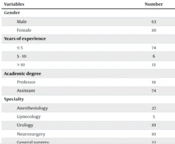
A response rate of 100% was achieved (271 responders from 271 eligible study responders). The participants’ characteristics (gender, years of experience, degree, and fields of specialty) are presented in Table 1. Moreover, 89 (33.1%) responders were attending, 180 (66.9%) were residents, 112 (41.6%) were female, and 157 (58.4%) were male. The mean years of experience was 82.4 ± 8.8 (2 - 28 years). The physicians’ answers to each question about knowledge and practice toward general anesthesia-related neurotoxicity are shown in Tables 2 and 3.
Table 1.
Parcipitated Physicians’ Characteristics
| Variables | No. (%) |
|---|---|
| Gender | |
| Male | 157 (58.4) |
| Female | 112 (41.6) |
| Years of experience | |
| Less than 5 years | 64 (23.8) |
| More than 5 years | 205 (76.2) |
| Degree | |
| Faculty | 89 (33.1) |
| Residents | 180 (66.9) |
| Fields of specialty | |
| Anesthesiologist | 26 (9.7) |
| Obstetrics | 26 (9.7) |
| Pediatrician | 25 (9.3) |
| Surgery | 24 (8.9) |
| Internal medicine | 20 (7.4) |
| Orthopedics | 19 (7.1) |
| Psychiatrics | 19 (7.1) |
| Neurosurgery | 18 (6.7) |
| Cardiology | 17 (6.3) |
| Emergency medicine | 16 (5.9) |
| Urology | 15 (5.6) |
| Ophthalmologists | 15 (5.6) |
| Neurology | 15 (5.6) |
| Ear, nose, and throat (ENT) | 14 (5.2) |
Table 2.
The Knowledge of Participantsa
| Questions | Yes | No |
|---|---|---|
| Is there a possibility of cognitive impairment in a child who has undergone general anesthesia under the age of 4 years? | 123 (45.7) | 146 (54.3) |
| Is there a chance that IQ will drop in a child who has undergone general anesthesia under the age of 4 years? | 121 (45) | 148 (55) |
| Is there a possibility of behavioral disorders in a child who has undergone general anesthesia under the age of 4 years? | 120 (44.6) | 149 (55.4) |
| Is there a possibility of a learning disorder at school age in a child who has undergone general anesthesia under the age of 4 years? | 115 (42.8) | 154 (57.2) |
| Is there a possibility of neurotoxicity in a child who has undergone general anesthesia under the age of 4 years? | 108 (40.1) | 161 (59.9) |
| Do you know the definition of apoptosis? | 229 (85.1) | 40 (14.9) |
| Is it recommended to use local anesthetics and to some extent tolerate the pain by the child to avoid receiving anesthetic drugs? | 155 (57.6) | 114 (42.4) |
aValues are expressed as No. (%).
Table 3.
The Practice of Participantsa
| Questions | Yes | No |
|---|---|---|
| Do you recommend that non-emergency surgeries should be postponed in children under the age of 4 years? | 117 (43.5) | 152 (53.5) |
| If the parents of children under 4 years insist on doing an elective surgery will you try to dissuade them? | 99 (36.8) | 170 (63.2) |
| Do you inform parents about the possibility of harming anesthetic drugs in young children? | 102 (37.9) | 167 (62.1) |
| Do you document the advice and talk to parents about the risks of anesthetic drugs? | 88 (32.7) | 181 (67.3) |
| Do you consider a certain safe age for general anesthesia when talking to parents? | 102 (37.9) | 107 (62.1) |
aValues are expressed as No. (%).
5. Discussion
In the human brain, a window of vulnerability appears to happen during peak of synaptogenesis, which occurs in the primary senso-motor cortex near the birth time, temporal cortex at nine months, and prefrontal cortex at three years (19). The potential risk of neural injury and apoptosis are well established in experimental models. However, it remains still ambiguous whether it could be generalized to human or not (20, 21). In a population-based birth cohort study authored by Chien et al. (22) it was found that the incidence of behavioral disorders was higher in neonates delivered by cesarean section under GA compared to regional anesthesia, but the adjusted risk was not statistically significant between babies delivered by cesarean section with regional anesthesia and those who delivered vaginally.
Epidemiologic studies with controversial results have been conducted, which obviously have certain obstacles, including the lack of an obvious human phenotype for anesthetic neurotoxicity and specialized population and concurrent morbidities. Furthermore, evaluated items in these studies might not be optimized to diagnose the neurotoxicity (17, 23). The present work was developed to determine how residents and faculty of GUMS deal with the anesthesia-related neurotoxicity. Since all of the questionnaires were filled completely, it shows that physicians at Guilan academic hospitals are interested in this topic. On the whole, according to this paper, deficiency in communication skills and the lack of adequate knowledge regarding the issue were uncovered. In our study, only 14.9% of responders did not know the neuronal apoptosis phenomena, but 59.9% did not have any idea about GA neurotoxicity and consequently, 63.2% did not prevent parents from elective surgeries for their young children. In addition, 62.1% neither stated the possibility of a relationship between GA and neural injury when parents consulted nor cited a safe age for them. In fact, some theoretical topics have not been discussed adequately from a practical point of view. Of all responders, only 37.9% cited a specific safe age for GA. Also, 63% of responders indicated that they do not try to prevent parents from planning elective surgery for their child under four years.
According to the results of this research, we concluded that enough attention has not yet been paid to the issue. Anesthesiology and pediatric departments were expected to be aware of this topic as it is a part of their curriculum. However, this paper emphasizes the lack of enough communication with other physicians. Indeed, attempts should be made by these departments to communicate with other medical specialists. Furthermore, it is supposed that the real knowledge of our physicians is even less than what is observed in our study. This is because the doctors underwent a face to face interview and the aim of the study was explained at the beginning that could induce positive effects on their answers.
Our finding was in line with Ward et al. (18), who designed a survey in the US to evaluate the way that pediatric anesthesia department manages the issue of anesthetic neurotoxicity in clinical practice, communication with non-anesthesia providers, as well as discuss with families. They reported that the current program was not practical and is required to be promoted.
In line with Ward et al. paper, the available educational programs in GUMS do not have enough consistency to manage the topic of the risk of neurological deficits following GA in the developing brain. In fact, our study also represents that there is no program to provide information to faculty and residents of other fields.
These results underscore the momentous responsibility, which anesthesiologists are faced by, including a proper communication with non-anesthesia colleagues to aware them from the potential clinical risk of neurotoxicity information and discuss it with parents as well. Studies have shown that parents want to know about anesthesia-related side effects, such as brain damage, death, and emergence. They declare that by receiving tangible evidence about GA risks they have found the condition less stressful (24, 25). Parents also should receive formulized information such as brochures and direct talks about the points. By searching the literature, we could not find more similar surveys to compare our results with them. Thus the absence of challenging discussion might be a limitation, by the way, highlights the novelty of this work. Given the importance of the issue, great attempt must be made to modify the current approaches.
5.1. Strengths
It was the first study in Iran that tried to shed light on the importance of the subject to the public eyes. Additionally, this research could report valuable findings because it was a multicenter study with a proper sample size took place at Guilan University, with the majority of residential specialty fields.
5.2. Limitations
This survey was conducted at academic hospitals considering the importance that are training future physicians and formulate clinical guidelines; however, a large number of these children undergo surgeries in private centers.
5.3. Conclusions
Considering the gaps in managing the issue, the importance of the topic, which currently exists in anesthesia references, must be highlighted. Obviously, communication skill training courses must be added to the curriculum of medical schools rather just focusing on technical proficiency. Further well-planned studies are welcome to find new strategies to improve knowledge about this topic.