
1. Background
Job stress among healthcare workers is a critical concern because of its adverse effects on both workers and healthcare systems (1, 2). Physicians experience particularly high stress because of the life-or-death nature of their work (3). The emotional and physical demands of their roles may lead to burnout, mental health problems, and reduced quality of care (4, 5). These challenges may be intensified in military hospitals by resource scarcity, long shifts, and the pressure to work in high-stakes environments (6, 7). Recent research has also shown that job motivation influences stress, aggression, and burnout among healthcare workers, as reported by Ramezani et al. (8).
Quality of work life (QWL) reflects employees' satisfaction with their work environment and the conditions that affect their well-being (9, 10). High job stress is often associated with lower QWL, which may adversely affect job performance, patient care, and physician retention (11). Occupational stress in healthcare has also been associated with cardiovascular risk factors, as reported by Saberinia et al. (12). In addition, physiological stress indicators such as the hemoglobin, albumin, lymphocyte, and platelet (HALP) score have been used to predict adverse outcomes in acute-care settings (13), providing a conceptual parallel to the chronic stress burden experienced by physicians. Military healthcare settings may involve rigid hierarchies and deployment-related pressures that intensify the relationship between stress and QWL.
2. Objectives
This study aimed to determine whether job stress was negatively correlated with QWL among military physicians and whether this association differed by gender or specialty. We hypothesized that job stress would be significantly and negatively correlated with QWL.
3. Methods
3.1. Study Design and Participants
This cross-sectional descriptive-analytical study included 139 physicians working at Imam Reza and Besat Military Hospitals in Tehran (14). Participants were selected using stratified random sampling by specialty. A power calculation performed using G*Power indicated a minimum sample size of 134 (power = 0.80, effect size = 0.30, and α = 0.05); the final sample of 139 accounted for a 10% nonresponse rate. Eligible participants had a medical degree and had worked at the hospitals for at least 6 months. Physicians who declined participation or provided incomplete data were excluded. This design enabled a cross-sectional assessment of stress and QWL in military hospitals, where longitudinal follow-up may be difficult because of personnel rotations and operational demands.
3.2. Instruments
The Hellrigel and Slocum Job Stress Questionnaire was used to assess job stress. The questionnaire evaluates 3 domains: physical environment, job conflict, and role ambiguity. Items are rated on a 5-point Likert scale according to the frequency of specific stressors. The questionnaire has been validated in Iranian healthcare settings, with a Cronbach α of 0.82 (15).
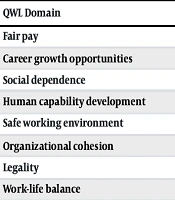
The Darren Van Laar Quality of Work Life Questionnaire includes 27 items covering 8 QWL domains, including fair pay, a safe working environment, career growth opportunities, social dependence, and human capability development. In the present study, test-retest reliability was r = 0.72, indicating adequate reliability. These instruments were selected because of their relevance to healthcare settings and their ability to assess the multidimensional nature of stress and QWL.
3.3. Statistical Analysis
Data were analyzed using SPSS version 25. The Shapiro-Wilk test indicated nonnormal distributions, supporting the use of nonparametric tests. Descriptive statistics included means and standard deviations. Group differences were assessed using t tests, analysis of variance, Mann-Whitney U tests, and Kruskal-Wallis tests, as appropriate. Spearman rank correlation coefficients were used to assess the strength and direction of the relationship between job stress and QWL, and the monotonicity assumption was examined. Fisher z transformation was used to compare correlations between male and female subgroups. Effect sizes were calculated as r = Z/√N for Mann-Whitney U tests and Cohen d for independent t tests. For all QWL domains, 95% Hodges-Lehmann confidence intervals were estimated for the median difference between male and female physicians. A multivariable linear regression model was constructed with total QWL as the dependent variable and job stress, age, gender, years of experience, and hospital as independent variables. Regression assumptions were assessed, and no major violations were identified.
3.4. Ethical Considerations
The study was approved by the AJA University Institutional Review Board (IR.AJAUMS.REC.1403.303). All participants provided written informed consent, and data confidentiality was maintained.
4. Results
4.1. Demographic and Descriptive Findings
The physicians’ mean age was 42.32 ± 6.64 years, and most participants (84.2%) were male. The most common age group was 41 - 50 years (45.32%), and 35.25% of participants had 15 - 19 years of work experience. The mean job stress score was 50.62 ± 10.36, and the mean QWL score was 84.1 ± 11.68. Male physicians had a higher mean QWL score (85.16) than female physicians (79.09). The effect size was medium (Cohen d = 0.52). However, job stress did not differ significantly between male and female physicians. Table 1 presents comparisons of job stress and QWL by gender.
Table 1.
Comparison of Job Stress and Quality-of-Work-Life Scores by Gender a
| Variables | Male (n = 117) | Female (n = 22) | P-Value b | Effect Size c |
|---|---|---|---|---|
| Job stress | 50.72 ± 10.52 (48.80 - 52.65) | 50.09 ± 9.69 (45.79 - 54.39) | 0.702 | r = 0.033 |
| QWL | 85.16 ± 11.60 (83.04 - 87.28) | 79.09 ± 10.89 (74.26 - 83.92) | 0.028 | d = 0.52 |
a Values are expressed as mean ± SD (95% CI). Abbreviations: CI, confidence interval; QWL, quality of work life.
b Mann-Whitney U test.
c Independent t test; total QWL was normally distributed.
4.2. Correlation Between Job Stress and Quality of Work Life
Job stress and QWL were significantly and negatively correlated among all participants (ρ = -0.553, P < 0.001). The correlation was stronger among female physicians (ρ = -0.719, P < 0.001) than among male physicians (ρ = -0.557, P < 0.001). However, a Fisher z transformation showed that the difference between the correlations was not statistically significant (z = 1.12, P = 0.26), indicating that the apparently stronger correlation among female physicians may reflect chance or the small female sample. Table 2 summarizes the correlation results.
Table 2.
Spearman Correlations Between Job Stress and Quality of Work Life a
| Group | Correlation Coefficient (ρ) | P-Value | 95% CI for ρ |
|---|---|---|---|
| All physicians (n = 139) | -0.553 | < 0.001 | -0.658 to -0.425 |
| Male physicians (n = 117) | -0.557 | < 0.001 | -0.670 to -0.416 |
| Female physicians (n = 22) | -0.719 | < 0.001 | -0.875 to -0.426 |
a Abbreviation: CI, confidence interval. Fisher z test for the difference between male and female correlations: z = 1.12, P = 0.26.
4.3. Quality-of-Work-Life Domains by Gender
Table 3 presents domain-specific QWL scores for male and female physicians. Significant differences were observed in career growth opportunities (P = 0.027) and human capability development (P = 0.025), with higher scores among male physicians. Effect sizes were small for all domains (r ≤ 0.190). Hodges-Lehmann 95% confidence intervals are presented for the median differences; intervals that include 0 indicate nonsignificant gender differences, consistent with the reported nonsignificant P values.
Table 3.
Domain-Specific Quality-of-Work-Life Scores by Gender a
| QWL Domain | Male | Female | P-Value b | Median Difference, Male - Female (95% CI) | Effect Size, r |
|---|---|---|---|---|---|
| Fair pay | 12.5 ± 2.1 | 11.0 ± 2.3 | 0.057 | 1.00 (0.00 - 2.00) | 0.161 |
| Career growth opportunities | 10.8 ± 1.7 | 9.5 ± 1.9 | 0.128 | 1.00 (0.00 - 2.00) | 0.129 |
| Social dependence | 11.3 ± 2.0 | 10.9 ± 2.2 | 0.187 | 1.00 (0.00 - 2.00) | 0.187 |
| Human capability development | 13.6 ± 1.8 | 12.1 ± 2.1 | 0.015 | 0.00 (-1.00 to 2.00) | 0.015 |
| Safe working environment | 14.2 ± 1.9 | 13.9 ± 2.0 | 0.015 | 0.00 (-1.00 to 2.00) | 0.015 |
| Organizational cohesion | 12.8 ± 1.6 | 12.3 ± 1.8 | 0.131 | 1.00 (0.00 - 2.00) | 0.131 |
| Legality | 11.9 ± 2.0 | 11.5 ± 2.1 | 0.111 | 1.00 (0.00 - 2.00) | 0.111 |
| Work-life balance | 12.4 ± 1.9 | 11.2 ± 2.2 | 0.190 | 1.00 (0.00 - 2.00) | 0.190 |
a Values are expressed as mean ± SD. Abbreviations: CI, confidence interval; QWL, quality of work life.
b Mann-Whitney U test; effect size r = Z/√139, with Z approximated from the P value.
4.4. Job Stress Subscales
Table 4 presents the mean scores for the 3 job stress subscales. Job conflict was the highest-rated source of stress, whereas role ambiguity was the lowest-rated.
Table 4.
Job Stress Subscale Scores for All Participants a
| Subscale | Mean ± SD (95% CI) |
|---|---|
| Physical environment | 17.33 ± 4.87 (16.52 - 18.14) |
| Job conflict | 20.02 ± 5.67 (19.07 - 20.97) |
| Role ambiguity | 13.26 ± 4.82 (12.45 - 14.07) |
a Abbreviation: CI, confidence interval.
4.5. Multivariable Analysis
A multiple linear regression analysis was performed to examine the independent association between job stress and QWL after controlling for potential confounders. Total QWL was the dependent variable, and job stress, age, gender (coded as 0 = male and 1 = female), years of experience, and hospital were predictors. As shown in Table 5, job stress remained a significant negative predictor (B = -0.33, P < 0.001), indicating that each 1-unit increase in stress was associated with a 0.33-point decrease in QWL after adjustment. Age was also significantly associated with lower QWL (B = -0.51, P = 0.040). Gender, experience, and hospital were not significant predictors (P > 0.05). The model explained 15.1% of the variance in QWL (R2 = 0.151).
Table 5.
Multiple Linear Regression Predicting Total Quality of Work Life a
| Predictor | B (95% CI) | SE | Standardized β | t | P-Value |
|---|---|---|---|---|---|
| Constant | 115.34 (99.01 - 131.67) | 8.26 | - | 13.97 | < 0.001 |
| Job stress | -0.33 (-0.51 to -0.15) | 0.09 | -0.33 | -3.60 | < 0.001 |
| Age | -0.51 (-1.00 to -0.02) | 0.25 | -0.19 | -2.07 | 0.040 |
| Gender (female) | -4.58 (-9.88 to 0.72) | 2.68 | -0.14 | -1.71 | 0.090 |
| Experience | 1.88 (-0.56 to 4.31) | 1.23 | 0.15 | 1.52 | 0.130 |
| Hospital (Besat) | 1.85 (-1.97 to 5.67) | 1.93 | 0.08 | 0.96 | 0.340 |
a Model summary: R2 = 0.151; adjusted R2 = 0.119; F(5, 133) = 4.745; P < 0.001. Abbreviation: CI, confidence interval.
4.6. Findings by Medical Specialty
Infectious disease specialists had the highest stress score (60.5 ± 5.0), whereas ophthalmologists had the lowest (40.28 ± 10.79). Ophthalmologists had the highest QWL score (97.75 ± 10.34), followed by neurologists (94.28 ± 5.36) and psychiatrists (92 ± 8.54). Job stress and QWL did not differ significantly by age group or years of work experience.
5. Discussion
The findings are consistent with previous research demonstrating a significant negative relationship between job stress and QWL among healthcare workers (1, 6). Job stress can contribute to burnout, fatigue, and other mental health problems, which may reduce QWL (16). Similar associations between high stress and low QWL have been reported among physicians and other healthcare professionals (1, 6, 10). The present findings extend this evidence by showing that job stress remained an independent predictor of QWL after adjustment for age, gender, experience, and hospital. Thus, the observed relationship was not explained solely by demographic differences. The influence of job motivation on stress and burnout, as highlighted by Ramezani et al. (8), provides further context and suggests that motivational deficits may compound the adverse effects of stress on QWL.
The negative correlation between job stress and QWL appeared stronger among female physicians. However, the difference was not statistically significant according to the Fisher z test (z = 1.12, P = 0.26); therefore, this finding should be interpreted cautiously. The small number of female participants (n = 22) limits the stability of the correlation estimate. In the adjusted model, gender was not a significant predictor of QWL (P = 0.090), although the coefficient (B = -4.58) suggested a tendency toward lower QWL among female physicians. Nevertheless, social pressures and additional roles experienced by women may contribute to perceived work-life imbalance (17, 18), warranting further investigation in larger samples.
The results underscore the importance of addressing job stress in military healthcare settings, where physicians may face resource limitations, long working hours, rigid hierarchies, and the psychological demands of military service. Age was negatively associated with QWL, indicating that older physicians reported slightly lower QWL independently of stress level. This association may reflect cumulative occupational fatigue and suggests that interventions should consider career-stage-specific needs. Potential strategies include mental health support, improved working conditions, and professional development opportunities (19, 20). Spiritual skills training may also reduce stress, anxiety, and depression among healthcare workers, as reported by Rezvaniamin et al. (21). Job conflict, the highest-scoring stress subscale, may reflect military-specific pressures such as hierarchy and dual roles, as discussed by Said and El-Shafei (22). Work-related musculoskeletal disorders among hospital employees further illustrate how physical and psychological stressors may converge to reduce work ability and QWL (23).
QWL varied across specialties. Ophthalmologists and psychiatrists had the highest QWL, whereas obstetrics and gynecology specialists had the lowest. Differences in resource allocation, workload, and professional autonomy may contribute to this variation. Greater autonomy may partly protect ophthalmologists and psychiatrists from the high-intensity demands experienced in other specialties. These findings may inform targeted interventions designed to improve autonomy and QWL across military medical specialties.
Future studies should assess workplace interventions such as counseling, mentorship, and organizational change. Longitudinal studies could clarify the long-term effects of job stress on QWL and physician retention (24). Comparisons across healthcare professions, including dentists, may help distinguish universal from profession-specific determinants of occupational stress (25). Such research may support the development of sustainable policies to improve physician well-being.
5.1. Limitations
The gender imbalance (84.2% male) may have reduced statistical power for female-specific analyses and introduced selection bias. Unmeasured confounders, including workload, and the cross-sectional design limit causal inference. The regression model explained only 15% of the variance in QWL, indicating that other factors contributed substantially. The Hodges-Lehmann confidence intervals for QWL domain differences were calculated using an asymptotic approximation; exact intervals may differ slightly, although the interpretation is unlikely to change. The post-COVID-19 context may have increased stress scores among infectious disease specialists. Factors affecting return to work after COVID-19 hospitalization may also represent unmeasured influences on physician well-being, as reported by Davari et al. (26).
5.2. Conclusions
Job stress was significantly and negatively correlated with QWL among physicians working in military hospitals. Although the correlation appeared numerically stronger among female physicians, Fisher z testing showed no significant gender difference. Multivariable analysis confirmed that job stress was an independent negative predictor of QWL after adjustment for age, gender, experience, and hospital. Organizational changes that improve working conditions, reduce job stress, and support physicians' well-being may improve both QWL and patient care. Evidence concerning work-related musculoskeletal disorders and stress biomarkers such as the HALP score may help inform holistic wellness programs (13, 23). Targeted interventions addressing specific sources of stress may strengthen staff resilience, patient outcomes, and retention in military healthcare systems (18, 27).