
1. Background
Traveler's diarrhea (TD) is a digestive disorder and one of the most common gastrointestinal illnesses among travelers. It is defined as diarrhea occurring within 24 hours of travel or within 10 days after return from travel. The risk of TD is related to the standard of living and health conditions in the destination country, particularly in developing countries, and the mortality rate in the absence of effective and timely treatment has been reported as 1% - 10% (1, 2). Infection with bacterial pathogens leads to the release of neurotransmitters (eg, 5-hydroxytryptamine) from endocrine cells and the activation of afferent neurons, which stimulate submucosal secretory motor neurons and result in the leakage of electrolytes and fluids into the intestinal lumen. Activation of adenylate cyclase and increased intracellular cAMP in enterocytes, mediated by bacterial toxins, cause secretory diarrhea. Among bacterial pathogens, enterotoxigenic Escherichia coli (ETEC) is a major enteric pathogen capable of producing heat-labile (LT) and heat-stable (ST) enterotoxins. LT is a high-molecular-weight (84 kDa) enterotoxin with an active alpha subunit surrounded by 5 identical binding B subunits. ETEC infection is associated with symptoms including vomiting, abdominal cramps, headache, and, rarely, low-grade fever (3). Treatment of TD has become increasingly challenging because of antimicrobial resistance (AMR). Approximately 20% - 70% of travelers to developing countries are infected with multidrug-resistant (MDR) enteric bacteria, particularly extended-spectrum beta-lactamase-producing Enterobacteriaceae, and commonly used antibiotics have become less effective because of increasing microbial resistance. Norfloxacin, a fluoroquinolone antibacterial agent, is more active against gram-negative bacteria than gram-positive cocci. It interferes with bacterial DNA replication by inhibiting the A subunit of DNA gyrase. Rifaximin is another antibiotic used to treat TD. It was first approved in Italy in 1987 and has been licensed in more than 30 countries for several gastrointestinal diseases, particularly acute infectious diarrhea such as TD. Rifaximin exerts its antimicrobial effects by irreversibly inhibiting bacterial protein synthesis (4-6).
2. Objectives
This study aimed to investigate the prevalence of bacterial traveler’s diarrhea, determine the frequency of bacterial isolates, and compare their antimicrobial resistance patterns, with a particular focus on norfloxacin and rifaximin, to inform strategies and guidelines for the prevention and treatment of traveler’s diarrhea.
3. Methods
3.1. Study Population and Bacterial Isolation
This descriptive cross-sectional study was conducted over 1 year, from July 2012 to August 2013. In total, 143 diarrheal stool samples were collected from patients hospitalized at medical centers in Golestan Province. The patients presented with diarrhea, nausea, vomiting, bloating, fever, and weakness; had returned from domestic or international travel at least 4 days earlier; and were hospitalized because home-based or self-limited treatment had been unsuccessful. Demographic and clinical information, including age and gender, were collected in accordance with ethical guidelines. The mean age of the participants was 38.0 years (range, 12 - 78 years). The inclusion criteria were gastrointestinal signs and no antibiotic use before sampling. Stool samples were collected in sterile containers, and a direct methylene blue slide was initially prepared to detect white blood cells. Samples were then cultured on MacConkey agar, Hektoen enteric agar, SS agar, Campy BAP agar, and EMB agar (Merck, Germany) and incubated for 24 - 48 hours. Gram staining and biochemical tests, including carbohydrate fermentation, IMVIC, citrate decarboxylation, ornithine, indole, and H2S tests, were performed for phenotypic identification. Nalidixic acid sensitivity, cephalothin resistance, and hippurate hydrolysis tests were used to identify and differentiate Campylobacter.
3.2. Antibacterial Susceptibility Testing
For the Kirby-Bauer disk diffusion method, a 0.5 McFarland bacterial suspension was prepared from overnight cultures of the isolates and inoculated onto Mueller-Hinton agar. The following 10 antibiotics were used to assess susceptibility: ampicillin (AM 10), co-amoxiclav (AMC 30), gentamicin (GM 10), ciprofloxacin (CIP 5), norfloxacin (NOR 5), rifaximin (RAX40), chloramphenicol (C 30), ceftriaxone (CRO 30), tetracycline (TE 30), and cotrimoxazole (SXT 1.25 + 23.75 μg), produced by Padnanteb Co, Iran. After the disks were placed on the inoculated plates, the plates were incubated for 16 - 18 hours at 37 °C. Inhibition zones were measured and interpreted according to the Clinical and Laboratory Standards Institute (CLSI) 2021 guidelines (7).
3.3. Detection of Enterotoxigenic Escherichia coli
To identify ETEC according to the manufacturer's protocol (Oxoid, UK), a suspension obtained from a pure culture of E. coli in tryptic soy broth was centrifuged for 30 minutes at 900 g. The heat-labile toxin (LT) was then detected using the inactivated latex agglutination test (VET-RDLA kit). For this purpose, 10,000 units/mL of polymyxin B was added to EMB medium, and E. coli strains were incubated on this medium at 37 °C for 24 hours. Then, 4 μL of test antiserum was added to 200 μL of glycine-saline buffer. After 50 μL of antigen was added to 50 μL of diluted antiserum and incubated for 10 minutes at room temperature, the mixture was placed on a glass slide with 10 μL of latex. Escherichia coli ATCC35401 was used as a positive control.
3.4. Minimum Inhibitory Concentration Screening
For MIC determination using the broth microdilution method, 100 μL of a bacterial suspension obtained from a pure culture at a concentration of 1.5 × 10⁸ colony-forming units (0.5 McFarland concentration) was added to wells containing 100 μL of rifaximin in methanol or norfloxacin in water with 0.1 mol/L NaOH (Sigma-Aldrich, St Louis, MO, USA) at concentrations of 0.5 - 1024 μg/mL, and 100 μL of Mueller-Hinton broth. The positive-control well contained the microbial suspension and Mueller-Hinton broth, and the negative-control well contained Mueller-Hinton broth and rifaximin or norfloxacin. After incubation for 24 hours at 37 °C, the minimum concentration that inhibited bacterial growth was considered the MIC (7).
3.5. Statistical Analysis
Data were analyzed using SPSS version 23, and graphs were generated using Microsoft Excel 2010. Confidence intervals (CIs) were calculated using Stata MP 14. A regression model was used to assess the relationship between pathogen-related disease development and demographic characteristics. The nonparametric Wilcoxon-Mann-Whitney test was used, with the significance level set at 0.05. Microbiological data were categorized by pathogen type, and regression analysis was used to assess trends in frequency changes.
4. Results
Among the 143 samples collected from patients with diarrhea, 34 (23.78%) were bacterial culture-positive. The identified bacterial isolates included Salmonella spp. (19 samples, 13.29%), Campylobacter spp. (8 samples, 6%), ETEC (4 samples, 2.8%), and Aeromonas spp. (3 samples, 2%). Among the ETEC isolates, 75% were obtained from women older than 35 years, whereas 100% of Aeromonas isolates were obtained from women older than 35 years. All Campylobacter isolates and 58% of Salmonella isolates were obtained from men older than 35 years (Figure 1).
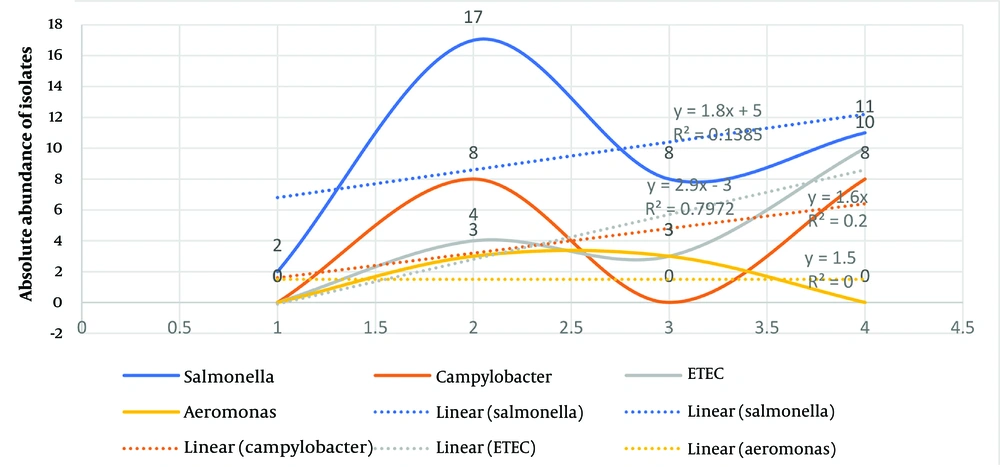
Figure 1.
An ordered logistic regression model was used to identify the association between age, gender, and bacterial populations in diarrheal specimens.
Salmonella isolates showed the highest resistance to ampicillin, with 18 of 19 isolates (94.5%) resistant. Campylobacter isolates showed the highest resistance to tetracycline, with 7 of 8 isolates (87.5%) resistant. Aeromonas isolates showed the highest resistance to both tetracycline and chloramphenicol, with 2 of 3 isolates (66.6%) resistant. All ETEC isolates were resistant to ampicillin, trimethoprim, chloramphenicol, and tetracycline. Overall, Aeromonas and Salmonella isolates showed the greatest sensitivity to rifaximin, with sensitivity rates of 100% and 94.5%, respectively (P = 0.371) (Figure 2). As shown in Table 1, rifaximin and norfloxacin inhibited Aeromonas at lower concentrations. Overall, the MIC of rifaximin that inhibited the growth of 90% of E. coli isolates was 512 μg/mL, which was 2-fold lower than that of norfloxacin. This value was also 2-fold lower for the inhibition of Salmonella, Campylobacter, and Aeromonas species, indicating 2-fold greater potency of rifaximin than norfloxacin against the bacterial isolates in this study (P < 0.05).
Table 1.
Comparison of the Activities of Rifaximin and Norfloxacin Against Bacterial Isolates
| Antimicrobial and Parameters | ETEC (n = 4) | Salmonella (n = 19) | Campylobacter (n = 8) | Aeromonas (n = 3) | P-Value |
|---|---|---|---|---|---|
| Rifaximin (μg/mL) | 0.03 a | ||||
| MIC90 | 512 | 256 | 256 | 128 | |
| MIC50 | 128 | 64 | 128 | 32 | |
| Range | 32 - 64 | 8 - 32 | 8 - 64 | 4 - 64 | |
| Norfloxacin (μg/mL) | 0.06 | ||||
| MIC90 | 1024 | 512 | 512 | 256 | |
| MIC50 | 256 | 64 | 256 | 64 | |
| Range | 64 - 128 | 32 - 256 | 64 to > 256 | 32 to > 128 |
a P value ≤ 0.05 was considered statistically significant.
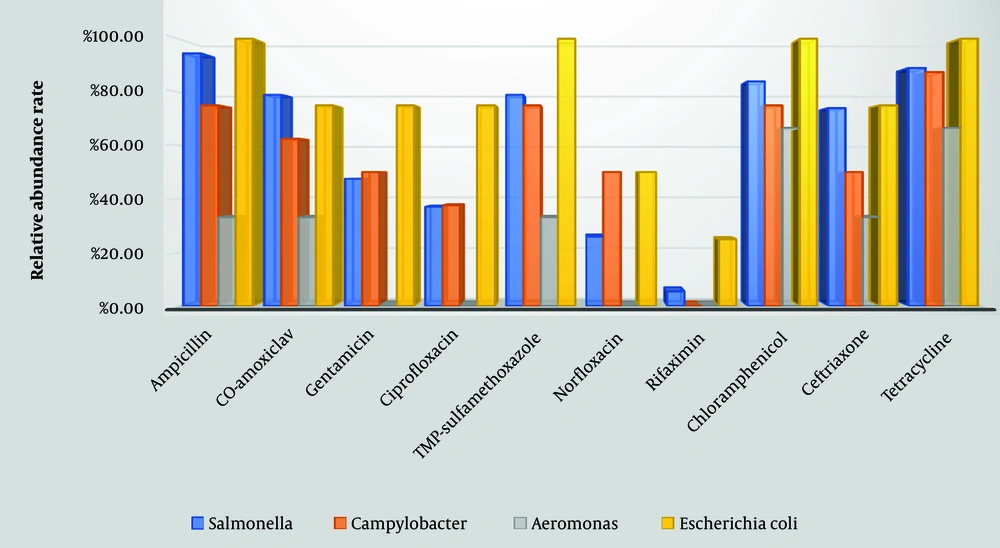
Figure 2.
Prevalence of antibiotic resistance among bacterial isolates obtained from diarrhea samples.
5. Discussion
ETEC has frequently been identified as a major cause of diarrhea among travelers and children younger than 5 years in developing countries. In the present study, the prevalence of ETEC was 2.8%, which was lower than previously reported in Iran and Nigeria (8, 9). In addition to enterotoxigenic E. coli, Salmonella, Shigella, Campylobacter, and Yersinia have also been reported as causes of traveler’s diarrhea. In a 2019 systematic study on the prevalence of traveler’s diarrhea among military personnel, ETEC, enteroaggregative E. coli (EAEC), and Campylobacter were the predominant strains, with similar findings reported in Southeast Asia, Latin America, and the Middle East (3). In the present study, the prevalence of Campylobacter was 6%. Salmonella had the highest prevalence at 13.29%, similar to findings reported in Iran in 2020.
Differences between the present findings and those of other studies may be attributable to the number of samples examined, the use of different diagnostic methods, geographical differences among populations, the study period, genetic factors, and drug resistance patterns. Over the past decade, resistance to commonly used drugs for treating intestinal infections in travelers, including ampicillin, tetracycline, and cotrimoxazole, has increased among diarrhea-causing E. coli. In the present study, the highest levels of antibiotic resistance were observed to tetracycline and ampicillin, whereas all isolates were highly susceptible to rifaximin.
In a study conducted in South Korea, treatment of acute non-travel-related diarrhea with a short course of rifaximin significantly shortened the duration of diarrhea. In addition, the overall effectiveness of rifaximin was greater than that of ciprofloxacin (10), consistent with the present findings. A 2018 study in India suggested that rifaximin was a more suitable alternative to norfloxacin for the long-term primary and secondary prevention of spontaneous bacterial peritonitis (SBP) in patients with cirrhosis and ascites (11).
In 2018, researchers in Thailand recommended rifaximin over doxycycline, trimethoprim/sulfamethoxazole, and fluoroquinolones for the prevention of TD (12). A 2019 study in the United States (13) examining the antibiotic susceptibility patterns of Campylobacter isolates from patients with diarrhea showed high resistance to quinolones, whereas a 2025 study in Jordan (14) showed high susceptibility to quinolones; these findings were lower and higher, respectively, than those in the present study. In the present study, rifaximin had a greater inhibitory effect on microbial isolates than norfloxacin at low concentrations. In a 2024 study in Egypt, rifaximin was approved for the secondary prevention of bacterial peritonitis and hepatic encephalopathy in patients with cirrhosis (15). Other studies comparing rifaximin and norfloxacin for the control of traveler’s diarrhea also indicated greater efficacy of rifaximin (16, 17).
5.1. Study Limitations and Conclusions
In contrast to most previous research, this study found that ETEC was not the predominant cause of TD. The study had several limitations, including the small number of isolates by travel destination due to its cross-sectional design and limited access to relevant variables. The study included hospitalized patients from a specific area of northern Iran, which limits the generalizability of the findings to other regions or populations. In addition, the study identified only ETEC among diarrheal pathogens. A strength of the study was monitoring drug resistance among bacterial isolates from patients with traveler’s diarrhea in northern Iran.
The findings indicate that antibiotics such as ampicillin and tetracycline may no longer be effective for treating diarrheal infections in the study area because of the high levels of resistance observed. Rifaximin appears to be a promising option for treating diarrheal infections, particularly in critical situations. However, further studies and in vivo evaluations are needed in different geographical areas, including Iran, and over longer periods.