
1. Introduction
Deep cerebral venous thrombosis, which refers to the formation of blood clots within the internal cerebral veins, basal veins, and vein of Galen, is a rare type of cerebrovascular disease that often occurs in young people, women of reproductive age, and patients with a prothrombotic state. Various risk factors can create a prothrombotic state, resulting in clot formation that obstructs cerebral venous drainage. Major risk factors include oral contraception, pregnancy or puerperium, acquired thrombophilias (antiphospholipid antibody syndrome, JAK2 mutations, malignancy, and autoimmune disease), genetic thrombophilias (protein C and protein S deficiency, factor V Leiden, and prothrombin G20210A polymorphism), infections, dehydration, other medications (corticosteroids, L-asparaginase, and vaccine-induced thrombotic thrombocytopenia), and mechanical provoking factors (head trauma, neurosurgical procedures, and compressive lesions) (1). In most cases, patients present with headache. Other common signs and symptoms include nausea, transient visual obscurations or vision loss, papilledema, diplopia, seizure, focal neurological deficits according to brain lesions, encephalopathy, and somnolence or coma (1, 2). The mainstay of treatment is anticoagulation, typically with low-molecular-weight heparin or oral anticoagulants. In severe or refractory cases, thrombolysis or endovascular interventions may be considered. Deep cerebral venous thrombosis typically leads to bilateral thalamic lesions, along with damage to cerebral structures adjacent to the thalami, such as the basal ganglia, splenium of the corpus callosum, and mesencephalon. However, in rare cases, the damage is unilateral. We describe a rare case of unilateral basal ganglion, thalamus, and splenium of the corpus callosum lesions due to thrombus in the deep cerebral venous system.
2. Case Presentation
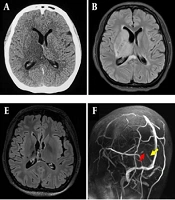
A 31-year-old Asian woman had a headache for 2 days after a miscarriage. She presented with left limb weakness and somnolence 10 hours after the headache and arrived at the emergency department 1 day after headache onset. She had no medical history and did not use contraceptives. Her National Institutes of Health Stroke Scale score was 8, and her Glasgow Coma Scale score was 14. Laboratory tests revealed elevated D-dimer (5.38 μg/mL) and fibrinogen degradation products (8.18 μg/mL). Noncontrast computed tomography indicated hypodensity in the right basal ganglion, thalamus, and splenium of the corpus callosum and hyperdensity of the right internal cerebral vein and straight sinus (Figure 1A). The patient underwent magnetic resonance imaging (MRI) and magnetic resonance venography (MRV). T2 fluid-attenuated inversion recovery imaging demonstrated a hyperintensity signal involving the right basal ganglion, thalamus, and splenium of the corpus callosum (Figure 1B). Diffusion-weighted imaging showed a heterogeneous hyperintensity signal in the right thalamus (Figure 1C). Hemorrhagic transformation in the right thalamus was confirmed by susceptibility-weighted angiography sequence. MRV revealed absence of the deep cerebral venous system (Figure 1D). Right thalamic infarction with hemorrhage, as well as right basal ganglion and splenium of the corpus callosum edema due to deep cerebral venous thrombosis, was diagnosed according to the clinical presentation and imaging features. The differential diagnosis initially included glioma and intracerebral abscess. However, these were not sufficiently supported by the MRV findings or by the absence of fever or mass effect.
Because of progressive deterioration in the patient’s symptoms and consciousness, emergent endovascular treatment, including aspiration and thrombolysis, was performed after adequate discussion with the patient’s family. After successful vascular access was obtained in the left femoral artery and right femoral vein using the Seldinger technique, digital subtraction angiography showed absence of the deep cerebral venous system and confirmed the thrombus. A 6F AXS Catalyst catheter (132 cm) was advanced to the torcular Herophili. Through this catheter, a Synchro-14 guidewire (300 cm) and an Echelon-10 microcatheter were navigated into the straight sinus, guided the Catalyst catheter to the straight sinus, and were withdrawn. Thrombus was aspirated through the Catalyst catheter. This process was repeated several times, and subsequent digital subtraction angiography showed partial recanalization of the straight sinus. The Synchro guidewire and Echelon microcatheter were reintroduced into the straight sinus, and after the Synchro guidewire was withdrawn, urokinase was rapidly infused through the microcatheter at a rate of 30,000 units per hour. Postinterventional MRI revealed mild hemorrhage in the right thalamus. Her symptoms resolved 3 days later without complications, and the microcatheter was withdrawn after discontinuation of urokinase infusion, with transition to low-molecular-weight heparin. Subsequent tests for thrombophilia and autoimmune antibodies were negative. Upon discharge, she was prescribed a vitamin K antagonist, with a target international normalized ratio of 2 - 3 for therapeutic anticoagulation.
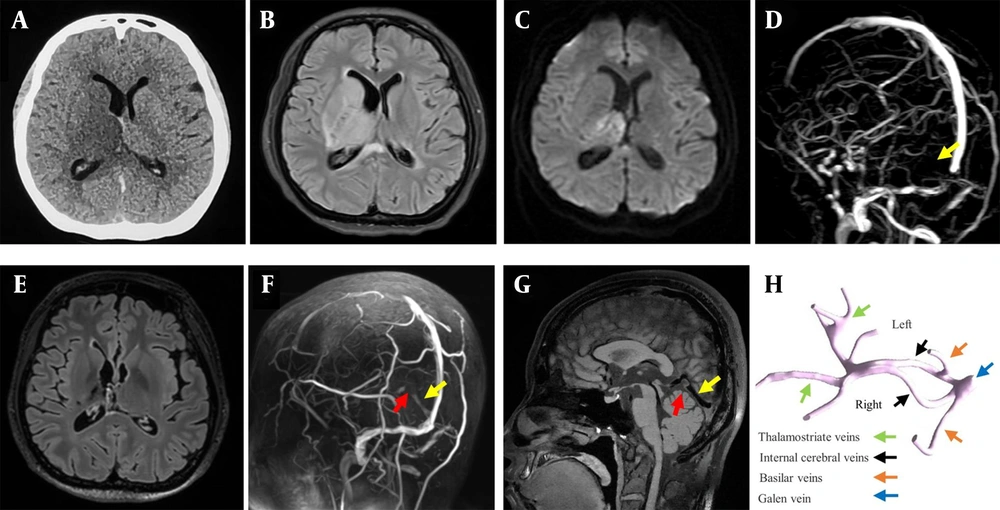
Figure 1.
Images of a 31-year-old Asian woman who presented with headache, left limb weakness, and drowsiness. A, Noncontrast computed tomography showed hypodense lesions in the right basal ganglion, thalamus, and splenium of the corpus callosum and hyperdensity of the right internal cerebral vein and straight sinus; B, T2 fluid-attenuated inversion recovery imaging demonstrated a hyperintensity signal involving the right basal ganglion, thalamus, and splenium of the corpus callosum; C, diffusion-weighted imaging showed a heterogeneous hyperintensity signal in the right thalamus; D, magnetic resonance venography revealed absence of the deep cerebral venous system; E, 1-year follow-up T2 fluid-attenuated inversion recovery imaging showed a small patchy area with hemosiderin deposition in the right thalamus; F, 1-year follow-up magnetic resonance venography demonstrated a round filling defect located in the proximal segment of the straight sinus; G, 1-year follow-up high-resolution magnetic resonance vessel wall imaging detected an arachnoid granulation protruding into the straight sinus; H, 3-dimensional reconstruction based on high-resolution images indicated symmetry of venous drainage in the bilateral deep venous system.
2.1. Follow-up
At the 1-year follow-up, she was asymptomatic. Follow-up MRI showed a small patchy area with hypointensity distributed in the right thalamus, which suggested hemosiderin deposition (Figure 1E). MRV demonstrated a round filling defect located in the proximal segment of the straight sinus (Figure 1F). High-resolution magnetic resonance vessel wall imaging detected an arachnoid granulation protruding into the straight sinus (Figure 1G). Furthermore, 3-dimensional reconstruction based on high-resolution images showed symmetry of venous drainage in the bilateral deep venous system (Figure 1H).
3. Discussion
Cerebral venous thrombosis is an unusual cerebrovascular disease caused by obstruction of cerebral venous drainage. The most common affected sites are the superior sagittal sinus and transverse-sigmoid sinus. Thromboses also occur independently in deep venous structures, including the straight sinus, vein of Galen, inferior sagittal sinus, internal cerebral veins that drain the thalami, and basal veins of Rosenthal (1). Disease onset can be acute, subacute, or chronic. Headache occurs in most patients and is sometimes followed by a decreased level of consciousness, focal neurological deficits related to the affected vein, and seizure (1, 2, 3). Current practices recommend MRI and MRV as the preferred brain imaging modalities to differentiate deep cerebral venous thrombosis from other disorders, although spontaneously increased density of cerebral veins can sometimes be detected by noncontrast computed tomography in the acute phase of the disease (4).
The primary etiologies of the disease include oral contraceptives, hormone-replacement therapy, pregnancy or the postpartum period, thrombophilia, infection, autoimmune disorder, surgery, and trauma (1, 2). Regarding thrombus formation in the present case, based on Virchow’s triad, hypercoagulability resulting from miscarriage heightened vulnerability to cerebral venous thrombosis. In addition, protrusion of an arachnoid granulation into the straight sinus was detected. Seventeen percent of arachnoid granulations are localized in the straight sinus, appearing as focal filling defects on vessel imaging with cerebrospinal fluid-like content (5). It is presumed that impaired outflow in the straight sinus potentially contributed to thrombosis in this case.
Due to the symmetry of venous drainage, lesions secondary to deep cerebral venous thrombosis are usually bilateral (6). Unilateral lesions secondary to deep cerebral venous thrombosis are rare. Reported cases in the literature are shown in Table 1. The presence of adequate collateral venous drainage on the contralateral side may explain unilateral lesions (14). Given the relative rarity of such cases, these unilateral lesions can closely resemble deep-seated gliomas, to the extent that clinicians may at times consider brain biopsy in some patients (9). This underscores the need for heightened caution when making diagnoses and conducting invasive examinations in these patients.
Table 1.
Clinical Features, Duration, and Outcomes of Reported Cases of Unilateral Infarct with Deep Cerebral Venous Thrombosis in the Literature
| Author and Age/Sex | Presentation | Duration | Site | Vessel Involved | Outcome |
|---|---|---|---|---|---|
| Küker et al, (2001) (7) | |||||
| 49/female | Headache, somnolence, aphasia | 3 days | Left thalamus | ICV, straight sinus, left TS and SS | Without disability |
| 58/female | Headache, drowsiness | - | Left thalamus | Left ICV, straight sinus, left TS and SS | Without new neurologic deficits |
| 31/female | Headache, nausea | - | Left thalamus, medial part of left temporal lobe | ICV, straight sinus | - |
| Herrmann et al. (2004) (8) | |||||
| 47/female | Headache, hemiparesis, retrograde amnesia | 2 weeks | Left thalamus | Left ICV | Complete recovery |
| van den Bergh et al. (2005) (6) | |||||
| 30/female | Headache, hemianopia, drowsiness, seizure | 2 weeks | Left thalamus | ICV, vein of Galen, left TS and SS | Residual headache, fatigue |
| 28/female | Right hemiparesis | 1 day | Left thalamus | Left ICV, vein of Galen, straight sinus, left TS and SS | Mild hemiparesis, dysphasia |
| 53/female | Headache, aphasia, right hemiparesis | 3 days | Left thalamus | Partial thrombosis of straight sinus and left ICV | - |
| Wieshmann et al. (2009) (9) | |||||
| 14/female | Headache, vomiting, drowsiness, aphasia, right-sided weakness | 3 days | Left thalamus | ICV, vein of Galen, straight sinus | Mild weakness, memory impairment |
| Desai (2010) (10) | |||||
| 30/female | Headache, vomiting | 2 days | Left thalamus, caudate and lentiform nuclei | Vein of Galen, straight sinus | Improved |
| Chung et al. (2012) (11) | |||||
| 36/female | Headache, dysarthria, right hemiparesis | 1 week | Left thalamus | Left ICV and thalamostriate vein | Mild headache |
| Deshpande et al. (2014) (12) | |||||
| 31/male | Headache, vomiting, status epilepticus | 4 days | Right thalamus | ICV, vein of Galen, SSS | Memory impairment |
| Chung et al. (2018) (13) | |||||
| 1/male | Right hemiparesis | 3 hours | Left thalamus | ICV, vein of Galen, straight sinus | Complete recovery |
| Menon et al. (2019) (14) | |||||
| 43/female | Headache, apathy, right hemiparesis | 3 days | Left thalamus, caudate and lentiform nucleus; left superior frontal gyrus | Left ICV, vein of Galen and cortical vein | Complete recovery |
| 23/female | Headache | 2 days | Left thalamus | ICV, vein of Galen, straight sinus, SSS | Complete recovery |
| Linley- Adams et al. (2022) (15) | |||||
| 40/male | Fatigue, unsteadiness, fine motor control difficulty of left hand | 6 weeks | Right thalamus | ICV, straight sinus, vein of Galen | Occasional fine motor control difficulty of left hand |
| Ivaturi and Gopinath (2022) (16) | |||||
| 32/male | Headache | 6 weeks | Right thalamus | ICV | Complete recovery |
| Current case (2026) | |||||
| 31/female | Headache, somnolence, hemiparesis | 2 days | Right thalamus, basal ganglion, splenium of the corpus callosum | ICV, vein of Galen, straight sinus | Complete recovery |
Abbreviations: ICV, internal cerebral vein; SS, sigmoid sinus; SSS, superior sagittal sinus; TS, transverse sinus.
Anticoagulation is the standard management for deep cerebral venous thrombosis, and outcomes are usually favorable. Nevertheless, for patients who exhibit severe and progressive symptoms despite medical treatment, endovascular intervention, offering faster recanalization, may be a viable alternative option (1, 17). In the present case, unilateral lesions may have progressed to bilateral involvement without timely treatment.
4. Conclusions
Deep cerebral venous thrombosis can manifest as unilateral thalamic lesions with involvement of adjacent structures, demanding careful diagnosis and cautious invasive testing. Endovascular intervention may serve as a viable therapeutic alternative for patients who exhibit persistent and worsening symptoms despite optimal medical management.