
1. Background
Autism spectrum disorder (ASD) is a neurodevelopmental disorder characterized by persistent difficulties in social communication and repetitive behavioral patterns (1).
A prominent feature of ASD is impaired emotion processing, which is evident when individuals encounter social stimuli such as faces and emotional words (2, 3).
Recognition memory refers to the ability to distinguish previously encountered stimuli from novel ones. Studies in neurotypical populations show that emotion typically enhances memory. Emotional stimuli are recognized more accurately and rapidly than neutral stimuli. This emotional enhancement is considered an adaptive mechanism that facilitates survival by prioritizing the processing of salient or potentially threatening information (4).
The study by Deruelle et al. challenges this classical hypothesis in individuals with ASD. In their experiment, neurotypical adults and adults with ASD were asked to memorize images of emotional (happy and angry) and neutral faces and then complete a recognition task. The key findings indicated that neurotypical participants showed more accurate recognition of emotional faces, especially negative faces, whereas this pattern was absent in the ASD group. Recognition performance for emotional versus neutral faces did not differ significantly in individuals with ASD. These results suggest that the modulatory influence of emotion on encoding and/or retrieval processes in recognition memory may be attenuated or altered in the ASD group (4).
Although studies such as Deruelle et al. point to a lack of emotional facial recognition memory in the ASD population, other research indicates that initial recall for emotional verbal stimuli may remain intact (4, 5).
However, individuals with ASD appear to lack the facilitating effect of emotion on memory over time. In other words, although they may initially prioritize emotional information, such information does not show greater resistance to forgetting during the consolidation phase (5).
A central component of emotion recognition associated with memory performance is the emotional memory enhancement effect, a phenomenon whereby emotionally arousing events are remembered more readily and with greater long-term stability than neutral events. Understanding the integrity or disruption of this mechanism in ASD is essential for interpreting the disorder's cognitive-emotional profile. In this regard, Maras et al. assessed emotional memory in adults with ASD using two experimental paradigms. Their findings indicated that both ASD participants and controls showed comparable increases in physiological arousal in response to emotional content and, importantly, that both groups demonstrated significant and equivalent memory ability for emotional events. These results suggest that emotional arousal can also enhance memorization in individuals with ASD. Thus, despite preserved basic emotional memory enhancement, qualitative differences in how emotion and cognition interact at more complex levels of processing may help explain the distinctive functional patterns observed in social contexts among individuals with ASD (6).
In summary, Maras and colleagues demonstrated that emotional episodic memory for stories is preserved in ASD, whereas Deruelle and colleagues found that emotional facial recognition memory is impaired. This discrepancy underscores the complexity of the phenomenon and the need to examine distinct mechanisms underlying emotional memory in ASD (4, 6).
In neurotypical individuals, emotional stimuli generally facilitate recognition memory; however, some studies indicate that this effect is diminished or absent in individuals with ASD (4, 5). Findings from cognitive neuroscience show that emotion and cognition networks interact dynamically (7, 8). This interaction highlights the role of prefrontal regions in emotion regulation and the influence of structures such as the amygdala on memory and attention (9). In the study by Loukusa et al., recognition memory performance in children with ASD was compared with that of children with specific language impairment (SLI). The results showed that in tasks assessing emotion recognition and theory of mind, the ASD group performed more poorly than the SLI group. These findings indicate that deficits in social cognition are more severe in children with ASD and may affect their ability to interpret social cues and understand the mental states of others. The authors suggested that although both groups experience developmental challenges, children with ASD exhibit distinctive impairments in social understanding that cannot be explained solely by language difficulties (10).
Given the crucial role of language in learning and social interaction, examining emotional processing at the linguistic level is particularly important. Prior research indicates that emotional word processing in individuals with ASD follows an atypical pattern and that the emotional enhancement effect on memory is reduced in this population (3, 5).
Investigating recognition memory for emotional words in ASD is important for both theoretical and clinical reasons. From a theoretical perspective, emotional memory reflects the interaction between affective and cognitive systems, including mechanisms involved in attention allocation, encoding, consolidation, and retrieval. Examining whether emotional information influences memory function in the ASD group in the same way as in typically developing individuals may therefore contribute to a better understanding of how emotion and cognition interact in this population. From a clinical perspective, emotional language is fundamental to social communication, academic learning, and everyday interpersonal functioning (5). Difficulties in processing and remembering emotionally meaningful verbal information may contribute to broader challenges in social understanding and adaptive functioning. Despite its potential importance, most previous research has focused on emotional faces or visual stimuli, whereas emotional word processing has received considerably less attention, particularly in children and adolescents with ASD. Addressing this gap may provide insights into cognitive mechanisms that are directly relevant to language-based social interactions.
2. Objectives
The present study investigated recognition memory for pleasant, unpleasant, and neutral words in children and adolescents with ASD compared with typically developing peers.
The primary objectives were to examine (1) whether recognition memory performance differs between the ASD and typically developing groups and (2) whether emotional valence (pleasant, unpleasant, and neutral) influences recognition memory performance. We further examined whether the effect of emotional valence differed between the groups.
The secondary objective was to explore associations between recognition memory performance and social communication characteristics, as measured by the Social Communication Questionnaire (SCQ) and the Social Responsiveness Scale, Second Edition (SRS-2). Based on previous literature, we expected children and adolescents with ASD to demonstrate lower recognition memory performance than typically developing peers and anticipated that better memory performance would be associated with fewer social-communication difficulties.
3. Methods
3.1. Study Design and Setting
This study employed a cross-sectional, observational, comparative design to examine cognitive performance in children and adolescents with ASD compared with typically developing peers. Data were collected in a controlled research setting associated with child psychiatry services.
3.2. Participants
A total of 30 children and adolescents aged 9 to 15 years, matched by age, were initially recruited, including 15 with ASD.
The age range of 9 to 15 years was selected because individuals at this developmental stage generally have sufficient reading skills and cognitive maturity to complete the emotional word recognition task reliably.
Participants with ASD were recruited via convenience sampling from a child psychiatry clinic in Tehran. Data collection was conducted between November 2023 and September 2024. ASD diagnoses were established before study enrollment through comprehensive clinical evaluations conducted by a child psychiatrist and a clinical psychologist according to DSM-5 diagnostic criteria (1). Intellectual functioning was assessed using the Wechsler Intelligence Scale for Children-Fourth Edition (WISC-IV), and all participants had IQ scores above 70 (typically developing group: M = 98.27; ASD group: M = 84).
3.3. Recruitment of the Typically Developing Group
Typically developing participants were recruited through announcements distributed via social media inviting children and adolescents to participate in a cognitive assessment study. Participants and their parents received feedback on the results of the intelligence and memory assessments as compensation for participation. Among volunteers who expressed interest, individuals were selected who were close in age to the ASD participants and resided in similar residential areas to improve comparability between groups.
3.4. Matching and Screening Procedures
The ASD and typically developing groups were matched primarily by age. In addition, participants were screened to ensure comparable language abilities and adequate reading and writing skills, enabling them to complete the experimental tasks. For the typically developing group, the absence of developmental, neurological, or psychiatric disorders was confirmed based on parental report during screening.
Eligibility criteria included an age between 9 and 15 years, right-handedness, adequate reading ability, IQ > 70, normal or corrected-to-normal vision, and no history of severe neurological or psychiatric disorders. Participants in the ASD group were also required to have a clinical diagnosis of ASD based on a clinical interview conducted by a child and adolescent psychiatrist. Symptom severity, particularly social communication, was measured using the SCQ and SRS-2.
3.5. Data Quality Screening and Analyzed Sample
Following data collection, all datasets were screened for data quality before statistical analysis. During this process, the responses of one participant in the ASD group suggested random answering without adequate attention to the task stimuli. Consequently, this dataset was excluded from the final analyses. The final analyzed sample therefore consisted of 29 participants: 15 typically developing participants and 14 participants with ASD.
Given the limited availability of children and adolescents with ASD who met the study eligibility criteria and the exploratory nature of the investigation, the sample size was determined based on feasibility considerations. Consistent with recommendations for pilot studies, approximately 12 - 15 participants per group were considered sufficient to provide preliminary estimates of effect sizes and evaluate the feasibility of the study procedures (11). Accordingly, 30 participants were recruited, including 15 participants with ASD and 15 typically developing participants.
3.6. Measures
3.6.1. Wechsler Intelligence Scale for Children-Fourth Edition (WISC-IV)
Intellectual functioning was assessed using the Persian version of the WISC-IV, a standardized and widely used measure of cognitive ability in children and adolescents that has demonstrated satisfactory psychometric properties in Iranian populations. The full WISC-IV was administered by a trained examiner, and the Full-Scale IQ score was used both as an eligibility criterion (IQ > 70) and as a covariate in analyses examining recognition memory performance.
3.6.2. Social Communication Questionnaire (SCQ)
The SCQ is a 40-item parent-report questionnaire with yes/no responses designed to screen for autism-related symptoms in children aged 4 years and older. Scores of 9 or above indicate impairments in social communication. The questionnaire has been standardized in Iran and exhibits strong reliability (Cronbach's alpha = 0.88 - 0.94) and test-retest validity of 0.88 (12).
3.6.3. Social Responsiveness Scale, Second Edition (SRS-2)
The SRS-2 is a 65-item questionnaire rated on a 4-point Likert scale 1 - 4 that assesses autism-related social behavior across five subscales: Social Awareness, Social Cognition, Social Communication, Social Motivation, and Restricted Behaviors. Total scores range from 0 to 195 and evaluate the child's behavior over the past 6 months. The Persian version demonstrates reliability coefficients of 0.86 - 0.89 and test-retest reliability of 0.72 - 0.83 (13), with a correlation of 0.43 with the SCQ (14).
3.6.4. Recognition Memory Task
The recognition memory task was programmed in MATLAB software to assess recognition memory for emotional and neutral Persian words. The task consisted of one practice block and six main experimental blocks and was administered in two phases: Encoding and recognition.
Stimuli comprised 180 Persian words: 60 pleasant, 60 unpleasant, and 60 neutral. Words were selected based on normative valence and arousal ratings and were matched for lexical characteristics, including frequency and length.
Pleasant, unpleasant, and neutral words were equally distributed across experimental blocks. Each block contained five pleasant, five unpleasant, and five neutral words presented in randomized order.
In addition, lexical and emotional characteristics of the stimuli, including word frequency, word length, arousal, and valence, were controlled during stimulus selection based on the normative characteristics reported.
Each trial began with a blank screen displayed for 200 ms, followed by word presentation for 2600 ms. After stimulus presentation, another blank screen was shown for 200 ms.
The primary outcome variables included the number of correct responses, incorrect responses, omission errors, commission errors, and reaction time during the recognition phase.
Correct responses (hits) were operationally defined as correctly identifying previously presented (old) words during the recognition phase. Participants were instructed to press the space key when they recognized a word as having been presented during the encoding phase. Incorrect responses referred to incorrect recognition judgments. Omission errors were defined as failures to respond to previously presented target words, whereas commission errors were defined as incorrectly identifying new words as previously seen. Reaction time was recorded for recognition responses during the retrieval phase. Recognition accuracy was calculated based on the number of correctly identified old words during the recognition phase.
3.7. Procedure
All assessments were completed during a single morning session lasting approximately 3 hours. Participants first completed the WISC-IV, while parents completed the SRS-2 and SCQ. Following a short break and a light snack, participants performed the computerized recognition memory task. Family members accompanied participants during breaks; however, all assessments were conducted individually with the examiner.
The task included one practice block and six main blocks and was administered in two phases.
3.7.1. Encoding Phase
Participants were presented with 180 Persian words, including 60 pleasant, 60 unpleasant, and 60 neutral words. Each block contained 15 words, five from each emotional category, presented in random order. Participants were instructed to memorize the words for a subsequent memory test.
3.7.2. Recognition Phase
After a 1-minute interval, 30 words (15 old and 15 new) were presented in random order. Participants were instructed to indicate whether each word had been previously presented or was new by pressing the designated response keys. The six main blocks were separated by 1-minute breaks to minimize fatigue.
Recognition accuracy scores were derived only from responses provided during the recognition phase and were calculated according to the number of correctly recognized old words across the experimental trials.
A schematic overview of the recognition memory task is presented in Figure 1.
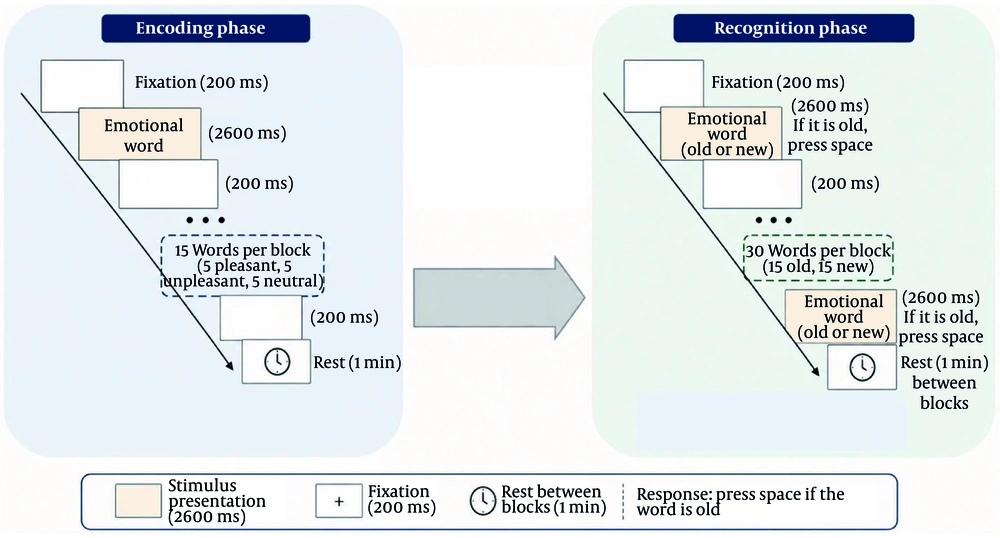
Figure 1.
Experimental design and trial structure of the emotional word recognition memory task. The task had two phases: Encoding and recognition. During encoding, each block included 15 words. After a 1-minute delay, recognition was tested with 30 words. Each trial showed a fixation cross for 200 ms followed by a word for 2600 ms. Participants pressed the space key when they recognized an old word.
3.8. Statistical Analysis
All statistical analyses were conducted using IBM SPSS Statistics version 27 (IBM Corp., Armonk, NY, USA). Statistical significance was set at P < 0.05 (two-tailed).
Before the main analyses, assumptions for parametric tests were examined. Normality of the study variables was assessed using the Kolmogorov-Smirnov test, along with inspection of skewness and kurtosis values. Homogeneity of variances for between-group comparisons was evaluated using Levene's test.
Independent-samples t-tests were used to compare the ASD and typically developing groups on IQ, SCQ, and SRS-2 scores.
Effect sizes for group differences were interpreted alongside p-values to estimate the magnitude of observed effects.
To examine performance on the recognition memory task, repeated-measures analysis of variance (ANOVA) was conducted with emotional stimulus type (pleasant, unpleasant, and neutral words) as the within-subjects factor and group (ASD vs typically developing) as the between-subjects factor. Because the groups differed in IQ, IQ was included as a covariate in the model.
The assumption of sphericity for the within-subjects factor was assessed using Mauchly's test. When the sphericity assumption was violated, Greenhouse-Geisser corrections were applied to adjust the degrees of freedom.
Partial eta squared (ηp2) was reported as the measure of effect size for ANOVA effects.
When significant main effects were observed, follow-up paired-samples t-tests were conducted to examine differences between emotional stimulus conditions.
Pearson correlation coefficients were calculated to examine associations between recognition memory indices and measures of social communication (SCQ and SRS-2) within each group.
Given the relatively large number of correlation analyses and the modest sample size, the results were interpreted cautiously, with emphasis placed on the magnitude and consistency of correlation coefficients rather than solely on statistical significance.
Effect sizes were interpreted according to conventional benchmarks (small ≈ .10, medium ≈ .30, large ≥ .50).
Where appropriate, 95% confidence intervals were considered to estimate the precision of the observed effects.
4. Results
Before the statistical analysis, the dataset was screened for data quality. One participant in the ASD group was excluded because the response pattern indicated random answering without adequate engagement with the task stimuli. Accordingly, all subsequent analyses were conducted on 14 participants with ASD and 15 typically developing participants.
An independent-samples t-test was used to compare IQ, SRS-2, and SCQ scores between the ASD and typically developing groups. The results are presented in Table 1.
Table 1.
Comparison of IQ, SCQ, and SRS-2 Scores Between Typically Developing and ASD Groups a
| Variables and Groups | No. | Mean | SD | t | df | P-Value |
|---|---|---|---|---|---|---|
| IQ | 2.17 | 27 | 0.03 b | |||
| Typically developing | 15 | 98.27 | 15.25 | |||
| ASD | 14 | 84.00 | 20.05 | |||
| SCQ | -6.96 | 27 | < 0.001 b | |||
| Typically developing | 15 | 1.67 | 2.99 | |||
| ASD | 14 | 10.79 | 4.02 | |||
| SRS-2 Total | -8.21 | 27 | < 0.001 b | |||
| Typically developing | 15 | 13.47 | 8.04 | |||
| ASD | 14 | 79.14 | 29.89 | |||
| Social Communication | -8.52 | 27 | < 0.001 b | |||
| Typically developing | 15 | 12.6 | 6.96 | |||
| ASD | 14 | 65.43 | 22.93 | |||
| Restricted Interests & Repetitive Behaviors | -6.86 | 27 | < 0.001 b | |||
| Typically developing | 15 | 0.67 | 1.40 | |||
| ASD | 14 | 13.71 | 7.24 | |||
| Social Motivation | -8.07 | 27 | < 0.001 b | |||
| Typically developing | 15 | 2.07 | 2.05 | |||
| ASD | 14 | 13.64 | 5.14 | |||
| Social Interaction | -6.80 | 27 | < 0.001 b | |||
| Typically developing | 15 | 4.00 | 4.60 | |||
| ASD | 14 | 26.00 | 11.60 | |||
| Social Cognition | -8.34 | 27 | < 0.001 b | |||
| Typically developing | 15 | 1.87 | 2.42 | |||
| ASD | 14 | 15.64 | 5.89 | |||
| Social Awareness | -4.96 | 27 | < 0.001 b | |||
| Typically developing | 15 | 4.87 | 1.68 | |||
| ASD | 14 | 10.14 | 3.74 |
a Abbreviations: ASD, autism spectrum disorder; SCQ, Social Communication Questionnaire; SRS-2, Social Responsiveness Scale, Second Edition; SD, standard deviation; df, degrees of freedom. Higher scores on the SCQ and SRS-2 reflect greater impairment.
b P < 0.05 was considered statistically significant.
As shown in Table 1, statistically significant differences were observed between the typically developing and ASD groups across all variables. The typically developing group had higher mean IQ scores, whereas the ASD group had higher SCQ and SRS-2 scores, including all SRS-2 subscales.
Descriptive statistics, including means and standard deviations, for recognition memory task performance, reaction times, and error measures in the ASD and typically developing groups are presented in Table 2.
Table 2.
Descriptive Statistics for Recognition Memory Task Performance by Group a
| Indexes and Groups | No. | Mean | SD |
|---|---|---|---|
| Number of correct responses | |||
| Typically developing | 15 | 144.33 | 13.67 |
| ASD | 14 | 131.14 | 25.59 |
| Correct responses to pleasant words | |||
| Typically developing | 15 | 47.93 | 5.31 |
| ASD | 14 | 45.57 | 8.17 |
| Correct responses to unpleasant words | |||
| Typically developing | 15 | 47.20 | 4.80 |
| ASD | 14 | 42.50 | 9.48 |
| Correct responses to neutral words | |||
| Typically developing | 15 | 49.20 | 4.96 |
| ASD | 14 | 43.07 | 8.82 |
| Reaction time | |||
| Typically developing | 15 | 1.34 (s) | 0.18 |
| ASD | 14 | 1.33 (s) | 0.22 |
| Number of omission errors | |||
| Typically developing | 15 | 26.00 | 10.62 |
| ASD | 14 | 30.79 | 23.05 |
| Number of commission errors | |||
| Typically developing | 15 | 9.67 | 9.44 |
| ASD | 14 | 18.00 | 17.75 |
| Reaction time to commission errors | |||
| Typically developing | 15 | 1.64 (s) | 0.33 |
| ASD | 14 | 1.30 (s) | 0.55 |
a Abbreviation: SD, standard deviation. Reaction time values are reported in seconds (s).
A repeated-measures ANOVA was conducted to examine the effects of emotional stimulus type (pleasant, unpleasant, and neutral) and group (ASD vs typically developing) on recognition memory performance, with IQ included as a covariate. Mauchly's test indicated that the assumption of sphericity for the emotional stimulus factor was violated; therefore, Greenhouse-Geisser corrections were applied. The results of the ANOVA are presented in Table 3.
Table 3.
Repeated-Measures ANOVA Results for Recognition Memory Performance a
| Dependent Variables and Effect Types | SS | df | MS | F | P-Value | Effect Size |
|---|---|---|---|---|---|---|
| Recognition accuracy | ||||||
| Within emotional stimulus type | 2836.63 | 3 | 945.54 | 21.66 | < 0.001 | 0.45 |
| Within stimulus type × IQ | 701.76 | 3 | 233.92 | 5.36 | 0.002 | 0.17 |
| Within stimulus type × group | 124.63 | 3 | 41.54 | 0.95 | 0.420 | 0.04 |
| Between group | 1678.36 | 1 | 1678.36 | 24.47 | < 0.001 | 0.49 |
| Reaction time | ||||||
| Within emotional stimulus type | 0.071 | 3 | 0.024 | 1.59 | 0.199 | 0.06 |
| Within stimulus type × IQ | 0.056 | 3 | 0.019 | 1.25 | 0.298 | 0.05 |
| Within stimulus type × group | 0.002 | 3 | 0.001 | 0.05 | 0.985 | 0.00 |
| Between group | 0.029 | 1 | 0.029 | 0.19 | 0.667 | 0.01 |
| Commission and omission errors | ||||||
| Within error type | 1172.89 | 1 | 1172.89 | 3.99 | 0.056 | 0.13 |
| Within error type × IQ | 597.44 | 1 | 597.44 | 2.03 | 0.166 | 0.07 |
| Within error type × group | 244.48 | 1 | 244.48 | 0.83 | 0.370 | 0.03 |
| Between group | 111.88 | 1 | 111.88 | 0.64 | 0.431 | 0.02 |
a Abbreviations: SS, sum of squares; MS, mean square; df, degrees of freedom. Effect size values represent partial η2.
The analysis revealed a significant main effect of emotional stimulus type, indicating that recognition accuracy differed across emotional conditions. Effect sizes (partial η2) indicated a substantial influence of emotional valence on memory performance.
A significant main effect of group was also observed, indicating that children with ASD had lower recognition accuracy than typically developing children after controlling for IQ.
In addition, the interaction between emotional stimulus type and IQ was significant, F(3, .) = 5.36, P = .002, ηp2 = .17, indicating that the effect of emotional valence on recognition memory performance varied according to participants' intellectual functioning.
Figure 2 illustrates recognition accuracy across pleasant, unpleasant, and neutral word conditions in the ASD and typically developing groups. Consistent with the ANOVA results, recognition performance was higher for pleasant and neutral words than for unpleasant words in both groups. Although the ASD group showed lower overall recognition accuracy, the pattern of emotional modulation was similar across groups.
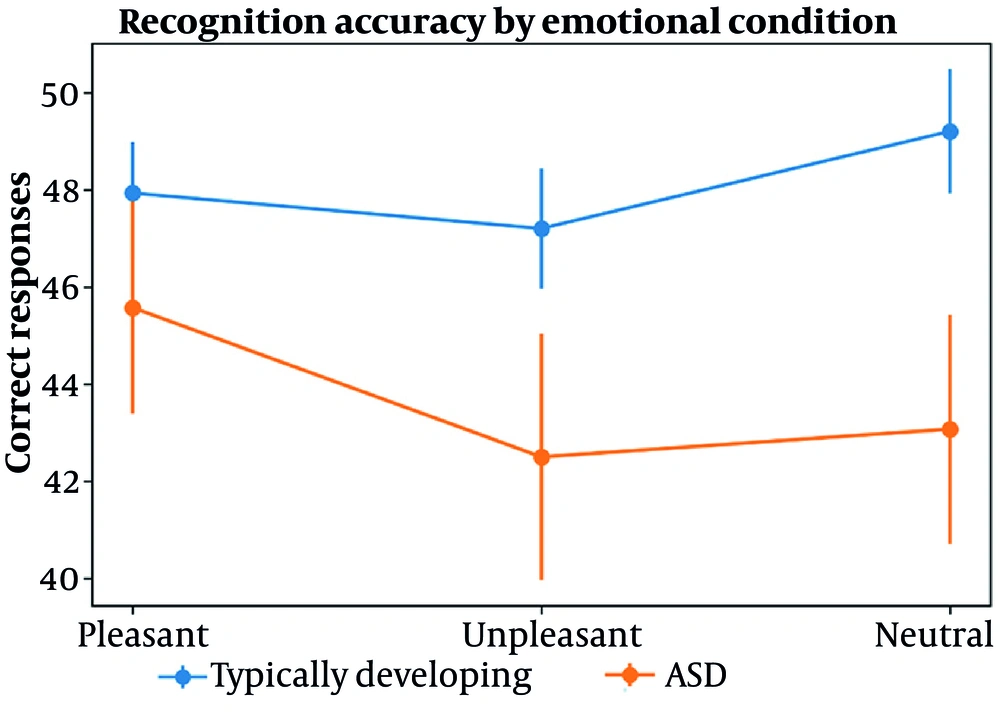
Figure 2.
Recognition memory accuracy for pleasant, unpleasant, and neutral words in the ASD and typically developing groups. Values represent mean numbers of correctly recognized words. Error bars indicate 95% confidence intervals. ASD, autism spectrum disorder.
Participants' accuracy varied as a function of word emotional valence. Given the IQ differences between the two groups, IQ was entered as a covariate; after controlling for IQ, the effect of emotional valence remained significant. To further examine these differences, paired-samples t-tests were conducted.
The dependent t-test results showed that recognition performance for pleasant words (M = 46.79) was significantly higher than for unpleasant words (M = 44.93) (p = .027). In addition, recognition of neutral words (M = 46.24) was significantly better than recognition of unpleasant words (p = .030), whereas the difference between pleasant and neutral words was not significant (p = .515).
The interaction between stimulus type and group was nonsignificant, indicating that both groups exhibited similar response patterns to emotional stimuli. However, the main effect of group was significant; the ASD group performed markedly worse in overall recognition accuracy than typically developing children, with a higher number of correct responses in the typically developing group.
For reaction time, the main effects of emotional stimulus type and group, as well as the stimulus type × group interaction, were not significant. Neither the main effect of emotional stimulus type, F(3, .) = 1.59, p = .199, nor the main effect of group, F(1, .) = 0.19, p = .667, was statistically significant. The emotional stimulus type × group interaction was also nonsignificant, F(3, .) = 0.05, p = .985. Thus, reaction time was not influenced by the emotional valence of the words, and no difference was observed between the ASD group and typically developing children.
The effect of error type approached significance, indicating a marginal difference between omission and commission errors. However, neither the main effect of group nor the error type × group interaction was significant, suggesting that the total number and pattern of errors were comparable between the ASD and typically developing groups.
Pearson correlation analyses were conducted to examine associations between recognition memory variables and measures of social communication (SCQ and SRS-2) within the typically developing group. The results are presented in Table 4.
Table 4.
Pearson Correlations Between Recognition Memory Measures and SCQ/SRS-2 Scores in the Typically Developing Group a
| Recognition Memory Measures and Questionnaire | r | P-Value |
|---|---|---|
| Total correct | ||
| SCQ | -0.568 | 0.027 |
| Correct-neutral words | ||
| SCQ | 0.553 | 0.033 |
| Correct-unpleasant words | ||
| SRS-2 total | 0.532 | 0.041 |
| Social communication | 0.557 | 0.031 |
| Social motivation | 0.644 | 0.010 |
| Correct-pleasant words | ||
| Social motivation | 0.587 | 0.021 |
| Commission error | ||
| SRS-2 total | -0.725 | 0.002 |
| Social communication | -0.598 | 0.019 |
| Restricted interests | -0.720 | 0.002 |
| Social motivation | -0.662 | 0.007 |
| Reaction time | ||
| SRS-2 total | 0.885 | < 0.001 |
| Social communication | 0.707 | 0.003 |
| Restricted interests | 0.684 | 0.005 |
| Social motivation | 0.817 | < 0.001 |
| Omission error | ||
| Social motivation | 0.916 | < 0.001 |
| SRS-2 total | 0.922 | < 0.001 |
| Social communication | 0.917 | < 0.001 |
| RT to commission error | ||
| Social motivation | -0.581 | 0.023 |
| SRS-2 total | -0.632 | 0.011 |
| Social communication | -0.609 | 0.016 |
| Restricted interests | -0.525 | 0.044 |
a Abbreviations: SCQ, Social Communication Questionnaire; SRS-2, Social Responsiveness Scale, Second Edition; r, Pearson correlation coefficient.
Similar Pearson correlation analyses were conducted within the ASD group to explore the relationships between recognition memory performance and social communication measures. The results are summarized in Table 5.
Table 5.
Pearson Correlations Between Recognition Memory Measures and SCQ/SRS-2 Scores in the ASD Group a
| Recognition Memory Measure and Questionnaire | r | P-Value |
|---|---|---|
| Correct-neutral words | ||
| SCQ | -0.562 | 0.037 |
| Social awareness | -0.609 | 0.021 |
| Correct-unpleasant words | ||
| Social awareness | -0.569 | 0.034 |
| Commission error | ||
| Social awareness | 0.942 | < 0.001 |
| Social motivation | 0.979 | < 0.001 |
| Reaction time | ||
| Social motivation | 0.948 | < 0.001 |
| Social interaction | 0.976 | < 0.001 |
| Social cognition | 0.974 | < 0.001 |
| Omission error | ||
| Social motivation | 0.879 | < 0.001 |
| Social cognition | 0.879 | < 0.001 |
| RT to commission error | ||
| Social motivation | 0.879 | < 0.001 |
a Abbreviations: SCQ, Social Communication Questionnaire; SRS-2, Social Responsiveness Scale, Second Edition; r, Pearson correlation coefficient.
The results indicate that recognition memory ability was correlated with various dimensions of social communication and that this association followed a different pattern in the ASD group than in the typically developing group. Overall, higher recognition accuracy was associated with lower severity of social communication difficulties, whereas higher error rates and longer reaction times were associated with greater impairments in social communication.
With respect to emotional stimuli, positive correlations were observed in the typically developing group between recognition accuracy for pleasant and unpleasant words and social motivation, whereas these relationships were weak and negative in the ASD group. Furthermore, commission errors, omission errors, and reaction time showed very strong positive correlations with multiple domains of social communication in the ASD group, whereas these associations were weaker and, in some cases, inverse in the typically developing group.
Given the relatively small sample size in each group, these correlation findings should be interpreted with caution because correlation coefficients may be unstable in small samples.
5. Discussion
The present study investigated recognition memory for emotional (pleasant and unpleasant) and neutral words in children with ASD and typically developing peers. The findings revealed two primary patterns. First, recognition accuracy differed as a function of emotional valence. Second, children with ASD demonstrated lower overall recognition accuracy than typically developing children, even after controlling for IQ.
The repeated-measures ANOVA revealed a significant main effect of emotional stimulus type on recognition accuracy, indicating that memory performance varied by the emotional valence of the stimuli. Follow-up analyses showed that recognition performance for pleasant words was significantly higher than that for unpleasant words, and recognition of neutral words was also significantly higher than recognition of unpleasant words. However, the difference between pleasant and neutral words was not statistically significant. These findings suggest that unpleasant stimuli were associated with relatively lower recognition accuracy across participants.
Importantly, the interaction between emotional stimulus type and group was not significant, indicating that children with ASD and typically developing children showed broadly similar patterns of recognition across emotional conditions. In other words, although overall recognition performance differed between groups, the influence of emotional valence on recognition memory appeared comparable in the two groups.
A significant main effect of group was observed for recognition accuracy, with children with ASD demonstrating lower overall recognition performance than typically developing children. This finding is consistent with previous research suggesting that individuals with ASD may experience difficulties in certain aspects of episodic or recognition memory, particularly when tasks involve verbal materials or require sustained attentional engagement (4-6).
In contrast to recognition accuracy, reaction time did not differ significantly between groups and was not influenced by the emotional valence of the stimuli. The absence of reaction-time differences suggests that the observed group differences in recognition accuracy cannot be attributed to generalized slowing or differences in response speed. Instead, the findings may reflect differences in the efficiency of encoding or retrieval processes during the recognition task.
Similarly, analyses of omission and commission errors did not reveal significant main effects of group or significant interactions between error type and group, although the difference between error types approached statistical significance. This pattern suggests that, despite lower recognition accuracy in the ASD group, the overall pattern of errors was broadly comparable across groups.
The correlation analyses provided further insight into the relationship between recognition memory performance and social-communication characteristics. In the typically developing group, several recognition memory indices were significantly associated with SCQ and SRS-2 scores. Notably, higher recognition accuracy for emotional words was positively associated with social motivation, whereas commission errors were negatively correlated with several dimensions of social responsiveness. Reaction time and omission errors were also strongly associated with SRS-2 scores.
In the ASD group, a somewhat different pattern of associations emerged. Recognition accuracy for neutral and unpleasant words showed negative correlations with measures of social awareness, indicating that better recognition performance was associated with fewer social-communication difficulties in this domain. In contrast, commission errors, omission errors, and reaction times showed strong positive correlations with several dimensions of social functioning, including social motivation, social interaction, and social cognition. These findings suggest that poorer performance on memory-related indices may be associated with greater social-communication difficulties in children with ASD.
However, these correlation findings should be interpreted cautiously. The relatively small sample size in each group increases the likelihood that correlation coefficients may be unstable or inflated. Future studies with larger samples are needed to confirm the robustness of these associations.
The present findings can be interpreted within broader theoretical perspectives emphasizing interactions between emotional processing and cognitive control systems. The interaction between emotion and cognition has been widely discussed in the literature, suggesting that emotional stimuli can modulate attention and memory processes depending on task demands and contextual factors (7-9).
Recent models further emphasize the dynamic interaction between emotional and executive networks in guiding cognitive processing (15). Within this framework, emotionally salient stimuli may attract attentional resources that support encoding and retrieval processes.
These findings may also have implications for intervention research. Previous studies have demonstrated that targeted cognitive and behavioral interventions can improve emotion regulation and social functioning in children with ASD. For instance, computerized cognitive training programs have been shown to significantly improve emotion regulation abilities in children with high-functioning ASD, with these gains remaining stable at a 2-month follow-up. The authors suggested that enhancing core cognitive abilities through structured training programs may strengthen regulatory mechanisms involved in emotional functioning, highlighting the interconnected nature of executive and emotional systems in ASD (16). These findings provide additional support for theoretical models proposing that cognitive processes play a critical role in modulating emotional responses and adaptive behavior in this population. Similarly, developmental play-based interventions such as DIR/Floor Time therapy have been associated with improvements in social skills and emotion regulation in children with ASD (17). These findings suggest that emotional processing and related cognitive mechanisms may be modifiable through structured therapeutic programs.
Previous neuroimaging studies have reported differences in brain regions involved in emotional and memory processing in ASD, including the amygdala and hippocampus (9, 18). However, these findings provide only broader neurobiological context and cannot be directly inferred from the current results.
5.1. Study Limitations
Several limitations should be acknowledged when interpreting these findings. First, the sample size was relatively small and was selected to support an exploratory preliminary investigation. Recruiting children and adolescents with ASD who met the study inclusion criteria was challenging, particularly because participation required completion of cognitive assessments and experimental memory tasks. Consequently, the study may have been underpowered to detect small-to-moderate effects, especially interaction effects and correlational associations. Future studies should recruit substantially larger samples to permit more precise effect-size estimation and more robust testing of group differences and emotion-related memory effects. Moreover, it would be preferable to use a standard diagnostic tool for evaluating ASD, such as the ADOS or ADI. Second, the task involved only verbal emotional stimuli; therefore, the findings cannot be generalized to other forms of emotional information processing, such as facial expressions or multimodal social cues. An additional limitation is that socioeconomic status, parental educational level, and family background variables were not formally assessed or controlled. These factors may influence cognitive development and memory performance and therefore could have contributed to some of the observed group differences. Future studies should recruit more closely matched groups and explicitly evaluate socioeconomic and family characteristics to minimize potential confounding effects.
Despite these limitations, the present study contributes to the growing literature examining the relationship between emotional processing, memory performance, and social-communication characteristics in ASD. The results indicate that, although children with ASD show lower overall recognition accuracy, the influence of emotional valence on memory performance appears similar to that observed in typically developing children. In addition, the observed associations between memory performance and social-communication measures highlight the potential importance of cognitive processes related to attention, response monitoring, and memory functioning in the broader social phenotype of autism.
The present study contributes to the autism literature by showing that children with ASD exhibit reduced overall recognition accuracy, while the effect of emotional valence on performance remains broadly comparable to that of typically developing peers. This pattern is theoretically informative because it suggests that memory difficulties in ASD may be better characterized as a general reduction in recognition performance rather than an ASD-specific disruption in valence sensitivity. Another novel aspect of this study is the demonstration that recognition memory indices are systematically related to dimensions of social functioning, linking cognitive performance to the broader behavioral phenotype of autism. Taken together, these findings help clarify the cognitive profile of ASD and support the view that emotional memory should be studied in conjunction with social-communication characteristics rather than in isolation.
5.2. Conclusions
The findings of this preliminary study indicate that children and adolescents with ASD demonstrated lower overall recognition memory performance than typically developing peers, particularly for neutral words. Recognition accuracy was higher for pleasant and neutral words than for unpleasant words across groups, suggesting that emotional valence was associated with memory performance. In addition, several measures of social communication were significantly associated with recognition memory performance, error rates, and reaction times.
Beyond documenting group differences in recognition memory, the present findings contribute to understanding the relationship between emotional and cognitive processes in ASD. The results suggest that emotional modulation of recognition memory may be relatively preserved despite lower overall memory performance, which may help explain inconsistencies in previous research. By focusing on emotional word recognition in children and adolescents, this study provides preliminary evidence regarding associations between emotional processing, memory performance, and social communication in ASD. Given the pilot nature of the study and its relatively small sample size, these findings should be interpreted with caution and require replication in larger and more diverse samples.