1. Background
Autism spectrum disorders (ASDs) have been conceptualized as pervasive lifelong disorders, and a number of longitudinal studies on ASDs have supported the stability of these diagnoses over time (1, 2). According to the Diagnostic and Statistical Manual of Mental Disorders (Fourth Edition, Text Revision; DSM-IV-TR), ASDs are developmental disorders characterized by deficits in social interaction and communication as well as a restricted range of interests. Individuals with an ASD frequently exhibit deficits in social skills or social interaction (3). Prospective population-screening studies indicate that approximately one percent of child and adult populations are affected by ASDs (4). Emotional intelligence (EI) is a psychological component relating to ASDs. EI is defined as the ability to perceive emotions accurately, use emotions to enhance thinking, understand and label emotions, and regulate emotions in the self and others (5). Clinical reports and a few initial empirical studies provide evidence of severe impairments in emotional functioning among individuals with ASDs (6-10). Samson et al. (11) found that children and adolescents with ASDs fail to regulate their emotions. Lerner et al. (12) remarked that an emotion dysregulation is the best predicator of problematic behaviors in autistic individuals. Rieffe et al. (13) conducted a study on children with ASDs and argued that emotional consciousness (the ability to categorize one’s and others’ emotions and to act accordingly) has an inverse relation with the bodily complaints of this group of children. Montgomery et al. (14) pointed out that there is a negative significant relationship between trait EI (interpersonal, adaptive, management stress, and general mood) and Asperger's syndrome and that trait and ability EI can predict the symptoms and signs of this syndrome. Also, more detailed studies suggest that autistic individuals process emotional experiences differently from non-autistic individuals. Autistic adults find it harder than controls to differentiate between emotions and describe their feelings (15).
In light of the above-mentioned evidence, it seems that further knowledge about EI plays an essential role in fully understanding the factors the cause ASDs. Despite the significance of the role of this psychological component in ASDs, however, no research has hitherto been conducted on Iranian samples in this field, which underscores the significance of the present study conducted on the basis of 2 hypotheses: Hypothesis 1 and Hypothesis 2.
1.1. Hypothesis 1
There is a relationship between EI and its dimensions (i.e. appraisal of emotions, utilization of emotions, and regulation of emotions) and ASDs.
1.2. Hypothesis 2
EI and its dimensions (i.e. appraisal of emotions, utilization of emotions, and regulation of emotions) are able to predict the variance in ASDs.
2. Objectives
Given the current paucity of information on the relationship between EI and ASDs in the adult population, the present study sought to predict ASDs on the basis of EI and its components (i.e. appraisal, utilization, and regulation of emotions) in a sample of university students.
3. Patients and Methods
This study had a cross-sectional correlation design. The study population was comprised of all the MA students of the Babol Branch, University of Payam Noor, in the 2013 - 2014 academic years. Out of an initial 5000 students, 100 subjects were selected through the voluntary sampling method. The participants filled in our research questionnaire. In correlational studies, small spurious correlation values appear statistically significant in large sample sizes; therefore, a sample size of 30 to 100 people is adequate for this type of research (16). Accordingly, a study sample of 100 students, who met the inclusion criteria comprising being a university student, having no serious medical and psychiatric illnesses, and consent to participation, was selected via the voluntary sampling method.
3.1. Measures
The data collection tool was a questionnaire consisting of 3 parts: demographic characteristics; the Autism Spectrum Quotient (AQ); and the Modified Schutte Emotional Intelligence Scale (MSEIS).
Demographic characteristics: The first part included personal information such as age, gender, and marital status.
The Autism Spectrum Quotient (AQ): In the second part, the short form of the AQ (4) was translated into Persian and was used to assess autism spectrum tendency. The validity and reliability of the translated version have been confirmed in a previous study (17). The AQ consists of 10 items referring to various situations. The participants rated each of these items on a 4-point scale, ranging from 1 (definitely disagree) to 4 (definitely agree). Example items included: “I find it easy to do more than one thing at once.” and “I often notice small sounds when others do not.” (For additional details, see 4.) The test-retest reliability and internal consistency of the AQ have been previously shown to be good. The inventory has also been used either under the framework of clinical studies or in ordinary populations (4, 17). Khanjani et al. (17) aimed at normalizing this scale through a study on 187 Iranian students and reported concurrent validity of 0.35 with the Schizotypal Personality Questionnaire. The reliability of this scale in this study was 0.61 using Cronbach’s alpha.
The Modified Schutte Emotional Intelligence Scale (MSEIS): In the third part, the MSEIS was used to measure ability and trait EI. The MSEIS has 41 items (20 forward-keyed and 21 reverse-keyed items) and was designed and manufactured by Austin et al. (2004). The items are rated on a 5-point Likert scale from 1 (strongly disagree) to 5 (strongly agree). Example items included: “I am aware of my emotions as I experience them.” and “I arrange events others enjoy.” (18). The MSEIS is composed of 3 subscales: regulation of emotions; utilization of emotions; and appraisal of emotions. Previous investigations have found the total scores and subscales on the MSEIS to be acceptably internally consistent (18). The validity and reliability of the Iranian version have been confirmed in a previous study (19). The reliability of this scale in this study was 0.77 using Cronbach’s alpha.
3.2. Procedure
The students recruited in the present study based on the desired criteria were first became acquainted with the general objectives of the study and then, pointing to the importance of the study results, were made aware of their responsibility in providing true and careful replies. Upon their agreement, they individually completed the sections on demographic characteristics, the AQ, and the MSEIS as a questionnaire set. Efforts were made so that no item was left unanswered as far as possible. It should be noted that in order to respect the rights of the participants and research ethics, the questionnaires were completed without a name in addition to a clear declaration of voluntary participation in the study, either orally (before the research) or in writing (at the top of the questionnaire). Also, to thank the participants, the students willing to be informed of the findings regarding their own questionnaires could write down a code or nickname at the top of their papers.
3.3. Data Analysis
The data obtained in this study were evaluated via descriptive and inferential statistics (i.e. mean, percentage, Pearson correlation coefficient, and multiple regression analysis) using Statistical Package for Social Sciences (SPSS) software, version 21. A P value < 0.05 was considered statistically significant.
4. Results
Fifty percent (n = 50) of the subjects were male and 50% (n = 50) were female. Single students accounted for 65% (n = 65) of the study population, and 35% (n = 35) were married. The mean and standard deviation of age in the male and female students was 23.18 ± 5.21 and 22.04 ± 4.23 years, respectively. Likewise, the mean value and standard deviation of the age of the all the subjects was 22.61 ± 4.76 years. Table 1 shows the descriptive characteristics of the study variables.
Table 1.
Descriptive Characteristics of the Study Variables
| Variable | Mean ± SD | Kurtosis | Skewness | Total Score |
|---|---|---|---|---|
| Autism spectrum disorders | 21.32 ± 3.12 | -0.19 | 0.29 | 2132 |
| Total Emotional Intelligence | 115.75 ± 12.69 | 0.04 | 0.17 | 11575 |
| Appraisal of emotions | 34.01 ± 6.22 | 0.69 | -0.56 | 3401 |
| Utilization of emotions | 36.89 ± 5.19 | 0.12 | 0.95 | 3689 |
| Regulation of emotions | 44.85 ± 5.14 | 0.44 | -0.43 | 4485 |
As can be seen in Table 1, the highest average among the participants was related to the total EI variable (M = 115.75) and the lowest one to the ASD variable (M = 21.33). The obtained values of the skewness and kurtosis of the variables were between -2 and +2. These values indicated that the scores of the examined scales had no problem in terms of skewness and kurtosis in the sample and, as such, did not need data conversion methods for adjustment. In addition, these values demonstrated that the analysis on this scales would not disturb the results and that all the variables were normally distributed according to the skewness and kurtosis values. Thus, the Pearson correlation coefficient and regression analysis could be used to analyze the findings of this study.
As is illustrated in Table 2, the results of the Pearson correlation coefficients showed a negative and significant relationship between ASDs and global EI (r = -0.43; P < 0.01), appraisal of emotions (r = -0.27; P< 0.01), utilization of emotions (r = -0.45; P < 0.01), and regulation of emotion regulations (r = -0.28; P < 0.01). Moreover, ASDs among the students had the highest correlation with utilization of emotions and the lowest correlation with appraisal of emotions.
Table 2.
Correlation Coefficients between the Scores of the Autism Spectrum Disorders and Emotional Intelligence
| Variables | 1 | 2 | 3 | 4 | 5 |
|---|---|---|---|---|---|
| Autism spectrum disorders | 1 | -0.43 a | -0.27 a | -0.45 a | -0.28 a |
| Total Emotional Intelligence | - | 1 | 0.83 a | 0.75 a | 0.81 a |
| Appraisal of emotions | - | - | 1 | 0.67 a | 0.36 a |
| Utilization of emotions | - | - | - | 1 | 0.20 b |
| Regulation of emotions | - | - | - | - | 1 |
a Correlation was significant at the 0.01 level.
b Correlation was significant at the 0.05 level.
Figure 1 shows that the regression standardized residual based total EI in P-P plot was a function of 45°D line. Consequently, the assumption of regression normality was not violated and normality assumption was confirmed. In addition, assumption was tested to use the regression model. To this aim, the Durbin/Watson test for independence of errors was performed. The results demonstrated that the value for the Durbin/Watson test was 2.010, indicating that the errors were independent.
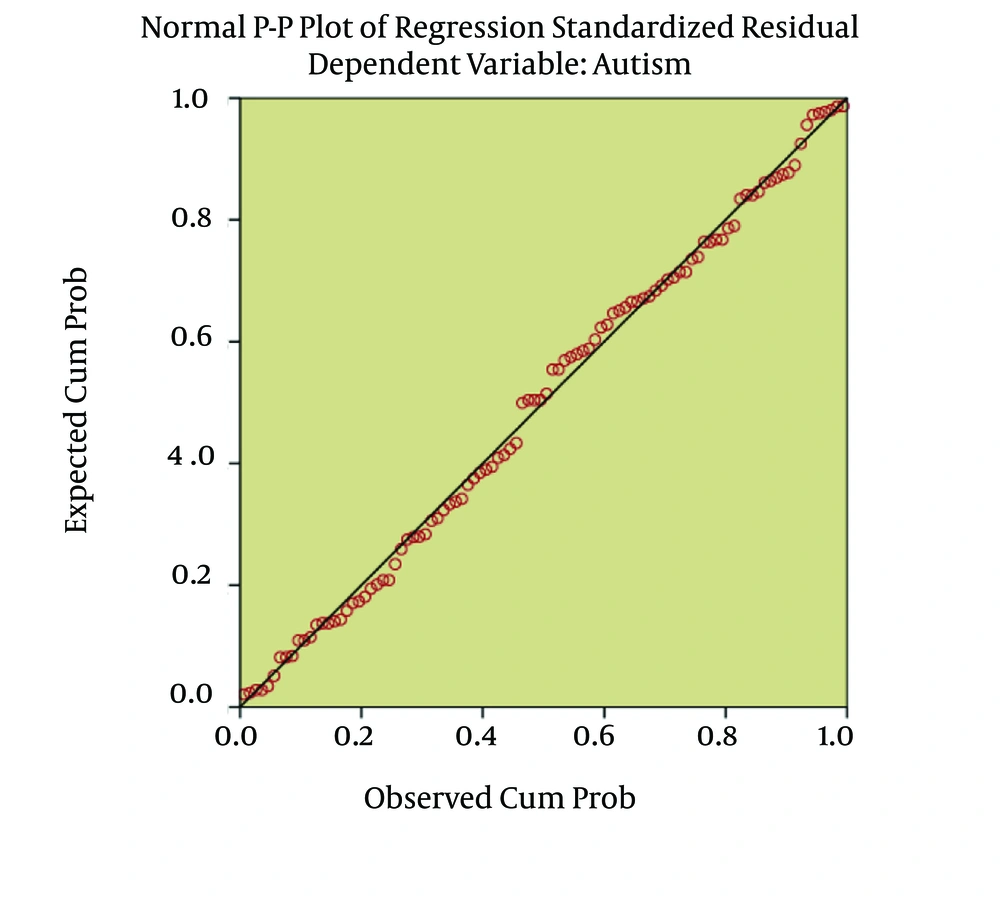
Figure 1.
Regression Standardized Residual Based Total Emotional Intelligence
To predict ASDs on the basis of total EI, the enter method regression analysis was employed, the results of which are depicted in Table 3. As the results show, the measure of F (23.008) was significant (P < 0.001) and 18.2% of the variance of ASDs was explained by total EI (∆R2 = 0.182). The regression coefficient of the predictor variable showed that total EI was able to explain the variance of ASDs significantly. The coefficient of the effect of total EI (β = -0.436) and t statistic indicated that this variable was able to predict the variance in ASDs with a 99% confidence interval in the students.
| Model | SS | df | MS | F | P | R | R2 | ∆R2 | B | SE | β | t | P |
|---|---|---|---|---|---|---|---|---|---|---|---|---|---|
| (Constant) | - | - | - | - | - | - | - | - | 33.742 | 2.605 | - | 12.952 | 0.001c |
| Regression | 183.62 | 1 | 183.62 | 23.008 | 0.001 | 0.436 | 0.190 | 0.182 | -0.107 | 0.22 | -0.436 | -4.79 | 0.001 |
| Residual | 782.13 | 98 | 7.98 | 23.008 | 0.001 | 0.436 | 0.190 | 0.182 | -0.107 | 0.22 | -0.436 | -4.79 | 0.001 |
a Dependent variable: Autism Spectrum Disorder (ASD).
b Predictors; (Constant): Total Emotional Intelligence (EI).
c Enter method regression analysis.
Figure 2 shows that the regression standardized residual based EI subscales (i.e. appraisal, utilization, and regulation of emotions) in P-P plot were a function of 45°D line. Thus, the assumption of regression normality was not violated and normality assumption was confirmed. In addition, the assumptions were tested to use the regression model. Hence, the Durbin/Watson test for independence of errors and collinearity with 2 indicators of tolerance and variance inflation factor was performed. The results showed that the value for the Durbin/Watson test was 1.948, indicating that the errors were independent. The results demonstrated that the measures of tolerance and variance inflation factor were 0.632 - 0.964 and 1.037 - 1.583, respectively. These results meant that the predictor variables were independent of each other and there was no occurrence of multicollinearity.
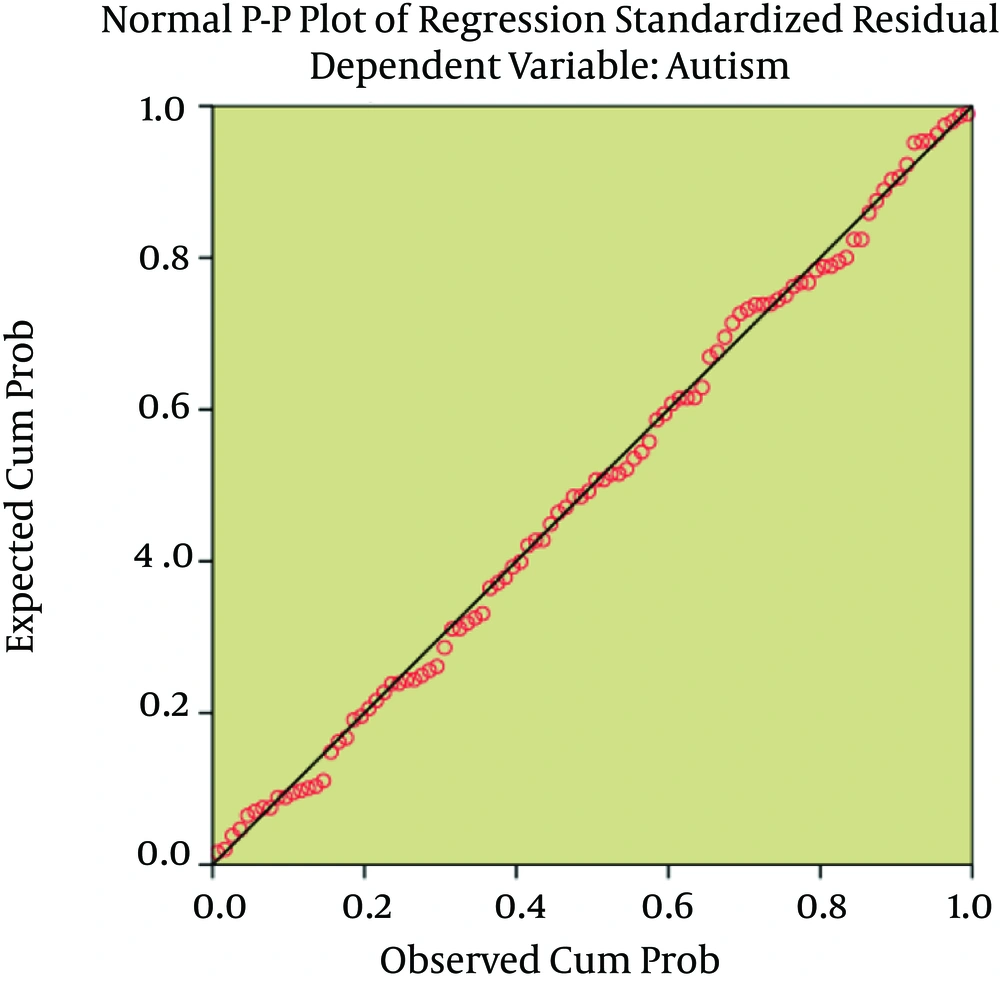
Figure 2.
Regression Standardized Residual Based Emotional Intelligence Subscales
To determine the share of EI subscales (i.e. appraisal, utilization, and regulation of emotions) in explaining the variance of ASDs in the students, regression analysis was used and the independent variables of the study (i.e. appraisal, utilization, and regulation of emotions) were entered in the regression analysis (using the stepwise method). The results are shown in Table 4. As is shown, in the first step when utilization of emotion was entered in the regression, ∆R2 was 0.199, meaning that 19.9% of the variance in ASDs was explained by utilization of emotions in the participants. In the next step, regulation of emotions was entered and ∆R2 was 0.230, meaning that utilization of emotions and regulation of emotions was able to explain 23% of the variance in ASDs. Appraisal of emotions was omitted from the regression equation.
Table 4.
| Step | Model | R | R2 | ∆R2 | F | Significant | B | SE | Beta | t | Significant |
|---|---|---|---|---|---|---|---|---|---|---|---|
| 1 | (Constant) utilization of emotions | ||||||||||
| - | - | - | - | - | 31.408 | 2.012 | - | 15.607 | P < 0.001 | ||
| 0.455 | 0.207 | 0.199 | 25.622 | P < 0.001 | -0.273 | 0.54 | -0.455 | -5.062 | P < 0.001 | ||
| 2 | (Constant) utilization of emotions regulation of emotion s | ||||||||||
| - | - | - | - | - | 33.953 | 2.284 | - | 14.868 | P < 0.001 | ||
| 0.495 | 0.245 | 0.230 | 15.775 | P < 0.001 | -0.250 | 0.054 | -0.417 | -4.647 | P < 0.001 | ||
| -0.100 | 0.045 | 0.199 | -2.215 | P < 0.029 |
a Dependent Variable: Autism Spectrum Disorder (ASD).
b Predictors; (Constant): Emotional Intelligence Subscales.
5. Discussion
The purpose of this research was to demonstrate the relationship between global EI and its aspects with ASDs in a sample of university students (both genders). Our first hypothesis was confirmed by the results, which indicated that EI and all its aspects (i.e. appraisal, utilization, and regulation of emotions) were negatively correlated with ASDs in the students. Accordingly, decreased total EI and its aspects corresponded with increased ASDs. The result is consistent with the findings of the studies conducted by Mazefsky et al. (6, 7), Laurent and Rubin (8), Myles (9), Brady et al. (10), and Samson et al. (11). Mazefsky et al. (6) showed that ASDs are associated with amplified emotional responses and poor emotional control. Brady et al. (10) indicated that young adults with ASDs acquire lower scores than healthy people in total EI, interpersonal, adaptability, stress management, and general mood. Samson et al. (11) reported high rates of emotion dysregulation in individuals with ASDs. Collectively, these findings demonstrate a strong overlap between traits and dimensions of EI and ASD traits. Deficits in EI and its components are core problems in individuals with ASDs (11). EI plays an important role in social relationships, communication, and interpersonal skills development (5). ASDs encompass disorders in which optimal social interaction and communication has been disrupted (3). Therefore, the weakness in social interaction, communication, and interpersonal skills of autistic individuals links with the defect in EI performances. Emotions are socially useful and can be constructive in transferring feelings, making social interactions, and maintaining or terminating relations with others; therefore, the appraisal, regulation, and utilization of emotions can play an effective role in healing psychological and behavioral disorders such as ASDs (10). The current finding of a negative relationship between EI and ASDs is consistent with the prior studies of social cognition in adults with Asperger's or high-functioning autism that have identified impairments in emotion perception and theory of mind (20, 21). The pattern in the literature suggests that adults with Asperger's or high-functioning autism are impaired in more complex social cognitive skills (e.g. emotional intelligence and theory of mind), which require more than emotional and affective aspects.
With regard to the second hypothesis of the current study, the results of our regression analysis indicated that global EI and 2 of its dimensions (i.e. utilization and regulation of emotions) were able to predict the variance of ASDs in the students. These results are consistent with earlier studies reporting that emotions and its components play a significant role in predicting ASD symptoms (12-14), which is to be expected. Indeed, as was stated by Lerner et al. (12), difficulties in identifying and describing feelings, deficiency in emotional regulation, absence of emotional clarity, limited access to emotion regulation strategies, and lack of utilization of emotions are risk factors for ASDs (12). Additionally, a higher percentage of the people suffering from deficits in emotional functioning, poorer EI, and lack of emotional awareness are affiliated with the potentially dissociable aspects of ASDs (13, 14). According to an EI model (5), failure in emotional mechanisms, destructive affective functions, and signs of unprocessed emotions lead to emotional/behavioral and psychological maladjustment and persistence in ASD symptoms (14, 15). Thus, lower levels of EI can be considered a risk factor and a threat to a person in a subgroup of patients vulnerable to ASDs. This finding can be further explained by the notion that the ability to understand, utilize, and regulate emotions is one of the success principles of life (5) and that failure in regulating and utilizing emotions may bring about negative outcomes such as ASDs.
The appraisal of EI and ASDs based on the self-report of subjects, who may be biased, is among the limitations of the present study. Another limitation is related to the sample group insofar as caution should be exercised in generalizing the results to external subjects. The adopted cross-sectional research design, as opposed to a longitudinal or experimental methodology, does not allow affirmative causal explanations. This study shows a partial and relative picture of the negative relationship between EI and ASDs in the community. To complete this picture, further research should be undertaken. The present study can be considered as a pilot study. Based on our findings, it can be concluded that trait EI affects behavior, self-referent cognitions, health-related quality of life, and mental and physical health status; it is, therefore, an important variable to consider in the evaluation and treatment of individuals with ASDs.
Overall, our results indicated a significant relationship between EI and its aspects and ASDs in the university students recruited in the study. In addition, total EI and 2 of its dimensions (i.e. utilization and regulation of emotions) were able to significantly predict ASDs in our study population. Therefore, examining the role and importance of EI and its dimensions in expressing ASDs in students is highly recommended and the results could be of great use to the Student Consulting Center in its endeavors to lessen ASD symptoms through considering the relevant variables and their related treatments (e.g. treatment based on EI and emotion-regulation strategies). Similarly, conducting further studies using various samples (clinical subjects with ASDs) may provide stronger evidence to confirm the role of EI and its components in predicting ASDs. Given the relationship between ASDs and EI and its dimensions among the university students in the current study, it seems essential that therapists involved in therapy and counseling centers of universities be familiarized with the methods of assessment, diagnosis, and treatment of ASDs in adults.