
1. Background
For centuries, the concept of meaning in life was an enigma for humans (1). Having meaning in life is an essential quality of humans (2). We can define meaning in life as "the amount of value that one individual feels in his/her life" (3). The meaning of life alludes to a sense of existential solidarity that tries to answer questions like what life is and its purpose. Its origins go to our most fundamental beliefs about the world, ourselves, and our relationship with the world, which leads to a diversity of people's meaning in life (4). Victor Frankl (as cited in Sipowicz) stated that the lack of meaning in life is the main reason for psychological disorders, and discovering meaning in life is an essential human need (5). Finding meaning in life can be broken down into three main components: (1) Comprehension, (2) purpose, and (3) mattering. There are three primary sources of meaning in life: (1) Creative values, (2) experiential values, and (3) attitudinal values (6). One way to find or form meaning is through our connections with others. Relational meaning in life is when an individual defines their life's purpose based on their relationships with others (3). There are many sources for relational meaning in life, like family (7), love, and self-transcendence (8).
The absence of meaning can lead to mental health problems; therefore, having a sense of meaning in life is essential for mental well-being (9). Studies have shown that meaning in life moderated the relationships between bullying victimization and suicidal ideation (10). Some studies suggest a relationship between meaning in life and physical health (11). Meaninglessness, could cause much psychological distress like anxiety, depression, and hopelessness (12, 13). Moomal showed a notable correlation between meaning in life and many psychopathologies, as indicated by the MMPI and Eysenck Personality Questionnaire (2). One crucial factor that determines personality patterns is object relations (14).
Object relations are one of the most essential topics in psychology (15). Object relations are representations of oneself and others, followed by emotions, specifying people's capacity for interpersonal relations and quality (16). Based on the object relations theory, early relations conflicts and their primary emotion and affect get recreated in new relationships (17). The challenging communication with parents in the early days of youth is the significant reason for various mental disorders in adulthood (18). Kernberg's theory of personality organization (PO) is one of object relations theories.
In Kernberg's Model of Personality Organization, there are three levels of personality organization: (1) Psychotic, (2) borderline, and (3) neurotic and the significant effect of personality organization on one's quality of relationships is comprehensible (19).
It has been said that healthcare workers, due to the stressful nature of their jobs, are at high risk for mental health symptoms (20). Studies have shown that medical practitioners are at elevated risk for suicide (21) and There is a negative correlation between the meaning of life and depression in healthcare workers (9).
Nevertheless, despite the mental health challenges of working in a healthcare system, According to Viktor Frankl, Healthcare workers, because of their job, could find a powerful meaning in their lives, which originated from the relational nature of their career, in addition to the helping and the sacrifice they made (5). So, Studying the meaning of life and predicting it in healthcare workers is crucial.
2. Objectives
There are a lack of research studies the various aspects of meaning in life, especially concerning searching for relational meaning in life from a psychodynamic perspective. This study examines how object relations and personality organization affect the search for relational meaning in life among Nursing and Psychology students, who may become healthcare professionals in the future.
3. Methods
3.1. Study Design and Participants
This cross-sectional descriptive study involved 200 nursing and psychology students (100 from each group) in Gilan province during the 2021 - 2022 academic year, selected using Convenience Sampling. We used Free Statistics Calculators version 4.0 to calculate the sample size; due to the effect size of 0.07, power of 0.90, two predictor variables, and α of 0.50, free statistics calculators suggested the sample size of 182 (22, 23), And due to the possible drops in the sample, we collected 10% more, i.e., a sample with 200 participants. Inclusion criteria required participants to be aged 18 to 45 and enrolled in nursing or psychology programs in Gilan province universities, while exclusion criteria included refusal to complete questionnaires or incomplete responses. Following the explanation of research objectives, confidentiality measures, and ethical considerations, all participants provided informed consent and completed an online questionnaire encompassing study variables and demographic information.
3.2. Instruments
Our online questionnaire has four parts to collect the study data. The instruments included a demographic questionnaire, the Relational Meaning in Life Questionnaire (RMLQ), which used its search for relational meaning in life subscale, the Bell Object Relations and Reality Testing Inventory (BORRTI), and the Inventory of Personality Organization (IPO). The demographic data form included questions on the participant's age, sex, marital status, birth order, educational field, and level.
The RMLQ questionnaire contains ten items in 2 subscales, namely, the presence of relational meaning and the search for relational meaning, and we used its search for relational meaning in the life subscale. 7-point Likert scale ranging from completely false (1) to entirely true (7) (only item 9 is scored reversely). Scores of each subscale are converted to a standard score ranging from 5 to 35. Higher scores indicate a higher sense of relational meaning in life or a greater desire to search for relational meaning in life (24). The Persian version of RMLQ has been deemed valid and its internal consistency has been assessed using the Cronbach α method, which returned a score of 0.80 (25). In this study, we have also confirmed the validity of this questionnaire and evaluated its internal consistency using the same method, which resulted in a score of 0.70.
The BORRTI scale is made up of 45 true (1) and false (0), and its questions cover the four subscales of insecure attachment (IA), alienation (ALN), social incompetence (SI), and egocentricity (EGC). This instrument was designed to measure the quality of object relations in people. Its scores get calculated by a t-score measure, and if a person gets a rate higher than 60, his/her object relations are dysfunctional. Also, items 1, 7, 8, 15, 21, 30, 37, 42, and 45 are scored reversely [true (0) and false (1)] (26). Mesgarian et al. researched the psychometric properties of BORRTI in Iran. They reported that the reliability of its factors was measured using Cronbach's α coefficient (0.66 - 0.77), split-half reliability (0.60 - 0.77), and the total ordinal correlation of the scale was found to be 0.86 (27).
The IPO contains 57 items scored on a 5-point Likert scale ranging from 1 (never true) to 5 (always true) in 3 subscales, namely, reality testing impairments (RT), identity diffusion (ID), and the primitive defense mechanisms (PD), from combination of PD and ID subscale, we reach a new subscale named borderline personality organization (28). Allebehbahani and Mohammadi conducted a study in Iran wherein they analyzed the factorial structure, validity, and reliability of a 57-item questionnaire. As a result of their analysis, the Persian version of the instrument was modified and reduced to 37 items. The reliability coefficients for the overall scale and the factors of primary defense mechanisms, identity confusion, and reality testing were found to be 0.90, 0.82, 0.68, and 0.91, respectively (29).
3.3. Data Analysis
Data analysis was performed using the SPSS 25. Descriptive statistics (frequency, percent, mean, and standard deviation) were used to describe participants' characteristics. The normality of the data distribution was evaluated using the Kolmogorov-Smirnov test. All research variables' skewness and kurtosis values ranged from +1 to -1. Since the data of this study was parametric, we used Pearson's correlation coefficients to examine the correlation between predictor variables (object relations and personality organization) and a criterion variable (search for relational meaning in life). At last, we used Stepwise regression analysis to illustrate the predicting power of predictor variables.
4. Results
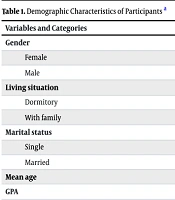
The data were collected from 200 nursing and psychology students in Gilan province. The research participants were 67.5% female and 32.5% male. The average age was 24.12, and its standard deviation was 6.23. Also, the highest age percentage was from 18 to 23 years (74.5). Table 1 presents other demographic variables.
Table 1.
Demographic and Treatment Characteristics (n = 200) a
| Characteristics | Values |
|---|---|
| Field of study | |
| Nursing | 100 (50) |
| Psychology | 100 (50) |
| Age (mean ± SD) | 24.12 ± 6.23 |
| 18 - 24 | 148 (74.5) |
| 25 - 31 | 24 (12.0) |
| 32 - 38 | 15 (7.5) |
| 39 - 45 | 12 (6.0) |
| Gender | |
| Female | 135 (67.5) |
| Man | 65 (32.5) |
| Marital status | |
| Single | 128 (64.0) |
| In an emotional relationship | 41 (20.5) |
| Married | 26 (13.0) |
| Divorced/widow | 5 (2.5) |
| Birth order | |
| First child | 104 (52.0) |
| Middle child | 23 (11.5) |
| Last child | 73 (36.5) |
a Values are expressed as No. (%) unless otherwise indicated.
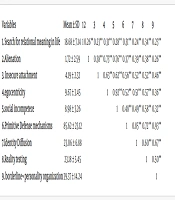
Table 2 indicate that the correlation coefficient of Object Relations subscales (insecure attachment (IA), alienation (ALN), social incompetence (SI), and egocentricity (EGC), and personality organization subscales (Primitive Defense mechanisms (PD), Identity Diffusion (ID), and reality testing (RT), and borderline personality organization), was significant in the search for the relational meaning in life (P > 0.01).
Table 2.
Means, Standard Deviations, and Bivariate Correlations for Research Variables
| Variables | Mean ± SD | 1 | 2 | 3 | 4 | 5 | 6 | 7 | 8 | 9 |
|---|---|---|---|---|---|---|---|---|---|---|
| 1. Search for relational meaning in life | 18.68 ± 7.14 | 1 | 0.26 a | 0.23 a | 0.31 a | 0.28 a | 0.31 a | 0.24 a | 0.34 a | 0.23 a |
| 2. Alienation | 1.72 ± 2.59 | 1 | 0.38 a | 0.73 a | 0.76 a | 0.37 a | 0.39 a | 0.38 a | 0.26 a | |
| 3. Insecure attachment | 4.19 ± 2.32 | 1 | 0.63 a | 0.62 a | 0.56 a | 0.52 a | 0.52 a | 0.46 a | ||
| 4. Egocentricity | 9.67 ± 3.45 | 1 | 0.92 a | 0.52 a | 0.51 a | 0.57 a | 0.36 a | |||
| 5. Social incompetece | 8.98 ± 3.26 | 1 | 0.48 a | 0.49 a | 0.58 a | 0.32 a | ||||
| 6. Primitive defense mechanisms | 85.62 ± 23.12 | 1 | 0.85 a | 0.72 a | 0.93 a | |||||
| 7. Identity diffusion | 23.06 ± 6.88 | 1 | 0.60 a | 0.67 a | ||||||
| 8. Reality testing | 23.18 ± 5.45 | 1 | 0.50 a | |||||||
| 9. Borderline personality organization | 39.37 ± 14.24 | 1 |
a Correlation is significant at the 0.01 level.
The research variables' skewness and kurtosis indices were in the mean of ±1. Cronbach's alpha for the variables of relational meaning of life, object relations, and personality organization were 0.70, 0.71, and 0.93, respectively.
Tolerance coefficient values for the predictor variables were in the range of 0.67 to 1, and the variance inflation factor (VIF) was equal to 1.48, which indicates compliance with the assumption of non-collinearity of the predictor variables.
The results of Stepwise regression analysis are illustrated in Table 3, where it could be observed that in the first step, identity diffusion (0.11) and the second step, egocentricity (0.14) predicted the variance of the search for relational meaning in life variable (P < 0.01). Other predictor variables had no significant predictive power in predicting the search for relational meaning in life (P < 0.05).
Table 3.
Stepwise Regression Analysis of the Search for Relational Meaning in Life Based on Object Relations and Personality Organization
| Variables | F | P | R2 | R | Beta | t | P |
|---|---|---|---|---|---|---|---|
| WQ2 Step 1 | |||||||
| Regression | 27.5 | 0.001 | 0.11 | 0.34 | |||
| Predictor identity diffusion | 0.34 | 5.34 | 0.001 | ||||
| Step 2 | |||||||
| Regression | 16.3 | 0.001 | 0.14 | 0.37 | |||
| Predictor egocentricity | 0.32 | 2.14 | 0.003 |
5. Discussion
This study explores the impact of object relations and personality organization on the searching for relational meaning in life among nursing and psychology students and suggests a strong positive relationship between searching relational meaning and specific factors within object relations and personality organization.
For many people, their intimate and self-transcendental relationships with other peoples are the only way to create or discover their meaning in life (8); this way of creating/discovering meaning named, relational meaning in life (3). According to this, the results of this study are not surprising because object relations are a critical factor in determining the quality of intimate relationships (30), and personality organization is one of the main theories of object relations theories (19). Since object relations are one of the most crucial parameters in individuals' pursuit and achievement of an intimate and satisfying relationship (25), it is reasonable that subscales of object relations and personality organization have significant relations with searching for relational meaning in life.
However, our results also indicated that one of the subscales of the Bell Object Relations and Reality Testing Inventory, egocentricity (0.14), and one of the subscales of Inventory of Personality Organization, identity diffusion (0.11), have significant predictive power for searching for relational meaning in life, but other variables do not. Since egocentricity is a narcissistic trait, can predict searching for relational meaning in life, because there are studies that prove narcissism is positively correlated with the sense of meaning in life through relations with significant others, since they seeks validation from others (31).
On the other hand, regarding the relationship between identity diffusion and searching for relational meaning in life, literature also suggests a relationship between identity and a sense of meaning in life. It defines identity as a phenomenon involved in social life and goal-setting in each person's life; so, in a person with identity diffusion, we can expect a total challenge with the concept of meaning in life, originating from problems with goal-setting (32). It should be worth mentioning that one with a desire to search for meaning in life probably did not find his/her meaning in life or was not satisfied with his/her current meaning in life (33). So, it is reasonable that suffering from ID plays a significant role in predicting the search for meaning in life. Individuals with ID may face challenges in forming intimate relationships, a key aspect of their life; they might seek to establish their identity through these relationships, making identity diffusion a significant predictor of the search for relational meaning and researches supports the idea that those with identity issues struggle with goal-setting and may find meaning in life through this pursuit (32).
Nursing students, face significant challenges with their identity due to external pressure, fear of not knowing enough, heavy workload, and emotional stress from working with cadavers and witnessing patient suffering (34), which could have a powerful effect on their searching for relational meaning in life. On the other hand, we can see the effect of personality traits, including egocentricity, in choosing one's career (for example, a surgical specialty in medical students or nursing or psychotherapy), Medical school students, including nursing students, may find personal and relational meaning in their field of study. It is important to consider their egocentricity when understanding their search for meaning.
It is important to note that there are certain limitations to this study. For instance, using a cross-sectional design meant that issues of causality could not be assessed. This study explored the effects of object relations and personality organization on searching for relational meaning in life. It did not cover other critical socio-psychological constructs that may play a role in this context. Future studies should investigate the impact of other relevant factors on individuals' relational meaning in life to gain a more comprehensive understanding of this phenomenon.
5.1. Conclusions
This study found a strong link between searching for relational meaning in life and Object Relations and Personality Organization in nursing and psychology students. Specifically, the subscales of Egocentricity and Identity Diffusion were significant predictors of relational meaning in life.