
Fulltext
Full-text is available in PDF format.
Journal of Nursing and Midwifery Sciences
The Official Journal of Mazandaran University of Medical Sciences
Authors
Context: It seems that more students’ engagement in the e‑learning environment leads to the use of more self‑regulated techniques in them; finally, they achieved more success.
Aim: This study aimed to determine the relationship between information and communications technology (ICT) engagement with online self‑regulated in nursing students of Mazandaran University of Medical Sciences.
Setting and Design: This research is a correlational study. The study population included all undergraduate nursing students in the 2nd to 6th semesters of Mazandaran University of Medical Sciences.
Materials and Methods: The sampling was done by accessible method according to the inclusion criteria. The sample size was estimated 272 students. In this study, in addition to examining the demographic characteristics, two standard questionnaires were used, which include: (a) ICT engagement questionnaire and (b) the online self‑regulated learning questionnaire.
Statistical Analysis Used: Inferential statistics such as ANOVA, independent t‑test, Pearson correlation coefficient, and univariate and multivariate linear regression were used.
Results: The results also showed that with multiple regression tests and Enter method, the ICT engagement, age, semesters 3, 5, and 6 and gender explain 30% of the variance of online self‑regulated in nursing students.
Conclusion: In this study, the ICT engagement and online self‑regulated had statistically significant relationship in nursing students and. So, for improving online self‑regulated, it is recommended that the officials of nursing schools provide the facility and related to ICT engagement of students.
© 2021, Author(s). This open-access article is available under the Creative Commons Attribution 4.0 (CC BY 4.0) International License (https://creativecommons.org/licenses/by/4.0/), which allows for unrestricted use, distribution, and reproduction in any medium, provided that the original work is properly cited.
Najafi M, Heidari Shahreza MA, Ketabi S. The Effect of an Online Teaching Platform on Self-concept and Self-regulation of Medical Students at Kashan University of Medical Sciences. Educ Res Med Sci. 2022;11(2):e121396. doi: https://doi.org/10.5812/erms-121396
Kamali M, Bagheri-Nesami M. The association between online self-regulated learning and E-learning acceptance among medical sciences students during the COVID-19 pandemic. J Nurs Midwifery Sci. 2022;9(3):e133520. doi: https://doi.org/10.4103/jnms.jnms_97_22
Khosrozadh M, Kordestani Moghadam P, Shahidi Delshad E, Mohammadi R, Mohammadi S, et al. Motivational Strategies for Learning Among Undergraduate Nursing Students: A Descriptive and Analytical Study. J Arch Mil Med. 2025;13(3):e164463. doi: https://doi.org/10.5812/jamm-164463
Langarizadeh M, Naghipour M, Valinejadi AL, Tabatabaei SM, yousefianzadeh O, et al. The relationship between information literacy, Internet addiction and general health of an Iranian medical students. koomesh. 2018;20(2):e152955. doi:
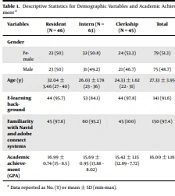
Daryazadeh S, Yavari M, Madani S, Taghavi-Ardakani A, Azadchahr MJ, et al. Correlation Between the E-learning Attitude and Academic Achievement of Medical Students in Clinical Levels. Educ Res Med Sci. 2021;10(2):e120391. doi: https://doi.org/10.5812/erms.120391
More by these authors
Last Update: 1 month ago
Last Update: 1 month ago
Last Update: 1 month ago
Last Update: 6 days ago
Last Update: 1 day ago
Last Update: 4 days ago

