
1. Background
Emotion regulation (ER) defines as the process of modulating the expression of emotions or set of emotions for achieving a purpose (1). Emotion regulation is implicate in reducing the deleterious effects of stressors (2) and difficulties with that have been shown important in numerous clinical syndromes (3). There are many ER strategies, but two of the most studied strategies are expressive suppression and cognitive reappraisal (4). Cognitive reappraisal means modifying the emotional effect of an event by thinking differently about that (5). For example, if a student fails an exam, he can reappraise the event by considering that There are many exams left and I can get good grades in them. In general, in response to aversive events, reappraisal appears to be a healthy ER strategy (4). The effectiveness of reappraisal stands in opposition to suppression, in which negative emotion demonstrate a weak, null, or paradoxical (reversed) alterations (1). For instance, an adolescent who can utilize cognitive reappraisal after hearing his parents fighting is less prone to internalize negative feelings in comparison with someone who employs emotional suppression (e.g., “I won’t show anyone that I am upset”) (6). The frequency of suppression is commonly linked with lesser well-being, more psychopathological symptoms and decreased levels of satisfaction in relationships (1).
Childhood maltreatment is defined as physical, sexual or emotional abuse and physical or emotional neglect by someone such as a parent, caregiver or other adult (7). researchers have theorized that maltreatments, especially those that have been frequent, such as child traumas, likely compromises successful ER (8, 9). For instance, results of a study on Emotion management skills in sexually maltreated and no maltreated girls that was conducted by Shipman et al. indicated that maltreated girls would demonstrate more dysregulated emotional behavior and less adaptive ER than their no maltreated peers in addition, maltreated girls show fewer situationally appropriate emotional displays and lower levels of empathy and emotional self-awareness (10). Similarly, findings in the physical maltreatment literature suggest that maltreated children demonstrate less understanding of negative emotion compared to their no maltreated peers (11). A meta-analytic review study on The Impact of abuse on coping strategies and emotional regulation during childhood and adolescence in 2020 showed similar results to previous studies. It indicated that Maltreatment was significantly related to decreased ER and increased emotion dysregulation (6).
In previous studies, most of them did not examine different forms of childhood trauma in each study, so we investigated multiple forms of abuse and neglect, including sexual abuse, physical abuse, emotional abuse, and physical and emotional neglect.
2. Objectives
Most previous studies have discussed the formation of mental disorders based on childhood traumatic experiences; but the present study aims to predict the use of reappraisal as an emotional regulation strategy in Iranian adolescents based on traumatic childhood experiences. Also, this is the first study in Iran on this topic.
3. Methods
3.1. Procedure
This descriptive-analytical study was conducted cross-sectionally among Iranian adolescents that are internet users. The convenience sampling method was used for recruiting participants. The questionnaires were designed online and their links were sent to the adolescents also the aim of the research and the principle of confidentiality were informed in several lines along with the questionnaires. Among 370 participants, 20 individuals were excluded from the analysis because they did not have inclusion criteria including: Being an adolescent (age 12 to 17), Able to read and write, and currently having accessibility to the internet.
3.2. Ethical Approval
The research proposal was approved by the research committee of the Shahid Beheshti University of Medical Sciences, with IR.SBMU.MSP.REC.1399.787 ethics code. Prior to participating in the research, all participants were informed about this research and any ethical considerations relevant to the study and filled up informed consent forms.
3.3. Childhood Traumas Questionnaire
Bernstein has designed this questionnaire in 2003 to measure childhood traumas. Aim of this screening tool is for revealing experiences of childhood abuse and neglect. Both adolescents and adults can use this questionnaire. Five types of childhood traumas, including sexual abuse, physical abuse, emotional abuse, and emotional and physical neglect are measured by this tool. The questionnaire contains 28 questions, of which 25 items for measuring the principle components of the questionnaire, and 3 items for identifying individuals who deny their childhood problems. In Bernstein et al. Cronbach's alpha coefficient of the questionnaire on a group of adolescents for dimensions of emotional abuse = 0.87, physical abuse = 0.86, sexual abuse = 0.95, emotional neglect = 0.89, and emotional neglect = 0.78 (12). In Iran, Ebrahimi et al. reported Cronbach`s Alpha in this questionnaire from 0.81 to 0.98 for its five components (13). In this study, Cronbach’s alphas for the Childhood Trauma Questionnaire (CTQ) and its subscales were as follows: Total scale = 0.93; emotional abuse = 0.76; physical abuse = 0.84; sexual abuse = 0.89; emotional neglect = 0.76; and physical neglect = 0.76.
3.4. Gross and John Emotion Regulation Scale (ERQ)
This scale is developed by gross and john to measure ER strategies. This scale consists of 10 items and has two subscales including: Reappraisal and Suppression. The answers are based on the 7 degrees Likert Scale (from the opposite to completely agreeable). Cronbach's alpha coefficient was 0.79 for Reappraisal and 0.73 for Suppression and 0.69 after 3 months for the whole scale. Another researcher obtained the validation of this questionnaire in Iran at 2018, and Cronbach's Alpha was reported above 0.7. In the present study, Cronbach's alphas for emotional reappraisal was equal to 0.67.
3.5. Statistical Analysis
Data were analyzed in two descriptively and inferentially levels. At the descriptive level the mean and standard deviation were reported for each variable and at the inferential level, hypotheses were tested using Pearson's correlation and stepwise regression analysis. Before conducting the regression analysis, its 3 assumptions were evaluated. These include the absence of uni and multivariate outliers, the normal distribution of the criterion variable (i.e., emotional reappraisal), the linear relationship between criterion and predictor variables, and the absence of multiple collinearities. Inspecting the standard scores indicated that some participants had z-scores > 3 or < -3 on some variables (3 participants on Emotional Reappraisal). However, Mahalanobis distances indicated 8 multivariate outliers. In total, eleven participants were excluded due to being the uni and multivariate outliers. Therefore, the final sample included 300 participants. The histogram of emotional reappraisal showed a close-to-normal distribution. Inspecting the scatter plots revealed a linear relationship between of emotional reappraisal and predictors. Finally, since the variance inflation factor (VIF) and the Tolerance statistics were close to 1, multiple colinearity was not present among the predictors. After ensuring these statistical assumptions, stepwise regression analysis was carried out. It should note that 39 participants were excluded from study because had denied their childhood problems based on validity scale of Childhood traumas questionnaire. All analyzes were done utilizing SPSS version 24.
4. Results
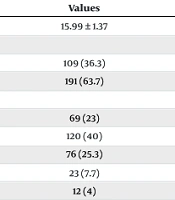
The demographic characteristics of the sample are presented in Table 1. The final sample included 300 adolescents. Their ages' mean was 15.99 (SD = 1.37). Among them, 36.3 % (n = 109) were female and 63.7% (n = 191) were male. Majority (50.7%) of adolescents were in their seventeenth. Finally, 63% of participants lived in families with low monthly income.
Table 1.
Demographic Characteristics of the Sample a
| Demographic Characteristics | Values |
|---|---|
| Age | 15.99 ± 1.37 |
| Gender | |
| Female | 109 (36.3) |
| Male | 191 (63.7) |
| Income (million tomans) | |
| 1 - 5 | 69 (23) |
| 5 - 10 | 120 (40) |
| 10 - 15 | 76 (25.3) |
| 15 - 20 | 23 (7.7) |
| More than 20 | 12 (4) |
a Values are expressed as No. (%) or mean ± SD.
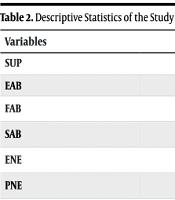
The descriptive statistics of the study variables and the correlations between them are presented in Table 2. As is evident from Table 2, emotional reappraisal had negative correlation with all predictors.
Table 2.
Descriptive Statistics of the Study Variables and the Correlations Between Them
| Variables | EMR | EAB | FAB | SAB | ENE | PNE |
|---|---|---|---|---|---|---|
| EMR | 1 | - | - | - | - | |
| EAB | -0.27 a | 1 | - | - | - | - |
| FAB | -0.44 a | 0.70 a | 1 | - | - | - |
| SAB | -0.42 a | 0.55 a | 0.66 a | 1 | - | - |
| ENE | -0.25 a | 0.66 a | 0.47 a | 0.36 a | 1 | - |
| PNE | -0.49 a | 0.65 a | 0.77 a | 0.69 a | 0.51 a | 1 |
Abbreviations: EMR, emotional reappraisal; EAB, emotional abuse; FAB, physical abuse; SAB, sexual abuse; ENE, emotional neglect; PNE, physical neglect.
a P < 0.01.
A stepwise regression analysis was conducted to identify the best predictors of emotional reappraisal. The results are reported in Table 3. As is evident from Table 3, the regression model involved two steps. Based on the standard coefficients in the final model, physical neglect and sexual abuse were the predictors.
Table 3.
The Results of the Stepwise Regression Analysis for Predicting Internet Addiction
| Step and Predictor | Unstandardized Coefficients | Standardized Coefficients | t | P | Variables' Adjusted R2 | Model's F | Model's Adjusted R2 | 95.0% Confidence Interval for b | ||
|---|---|---|---|---|---|---|---|---|---|---|
| b | S.E. | β | b | Lower Bound | Upper Bound | |||||
| 1. Constant | 32.031 | 0.808 | - | 39.666 | 0.000 | - | 15.607 | 50.302 | 30.44 | 33.62 |
| 2. Physical neglect | -0.464 | 0.084 | -.381 | -5.504 | 0.000 | 0.235 | - | 0.737 | -0.63 | -0.30 |
| 3. Sexual abuse | -0.160 | 0.072 | -0.154 | -2.221 | 0.027 | 0.245 | - | -1.481 | -0.30 | -0.02 |
In the first step, physical neglect was entered into the model (b = -0.464, β = -0.381, P < 0.001) and predicted 23.5% of the emotional reappraisal’s variance. In the second step, sexual abuse was also entered into the model (b = -0.160, β = -0.154, P < 0.05) and predicted additional 1.0% of the Internet Addiction’s variance. The final model implies that adolescents with higher scores on physical neglect and sexual abuse, use less Emotional Reappraisal as an emotional regulation strategy.
5. Discussion
The current study aimed to investigate the predictive relationships among childhood traumatic experiences and use of reappraisal as an emotional regulation method in a sample of Iranian adolescents. Based on the outcomes obtained in this study, the following were found: Physical neglect and sexual abuse expected use of reappraisal. Overall, they explained 23.5% and 1% (respectively) of variance on acquisition of reappraisal.
As children develop, they gradually acquire the ability to recognize emotion categories and understand the expressions, feeling states, and functions of emotion, aligns with the growth in cognitive and language skills. Their emotional competence allows them to effectively modulate their emotion feelings and related expressions and actions (14). In addition, Ardizzi at el. in their study have indicated that childhood maltreatment is associated with deficiencies in the processing and recognition of facial emotion expressions (15).
As mentioned, Since the capacity to self-regulate emotions is connected to various other aspects of children’s functioning, it is understandable that child and family researchers have significant emphasis on co regulation, or the processes of caregivers roles in providing external regulation or support to help children develop ER over the primary several years of life (16). Shipman at el. in their study, investigated how children's emotional regulation is influenced by the socialization practices of mothers in both physically maltreating and non-maltreating mother-child relationships. They consequences indicated that, Maltreating mothers tend to provide less validation and emotion coaching, and more invalidation in response to children's emotions compared to non-maltreating mothers (17). In addition, research on physical and sexual abuse has demonstrated that maltreating parents socialize emotion management skills differently than no maltreating parents (e.g., provide less support in response to children's emotion, engage in fewer emotion-related discussion) and that maltreated children show deficits in skills across all three emotion management categories (10, 18, 19) that include: (1) The process of encoding and decoding emotions which means identifying emotional expressions in others and producing suitable response; (2) emotional understanding, which means understanding the causes and outcomes of emotional expression; and (3) ER, that definition is the ability to regulate emotional expression and emotional experience (20).
5.1. Limitations
Although our study provides new insights regarding risky sexual behaviors in adolescents, several limitations should be considered in interpreting findings. First, the study was conducted cross-sectionally, and the results of these studies can only be cited temporarily. Second, the data gathering procedure was conducted utilizing self-report measures rather than actual behaviors that could be biased due to the respondents' inaccuracy in answering the questions. Third, the role of other factors such as the child's temperament, the number of family members, living with both biological parents or not, and the length of time they were maltreated were not investigated, which are recommended to be addressed in future studies.
5.2. Conclusions
In conclusion, this study suggests a predictive relationship between physical neglect and sexual abuse and acquisition of reappraisal among Iranian adolescents. Considering the important role of ER strategies in psychiatric disorders, studies such as the present study are necessary for clinical planning.