
1. Background
Adolescents experience psychological distress when they fail to successfully eliminate transformational crises and challenges. In some cases, this issue might lead to inefficient and even dangerous behaviors (e.g., self-harm) (1). Self-harm behaviors are defined as the deliberate destruction or alteration of the body without conscious suicidal intent (2). Evidence suggests that deliberate self-harm often starts at the age of 12 - 16 years (3).
Several studies have confirmed the role of emotion regulation factors in self-harm intentions (4). Emotion regulation is a specific form of self-regulation, through which the individual determines the type, time, and method used to experience emotions (5). Suicidal behaviors and suicide ideation are among the main areas of emotion regulation, which have recently attracted great attention (6, 7). For instance, Harris et al. (2018) reported the higher mean scores of all the components of emotion dysregulation in subjects with a history of self-harm attempts compared to those without such intentions (8).
Studies show that attachment styles (9) and initial stressful events (10) increase the frequency and intensity of non-suicidal self-injury (NSSI) through disrupting the emotion regulation process. In the early years of life, children establish a relatively stable emotional bond with and feel safe around those they interact with. Introducing this emotional relationship as an attachment for the first time, Bowlby (1980) believed that attachment in children plays a key role in human life (11). The attachment system is an organized structure, which defines a complex set of emotions, behaviors, and cognitions formed to maintain comfort and safety (12). Safe attachment is essential to developing adaptive emotion regulation (13). According to Hong and Lishner (2016), most self-harm behaviors in adolescence are influenced by insecure attachment styles even after depression control (14). Rogier et al. (2017) also stated that insecure attachment styles and difficulties in emotion regulation are most significantly correlated with self-harming behaviors (15).
Childhood trauma (16), insecure attachment styles through emotional discrediting and self-compassion lead to NSSI (17). Childhood trauma has a positive, indirect effect on psychological turmoil, self-harming behaviors, and suicidal ideation through the mediation of misdemeanor, bullying, and victimization (18). Studies show that prolonged emotional, physical, and sexual childhood abuse leads to difficulties in emotion regulation (19), self-harm, and suicide attempts (20, 21).
Identification of the direct and indirect influential factors in self-harming behaviors has been an important research priority and plays a key role in the prevention and treatment of such behaviors. Given that adolescents are the most vulnerable strata against high-risk behaviors in any community, any loss or inadequacy in their physical and mental health and the subsequent reduction of their ability inevitably slows-down community development. Therefore, evaluation of high-risk behaviors in adolescents is essential to developing preventive programs in this area. Overall, there is a research gap regarding the correlation between self-harming behaviors, the mentioned variables, and their predictive share. Therefore, not only could the influence of each variable be identified by determining a psychological pattern based on attachment styles, childhood trauma, and difficulties in emotion regulation, but also the share of these factors and probability of self-harming behaviors could be reduced by providing an intervention based on the mediating variables; notably, this would be a secondary and tertiary type of prevention.
Given the importance of this issue, we attempted to identify the underlying factors affecting self-harming behaviors in adolescents by a review of the current literature. The research question addressed the extent to which the proposed model (i.e., correlation between antecedent variables) would match the experimental data considering the mediating role of difficulties in emotion regulation in relation to self-harm. Notably, the proposed model was based on the variables that are intercorrelated and influence self-harming behaviors as previously confirmed in separate studies on different populations. We proposed a model that specifically discovered and identified the impact level of each factor on self-harming behaviors in the community.
2. Objectives
The present study aimed to evaluate the mediating role of difficulties in emotion regulation in the correlation between attachment styles and childhood trauma with self-harming behaviors in adolescents.
3. Methods
This survey was performed on adolescents aged 15 - 18 years in Kermanshah, Iran in 2019. Kline (2011 [cited in Sevari et al.]) recommends selecting 10 - 20 respondents per parameter, while in structural equation modeling (SEM), smaller sample sizes than 100, between 100 - 200, and larger than 200 are considered small, moderate, and large, respectively (law of N ≥ 100) (22). Given the total population of students in Kermanshah (n = 20,070), the sample size of this study was estimated at 400, and the participants were selected via convenience sampling.
Since the subjects were the high school students of Kermanshah city, the first step was to choose schools. Initially, 30 schools (15 girls’ schools and 15 boys’ schools) were selected from each district via simple random sampling based on the number of the schools in each region covered by healthcare centers. Afterwards, 15 schools with a history of self-harming behaviors (determined by referring to their psychological health files in the school or healthcare centers of the district) were selected via convenience sampling. Ultimately, 400 students were selected based on the inclusion and exclusion criteria.
The inclusion criteria were as follows: 1- age of 15 - 18 years; 2- no drug abuse; 3- receiving no psychological treatment or social welfare services; 4- failure to receive psychiatric medication within four months prior to participation; and 5- a history of self-harm. The exclusion criteria were unwillingness to participate and diagnosis of psychotic disorders.
The research tools were completed by all the participants following the sampling process, and sampling and data collection stages continued for 10 months. Data analysis was performed in SPSS version 24 and AMOS version 23 using SEM.
3.1. Research Instruments
3.1.1. Self-harm Behavior Questionnaire
The Self-harm Behavior Questionnaire (SHBQ) has 39 item. The psychometric properties of the SHBQ were assessed in a study performed on 235 students in Iran. The obtained results showed a correlation between the students’ SHBQ scores and other clinical scales assessing the symptoms of borderline personality disorder, suicide ideation, depression, and anxiety. In addition, the reliability of the scale has been confirmed at the Cronbach’s alpha of 0.88, 0.80, and 0.94 for intrapersonal and interpersonal factors and the entire scale, respectively (23). In the current research, the reliability of the SHBQ was confirmed at the Cronbach’s alpha of 0.95.
3.1.2. Difficulties in Emotion Regulation Scale
The Difficulties in Emotion Regulation Scale (DERS) has been developed by Gratz and Roemer (2004) and consists of 36 items, which are scored based on a five-point Likert scale. The validity and reliability of the DERS were assessed in a study conducted by Gratz and Roemer on 479 BSc students, and the results showed the proper internal consistency of the scale both in terms of the total score (Cronbach’s alpha: 0.93) and scores of the subscales (Cronbach’s alpha: 0.80) (8). In a study conducted by Karami et al. (2018), the reliability of the tool was confirmed at the Cronbach’s alpha of 0.93 (24). In the present study, the reliability of the DERS was confirmed at the Cronbach’s alpha of 0.78.
3.1.3. Adult Attachment Questionnaire
The Adult Attachment Questionnaire (AAQ) is a self-report instrument with two subscales of avoidance and ambivalence (attachment anxiety). In a study performed by Pakdaman (2004) on 100 adolescents, the test-retest reliability of the AAQ was estimated at 0.72, 0.56, and 0.37 for ambivalent, avoidance, and secure attachment. In addition, the reliability of the tool has been confirmed at the Cronbach’s alpha of 0.79 (25). In the present study, the reliability of the AAQ was confirmed at the Cronbach’s alpha of 0.74.
3.1.4. Childhood Trauma Questionnaire
The Childhood Trauma Questionnaire (CTQ) was developed by Bernstein et al. in 1994 (26). In a study by Essien et al., the convergent validity of the instrument was calculated to be 0.39 with a general health questionnaire in a group including 161 adolescents in Nigeria. In addition, the reliability of the CTQ has been confirmed at the Cronbach’s alpha of 0.80 (27). In Iran, the reliability of the short version of the CTQ was reported to have the Cronbach’s alpha value of 0.81 - 0.98 (28). In the present study, the reliability of the CTQ was confirmed at the Cronbach’s alpha of 0.88.
4. Results
In total, 188 of the subjects (47%) were female, and 212 (53%) were male. Table 1 describes mean values of research variables. kurtosis and skewness were applied to evaluate the hypothesis of univariate and multivariate normality. According to the obtained results, the values of kurtosis and skewness were within an acceptable range (kurtosis ± 5, skewness ± 3). According to the findings, all the variables had normal distribution (Table 2), and the distribution of the variables with skewedness ± 3 and kurtosis ± 5 was normal as well. Construct validity and Cronbach’s alpha were used to determine the validity and reliability of the instruments. Composite reliability values were higher than 0.7, which confirmed the composite or construct validity of the research tools. In addition, convergent validity was confirmed based on four conditions, and the AEV value was higher than the MSV and ASV values, thereby confirming the differential (divergent) validity of the model (Table 3).
Table 1.
Statistical Description of Mean Values of Self-harming Behaviors, Difficulties in Emotion Regulation, Childhood Trauma, and Attachment Styles
| Variable | No. | Mean ± SD |
|---|---|---|
| Self-harming behaviors | ||
| Intrapersonal behaviors | 400 | 0.727 ± 0.442 |
| Interpersonal behaviors | 400 | 0.636 ± 0.426 |
| Questionnaire | 400 | 0.671 ± 0.409 |
| Difficulties in emotion regulation | ||
| Non-acceptance of emotional responses | 400 | 2.687 ± 0.627 |
| Difficulties in managing purposeful behavior | 400 | 3.285 ± 1.109 |
| Difficulties in impulse control | 400 | 3.054 ± 1.093 |
| Lack of social awareness | 400 | 3.135 ± 0.914 |
| Limited access to emotion regulation strategies | 400 | 2.959 ± 0.96 |
| Lack of emotional clarity | 400 | 2.732 ± 0.625 |
| Questionnaire | 400 | 2.95 ± 0.694 |
| Childhood trauma components | ||
| Emotional abuse | 400 | 1.326 ± 1.106 |
| Physical abuse | 400 | 0.744 ± 0.912 |
| Sexual abuse | 400 | 0.509 ± 0.792 |
| Emotional negligence | 400 | 2.256 ± 1.013 |
| Physical negligence | 400 | 1.147 ± 0.604 |
| Process of denial | 400 | 2.306 ± 1.848 |
| Questionnaire | 400 | 1.284 ± 0.448 |
| Attachment styles | ||
| Avoidant secure attachment | 400 | 2.805 ± 0.746 |
| Avoidant insecure attachment | 400 | 2.805 ± 0.746 |
| Ambivalent insecure attachment | 400 | 2.923 ± 0.878 |
| Questionnaire | 400 | 2.857 ± 0.468 |
Table 2.
Variable Normality Assessment Indices
| Variable | Kurtosis | c.r. | Skewness | c.r. |
|---|---|---|---|---|
| Attachment styles | 0.624 | 1.335 | 0.578 | 1.765 |
| Childhood trauma | 0.532 | 1.423 | 0.345 | 0.657 |
| Difficulties in emotion regulation | 0.613 | 1.454 | 0.289 | 0.78 |
| Self-harming behaviors | 0.584 | 1.321 | 0.395 | 0.598 |
Table 3.
Results of Composite Reliability and Construct Validity
| Variable | ASV | MSV | AVE | CR |
|---|---|---|---|---|
| Self-harming behaviors | 0.511 | 0.716 | 0.654 | 0.821 |
| Difficulties in emotion regulation | 0.456 | 0.519 | 0.612 | 0.809 |
| Childhood trauma | 0.498 | 0.507 | 0.712 | 0.867 |
| Attachment styles | 0.501 | 0.598 | 0.692 | 0.763 |
Table 4 shows the correlation matrix of the study variables. Accordingly, a moderate correlation was observed between attachment and difficulties in emotion regulation. Moreover, a low correlation was denoted between childhood trauma and difficulties in emotion regulation and between difficulties in emotion regulation and self-harming behaviors. On the other hand, a very low correlation was observed between childhood trauma and attachment and between self-harming behaviors and attachment.
Table 4.
Results of Correlation Matrix
| Childhood Trauma | Attachment | Difficulties in Emotion Regulation | Self-harming Behaviors | |
|---|---|---|---|---|
| Childhood trauma | 1 | |||
| Attachment styles | 0.018 | 1 | ||
| Difficulties in emotion regulation | 0.374 | 0.601 | 1 | |
| Self-harming behaviors | 0.247 | 0.001 | 0.355 | 1 |
The results obtained from the first-order confirmatory factor analysis (CFA) of the observed variables, self-harming behaviors, difficulties in emotion regulation, childhood trauma, and attachment styles were assessed in AMOS version 23. In addition, the goodness-of-fit criteria of the model were evaluated for the four instruments. Validity was also confirmed given a higher load factor than 0.5 and the significance level of above 1.96. Notably, the load factor must be above 0.5, while the significance level should not be above ± 1.96. The first-order CFA shown in Table 5 confirmed the goodness-of-fit indices of all the instruments. Structural equation modeling was carried out after validity and reliability analysis, and the fit of the model was assessed by AMOS version 23 (Tables 6 and 7). The same method used for the measurement models was applied to interpret the goodness-of-fit criteria of the SEM.
Table 5.
Goodness-of-Fit Indices of Questionnaire Measurement Model
| Index | Optimal Range | Self-harming Behaviors | Difficulties in Emotion Regulation | Childhood Trauma | Attachment Styles |
|---|---|---|---|---|---|
| CMIN/DF | < 3 | 2.65 | 2.54 | 2.89 | 2.91 |
| GFI | > 0.90 | 0.90 | 0.91 | 0.91 | 0.93 |
| AGFI | > 0.90 | 0.93 | 0.89 | > 0.90 | > 0.90 |
| CFI | > 0.90 | 0.94 | 0.92 | 0.92 | 0.93 |
| IFI | > 0.90 | 0.94 | 0.95 | 0.92 | 0.92 |
| NFI | > 0.90 | 0.94 | 0.93 | 0.93 | 0.95 |
| NNFI | > 0.90 | 0.93 | 0.94 | 0.92 | 0.94 |
| T-value | > 0.05 | 0.000 | 0.000 | 0.000 | 0.000 |
| RMSEA | < 0.08 | 0.055 | 0.07 | 0.074 | 0.067 |
Table 6.
Research Hypothesis Testing Based on SEM
| Research Hypotheses | Standard Error Estimate | S.E. | C.R. | T | ||
|---|---|---|---|---|---|---|
| Self-harming behaviors | ← | Attachment | -0.015 | 0.21 | -0.703 | 0.83 |
| Difficulties in emotion regulation | ← | Attachment | -0.581 | 0.74 | -10.227 | 0 |
| Difficulties in emotion regulation | ← | Childhood trauma | 0.371 | 0.82 | 3.538 | 0 |
| Self-harming behaviors | ← | Childhood trauma | 0.305 | 0.57 | 4.42 | 0 |
| Self-harming behaviors | ← | Difficulties in emotion regulation | 0.301 | 0.72 | 3.659 | 0 |
Table 7.
Goodness-of-Fit Indices
| Indices | Values |
|---|---|
| CMIN/DF | 2.5 |
| RMSEA | 0.75 |
| GFI | 0 |
| AGFI | 0.4 |
| CFI | 0.1 |
| IFI | 0.3 |
| NFI | 0.5 |
| NNFI | 0.4 |
| t | 0.05 |
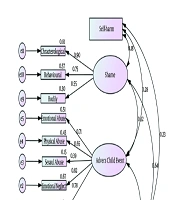
The first hypothesis regarding the effect of attachment on self-harming behaviors was ruled out (β = -0.015; t = -0.703) (Table 6 and Figure 1). However, hypotheses 2 - 5 regarding the effect of attachment on difficulties in emotion regulation (β = -0.581; t = -10.227), effect of childhood trauma on difficulties in emotion regulation (β = 0.371; t = 3.538), effect of childhood trauma on self-harming behaviors (β = 0.305; t = 4.420), and effect of difficulties in emotion regulation on self-harming behaviors (β = 0.301; t = 3.653) were confirmed.
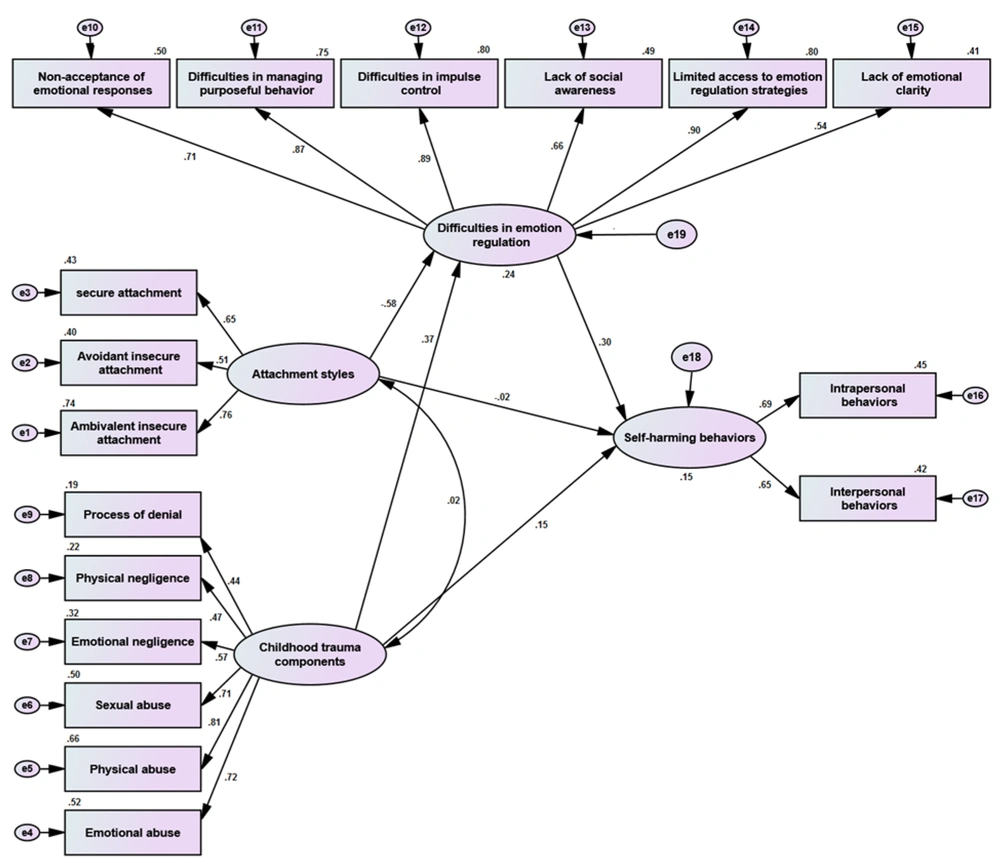
Figure 1.
Standard SEM
In terms of the mediating role of difficulties in emotion regulation in the correlation between attachment and self-harming behaviors, the direct path of the effect of attachment in self-harming behaviors was considered non-significant, whereas the indirect paths (effects of attachment on difficulties in emotion regulation and difficulties in emotion regulation on self-harming behaviors) were considered significant. As a result, the variable of difficulties in emotion regulation was recognized as a completely mediating variable between the other two variables.
In terms of the mediating role of difficulties in emotion regulation in the correlation between childhood trauma and self-harming behaviors, the direct and indirect paths of the effect of childhood trauma in self-harming behaviors were considered significant; the indirect paths were the effects of childhood trauma on difficulties in emotion regulation and difficulties in emotion regulation on self-harming behaviors. Therefore, the variable of difficulties in emotion regulation was regarded as a partially mediating variable between the two other variables.
Based on the value of the coefficient of determination (r2), the variables of attachment and childhood trauma predicted r2 = 0.24 of the changes in difficulties in emotion regulation. Moreover, the variables of difficulties in emotion regulation, attachment, and childhood trauma predicted r2 = 0.15 of the changes in self-harming behaviors.
5. Discussion
The results of the present study indicated a negative, direct correlation between attachment styles and difficulties in emotion regulation. In this respect, our findings are in line with the results of previous studies (9, 14, 17). Many individuals could easily deal with stress due to proper emotional relations with their parents during adolescence. Such an emotional relationship with parents helps adolescents learn to manage extreme emotions and reduce emotional distress. In contrast, those with unfavorable emotional relations with their parents and those whose parents (one of both) are physically and emotionally unavailable often have negative emotional experiences. Children’s expectations of the sensitivity, availability, and responsiveness of primary caregivers lead to different levels of attachment to the caregiver during infancy, through which children gradually internalize the behavioral patterns of themselves and others (29).
The findings of the current research demonstrated a positive, direct correlation between childhood trauma and difficulties in emotion regulation, which is consistent with the results of previous studies (19-21). It seems that an experience of severe trauma increases impulsivity, which reduces the brain’s capacity for response inhibition and controlling negative emotions, thereby increasing the risk of self-harming behaviors (19). Difficulties in emotion regulation are caused by several factors, such as genetic factors and childhood damages. Childhood emotional abuse is associated with emotion regulation problems, the intention to adopt incompatible emotion regulation strategies (e.g., alcohol consumption and drug abuse), and emotional breakdown (30). Evidence also suggests that childhood trauma has a debilitative effect on the brain development of children and adolescents; emotional disorders are one of the most likely outcomes in such cases. Furthermore, childhood abuse and neglect might result in chronic disabilities against emotional fluctuations, ultimately increasing the risk of emotional disorders such as depression and suicidal intentions (19). Children and adolescents who are exposed to different forms of disturbing experiences might have feelings such as helplessness and disability, confusion and instability, as well as difficulties in emotional self-regulation (31). Therefore, turning to self-harm may be a strategy in these cases to avoid unpleasant emotional states immediately.
Our findings indicated a positive, direct correlation between difficulties in emotion regulation and self-harming behaviors, which is congruent with the results of previous studies (4, 6). Difficulty in the regulation of one’s emotions increases the probability of high-risk thoughts, including suicidal ideation. Notably, the components of difficulty in impulse control and limited access to emotion regulation strategies could most significantly predict suicidal thoughts in our subjects. In other words, more difficulties in impulse control and more limited access to emotion regulation strategies increase the risk of suicidal thoughts. Individuals often exhibit self-harming behaviors and suicidal attempts as a means to escape unbearable and negative emotional experiences. Those with self-harming behaviors experience higher emotion dysregulation compared to others. With a consistent lack of self-reported emotional regulation by individuals, self-harming behaviors are also expected to increase (7).
In the present study, self-harming behaviors were considered an attempt to express, objectify, or manage negative emotional states. However, these behaviors often persist due to their impact on the reduction of negative emotions or creating positive states and liberation from emotionlessness and emotional numbness (32). Regarding the role of self-harm in emotion regulation as an attention allocation strategy, such behaviors deviate one’s attention from disruptive emotional stimuli and lead to carelessness, distraction, and the repression and avoidance of unpleasant emotional states, ultimately encouraging self-harming behaviors.
The results of the present study indicated a negative correlation between attachment styles and self-harming behaviors considering the mediating role of difficulties in emotion regulation. In this regard, our findings are consistent with the results of previous studies (9, 14, 16). Based on the viewpoints of attachment theorists such as Bowlby, child and adult psychological traumas stem from dysfunctional relationships between children and their caregivers, and attachment styles play a key role in the emergence of problematic behaviors. Accordingly, the optimal predictor of future self-harm behaviors is experiencing emotional neglect in childhood and a chaotic family environment (33). Lack of a responsible caregiver and not meeting the demands of children during childhood lead to emotional distress. The child or adolescent becomes aggressive to protest, and since they cannot express their anger in any other way or get help, they turn to self-harming behaviors. Therefore, self-harm is a sign of internal tension that has a public and a private message (34). Self-harming behaviors are a means to control extreme emotions that cannot be expressed verbally (35).
The current research shows a positive correlation between childhood trauma and self-harming behaviors through the mediation of difficulties in emotion regulation, which is consistent with the results of previous studies (19-21). As mentioned earlier, childhood trauma has a debilitative effect on the brain development of children and adolescents; such an example is emotional disorders. Childhood abuse and neglect might also lead to chronic disabilities in dealing with emotional fluctuations, thereby increasing emotional disorders such as depression and suicidal intentions (20). Emotional abuse and neglect are a form of emotional deprivation leading to depression, and major depressive disorder is significantly associated with suicidal ideation. Therefore, emotional, physical, and sexual abuse may trigger stress systems driven by the hypothalamic-pituitary-adrenal axis. Factors such as abandonment, inattention to primary needs, and physical harms in childhood act as a catalyst in adulthood, such that chronic and severe dysphoric, impulsive feelings in the form of self-destructive behaviors, suicide threats/attempts, disturbed interpersonal relationships, and extreme dependence may result from such disturbing experiences in early life.
5.1. Limitations of the Study
One of the main limitations of the present study was the use of self-report tools. Most adolescents may not be willing to respond to questions about self-harm and disturbing experiences. Therefore, it is suggested that other data collection methods (e.g., interviews) be used to collect data. Another limitation was the differences between the participants regarding their economic, social, and cultural status, as well as in population composition, and gender, which might have affected the results. Since the current research was only performed in Kermanshah, it is recommended that similar investigations be conducted in other cities with different social and cultural contexts as cultural and social backgrounds largely influence the relationship between parents and children.
5.2. Conclusions
According to the results, insecure attachment styles and an experience of childhood trauma made adolescents susceptible to self-harm through their negative effects on the emotional regulation of these individuals. Self-harm in adolescents is a response to childhood damages and mistreatments. From the perspective of the four-factor self-harming model (1), self-harming behaviors in adolescents act as a ‘negative reinforcer’ in social situations. Adolescents engage in self-harming behaviors as a response to the experience of misbehaviors toward them during childhood to convey a message that cannot be expressed in any other way. The nature of self-harming behaviors is similar to that of paradoxical self-medication, which may be an emotionally liberating experience for the abused adolescent. In conclusion, it is recommended that emotion regulation be considered as a concept affecting the control and reduction of self-harming behaviors in adolescents. Self-harming behaviors could be minimized by improving emotion regulation in this population.