
1. Background
Urinary tract infections (UTIs) are among the most frequent diagnoses in adult emergency departments (EDs) and account for a large proportion of antibiotic prescriptions (1, 2). Although these treatments are often essential for managing UTIs, inappropriate or excessive antibiotic use substantially contributes to the emergence of bacterial resistance, a rapidly growing public health issue worldwide (3). As the fifth-largest consumer of antibiotics in Europe, France has worryingly high resistance rates, particularly in high-consumption areas such as the Hauts-de-France region.
Emergency departments lie at the interface between inpatient and outpatient care and are therefore key settings for antibiotic stewardship programs. Given the high volume of visits and prescriptions each year, decisions made in this context can influence bacterial ecosystems within and around hospitals. However, the inherent challenges of this environment, including a heavy workload, heterogeneous prescribers, and limited time for diagnosis, increase the likelihood of inappropriate prescribing (4, 5).
The 2018 guidelines issued by SPILF emphasize appropriate empirical antibiotic therapy based on local bacterial ecology and short treatment durations to curb the emergence of resistance (6, 7). Nevertheless, the substantial discrepancies observed in clinical practice underscore the need to thoroughly evaluate current prescribing patterns and develop strategies for improvement.
2. Objectives
The primary objective of this study was to assess the extent to which antibiotic prescriptions for uncomplicated UTIs in the ED complied with the SPILF French national guidelines. The secondary objectives were to characterize local bacteriological profiles and resistance patterns and to identify reasons for noncompliance with these guidelines.
3. Methods
3.1. Study Design
This retrospective, single-center study was conducted at Amiens-Picardie University Medical Center, Amiens, France. The study examined the medical records of patients admitted to the ED with a diagnosis of acute uncomplicated UTI between January 1, 2021, and December 31, 2023. The study protocol, information form, and consent form were approved by the institutional review board of our university hospital and registered under PI2023_843_0105.
3.2. Study Population
3.2.1. Inclusion Criteria
The main inclusion criteria were age 18 years or older and presentation to the ED for an acute uncomplicated UTI. This condition was defined as 1) cystitis, whether recurrent or not and regardless of the risk of complications; 2) acute male UTI, regardless of the risk of complications; and 3) acute pyelonephritis (APN), regardless of severity and risk of complications.
3.2.2. Noninclusion Criteria
The main noninclusion criteria were other urological conditions; absence of microbiological examination of urine (MEU) data in males, because this test is mandatory for diagnosing male UTIs; presence of an indwelling urinary catheter; pregnancy; sexually transmitted infection; presentation to the ED from a hospital ward; and refusal to allow research use of personal medical data (Appendix 1 in Supplementary File).
3.2.3. Exclusion Criteria
Patients receiving home care, those with hypogastric abdominal pain unrelated to a UTI, and those with an uncomplicated UTI who were admitted to the hospital for other reasons, such as acute kidney injury or electrolyte imbalance, were excluded from the analysis.
3.3. Data Collection and Interventions
Data were extracted from two electronic medical record platforms: ResUrgences® (Berger-Levrault SA, Boulogne-Billancourt, France) and DxCare® (Dedalus France, Artigues-près-Bordeaux, France).
Extracted data included 1) demographics: age, sex, dependency according to the French Groupe Iso-Ressource (GIR) dependency classification (Appendix 2 in Supplementary File), and the Charlson Comorbidity Index (CCI; Appendix 3 in Supplementary File) (8); 2) comorbidities: urological history and chronic conditions, such as kidney failure, cancer, and diabetes; 3) clinical context: reason for consultation; symptoms, including dysuria, flank pain, fever at home, feeling feverish, hematuria, signs of urinary dysfunction, pollakiuria, abdominal pain, a burning sensation on urination, and right or left flank pain; vital signs, including heart rate, systolic blood pressure, body temperature, and mental status; and the quick Sequential Organ Failure Assessment (qSOFA; Appendix 4 in Supplementary File) (9, 10); 4) investigations: urine dipstick test, MEU, blood cultures, laboratory assays, including C-reactive protein, white blood cell count, and creatinine, and imaging results; 5) antibiotic prescriptions: antibiotic molecule, dose regimen, treatment duration, and adjustments according to urine culture results; 6) hospital admission within the previous 6 months; 7) risk factors for multidrug-resistant bacteria: multiple hospital admissions; antibiotic therapy with amoxicillin-clavulanic acid, second- or third-generation cephalosporins, or fluoroquinolones within the previous 3 months; nosocomial infection; prior colonization or infection with third-generation cephalosporin-resistant Enterobacteriaceae within the previous 3 months; recent travel within the previous 3 months to high-risk geographic regions, including the Indian subcontinent, Southeast Asia, the Middle East, North Africa, and the Mediterranean Basin; or structural/functional abnormalities of the urinary tract; 8) ongoing treatments: antiplatelet drugs, anticoagulants, angiotensin-converting enzyme inhibitors, sartans, diuretics, or immunosuppressants; 9) place of residence: an institution or the patient’s own home; 10) identified bacteria and their resistance profiles; and 11) post-ED follow-up: another consultation or hospital admission within 30 days, changes to antibiotic therapy after 72 hours, and recurrence within 90 days.
3.4. Outcome Measures
The primary outcome was compliance of the antibiotic prescription with the SPILF guidelines in terms of antibiotic molecule, dose regimen, and treatment duration.
To identify potential risk factors associated with noncompliant management, secondary outcomes included the incidence of antibiotic prescription adjustments at 48 or 72 hours, the nature of bacterial isolates, and their resistance profiles.
3.5. Statistical Analysis
Study data were collected anonymously. Data were entered and analyzed using Microsoft Excel 2019 software (Microsoft Corporation, Redmond, WA, USA) and R software (R Foundation for Statistical Computing, Vienna, Austria; version 4.3.2, 2023 - 10 - 31). Descriptive analyses were used to summarize patient characteristics, administered treatments, and UTI characteristics. Continuous variables were expressed as mean ± standard deviation or median [interquartile range (IQR)], depending on their distribution. Categorical variables were expressed as frequency (percentage).
Bivariate analyses were used to explore associations between variables. Data were stratified according to compliance or noncompliance with the management protocol. For categorical variables, the chi-squared test or Fisher exact test was used, as appropriate. For continuous variables, the Student t-test or the Mann-Whitney U test was applied, depending on whether the data were normally distributed. The threshold for statistical significance was set at P < 0.05.
Multivariate logistic regression analysis was used to evaluate the association between guideline-compliant antibiotic prescriptions and selected clinically relevant explanatory variables, including sex, age, diagnosis, CCI, length of stay in the ED, hypertension, diabetes, cardiopathy, home care, risk factors for complications, flank pain, serum creatinine, and serum urea. Variables with P < 0.20 in bivariate analysis were included in the multivariate model. Multicollinearity was assessed using the Belsley-Kuh-Welsch technique, and heteroskedasticity and residual normality were tested using the White test and Shapiro-Wilk test, respectively. The threshold for statistical significance in the multivariate model was set at P < 0.05. Patients with missing data were excluded from the analysis.
4. Results
4.1. Characteristics of the Study Population
A total of 4749 cases were initially identified as potential uncomplicated UTIs (Figure 1). After application of the predefined criteria, the final analysis included 456 patients: 178 (39.0%) with cystitis, 95 (20.8%) with male UTI, and 183 (40.2%) with APN. There were 338 female patients (74.1%) (Table 1).
Table 1.
Demographic, Clinical, Comorbidity-Related, and Symptom-Related Characteristics of Patients Presenting at the ED for a UTI a
| Variables | Total Study Population (n = 456) |
|---|---|
| Demographic characteristics | |
| Age (y) | 41 (31 - 58) |
| Sex (female/male) | 338 (74.1) / 118 (25.9) |
| Charlson Comorbidity Index | 1 [0; 2] |
| Living in an institution | 11 (2.4) |
| GIR dependency level | |
| Level 6 | 410 (89.9) |
| Level 5 | 19 (4.2) |
| Level 4 | 8 (1.7) |
| Level 3 | 7 (1.5) |
| Level 2 | 2 (0.5) |
| Level 1 | 5 (1.1) |
| Not reported | 5 (1.1) |
| Vital signs on admission | |
| Heart rate (bpm) | 91 [79; 103] |
| Systolic blood pressure (mmHg) | 135 [121; 146] |
| Mean blood pressure (mmHg) | 97 [86; 106] |
| Temperature (°C) | 36.7 [36.1; 37.2] |
| No alteration in cognitive status | 456 (100.0) |
| Symptoms reported | |
| Right or left flank pain | 230 (50.4) |
| Burning sensation upon urination | 229 (50.2) |
| Abdominal pain | 184 (40.4) |
| Pollakiuria | 119 (26.1) |
| Signs of urinary dysfunction | 111 (24.3) |
| Hematuria | 93 (20.4) |
| Dysuria | 90 (19.7) |
| Feeling feverish | 88 (19.3) |
| Lower abdominal pain | 63 (13.8) |
| Fever at home | 41 (9.0) |
| Comorbidities | |
| Patients with urological comorbidities | 102 (31.0) |
| Cystitis | 52 (11.4) |
| Pyelonephritis | 45 (9.9) |
| Renal colic | 23 (5.0) |
| Previous male UTI | 19 (4.2) |
| Previous surgery | 14 (3.1) |
| Benign prostatic hypertrophy | 12 (2.6) |
| Urinary tract malformation | 8 (1.8) |
| Neoplasia | 7 (1.5) |
| Kidney transplant | 1 (0.2) |
| Patients with other comorbidities | |
| Hypertension | 68 (14.9) |
| Smoking | 37 (8.1) |
| Cardiac pathology | 35 (7.7) |
| Diabetes | 32 (7.0) |
| Stroke | 18 (3.9) |
| Alcohol abuse | 9 (2.0) |
| Solid cancer | 6 (1.3) |
| Immunocompromised status | 2 (0.4) |
| Risk factors for complications | |
| Patients with risk factors | 137 (30.1) |
| Urinary tract anomaly | 12 (8.7) |
| Male sex | 118 (86.2) |
| Creatinine clearance rate < 30 mL/min | 5 (3.6) |
| Frailty | 20 (14.6) |
| Age > 75 (y) | 43 (31.4) |
| Patients with ESBL risk factors | 45 (9.9) |
| Hospital admission within the previous 3 (mo) | 29 (6.4) |
| Antibiotic use within the previous 6 (mo) | 44 (9.6) |
| Residence in an institution | 9 (1.9) |
| Travel to high-risk countries | 3 (0.7) |
| ESBLPE within the previous 6 (mo) | 1 (0.2) |
a Values are expressed as median [interquartile range] or and No. (%). Abbreviations: bpm, beats per minute; ED, emergency department; ESBLPE, extended-spectrum beta-lactamase-producing Enterobacteriaceae; GIR, Groupe Iso-Ressources, a French classification system used to assess dependency level in older individuals; mmHg, millimeters of mercury; UTI, urinary tract infection.
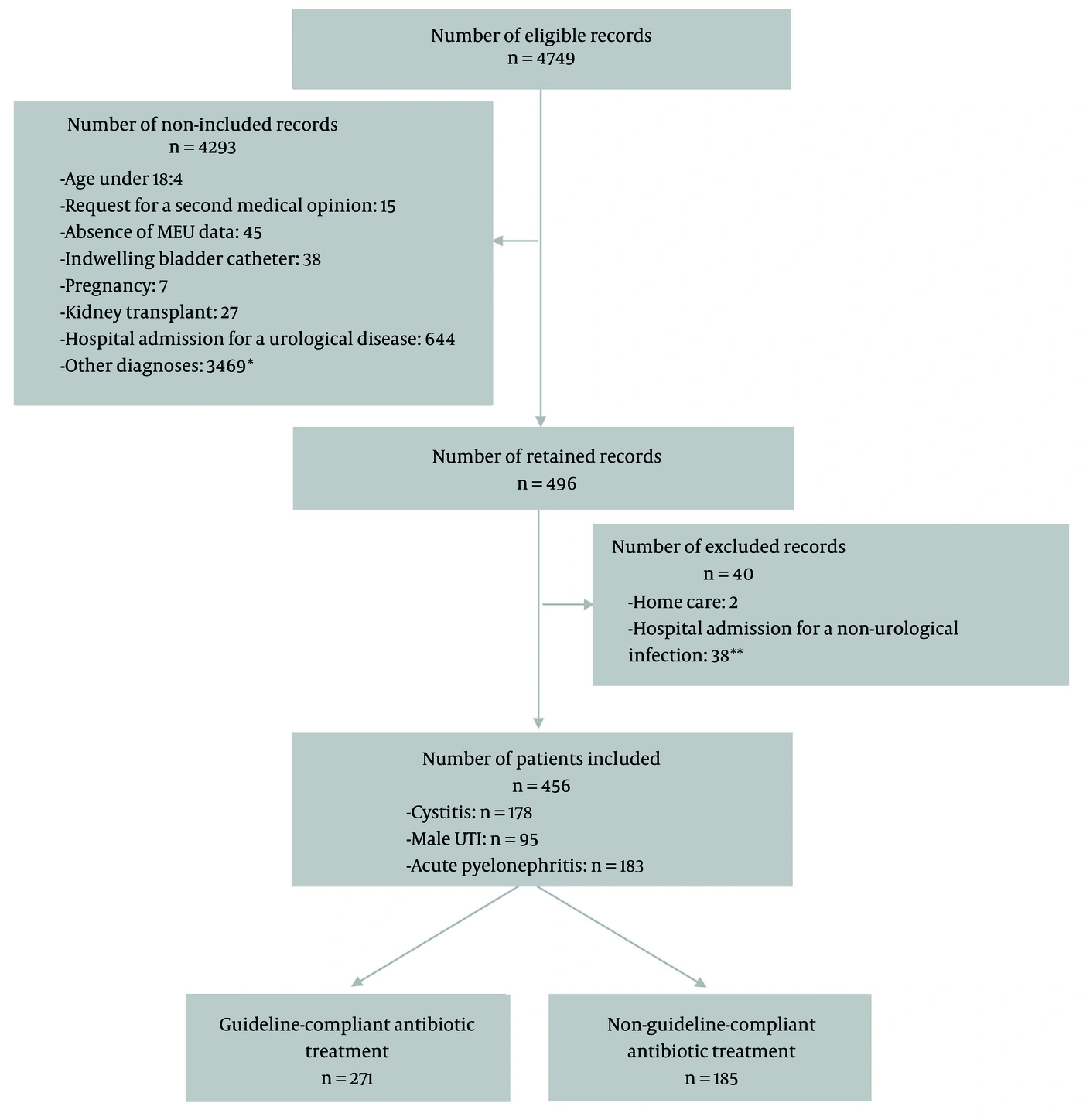
Figure 1.
Study flowchart
The median age was 41 years (31 to 58). Overall, 102 patients (31.0%) had a history of urological comorbidities, including cystitis and APN; 137 patients (30.1%) had risk factors for complications; and 45 (9.9%) had risk factors for extended-spectrum beta-lactamase (ESBL)-producing Enterobacteriaceae. The qSOFA score was below 2 in all cases.
4.2. Additional Examinations and Antibiotic Treatments
Most patients underwent additional examinations during their stay in the ED. Venous blood samples were collected from 369 patients (80.9%), and blood cultures were obtained in 28 of these cases (14.0%). Assays showed a median C-reactive protein level of 49.9 mg/L [5.5; 70.9] and a median white blood cell count of 11096/mm3 (8200 - 13100). Kidney function tests showed a median serum creatinine level of 71.3 μmol/L (57 - 77) and a median serum urea level of 4.6 mmol/L [3.2; 5]. Urinary dipstick test data were available for 446 patients (97.8%), and 392 tests (85.9%) were positive. Furthermore, MEU data were available for 408 patients (89.5%), and a bacterial pathogen was identified in 324 cases (79.4%). Radiological imaging in the ED was performed less frequently, with ultrasound data acquired for 50 patients (10.9%) and abdominal-pelvic computed tomography performed for 39 patients (8.6%) (Table 2).
Table 2.
Additional Examinations and Antibiotic Therapy in Patients with a UTI a
| Variables | Cystitis n = 178 (40) | Male UTI n = 95 (21) | APN n = 183 (40) | Total n = 456 (100) |
|---|---|---|---|---|
| Type of UTI | ||||
| No risk of complications | 155 (87.1) | 0 (0.0) | 151 (82.5) | 306 (67.1) |
| Risk of complications | 23 (12.9) | 95 (100.0) | 32 (17.5) | 150 (32.9) |
| Dipstick urine test | ||||
| Test performed | 174 (97.7) | 92 (96.8) | 180 (98.4) | 446 (97.8) |
| Test not performed | 4 (2.3) | 3 (3.2) | 3 (1.6) | 10 (2.2) |
| Positive test | 154 (86.5) | 74 (77.9) | 164 (89.6) | 392 (86.0) |
| Negative test | 20 (11.2) | 18 (18.9) | 16 (8.7) | 54 (11.8) |
| Laboratory data | ||||
| MEU only | 48 (27.0) | 6 (6.3) | 3 (1.6) | 57 (12.5) |
| Blood culture only | 15 (8.4) | 3 (3.2) | 9 (4.9) | 27 (5.9) |
| MEU and blood culture | 88 (49.4) | 85 (89.5) | 169 (92.3) | 342 (75.0) |
| Positive MEU | 110 (61.8) | 59 (62.1) | 152 (83.1) | 321 (70.4) |
| Sterile MEU | 38 (21.3) | 22 (23.2) | 10 (5.5) | 70 (15.4) |
| Contaminated MEU | 24 (13.5) | 12 (12.6) | 12 (6.6) | 48 (10.5) |
| Missing data | 6 (3.4) | 2 (2.1) | 9 (4.9) | 17 (3.7) |
| Imaging | ||||
| None | 163 (91.6) | 86 (90.5) | 122 (66.7) | 371 (81.4) |
| Ultrasound only | 13 (7.3) | 3 (3.2) | 33 (18.0) | 49 (10.7) |
| CT alone | 2 (1.1) | 5 (5.2) | 27 (14.75) | 34 (7.5) |
| Ultrasound and CT | 0 (0.0) | 1 (1.1) | 5 (2.73) | 6 (1.3) |
| Antibiotic therapy | ||||
| No antibiotics | 10 (5.6) | 9 (9.5) | 0 (0.0) | 19 (4.1) |
| Monotherapy | 167 (93.8) | 84 (88.4) | 178 (97.3) | 429 (94.1) |
| Combination therapy | 1 (0.6) | 2 (2.1) | 5 (2.7) | 8 (1.7) |
| Antibiotic molecules | ||||
| Amoxicillin | 6 (3.4) | 0 (0.0) | 1 (0.5) | 7 (1.5) |
| Amoxicillin-clavulanic acid | 1 (0.6) | 1 (1.1) | 1 (0.5) | 3 (0.65) |
| Third-generation cephalosporins | 0 (0.0) | 17 (17.9) | 60 (32.8) | 77 (16.9) |
| Fluoroquinolone | 7 (3.9) | 65 (68.4) | 122 (66.7) | 194 (42.5) |
| Fosfomycin | 130 (73.0) | 0 (0.0) | 1 (0.5) | 131 (28.7) |
| Trimethoprim-sulfamethoxazole | 2 (1.1) | 0 (0.0) | 2 (1.1) | 4 (0.87) |
| Pivmecillinam | 15 (8.4) | 0 (0.0) | 0 (0.0) | 15 (3.3) |
| Nitrofurantoin | 7 (3.9) | 1 (1.1) | 0 (0.0) | 8 (1.7) |
| Missing data | 2 (1.1) | 3 (2) | 0 (0.0) | 5 (0.9) |
a Values are expressed as No. (%). Abbreviations: APN, acute pyelonephritis; CT, computed tomography; MEU, microbiological examination of urine; UTI, urinary tract infection.
Empirical antibiotic therapy was initiated in 437 patients (95.8%). Fluoroquinolones were the most frequently prescribed antibiotics: ciprofloxacin in 106 treated patients (24.3%), ofloxacin in 51 patients (11.7%), and levofloxacin in 39 patients (8.9%). Third-generation cephalosporins, primarily ceftriaxone, were prescribed as first-line treatment in 51 patients (11.7%). In cases of APN, ciprofloxacin remained the preferred choice in 71 cases (38.8% of 183 patients), followed by ofloxacin in 34 cases (18.6%) and ceftriaxone in 60 cases (32.8%). In male UTIs, ciprofloxacin was prescribed for 32 of 95 patients (33.7%), followed by ceftriaxone in 15 cases (15.8%).
4.3. Compliance of Antibiotic Prescriptions with the Guidelines
Of the 456 first-line antibiotic prescriptions for UTIs, 271 (59.4%) adhered to the 2018 SPILF national guidelines on antibiotic stewardship (Table 3). The main cause of noncompliance was treatment duration, which was often too short or too long without a valid reason. In addition, 55 cases were noncompliant in terms of dose level, with the antibiotic prescribed at only half the recommended dose.
Table 3.
Overview of Antibiotic Prescription Compliance and Noncompliance in UTIs a
| Compliance status | Cystitis n = 178 (39) | Male UTIs n = 95 (21) | APN n = 183 (40) | Total n = 456 (100) | P-Value |
|---|---|---|---|---|---|
| Guideline-compliant | 143 (80.3) | 29 (30.5) | 99 (54.1) | 271 (59.4) | < 0.0001 |
| Not guideline-compliant | 35 (19.7) | 66 (60.5) | 84 (45.9) | 185 (40.6) | < 0.0001 |
| Duration | 22 (12.4) | 40 (42.1) | 67 (36.6) | 129 (28.3) | |
| Dose regimen | 19 (10.7) | 14 (14.7) | 22 (12.0) | 55 (12.1) | |
| Molecule | 22 (12.4) | 13 (13.7) | 30 (16.4) | 65 (14.3) |
a Values are expressed as No. (%). Abbreviations: APN, acute pyelonephritis; UTI, urinary tract infection.
Noncompliance regarding the prescribed molecule was observed in 65 patients. Overall, noncompliance regarding the choice of antibiotic molecule was observed in 69 cases (15.1%). These cases predominantly involved first-line use of antibiotics not recommended for that purpose, such as ciprofloxacin instead of ofloxacin, amoxicillin, and pivmecillinam. Inappropriate combinations were also noted, including ceftriaxone with a bolus of gentamicin (Appendix 5 in Supplementary File).
4.4. Risk Factors for Noncompliant Antibiotic Therapy
Bivariate analysis of antibiotic treatments identified demographic, clinical, and laboratory variables that were positively or negatively associated with noncompliance with prescribing guidelines (Appendix 6 in Supplementary File).
Multivariate logistic regression analysis (Figure 2) showed that a final diagnosis of cystitis was significantly associated with compliance with antibiotic prescribing in the ED (OR, 2.6; 95% CI, 1.42 - 4.75; P = 0.002). Conversely, prostatitis (OR, 0.35; 95% CI, 0.12 - 1.04; P = 0.0592), cardiopathy (OR, 0.55; 95% CI, 0.19 - 1.62; P = 0.2792), diabetes (OR, 0.76; 95% CI, 0.24 - 2.37; P = 0.6352), and flank pain (OR, 0.84; 95% CI, 0.51 - 1.4; P = 0.502) were not statistically significant predictors of guideline compliance.
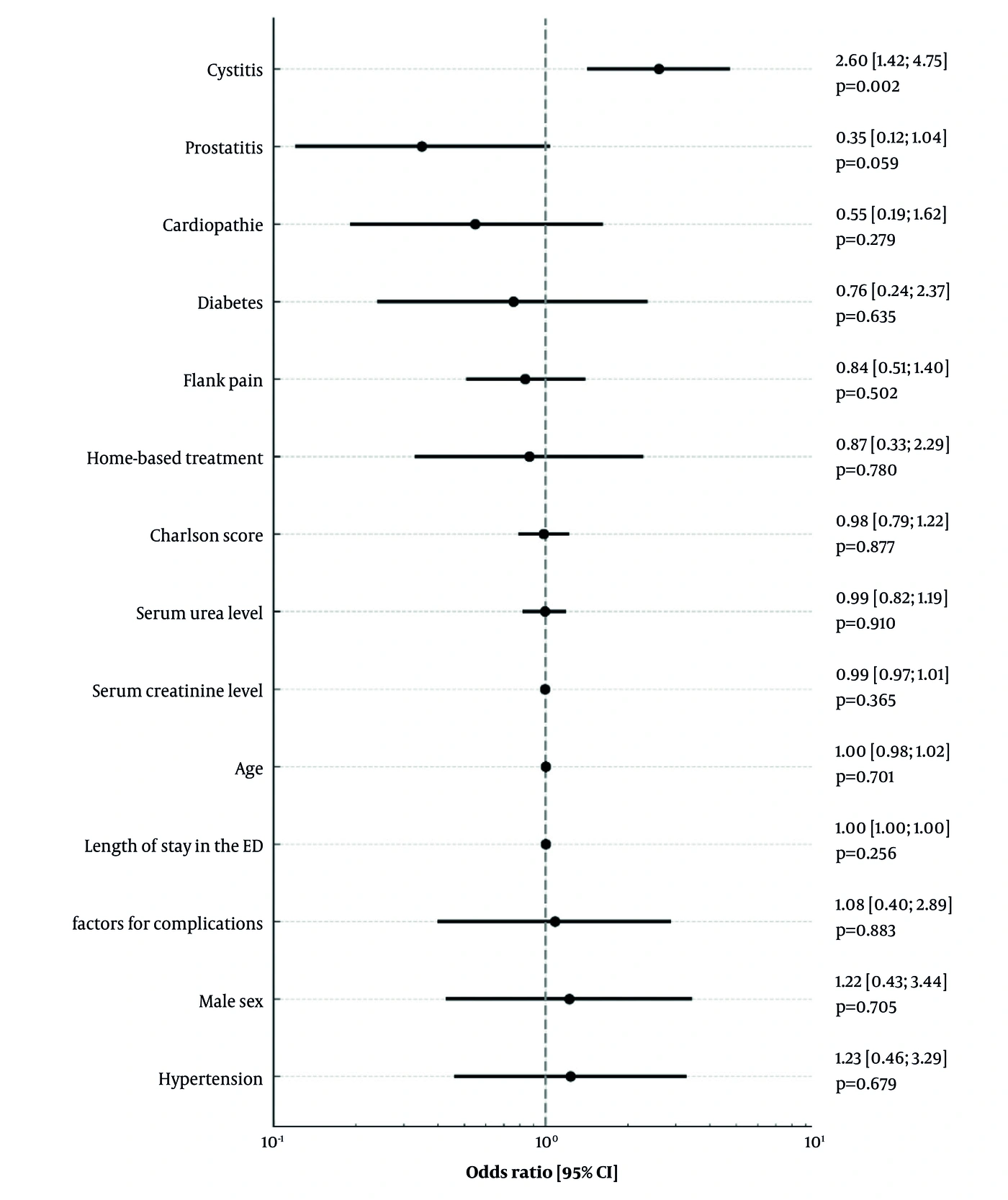
Figure 2.
Forest plot of the results of multivariate analysis of factors potentially associated with guideline-compliant antibiotic prescriptions. Abbreviations: CI, confidence interval; ED, emergency department.
No demographic or laboratory variables were significantly associated with guideline compliance, including age (OR, 1.0; 95% CI, 0.98 - 1.02; P = 0.7008), systolic blood pressure (OR, 0.87; 95% CI, 0.33 - 2.29; P = 0.7805), serum urea (OR, 0.99; 95% CI, 0.82 - 1.19; P = 0.91), and serum creatinine (OR, 0.99; 95% CI, 0.97 - 1.01; P = 0.3649).
The multivariate analysis also showed that male sex (OR, 1.22; 95% CI, 0.43 - 3.44; P = 0.7046), hypertension (OR, 1.23; 95% CI, 0.46 - 3.29; P = 0.6786), CCI (OR, 0.98; 95% CI, 0.79 - 1.22; P = 0.8773), and the presence of risk factors for complications (OR, 1.08; 95% CI, 0.4 - 2.89; P = 0.8827) were not significant predictors of compliance with antibiotic prescription guidelines.
4.5. Bacterial Ecology
Of the 408 MEU tests performed, 324 (79.4%) were positive (Table 4), and 327 microorganisms were identified. Among them, 282 pathogens (88.7%) were Gram-negative bacteria. Of the 327 identified pathogenic strains (Table 5), 137 (41.9%) were wild-type, and 190 (58.1%) were resistant to at least one antibiotic (Appendix 7 in Supplementary File).
Table 4.
Main Pathogens Identified According to Type of UTI a
| Cases | Cystitis (n = 178) | Male UTI (n = 95) | APN (n = 183) | Total (n = 456) |
|---|---|---|---|---|
| Positive MEU | n = 109 | n = 63 | n = 152 | n = 324 |
| E. coli | 79 (72.5) | 43 (68.3) | 125 (82.2) | 247 (76.2) |
| K. pneumoniae | 9 (8.3) | 3 (4.8) | 7 (4.6) | 19 (5.9) |
| P. mirabilis | 1 (1.0) | 2 (3.2) | 2 (1.3) | 5 (1.5) |
| S. saprophyticus | 18 (16.5) | 1 (1.6) | 9 (5.9) | 28 (8.6) |
| Other pathogens | 2 (1.8) | 14 (22.1) | 9 (6.0) | 25 (7.8) |
a Values are expressed as No. (%). Abbreviations: APN, acute pyelonephritis; MEU, microbiological examination of urine; UTI, urinary tract infection.
Table 5.
Identified Microorganisms
| Pathogens | Cases (n = 327) |
|---|---|
| Escherichia coli | 247 (123 wild-type strains and 124 resistant strains) |
| Klebsiella spp. | 19 (K. pneumoniae = 18, K. oxytoca = 1) |
| Enterobacter spp. | 5 (E. aerogenes = 3, E. cloacae = 2) |
| Enterococcus faecalis | 2 |
| Staphylococcus saprophyticus | 28 |
| Streptococcus spp. | 10 (S. agalactiae = 8, S. gallolyticus = 1, S. oralis = 1) |
| Other pathogens | 16 (C. koseri = 5, C. freundii = 1, P. mirabilis = 5, A. urinae = 1, P. regretti = 1, N. gonorrhoeae = 1, P. vulgaris = 1, S. epidermidis = 1) |
4.6. Post-ED Data
Of the 324 patients with a positive MEU, 111 (32.3%) were reassessed after discharge, including 52 (16.0%) within 72 hours and 59 (18.2%) more than 72 hours later. Based on antibiotic susceptibility test results, 89 of the 111 reassessed patients (80.2%) had received appropriate initial treatment, whereas the ED prescription should have been adjusted in 43 cases (48.3%). In 4 cases (4.5%), MEU results were forwarded directly to the primary care physician for targeted adjustment of antibiotic treatment. Treatment adjustment was deemed necessary in 194 of the 456 cases included in the study. However, adjustment was implemented in only 23 cases (11.9%).
Overall, 45 patients (9.9%) returned to the ED within 1 month of their initial visit. Nine of these 45 patients (2.0%) were admitted to hospital. Readmissions were primarily triggered by severe UTIs: 2 cases of obstructive pyelonephritis with appropriate antibiotic therapy, 1 case of septic shock of urinary origin with inappropriate antibiotic therapy, and 1 case requiring pain management. The remaining 5 patients were admitted for infections not affecting the urinary tract.
5. Discussion
In this study of first-line antibiotic prescriptions for uncomplicated UTIs, the compliance rate with SPILF guidelines was 59.4%. This value is consistent with the results of previous studies on adherence to clinical guidelines (11-13). A French study evaluating the impact of a computerized decision support system on compliance found a markedly lower rate of 33% for empirical antibiotic prescriptions for UTIs (14), whereas a single-center retrospective study of acute UTIs reported a value of 60% (15). These differences suggest that ensuring appropriate antibiotic stewardship in the ED remains challenging.
In the literature, pharmacist-led interventions have been shown to improve prescription accuracy and guideline compliance. A study by Sofeso et al. demonstrated that pharmacist review of discharge antibiotics for UTIs in the ED was associated with a significant decrease in the proportion of inappropriate prescriptions, from 64.2% to 5%, thereby underscoring the importance of pharmacist involvement in optimizing antimicrobial therapy (16). The main causes of noncompliance were an inappropriate duration in two-thirds of cases and prescription of an inappropriate first-line molecule or an incorrect dosing regimen in one-third of cases; this likely increased the risk of bacterial resistance or treatment failure (16, 17). Poor guideline adherence may have been related to diagnostic uncertainty due to atypical presentations, a misleading clinical picture, or a reason for consultation that did not immediately suggest an infectious etiology.
In the male UTI group, 69.5% of prescriptions did not comply with the guidelines. This may be because male UTIs are often clinically complex and involve several pathogens; physicians may therefore prescribe broader-spectrum or empirical treatments. Moreover, the frequent noncompliant treatment durations in this group (32.6%) suggest a heightened perception of severity or a lack of standardization in the treatment strategy. These inappropriate practices might promote the development of antibiotic resistance and increase the occurrence of adverse effects.
In this study, 194 patients were initially treated with fluoroquinolones. Among these patients, 33, including 18 with APN, received a noncompliant prescription. This result might be due to 1) the predominance of male patients in the sample, possibly leading to a higher frequency of fluoroquinolone prescriptions; and/or 2) the influence of contextual factors, such as allergies and comorbidities, on physicians' clinical judgment. However, systematic prescription of fluoroquinolones as first-line treatment in noncomplicated cases may select resistant bacteria, representing a major public health issue (18, 19). To limit inappropriate fluoroquinolone use and improve guideline compliance, prescribing practices in EDs should be assessed regularly.
Our results identified several risk factors for non-guideline-compliant antibiotic therapy in the ED. Notably, male sex, older age, and higher CCI were significantly associated with a greater likelihood of noncompliance. This finding corroborates published data emphasizing the impact of demographic and clinical factors on treatment adherence (20). The presence of comorbidities such as hypertension, diabetes, and cardiopathy further underscores the complexity of antibiotic stewardship in patients with two or more chronic conditions. Abnormal serum creatinine and urea levels suggest that impaired kidney function may contribute to deviations from guideline-adherent prescribing. This finding is consistent with studies on pharmacokinetic variability in older patients with multiple comorbidities (21, 22). Furthermore, symptoms such as burning on urination and flank pain were associated with noncompliance; this might be due to misinterpretation of symptom severity or delays in appropriately adjusting antibiotic treatment.
Initial guideline adherence was inversely related to the need for antibiotic adjustment at 72 hours, highlighting the importance of early reassessment. The absence of advice on hygiene and dietary measures was a major factor in nonadherence and emphasized the need for patient education and a multidisciplinary approach. Follow-up review of urine cultures at 72 hours is essential to avoid unnecessary prolongation of antibiotic therapy (23). The lack of documentation regarding continuation or discontinuation of treatment for 75% of sterile cultures in this study highlights the need to improve traceability and treatment follow-up.
Interestingly, the presence of Staphylococcus saprophyticus was significantly associated with noncompliance. This finding raises concerns about pathogen-specific treatment challenges and the need for accurate microbiological diagnosis to guide therapy. In contrast, our multivariate analysis indicated that a final diagnosis of cystitis was associated with higher compliance. Patient management is likely to be more straightforward for uncomplicated UTIs than for more complex conditions, such as prostatitis.
In the cystitis group, we identified only 23 patients at risk of developing complications. Interestingly, 151 patients underwent additional laboratory tests, including urine cultures and MEU. It can be hypothesized that patient pressure and/or easier access to resources in a hospital environment, compared with private practice, prompted physicians to prescribe these additional tests. Excessive prescription of bacteriological tests can reveal colonization and contamination that do not add value to patient management. Conversely, this information can lead to unnecessary antibiotic prescriptions, with detrimental consequences for both individual and public health. These consequences include selection and spread of multidrug-resistant bacteria and exacerbation of adverse effects related to antibiotic therapy, such as Clostridioides difficile infection. Excessive or repeated blood culture prescriptions have been shown to increase antibiotic prescribing (24).
The bacterial ecology observed in this study was consistent with that reported in the literature. Escherichia coli was the most frequently identified pathogen and accounted for 247 cases (76%), followed by Klebsiella pneumoniae in 19 cases (6%), Proteus mirabilis in 5 cases (2%), and Staphylococcus saprophyticus in 28.9% of cases (2, 25, 26).
The high level of antibiotic resistance observed in this study is notable: 58.1% of bacterial strains were resistant to at least one antibiotic. Escherichia coli accounted for most of these instances (76%), with resistance to fluoroquinolones in 18 strains. Twelve E. coli strains produced ESBLs. This resistance is concerning because it makes UTI treatment more difficult, especially for infections due to E. coli, which remains the main pathogen in both community-acquired and nosocomial UTIs. These findings corroborate reports by Critchley et al. and Abbott et al. (2023) on the growing resistance of uropathogens to antibiotics (27, 28). This phenomenon is primarily attributed to excessive antibiotic use and emphasizes the urgent need to restrict antibiotic prescribing in outpatient settings. In light of this situation, prescribing practices should be revised, and antimicrobial resistance should be managed more strictly to limit the public health impact of this issue.
5.1. Strengths and Limitations
Our findings should be interpreted in light of the inherently context-dependent nature of antimicrobial stewardship. The originality of our work lies in the ED setting, where stewardship is particularly challenging because of time pressure, limited access to complete clinical and microbiological data, patient heterogeneity, and difficulties in ensuring follow-up. These constraints have been shown to contribute to suboptimal antibiotic prescribing, with large-scale studies reporting that more than one-quarter of antibiotic prescriptions in EDs may be inappropriate (29). Continuous evaluation of prescribing practices is a key component of stewardship programs (30), and current recommendations emphasize that empirical therapy should be guided by local epidemiology and resistance patterns. Local bacterial ecology remains a major determinant of antibiotic appropriateness and supports the need for context-specific assessments. The methodology used in our study could be readily reproduced in other centers to generate context-specific data and guide targeted interventions (31). Finally, our results support recent evidence showing that inappropriate antibiotic prescribing remains frequent despite stewardship efforts (32), highlighting the need for ongoing local assessments.
This study had several limitations. First, its single-center design means that the results cannot necessarily be generalized to other populations. Second, retrospective data collection from patient medical records may have missed important information, particularly given the lack of a computerized physician order entry system in our ED. In cases with missing data, antibiotic treatment was considered noncompliant. Finally, selection bias may have influenced the inclusion of the various nosological categories because only the clinical observations made by the ED physician were used to classify the different UTIs.
5.2. Conclusions
The results of this study highlighted persistent challenges in achieving guideline-adherent antibiotic use in the ED. The 59.4% compliance rate with SPILF guidelines indicates that substantial gaps in practice remain, particularly with regard to treatment duration and choice of molecule, thereby increasing the risk of antimicrobial resistance. The low compliance rate for male UTIs and APN, largely due to inappropriate treatment durations and unnecessary fluoroquinolone use, further underscores the need for stricter stewardship measures.
Reassessment of urine cultures at 72 hours is crucial but remains underused, and failure to reassess may lead to unnecessary prolongation of antibiotic treatment. Enhancing access to real-time antibiotic susceptibility testing, reinforcing multidisciplinary collaboration, and integrating pharmacists into the ED workflow might help reduce the proportion of inappropriate prescriptions. Strengthening these strategies would likely curb antimicrobial resistance and ensure safer and more effective management of UTIs.
Optimizing antibiotic use is no longer merely an option; it is an urgent necessity. Future interventions must focus on standardized prescribing, improved follow-up, and reduction of the public health burden caused by antimicrobial resistance.