1. Background
Hypertension is the primary cause of cardiovascular disease and premature mortality (1). Data from the World Health Organization (WHO) indicate that globally, 1.28 billion individuals aged 30 to 79 are affected by hypertension, with the majority (two-thirds) residing in low- and middle-income countries. Approximately 46% of adults with hypertension are unaware of their condition. Furthermore, only 42% of adults with hypertension are diagnosed and treated, with 21% achieving controlled hypertension (2). The global target for non-communicable diseases is to reduce the prevalence of hypertension by 33% between 2010 and 2030 (2). Achieving these goals requires improved primary prevention strategies and effective management of hypertension. Successful control of hypertension necessitates comprehensive approaches that incorporate both secondary and tertiary preventive measures. Secondary prevention may involve traditional drug therapies, alternative treatments, and lifestyle modifications (3).
The majority of hypertensive patients fail to achieve target blood pressure reductions with antihypertensive medications, often due to non-adherence to prescribed regimens. Non-compliance can result from the extended duration of treatment, leading to missed doses or misconceptions about overcoming the condition (4, 5). Hypertension increases the risk of cardiovascular disease and affects lung function, with hypertensive individuals exhibiting lower pulmonary function test parameters and a prevalent pattern of obstruction (74%) (6). Another study observed decreased pulmonary function in hypertensive individuals not using beta-blockers, with a predominant pattern of restriction (34.4%) (7).
Complementary interventions, such as slow deep breathing exercises (SDBE), can address the inefficacy of antihypertensive treatment due to non-adherence. The SDBE synchronizes the lungs, nerves, and cardiovascular system (8); reduces blood pressure; and enhances lung function, which is compromised by hypertension. Research has demonstrated that SDBE improves lung function by increasing vital capacity (VC) and inspiratory muscle strength while reducing blood pressure in hypertensive patients (9). Enhanced inspiratory muscle strength promotes lung development, as evidenced by the forced vital capacity (FVC) during pulmonary function tests. In healthy subjects, SDBE improves forced expiratory volume in 1 second (FEV1) by decreasing airway resistance (10).
While existing research has demonstrated the individual effects of SDBE on blood pressure control and some aspects of lung function, there remains a significant gap in understanding its comprehensive impact on specific pulmonary function parameters in hypertensive populations. Previous studies have primarily focused on either blood pressure management or general respiratory improvements. However, studies that systematically examine the effects of SDBE on specific parameters, such as FVC, FEV1, and FEV1/FVC, in hypertensive patients are still lacking.
2. Objectives
The present study aimed to investigate the direct effects of SDBE on specific pulmonary function parameters in hypertensive patients. Understanding these relationships may aid in developing effective non-pharmacological interventions for patients with hypertension, potentially improving pulmonary function and overall management. This study provides insights into the potential of SDBE as a complementary therapy for managing hypertension and enhancing pulmonary function.
3. Methods
3.1. Research Methods
This study used a quasi-experimental, one-group pretest-posttest design.
3.2. Research Participants
The study subjects were patients with hypertension aged ≥ 45 years in Banyumas Regency, Central Java province, Indonesia. Subjects were obtained from elderly posyandu participants by total sampling. A total of 33 subjects were recruited based on the following criteria: (A) Not having hearing impairment, (B) not smoking, (C) not having respiratory system disorders, and (D) willingness to participate in the study by signing informed consent. Seven subjects did not complete the serial intervention, leaving 26 subjects for the analysis.
3.3. Training Protocol
The research intervention was the slow deep breathing Pranayama technique with a duration of 5 cycles (5 minutes per cycle) three times a week for 6 weeks.
3.4. Measurement of Study Variables
Anthropometric data (height and weight) and blood pressure were measured before the intervention. Blood pressure was measured manually using a sphygmomanometer. The primary outcome measure in this study was pulmonary function, which was evaluated pre- and post-intervention. A spirometer was used to determine FEV1 and FVC values. Prior to undergoing the spirometry test, the subjects adhered to several preparatory protocols. These included obtaining adequate rest, refraining from bronchodilator use, abstaining from smoking and alcohol consumption for a minimum of 4 hours preceding the examination, fasting for at least 2 hours prior, avoiding strenuous physical activity for a minimum of 1 hour beforehand, and ensuring bladder evacuation. Pulmonary function examination was performed using slow vital capacity (SVC) and FVC methods by breathing through the mouth mediated by a mouthpiece. During the examination, the patients were positioned upright with their clothing loosened to allow optimal and maximal breathing.
3.5. Data Analysis
The baseline characteristics of the study sample were described using means and standard deviations. Variables on a categorical scale were described using frequencies and percentages. All numeric variables were subjected to normality tests for data distribution. Pulmonary function was indicated by FEV1, FVC, and the FEV1/FVC ratio. Bivariate analysis was performed to assess the differences in each pulmonary function parameter before and after the SDBE intervention. Variables with normally distributed data were analyzed using a paired t-test (FEV1 and FVC), while FEV1/FVC was analyzed using the Wilcoxon signed-rank test, considering the abnormal data distribution. The level of significance was set at P < 0.05. All statistical analyses were performed using IBM SPSS Statistics version 23.0 as the statistical package.
3.6. Research Ethics
This study was reviewed and approved by the Health Research Ethics Committee, Faculty of Medicine, Jenderal Soedirman University (reference number: 118/KEPK/PE/VIII/2023).
4. Results
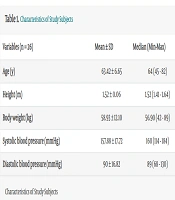
The subjects’ characteristics are shown in Table 1.
Table 1.
Characteristics of Study Subjects
| Variables (n = 26) | Mean ± SD | Median (Min-Max) | 95% CI |
|---|---|---|---|
| Age (y) | 63.42 ± 6.65 | 64 (45 - 82) | 60.74 - 66.11 |
| Height (m) | 1.52 ± 0.06 | 1.52 (1.41 - 1.64) | 1.50 - 1.55 |
| Body weight (kg) | 58.93 ± 12.10 | 56.90 (42 - 89) | 54.05 - 63.82 |
| Systolic blood pressure (mmHg) | 157.88 ± 17.72 | 160 (114 - 184) | 150.73 - 165.04 |
| Diastolic blood pressure (mmHg) | 90 ± 16.82 | 89 (68 - 130) | 83.21 - 96.79 |
Table 1 shows that the mean systolic blood pressure of the subjects was 157.88 ± 17.72 mm Hg. The mean diastolic blood pressure of the participants was 90 ± 16.82 mm Hg. The subject characteristics in Table 2 include categorical variables of the study subjects, such as sex, smoking status, Body Mass Index (BMI), and lung function profile.
Table 2.
Classification of Study Subject Characteristics
| Variables and Categories | No. (%) |
|---|---|
| Gender | |
| Male | 7 (26.92) |
| Female | 19 (73.08) |
| Smoking status | |
| Smokers | 4 (15.38) |
| Non-smokers | 22 (84.62) |
| BMI | |
| Underweight | 4 (15.38) |
| Normoweight | 6 (23.08) |
| Overweight | 0 (0) |
| Obesity grade I | 11 (42.31) |
| Obesity grade II | 5 (19.23) |
| Pulmonary function | |
| Normal | 16 (61.54) |
| Restrictive | 6 (23.08) |
| Obstructive | 2 (7.69) |
| Mixed | 2 (7.69) |
Abbreviation: BMI, Body Mass Index.
Table 2 shows that 73.08% of the subjects were female. The study population was predominantly non-smokers (84.62%), and the BMI was dominated by subjects with grade I obesity (42.31%). The pulmonary function of the study participants was primarily normal (61.54%). The remaining hypertensive subjects exhibited impaired lung function, categorized as restrictive (23.08%), obstructive (7.69%), or mixed (7.69%). The following table presents the results of the bivariate analysis of the effect of SDBE intervention on lung function values, using the paired t-test for FEV1 and FVC, and the Wilcoxon test for FEV1/FVC.
As shown in Table 3, there were significant differences in FEV1 (P = 0.016) and FVC values (P = 0.009) before and after the SDBE intervention. The Wilcoxon test results for FEV1/FVC variables showed no significant mean difference before and after the intervention (P = 0.989).
Table 3.
Differences in Pulmonary Function Values Before and After Slow Deep Breathing Exercises Intervention
| Variables | Mean ± SD | Difference | 95% CI | P-Value |
|---|---|---|---|---|
| FEV1 | 0.06 | -0.107 to -0.012 | 0.016 a | |
| Pretest | 0.90 ± 0.29 | |||
| Posttest | 0.96 ± 0.31 | |||
| FVC | 0.07 | -0.127 to -0.020 | 0.009 a | |
| Pretest | 0.83 ± 0.22 | |||
| Posttest | 0.90 ± 0.23 | |||
| FEV1/FVC | 0.01 | 0.989 b | ||
| Pretest | 0.81 ± 0.12 | |||
| Posttest | 0.80 ± 0.14 |
Abbreviations: FEV1, forced expiratory volume in 1 second; FVC, forced vital capacity.
a Paired t-test.
b Wilcoxon test.
5. Discussion
This study provides important insights into how SDBE impact lung function in hypertensive patients. Most participants (61.54%) exhibited normal lung function, while others displayed restrictive or obstructive pulmonary conditions. Importantly, the SDBE intervention led to significant improvements in both FEV1 and FVC, indicating enhanced respiratory performance. These improvements are particularly significant as FEV1 and FVC are crucial indicators of lung health. The FEV1 quantifies the volume of air forcefully exhaled in one second, while FVC measures the total air volume forcefully expelled after a full inhalation. The substantial mean differences observed in these parameters before and after SDBE suggest that this exercise routine can positively influence lung function in individuals with hypertension. Findings from this study are similar to previous studies (11-14). A systematic review showed that SDBE significantly improved lung function in patients with pulmonary disorders such as bronchial asthma, as indicated by an increase in FEV1 and FVC (12, 13). In patients with bronchial asthma, the lungs experience tissue damage and decreased lung complement, ultimately leading to decreased vital capacity. However, hypertensive patients can also experience complications of restrictive lung disorders characterized by decreased lung development ability. This is caused by baroreceptor dysfunction, which can increase the dominance of sympathetic nerves and the breathing rate. An increased breathing rate leads to respiratory muscle weakness (15). Additionally, an increased breathing rate decreases tidal volume and consequently decreases lung vital capacity.
Previous studies have demonstrated that SDBE using the Pranayama technique can enhance lung development capacity. This improvement is attributed to the release of prostaglandins and surfactants, triggered by the maximum inflation and deflation of the lungs during slow, deep breathing (10). Consequently, this practice prevents the easy collapse of the alveoli and lungs during slow, deep breathing, leading to increased lung compliance and vital capacity (16, 17). This indicates an improvement in lung development ability, resulting in enhanced FVC values, which measure lung development capacity. Pranayama, a form of controlled yoga breathing, may significantly boost lung function by strengthening the respiratory muscles used in inhalation and exhalation (18, 19). Studies have also shown that Pranayama or yoga breathing exercises can positively affect cognitive functions, autonomic processes, pulmonary performance, and metabolic activities. The benefits of SDBE are believed to stem from improved respiratory endurance, muscle relaxation, lung expansion, increased energy levels, and enhanced blood circulation (20). Additionally, yoga breathing techniques can improve the efficiency of the shoulder, chest, and abdominal muscles involved in respiration (14). In summary, SDBE, when practiced as part of yoga breathing exercises, can alleviate symptoms and enhance lung function in individuals with hypertension (21).
In this study, the results of the Wilcoxon test for the FEV1/FVC variable showed no significant mean difference before and after the intervention. This ratio is often used to diagnose obstructive lung diseases, such as chronic obstructive pulmonary disease (COPD). The lack of a significant difference in this ratio may indicate that the SDBE intervention had no significant impact on improving obstructive pulmonary disease in this population. In contrast to the significant increase in mean FEV1 and FVC variables, the FEV1/FVC variable decreased in mean between pre- and post-intervention from 0.81 to 0.80. This was because the increase in mean FVC was not proportional to the increase in mean FEV1. That is, the increase in mean FVC was higher than the increase in mean FEV1. This aligns with Shravya’s study (22), which showed a significant increase in the mean value of the FVC and FEV1 variables, with the significance of the change in the mean FVC value greater than the FEV1 value. However, there was no significant increase in the FEV1/FVC% variable or decrease in the mean.
Contrary to the results of this study, there is a study that states that SDBE affects changes in FEV1/FVC ratio values in post-laparoscopic cholecystectomy patients, showing that SDBE has higher effectiveness than breath training with a trifle spirometer (incentive spirometry) to prevent complications of decreased lung function on days 1 and 2 after laparoscopic cholecystectomy, as seen from the improvement in FEV1/FVC ratio values (23). The SDBE has also been shown to improve lung function. The more remarkable mean improvement in FVC values compared with FEV1 values may be due to confounding factors that affected both variables during the study and allowed for better FVC values than FEV1 values. One potential limitation is the absence of stratification of participants based on their baseline pulmonary function status (normal, obstructive, restrictive, or mixed). By analyzing the overall population without subgroup analysis, any potential differential effects of SDBE on the FEV1/FVC ratio within these subgroups may have been masked or averaged. Depending on the participant’s underlying pulmonary function patterns, SDBE may have varying effects on the FEV1/FVC ratio. For example, individuals with restrictive disorders may have experienced improvements in the FEV1/FVC ratio, whereas those with obstructive patterns may show a decrease or no change. Analyzing these subgroups separately could provide valuable insights into the specific effects of SDBE on obstructive versus restrictive patterns.
The main novelty of this article lies in its comprehensive integration between hypertension management and lung health, focusing on specific lung function parameters using a structured SDBE protocol, as well as an in-depth analysis of the underlying physiological mechanisms specifically in the hypertensive population. This is demonstrated by the selection of the study subject population. Previous studies have examined the effects of SDBE on blood pressure in hypertensive patients, not on lung function like this study. This study examines the effects of SDBE on lung function, including all parameters that determine lung function, as part of a study of the effect of hypertension on lung function. Previous studies examining the effects of SDBE on lung function were conducted in healthy humans, while this study was conducted in hypertensive patients because it wanted to see the benefits of SDBE in controlling complications of hypertension on lung function. This study was also conducted in the elderly, where it was also intended to see the effectiveness of SDBE interventions on the elderly with hypertension, where aging has occurred in the elderly population so that many suffer from hypertension.
The findings of this study have important implications for the management of patients with hypertension. Hypertension is a significant contributing factor to cardiovascular disease, and the presence of lung disease can further complicate its treatment and management. The results of this study suggest that incorporating SDBE into the treatment regimen of hypertensive patients may be beneficial for improving lung function and potentially reducing the risk of cardiovascular disease. Future studies could build upon the findings of this study by investigating the long-term effects of SDBE on lung function in patients with hypertension. In addition, exploring the potential mechanisms by which SDBE improves lung function in this population would be beneficial. For example, SDBE improves lung function by increasing lung elasticity, enhancing diaphragmatic function, and reducing inflammation.
In conclusion, this study provides evidence that SDBE can improve lung function in patients with hypertension, particularly in terms of FEV1 and FVC. These findings have important implications for managing patients with hypertension and suggest that SDBE may be a valuable adjunctive therapy for improving lung function in this population.
5.1. Conclusions
The SDBE improve lung function in hypertensive patients by explicitly raising the FVC and FEV1. However, SDBE do not affect FEV1/FVC values in hypertensive patients, because the average increase in FVC values is more significant than the average increase in FEV1 values.
5.2. Applicable Remarks
The findings of this study have important implications for the management of patients with hypertension. Unlike other studies, this study focused on the applicability and effects of SDBE on lung function in patients with hypertension. It has been suggested that SDBE can improve lung function in patients with hypertension.