1. Background
As Soccer is a universal socio-cultural keen interest, studying high-level practice foundations has been, for several decades, an obvious activity to deepen its knowledge. Induced match fatigue has especially been the subject of many studies because it is the basis of all soccer player activities during the week (competition, training sessions, recovery, medical treatments, etc.). Decrease of performance appears after high intensity actions, at the beginning of the second half and at the end of soccer match (1). Many markers have been analysed to study physiological and physical aspects of this fatigue. Decrease of muscular glycogen (2), increase of creatine kinase (CK), leukocytes, lactate dehydrogenase, C-reactive protein, protein carbonyls, uric acid and delayed onset muscle soreness (3), heart rate (HR) variations (4), decrease of lower limb strength (5, 6) are effects induced by match intensity, match duration, game conditions and mostly the repetition of high level actions during the match. As it had been shown in sports like rugby, several correlations might exist between these markers, in particular blood markers and difficulty of sessions (7). Thus the relevance of studying correlations between difficulties perceived by players and blood markers has been identified.
Players will need at least 72 hours to totally recover from muscles damages and oxidative stress imposed by a soccer match (3, 8, 9). However among male top-class professionals, recovery-training sessions could be planned the day after the match and some references on their recovery kinetic at 24 hours, 48 hours, and 72 hours post-match have been published. Furthermore, the distribution of weekly load differs from one professional soccer team to another, making it even more difficult the simultaneously analyse those many teams. Rampinini et al. (6) have analysed kinetic post match fatigue of professional soccer players and have found that 48 hours were enough to recover from peripheral fatigue factors such as sprint ability, maximal voluntary activation and contraction and EMG activity. Reports from this study are limited by the simulated match protocol, which would be quite far from physical and psychological strains of competitive match. Ispirlidis et al. (3) have found that simulated match inflammatory responses increased until 72 hours among Greek elite players. To the knowledge of the authors, no previous research has analysed fatigue marker development among professional soccer players after a competitive match. Tests and measures are quite complex to make before and after an official soccer match, as they are rarely compatible with match preparation and recovery procedures.
2. Objectives
The aim of the present study was to analyse fatigue markers 24 - 48 hours before and 24- 48 hours after soccer matches during the competitive period, in order to analyse the recovery kinetic variables after the match. It was hypothesised that subjective fatigue markers would be significantly correlated with blood markers, that players would have fully recovered 48 hours after the match and that the ability to recover would depend on the age. The findings of the study provide guidelines for the weekly training load between professional and youth elite soccer players.
3. Materials and Methods
3.1. Participants
Nine professional soccer players from French first league (age: 26.0 ± 2.0 years; height: 184.1 ± 5.7 cm; body mass: 78.9 ± 5.9 kg; body fat: 9.2 ± 1.3 %) and ten U-17 soccer players from the highest national level (age: 16.3 ± 0.5 years; height: 177.7 ± 7.4 cm; body mass: 67.7 ± 5.3 kg; body fat: 10.4 ± 2.3 %), all from the same French football club, participated in this study. Professional players participated in one match and four to seven training sessions per week; U-17 players participated in one match and six training sessions per week, with the same type of training in the two days before the game. 24h after the game, both groups performed a low intensity session; and 48h after the game, U-17 made a traditional session whereas the professionals performed a second low intensity session. Each player included in the study gave a written consent.
3.2. Procedures
All participants were familiar with the applied protocol tests (physical tests, heart rate measurement and the use of perceived fatigue questionnaire) since they were fully included in the individual monitoring made by staff of the club.
U-17 players who played at least 85 minutes in the game were tested (20 m sprint ability, heart rate at rest) and questioned (perceived fatigue and muscle soreness) two days before (PRE), the day after (POST24) and two days after (POST48) the match. For professional players who played at least 85 minutes in every game, blood samples, perceived fatigue, muscle soreness, and heart rate were collected the day before (PRE), the day after (POST24) and two days after (POST48) the two analysed games (n = 16 players). The tested team was ranked among the top 5, played against a top 10 team (first match) and won, and played against a bottom 3 team (second match) and lost, during the 28th and 29th day (over 38) of the French championship. Testing order was the same in every collecting session. Tests were systematically done at the same local time, in order to avoid differences due to circadian variations (10). Pitches’ sizes were: 102 (± 4) × 66.5 (± 2) meters in professional matches and 100 × 66 meters in U-17 one.
In order to limit dietetic and lifestyle influences on our results, all players were informed on nutritional guidelines; youth players had all their meals together in the training centre. The study protocol conformed to the ethical guidelines of the 1975 Declaration of Helsinki (11) and was approved by the local university of Lyon (France) ethics committee and the involved club.
3.3. 20 m speed performance
The sprint times were recorded using photocells system (Polifemo, Microgate, Bolzano-Bolzen, Italy) placed at 0 and 20 m. The players stood one meter behind the starting line, started on a whistle signal and ran as fast as possible to complete the total distance.
3.4. Resting heart rate (HRrest)
HRrest was obtained by placing the subjects lying supine after five minutes of rest, in the morning before breakfast, using Polar RS400 HR monitors (Polar, Kempele, Finland).
3.5. Post-Exercise Heart Rate Recovery (HRrecovery)
HRrecovery was recorded three minutes immediately after the training sessions with the use of Polar RS400 HR monitors (Polar, Kempele, Finland). The number of lost beats after the mentioned three minutes described the HRrecovery values. This marker is suggested as a reliable indicator of soccer player ability to recover (12, 13).
3.6. Subjective Rate of Perceived Fatigue (RPEf) and Muscle Soreness (RPEms)
Personal perception of fatigue was measured by using the Borg scale (14), a standard method validated against objective markers (15, 16). It was presented to players as an evaluation from 0 to 10, related to their state of fatigue (RPEf) and lower limb muscle soreness (RPEms) immediately after the end of exercise.
3.7. Blood Sampling and Blood Lactate Concentration
Blood samples were collected following usual clinical procedures. Plasma was first kept in a -80°C environment to permit levels of creatine kinase (CK) analysis. The blood sample was then deposited and homogenized in a heparinized tube followed by centrifugation. The plasma was separated and treated with 50nM HEPES. An enzymatic method at 37°C was used for CK analysis using a couple of reaction (NADH concentration variation thanks to a spectrophotometer). The analyses were made in triplicate at different incubation times in order to obtain a linear product increase. Blood lactate (La) was also measured immediately on site using a portable analyser (Lactate Pro, Arkray, Japan) validated by several researchers (17). Samples were taken at rest, from the tip of a finger of the hand, beforehand cleaned with alcohol.
3.8. Statistics
All data was presented as mean ± standard deviation (SD). The normality of distribution was tested before any other tests. One-way ANOVA with repeated measures (PRE, POST24 and POST48) were used to establish whether any of the results were significantly different from baseline. A two-way ANOVA with repeated measures was assessed to analyse age and time (PRE, POST24 and POST48) effect on RPE. And a post-hoc Tukey test was used in order to define the points of difference. The effect size was classified according to Cohen (18) where an effect size of 0.2 represents a small effect, 0.5 represents a medium effect and a 0.8 or above represents a large effect. Pearson correlation coefficients were also calculated to determine any relationship among the variables. STATISTICA 12.0 (StatSoft, Tulsa, USA) was used for all analysis, with a level of significance set as P < 0.05.
4. Results
4.1. Physiological Evolution Pre and Post Games
In professional players, POST24 values of HRrest (F =18.2), RPEf (F = 108.2), RPEms (F = 114.3), and La (F = 93.0) were significantly different (P < 0.05) from PRE and POST48 values with respectively a medium (0.55) and large (0.88; 0.88; 0.86) effect size. Indeed, HRrecovery was significantly lower (F = 82.6, P < 0.05) in POST24 (60 ± 11 lost bpm) and POST48 (84 ± 12 lost bpm) than PRE test (96 ± 13 lost bpm) with a large effect size (0.85) (Table 1). CK was significantly higher (F = 11.0, P < 0.05) in POST24 (1411 ± 1364 U/L) than baseline (PRE: 228 ± 185 U/L) with a small effect size (0.42). 48 hours after the game, CK was still higher than baseline (POST48: 729 ± 1224 U/L) although the difference was not significant. Coefficient of variation (CV) of CK ranged from 81 to 168 %. Correlation coefficients (r2) showed strong relations between RPEf, RPEms, and La (RPEf / RPEms: r2=0.75; RPEf / La: r2 = 0.76; RPEms/La: r2 = 0.65) (P < 0.05). CK had weak relation to the previously mentioned variables (r2 = 0.09 and 0.11) (P < 0.05). La had mean relations with HRrest (r2 = 0.21) and HRrecovery (r2 = 0.17) (P < 0.05) (Table 2).
Table 1.
Pre and Post-Match Measures From Professional Soccer Players a
| Variables | n | PRE | POST24 | POST48 | |||
|---|---|---|---|---|---|---|---|
| Values | CV | Values | CV | Values | CV | ||
| HRrest, bpm | 16 | 47 ± 4 | 8 | 51 ± 3 b | 6 | 47 ± 3 | 7 |
| HRrecovery, lost bpm | 16 | 96 ± 13 | 13 | 60±11 b | 19 | 84 ± 12 c | 14 |
| RPEf | 16 | 3.1 ± 1.2 | 39 | 7.4 ± 1.3 b | 18 | 3.0 ± 0.7 | 24 |
| RPEms | 16 | 0.9 ± 0.7 | 73 | 5.5 ± 1.5 b | 27 | 0.9 ± 0.7 | 82 |
| CK, U/L | 16 | 228 ± 185 | 81 | 1411 ± 1364 b | 97 | 729 ± 1224 | 168 |
| La, mmol/L | 16 | 2.2 ± 0.7 | 29 | 8.0 ± 2.3 b | 29 | 2.4 ± 0.6 | 23 |
a Data are presented as mean ± SD or %.
b Significantly different from PRE and POST48 (P < 0.05).
c Significantly different from PRE and POST24 (P < 0.05).
Table 2.
U-17 Soccer Players’ Fatigue Marker Variations, Pre and Post-Match a
| Variables | n | PRE | POST24 | POST48 | |||
|---|---|---|---|---|---|---|---|
| Values | CV | Values | CV | Values | CV | ||
| HRrest, bpm | 10 | 57.6 ± 3.4 | 6 | 58.8 ± 3.3 | 6 | NR | NR |
| RPEf | 10 | 3.3 ± 0.7 | 20 | 5.1 ± 0.7 b | 14 | 3.4 ± 0.5 | 15 |
| Speed-20 m, s | 10 | 3.27 ± 0.08 | 2 | 3.30 ± 0.07 b | 2 | 3.27 ± 0.08 | 2 |
a Data are presented as mean ± SD or %.
b Significantly different from PRE and POST48 (P < 0.05).
For young players, HRrest (F = 3.4) didn’t vary from PRE to POST24. However, RPEf was significantly (F = 52.1, P < 0.05) higher in POST24 (5.1 ± 0.7) than PRE (3.3 ± 0.7) and POST48 (3.4 ± 0.5) values with a large effect (0.85). 20m speed times showed POST24 values significantly (F = 27.0, p < 0.05) higher (3.30 ± 0.07 sec) than PRE and POST48 (3.27 ± 0.08 sec) values (Table 3) with medium size effect (0.75). Correlation coefficients were significant (P < 0.05) for HRrest and RPEf (r2 = 0.19). None of these two variables were significantly correlated with 20 m sprinting times.
Table 3.
R2 Correlation Between Different Variables Measured Over Professional Soccer Players a
| Variables | HRrest | HRrecovery | RPEms | RPEf | CK | La |
|---|---|---|---|---|---|---|
| HRrest | X b | |||||
| HRrecovery | NS | x | ||||
| RPEms | 0.22 | 0.16 | x | |||
| RPEf | 0.16 | 0.11 | 0.75 | x | ||
| CK | NS | 0.09 | 0.11 | 0.11 | x | |
| La | 0.21 | 0.17 | 0.76 | 0.65 | 0.11 | X |
a P < 0.05.
b X means the correlation was not feasible because it is the same marker.
4.2. Age Effect on The Recovery State After Official Games
Significant differences between groups were found in HRrest. For professionals, it was 18% lower at PRE (~47 vs. 57 bpm) and 12% lower at POST24 (~51 vs. 58 bpm) (F = 8.9, P < 0.05) than for youth players with a small size effect (0.27). In RPEf significant differences between groups were only found at POST24. RPEf was 40% higher for professionals (~7 vs. 5) (F = 21.0, P < 0.05), whereas both groups had similar measures at PRE and POST48 (~3) with a small size effect (0.47) (Figures 1 and 2).
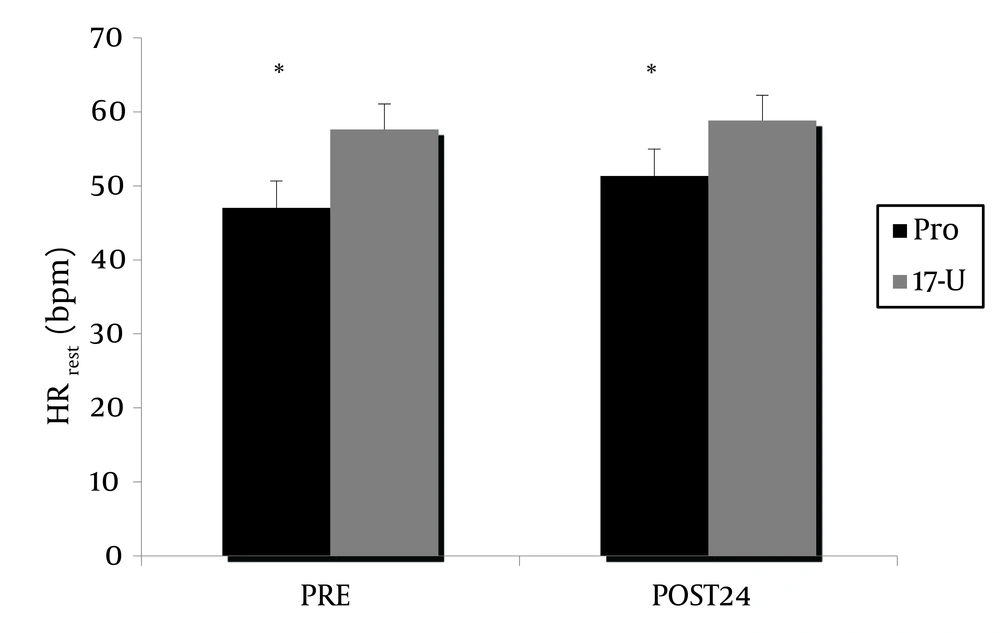
Figure 1.
* Pro < U-17 (P < 0.05).
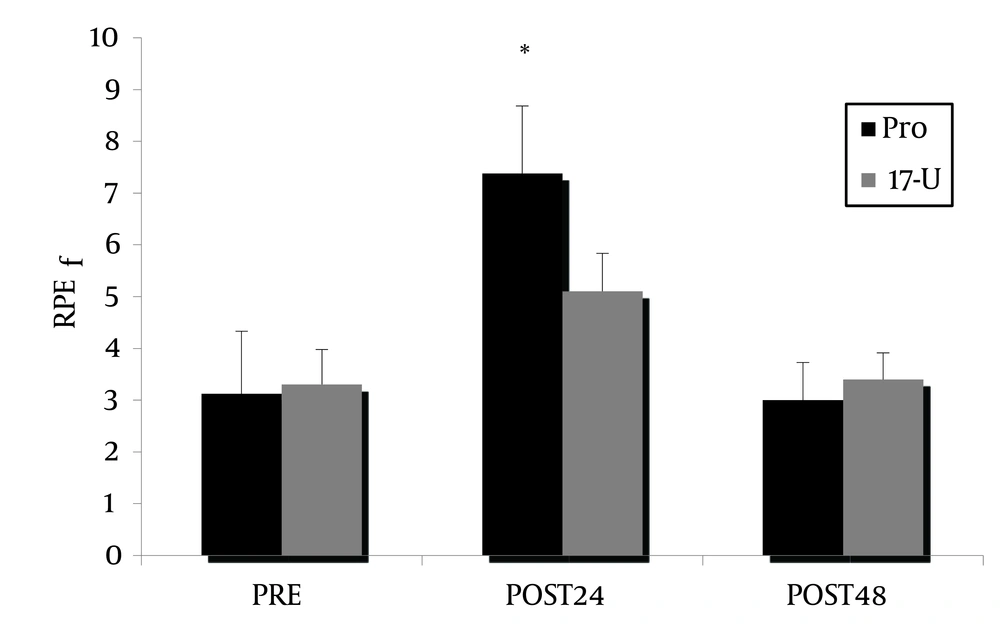
Figure 2.
* Pro > U-17 (P < 0.05).
5. Discussion
Soccer match efforts involve many physiological variations such as heart activity, blood flow and muscle damage increase, and these variations have short and long term impacts after the match. In order to observe the kinetic recovery of professional soccer players, players of the same team were tested before and after French first league championship matches, with chosen variables which represented the main physiological impacts. Our first hypothesis referred to a strong correlation existing between blood markers and perceived fatigue. It was partially confirmed. Indeed, strong correlations were found (0.6 < r2 < 0.8) between La and the two perceived fatigue notions RPEf and RPEms (Table 3). Furthermore, those three variables were significantly correlated with HRrest which represents variables of central fatigue, whereas correlation values were in accordance with the literature on this topic (19, 20). CK, considered as a reliable muscular damage marker (21), was also significantly correlated with RPEf and RPEms (r2 = 0.11). The very small effect could be explained looking at the considerable individual differences and the observed CVs which are ranged from 68 to 168%. Therefore it may be helpful to get more measures through more matches in future studies, in order to obtain a more homogeneous sample of CK.
The second hypothesis stated that professional soccer players only needed 48 hours to recover after a soccer match, and not 72 hours like what would be suggested in current literature (3, 8, 9). It was partially confirmed. Indeed, all measured variables except HRrecovery were not significantly different between PRE and POST48 tests. Players would have recovered within 48 hours. Ascensao et al. (8) explained that 72 hours were needed to recover from an official soccer match and differences existed between the results of our studies. For identical CK before the match (~200 vs. ~230U/L, respectively their results and ours), CK 24 hours after were different (~850 vs. ~1400 U/L) and 48 hours after were similar (~800 vs. ~730 U/L). Our values would confirm that the participants tested in this study recovered faster than those from Ascensao et al. study (8), because the difference between POST48 and POST24 was higher. The different tested population could explain this difference: they tested Spanish secondary division whereas the present study tested French first division players. It can also be understood that players from a higher category can recover faster than those from lower level. It can be suggested that the higher the category is, the better the player’s recovery capacity would be.
Rampinini et al. (6) analyzed the ability to recover after a friendly soccer match by observing CK, sprinting ability, RPEf and contractile properties of the lower limb. The mentioned analysis showed that 48 hours are needed to fully recover after a match, except CK values, which indicated a return to baseline after 72 hours. The results of the present study are similar, considering that players are generally less involved in a friendly match in comparison with an official league match (22). Indeed, at POST48, CK values (~730 U/L) were not significantly different from baseline (~230 U/L) although the values were significantly higher too. In future studies, it would be interesting to extend protocol measures to 72 hours post-match in order to complete the evolution of CK and precisely analyse differences between 48 and 72 hours post-match values.
HRrecovery was the only variable presenting POST48 values significantly different from baseline. The present study was the first one to include this variable to analyse professional soccer players’ kinetic recovery. Its use reveals the ability to recover from a certain physical effort in a precise instant. If the participants were already tired before the physical effort, his HRrecovery would vary. However, this variable presents several limits as it does not consider the effort intensity, mainly maximal HR the subject reached during or at the end of the effort. Conclusions of partial recovery after 48 hours were in accordance with the reviewed literature, although they analysed other markers (3, 6, 8). In future studies, measures taken 72 hours after the match (combined with physical performances and technical drills) may be relevant in order to observe the return to baseline values.
Lazarim et al. (23) observed CK in 128 adult professional players of the Brazilian championship in order to get the relation between over-fatigue and injury. They observed that 950 U/L was the upper limit before the risk of injury was relevant. In accordance with their results, players of the present study could train normally 48 hours after the match (~730 U/L).
The present study was the first one to study youth players’ post-match kinetic fatigue. Results showed match impact 24 hours after the match with a non-significant increase in HRrest (from 57.6 to 58.8 bpm) and RPEf (from 3 to 5) and 20 m speed performance (from 3.27 to 3.31 sec) significant increases. After 48 hours, all the measured variables were back to baseline, showing a total recovery. Unlike Ascensao et al. (8) result, the youth players tested in this study fully recovered the ability to accelerate and sprint 48 hours after the match. Differences between the two studies could be explained looking at the sample’s age and fitness condition differences. It must be noted that youth players analysed in this study played in French U-17 elite category, trained every day and had a mean VO2max at 59.9 ml.kg-1.min-1 calculated with the Leger and Boucher (24) formula; whereas the subjects analysed in the abovementioned study were 21 years old, played in secondary Spanish division and had a mean VO2max at 55 ml.kg-1.min-1. Differences between the two studies could be also explained by match conditions, which induce different levels of fatigue: a friendly match with two periods of 40 minutes was analysed in the present study while an official match with two periods of 45 minutes was analysed in the other one.
In youth players, a significant correlation (P < 0.05) was identified between RPEf and HRrest (r2 = 0.19). This correlation is logical since the subjective fatigue notions would impact the player’s central fatigue, which could also appear in HRrest increases. However, these two variables were not correlated with 20 m speed performance, which also seemed to be coherent since changes in sprint performance would have a rather peripheral impact than central fatigue. Several researchers, in addition to other signs or symptoms, validated the use of HRrest, as a predictor of over-trained athletes (25). The use of these two markers is essential in the individual monitoring made by medical and technical staff in soccer clubs.
The third hypothesis revealed that the kinetic recovery depends on player’s age. Observing RPEf, it showed that PRE and POST48 values were similar for professional (3.1; 3.0) and youth players (3.3; 3.4); however POST24 values were significantly higher (P < 0.05) for professionals (7.4 vs. 5.1). Firstly, youth players participated in a friendly match and could have been less involved than if they were actually playing an official game (22). Secondly, the environment of a professional soccer match is different from any other soccer match. Indeed, a very soliciting environment surrounds professionals before, during and after the match (medias, sponsors, fans, supporters, protocol organisation, etc.), and they must manage this environment as much as getting ready to perform. Even if the players would be used to these solicitations, they may increase the level of general fatigue. Furthermore, professional players in the present study had to play one of their two matches away. This element could have induced even more accumulation of fatigue (before the match) and impaired recovery process (after the match). While youth players were resting after their match, professionals were still travelling back from the match, which means that they had different recovery conditions; POST24 results may have been influenced by these differences.
As professional’s fatigue was more relevant the day after the match but went back to the same baseline values the next day, it can be concluded that they recovered more efficiently. Furthermore, the comparisons of HRrest showed that professional players had lower values of PRE (~47 vs. 57 bpm) and POST24 (~51 vs. 58) than youth players. As HRrest is a good reference for a player’s physical shape, these comparisons would permit to conclude that a better ability to recover is mostly linked with a good physical condition. Even considering that professionals had a better fitness preparation, it is worth mentioning that they had access to specific recovery methods (such as massages or hydration) that youth players did not benefit from. Such methods would permit optimization of the resynthesis of muscle glycogen storage, accelerate muscle-damage repair and have psychological relaxing effects (26). As the two tested matches were official, taking part during a competitive period with important sportive and financial outcomes, the authors could not design the study avoiding the use of the mentioned recovery methods.
The present study had certain limits that may affect its interpretation. No situational variables which could influence players’ activity on the pitch (27-29) such as game condition, playing formation, match importance, opponent quality or score evolution were taken into account during the whole analysis. Furthermore, it would have been relevant to analyse differences in the physical activity in order to compare the impact on post-match fatigue and kinetic recovery of the two populations tested. In addition, the present study presented the analysis of 16 professional and 10 national elite youth U-17 players’ activity. It may have been also interesting to involve more players in the analysis (30), in order to get a wider range of data and to analyse the potential differences among the playing positions.
Results from the present study showed that youth elite level and professional soccer players need 48 hours to recover from a soccer match. Professional soccer match conditions (psychological pressure, media demands, travel, etc.) might have increased player’s fatigue 24 hours after, in comparison with youth matches; but their better physical condition and all the recovery organisation (massages, specific nutrition, water immersion, etc.) help professionals to get back to baseline 48 hours after. Studying the kinetic fatigue during congested periods can also provide an optimal perspective as it occurs very frequently at the highest level. Results from such future studies would enhance top-level activity knowledge and help a team’s technical staff to optimize the week’s training load. Significant correlations were found between blood markers and perceived fatigue, suggesting that using such tools remains efficient to monitor daily fatigue variation of soccer players regardless of their age and category.
5.1. Practical Application
Results of the present study would help technical staff to manage the training load according to the player’s age. Indeed, youth elite level players would be able to train the day after the match while professionals would need to recover; and both groups would be able to train normally 48 hours after the match. Such training organisations might differ if competition was congested in a fixture period of matches every three days (31-36).
Training load might also differ according to the individual playing time. The players who played less than 85 minutes were not included in the study and might be less tired and able to train normally the day after.