1. Background
Low back pain (LBP) is a common and costly musculoskeletal problem throughout the world (1). Similar to the general population, LBP has become a common complaint amongst adolescent athletes (2).
Several studies in non-athletic population have shown changes in activity, recruitment and thickness of transversus abdominis (TrA) and lumbar multifidus (LM) in patients with LBP (3-5). However, only a few studies have investigated the role of these muscles in the athletes’ LBP. Cricketers with LBP showed less activity in TrA muscle (6), elite Australian Football League players with LBP had less drawing in maneuver performance (7), fast bowlers with LBP had thinner internal oblique muscle (IO) (8), and off-road cyclists with LBP had lower thickness of TrA and cross sectional area (CSA) of LM muscles (9).
Soccer is one of the most popular sports in the world. Lundin et al. in a follow-up that lasted over 13 years, showed that over 50 % of male soccer players in their study experienced moderate to severe LBP (10). In addition, Hangai et al. reported that LBP odds ratio is about 1.6 (CI: 1.3-2.2) in soccer players (11). Based on past research, it could be hypothesized that changes in IO, TrA and LM activation and/or size might have a role in soccer players’ LBP. As a result, therefore stabilizing exercises with focus on these muscles (12) may be helpful in prevention and treatment of LBP in soccer players.
To the best of our knowledge, no past study has investigated the role of lateral abdominal muscle thickness and CSA of LM in adolescent soccer players with LBP. The present study aims to compare the size and contraction of these muscles in adolescent soccer players with and without LBP via ultrasound imaging (USI). Considering the possible role of some risk factors, such as lumbar flexibility (13), low isometric muscle endurance of back extensors (14), and tight hamstrings (15), in adolescent athletes’ LBP, we had to also measure these factors for consideration of their potential confounding effects.
2. Methods
This case-control study was performed at the Sports Medicine Research Center from August 2014 to March 2016. The study was single-blinded and the assessors did not know the examinees (LBP or control). The study was approved by the local medical ethics committee and all participants and their parents received written and verbal information about the study and a written consent form was signed by all participants and their parents.
2.1. Participants
Participants were 12 to 15 years old adolescent soccer players who were playing in premier league having more than four hours of training per week and had more than two years of experience in competitive sports. They answered a self-administered questionnaire (which is available in supplementary materials and was examined for reliability in a previous study) (16). In the questionnaire LBP was defined as ‘‘the low back pain is a pain between the last rib and lower gluteal fold as you can see in the following mannequin (gray area), which is bad enough to limit or change an athletes’ daily routine or sports activities for more than 1 day”. After defining LBP, participants answered the following questions regarding having LBP 1) over the last 48 hours, 2) over the last month, 3) over the last 12 months, 4) any time after beginning sports participation, 5) any time throughout their life, and 6) whether their LBP became worse with sports activity. In addition, usual LBP VAS, care seeking behavior, and participation absence (from training session or competition) due to LBP were asked about. Participants who answered yes to question number 4 (having LBP any time after beginning sports participation) were recruited as cases if they met the following inclusion criteria: having no history of spinal trauma, spinal or abdominal surgery, systemic disease or musculoskeletal deformity with possible influence on the thickness of lateral abdominal muscles and multifidus (including, systemic scleroderma, muscular dystrophy, scoliosis, kyphosis, or abdominal wall hernia), and no history of participation in core strengthening exercises during the past six months.
Control participants were teammate adolescent soccer players without LBP (none of the aforementioned questions) who met the inclusion criteria of the study and were relatively matched for BMI, age and training hours per week.
2.2. Measurements
All recruited participants of the study were invited to the Sports Medicine Research Center for performing ultrasonic assessments and measurement of other variables including active lumbar forward flexion, isometric muscle endurance of trunk extensors, hamstring flexibility, and leg length discrepancy.
2.3. Baseline Characteristics
Baseline characteristics including age, height, weight, BMI, training/week (hours), age of sports participation for the first time, and players’ role in the sports field were collected from all participants.
2.4. Ultrasound Measurements
The thicknesses of lateral abdominal muscles including EO, IO and TrA, were measured at rest and during the abdominal drawing-in maneuver (ADiM) on both sides. The participants were positioned supine while their hips were flexed to 30 degrees (i.e., the hook-lying position) (17). The transducer was placed at 25 mm antero-medial to the midpoint between the last rib and ilium on the mid-axillary line where the fascial margins between TrA, IO and EO are parallel (17, 18). Thickness of abdominal muscles was recorded in B-mode format using a Sonosite Micromaxx (Sonosite Inc., Bothell, WA) US machine with a linear transducer (6 - 13 MHz) which was aligned perpendicular to the anterolateral abdominal wall at the mentioned anatomical point during measurements. The distance between the inferior and superior fascial layers (17, 19) at the center point of the image was recorded as the thickness of each muscle using the device’s caliper. Also, the image depth was set so that muscle layers filled approximately 40 - 50% of the ultrasound display while all three muscle layers could be seen clearly (20). The following guidelines were considered during the ultrasound measurement of lateral abdominal muscles: 1) the scanner screen was rotated in a way that participants could not see the monitor for prevention of feedback effects (21); 2) assessor applied an adequate amount of ultrasound gel during measurements for reducing the excess inward probe pressure and to increase the area of contact (17); 3) thicknesses of TrA, IO and EO were measured at the end of normal expiration; and 4) to avoid the effect of food consumption on lateral abdominal muscle thickness, the assessor performed all of the ultrasound measurements four hours after the last meal of the participants (20, 22).
Next, for measuring the muscles’ thickness during ADiM contraction, the goal was to try to isolate the TrA activation during ADiM, therefore participants were trained to perform proper ADiM for two repetitions while ultrasound was applied for feedback (21).
After the lateral abdominal muscle measurements, the CSA of the LM muscles at L4 level was measured bilaterally. In this regard, participants were placed in a prone position and a small pillow was placed under their abdomen; then the assessor found and marked the location of the spinous process of L4 vertebrae via palpation and confirmation by a longitudinal ultrasound scan.
Considering that sound waves emitted from a curved transducer could be more precisely perpendicular to the rounded border of LM and its higher reported reliability for CSA of LM in comparison with linear transducer (23, 24), the CSA of LM was measured with a 2 - 5 MHz curved transducer by tracing the LM borders on the US screen in the B mode format at rest and contraction (25, 26). Moreover, to familiarize participants with LM muscle contraction, they were instructed to contract and swell the LM under the assessor’s fingers after a relaxed inspiration and expiration for two repetitions before beginning of measurements (5).
In addition, all of ultrasound measurements were performed by an expert assessor (with two years of experience) in the field of musculoskeletal sonography. Also, two images were taken for each measurement and the mean value of them was taken for the study analysis.
2.5. Leg Length Measurements
Leg length discrepancy (LLD) was measured via clinical direct tape measure method. In this method distance between the anterior superior iliac spine (ASIS) and the medial malleolus was measured in each lower extremity and then the difference between them was considered as LLD (27).
2.6. Hamstring Tightness
Hamstring flexibility was assessed via the knee extension angle (KEA) test which has been shown as a valid and reliable method. In the KEA test, participants lay supine on the examination table and while contralateral lower extremity is flat on the table, the dominant lower extremity is positioned in the 90° hip and 90° knee flexion via two Baseline ® bubble inclinometers (Fabrication Enterprises, White Plains, NY) which were held on tibia at the level of medial malleolus and superior pole of the patella on the thigh. Then the assessor extended the knee passively until the point of feeling tightness and tolerable stretch based on participant’s report, meanwhile the thigh was held in 90° hip flexion. The angle of the leg inclinometer was recorded as “a” angle and “90° - a” was used for statistical analysis as hamstring tightness (28).
2.7. Active Lumbar Forward Flexion
The difference between T12 to S1 spinous process distance during standing and forward flexion using a tape measure was considered as active lumbar forward flexion (29). To increase the accuracy of T12 and S1 spinous process findings, the assessor located the tip of spinous process by palpation, then confirmed it by longitudinal ultrasound scan and marked it with a pen during both standing and forward flexion.
2.8. Isometric Muscle Endurance of Trunk Extensors
The isometric muscle endurance of trunk extensors was measured via the Sorensen test. Participants lay prone on the examination table while the upper edge of their iliac crests was aligned with the edge of the table. Pelvis, knees, and ankles were fixed to the table by three belts and arms were folded across the chest. Participants were asked to maintain their upper body horizontal to the ground by isometric contraction of trunk extensor muscles as the time in this position was recorded. When the trunk was down sloped by more than 5 to 10° the test was stopped (An inclinometer was applied gently between the two scapula for measuring trunk position) (30).
2.9. Sample Size Calculation
The sample size of 14 subjects per group was capable of detecting a 25% difference in CSA of LM at L4 vertebral level between cases and controls (5), assuming a standard deviation of 10%, an alpha level of 0.05, and a power of 80%.
2.10. Statistical Methods
Statistical analysis of data was performed via SPSS software version 20 (SPSS Inc., Illinois, US). Descriptive data are expressed by mean (SD) and P < 0.05 is considered statistically significant. To evaluate the association between LBP presence and abdominal muscle thickness, CSA of the LM muscles, and other variables we used linear regression mode.
3. Results
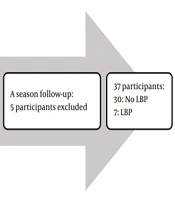
In total, 14 adolescent soccer players with LBP who were matched with 14 participants from controls group, participated in the study. As shown in Table 1, we found no significant difference in the baseline characteristics of participants between the LBP and Non-LBP groups.
Table 1.
The Baseline Characteristics of Participants Recruited in the Studya
| Variables, Mean (SD) | LBP Group, n = 14 | Non-LBP Group, n = 14 | 95% CI | P Value |
|---|---|---|---|---|
| Age, y | 14.0 (1.1) | 14.1 (0.9) | -0.9 to 0.6 | 0.71 |
| Height, cm | 165.4 (10.5) | 168.9 (8.3) | -10.8 to 3.9 | 0.35 |
| Weight, kg | 52.1 (6.6) | 54.1 (6.7) | -7.2 to 3.1 | 0.42 |
| BMI, kg/m2 | 19.0 (1.5) | 18.9 (1.9) | -1.4 to 1.3 | 0.98 |
| Training/week, h | 5.8 (0.8) | 5.9 (1.8) | -0.9 to 0.7 | 0.85 |
| Age of starting to compete, y | 10.8 (1.4) | 10.8 (1.8) | -1.2 to 1.3 | 0.99 |
| Pain VAS, 0 - 10 | 5.3 (2.2) | 0.0 | 4.0 to 6.5 | < 0.001 |
| Players’ role, No. (%) | 0.89 | |||
| Goalkeeper | 0.0 (0) | 0.0 (0) | ||
| Defenders | 35.7 (5) | 35.7 (5) | ||
| Midfielders | 42.9 (6) | 35.7 (5) | ||
| Forwards | 21.4 (3) | 28.6 (4) |
Abbreviations: BMI, body mass index; CI, Confidence Interval; LBP, low back pain; N, Number; SD, Standard Deviation; VAS, visual analog scale.
aStatistically significant, P < 0.05.
In addition, the LBP characteristics for participants with LBP are presented in Table 2. About half of the participants with LBP had experienced it in the last month and for more than 60% of them LBP became worse with sports activities.
Table 2.
LBP Characteristics of Participants with LBP
| Variable | No. (%) |
|---|---|
| LBP | |
| Life-time prevalence | 14 (100) |
| Sports life prevalence | 14 (100) |
| One year prevalence | 12 (85.7) |
| Last month prevalence | 6 (42.9) |
| Point prevalence | 3 (21.4) |
| LBP getting worse with sports activity | 9 (64.3) |
| Care seeking behaviours | |
| Visiting GP | 5 (35.7) |
| Visiting LBP specialist | 4 (28.6) |
| Use of medication | 3 (21.4) |
| Plain radiography | 1 (7.1) |
| MRI | 2 (14.3) |
| Absence due to LBP | |
| From training session | 6 (42.9) |
| From competition | 0.0 (0.0) |
Abbreviations: GP, general practitioner; LBP, low back pain; MRI, magnetic resonance imaging.
Although our main criteria for selecting participants with LBP was experiencing LBP during their sports life, we also collected whether they experienced LBP in the last year or the last month, and if their LBP had got worse with sports activity, we analyzed adjusted linear regression model for relaxed and contracted lateral abdominal muscles and LM considering these four categories (Table 3). All of measured data were in a close range and there was no relationship between muscle thickness and contraction and LBP. Finally, linear adjusted regression model for other measured factors such as hamstring tightness, leg length discrepancy, isometric muscle endurance of trunk extensors, and active lumbar forward flexion showed no significant difference between LBP and non-LBP groups in the 4 aforementioned categories regarding all of the measured variables (Table 3).
Table 3.
Comparison of Study Variables Between Adolescent Soccer Players with and without Low Back Paina
| Variables | Comparison 1b | Comparison 2b | Comparison 3b | Comparison 4b | ||||||
|---|---|---|---|---|---|---|---|---|---|---|
| Mean (SD) | P Value | Mean (SD) | P Value | Mean (SD) | P Value | Mean (SD) | P Value | |||
| EO Rest, cm | Right | LBP + | 0.7 (0.1) | 0.72 | 0.7 (0.1) | 0.97 | 0.7 (0.2) | 0.87 | 0.7 (0.1) | 0.19 |
| LBP - | 0.8 (0.2) | 0.8 (0.2) | 0.8 (0.2) | 0.8 (0.2) | ||||||
| Left | LBP + | 0.7 (0.1) | 0.97 | 0.8 (0.2) | 0.80 | 0.7 (0.1) | 0.63 | 0.8 (0.2) | 0.33 | |
| LBP - | 0.8 (0.1) | 0.8 (0.1) | 0.8 (0.2) | 0.8 (0.1) | ||||||
| IO Rest, cm | Right | LBP + | 0.9 (0.2) | 0.21 | 0.9 (0.3) | 0.18 | 0.9 (0.2) | 0.48 | 0.9 (0.4) | 0.44 |
| LBP - | 0.8 (0.1) | 0.8 (0.2) | 0.8 (0.3) | 0.8 (0.2) | ||||||
| Left | LBP + | 0.8 (0.2) | 0.18 | 0.8 (0.3) | 0.16 | 0.8 (0.1) | 0.67 | 0.8 (0.2) | 0.65 | |
| LBP - | 0.8 (0.2) | 0.8 (0.2) | 0.8 (0.2) | 0.8 (0.3) | ||||||
| TrA Rest, cm | Right | LBP + | 0.2 (0.1) | 0.29 | 0.2 (0.1) | 0.34 | 0.2 (0.1) | 0.28 | 0.2 (0.1) | 0.29 |
| LBP - | 0.2 (0.1) | 0.2 (0.1) | 0.2 (0.1) | 0.2 (0.1) | ||||||
| Left | LBP + | 0.2 (0.1) | 0.30 | 0.2 (0.1) | 0.28 | 0.2 (0.1) | 0.89 | 0.2 (0.1) | 0.54 | |
| LBP - | 0.2 (0.1) | 0.2 (0.1) | 0.2 (0.1) | 0.2 (0.1) | ||||||
| MF Rest, cm2 | Right | LBP + | 4.5 (0.9) | 0.37 | 4.4 (0.8) | 0.10 | 4.4 (0.5) | 0.18 | 4.6 (1.1) | 0.82 |
| LBP - | 5.0 (1.2) | 5.0 (1.3) | 4.9 (1.3) | 4.9 (1.2) | ||||||
| Left | LBP + | 4.4 (1.1) | 0.39 | 4.1 (0.9) | 0.08 | 4.1 (0.5) | 0.23 | 4.5 (1.2) | 0.97 | |
| LBP - | 4.8 (1.3) | 4.9 (1.4) | 4.7 (1.3) | 4.6 (1.1) | ||||||
| EO ADiM, cm | Right | LBP + | 0.7 (0.2) | 0.83 | 0.7 (0.2) | 0.44 | 0.7 (0.3) | 0.54 | 0.6 (0.2) | 0.52 |
| LBP - | 0.7 (0.2) | 0.7 (0.1) | 0.6 (0.2) | 0.6 (0.2) | ||||||
| Left | LBP + | 0.7 (0.2) | 0.22 | 0.7 (0.3) | 0.21 | 0.8 (0.3) | 0.33 | 0.7 (0.2) | 0.61 | |
| LBP - | 0.7 (0.1) | 0.7 (0.1) | 0.7 (0.1) | 0.7 (0.2) | ||||||
| IO ADiM , cm | Right | LBP + | 0.8 (0.3) | 0.13 | 0.9 (0.2) | 0.11 | 09 (0.2) | 0.09 | 0.9 (0.2) | 0.52 |
| LBP - | 0.8 (0.2) | 0.8 (0.2) | 0.8 (0.2) | 0.8 (0.2) | ||||||
| Left | LBP + | 0.9 (0.2) | 0.07 | 0.9 (0.2) | 0.11 | 0.9 (0.1) | 0.12 | 0.8 (0.2) | 0.23 | |
| LBP - | 0.8 (0.1) | 0.7 (0.2) | 0.8 (0.2) | 0.8 (0.2) | ||||||
| TrA ADiM, cm | Right | LBP + | 0.3 (0.1) | 0.59 | 0.3 (0.1) | 0.89 | 0.3 (0.1) | 0.89 | 0.3 (0.1) | 0.58 |
| LBP - | 0.3 (0.2) | 0.3 (0.1) | 0.3 (0.1) | 0.3 (0.1) | ||||||
| Left | LBP + | 0.3 (0.1) | 0.85 | 0.3 (0.1) | 0.86 | 0.3 (0.1) | 0.96 | 0.3 (0.1) | 0.79 | |
| LBP - | 0.3 (0.1) | 0.3 (0.1) | 0.3 (0.1) | 0.3 (0.1) | ||||||
| MF Cont, cm2 | Right | LBP + | 4.8 (1.6) | 0.84 | 4.6 (1.5) | 0.51 | 4.8 (1.5) | 0.92 | 5.0 (1.8) | 0.25 |
| LBP - | 5.0 (1.5) | 5.0 (1.4) | 4.9 (1.5) | 4.8 (1.3) | ||||||
| Left | LBP + | 4.7 (1.4) | 0.93 | 4.5 (1.4) | 0.68 | 4.7 (1.3) | 0.94 | 5.0 (1.6) | 0.17 | |
| LBP - | 4.9 (1.7) | 4.9 (1.6) | 4.8 (1.6) | 4.6 (1.5) | ||||||
| HT, degree | LBP + | 37.4 (12.2) | 0.86 | 37.4 (13.2) | 0.89 | 34.0 (10.5) | 0.35 | 40.2 (10.7) | 0.37 | |
| LBP - | 37.8 (6.4) | 37.8 (6.0) | 38.6 (9.3) | 36.4 (8.9) | ||||||
| Sorensen test, sc | LBP + | 140.8 (34.3) | 0.92 | 143.5 (36.2) | 0.12 | 145.2 (46.1) | 0.80 | 134.4 (38.8) | 0.57 | |
| LBP - | 143.0 (34.2) | 140.7 (32.8) | 141.0 (30.7) | 145.4 (31.4) | ||||||
| Length of back extensor muscles, cm | LBP + | 6.0 (1.2) | 0.95 | 6.1 (1.3) | 0.91 | 6.1 (1.1) | 0.85 | 6.0 (1.2) | 0.64 | |
| LBP - | 6.0 (1.1) | 6.0 (0.9) | 6.0 (1.1) | 6.0 (1.1) | ||||||
| Leg length difference | LBP + | -0.1 (0.4) | 0.09 | -0.08 (0.3) | 0.45 | -0.2 (0.4) | 0.35 | -0.1 (0.3) | 0.28 | |
| LBP - | 0.1 (0.3) | 0.03 (0.4) | 0.02 (0.3) | 0.02 (0.4) | ||||||
Abbreviations: ADiM, abdominal drawing-in maneuver; Cont, to contract and swell the LM; CSA, cross sectional area; EO, external oblique; HT, Hamstring tightness (was assessed via the knee extension angle test); IO, internal oblique; LBP, low back pain; Right, right side of the body; LM, lumbar multifidus; Left, left side of the body; SD, standard deviation; TrA, transversus abdominis.
aStatistically Significant: (P value < 0.05).
bComparison 1, Sports Life History of LBP (n = 14) vs. with-out LBP (n = 14); Comparison 2, Last Year History of LBP (n = 12) vs. with-out LBP (n = 16); Comparison 3, Last Month History of LBP (n = 6) vs. with-out LBP (n = 22); Comparison 4, LBP Gets Worse with Sports (n = 9) vs. with-out LBP (n = 19).
cSorensen test, For measuring back muscle endurance.
4. Discussion
The present study shows that there was no difference in lateral abdominal muscle thickness and L4 multifidus muscle CSA in adolescent soccer players with and without LBP in four categories including those who experienced LBP during their sports life, during last year, last month, and those with LBP that became worse with sports activity. To the best of our knowledge this is the first study in the field of lateral abdominal muscles and CSA of LM measurements via ultrasound in soccer players.
There is a controversy among different studies’ findings regarding activation of lateral abdominal muscles in athletes with or without LBP. Similar to our findings, Gildea et al. showed that thickness of TrA and IO at rest and during ADiM do not differ between adult dancers with and without LBP using MRI (31). In the same way, in a recent study Gray et al. demonstrated that while total thickness of lateral abdominal muscles is greater in fast bowler adolescents without LBP on the non-dominant side, there is no difference between total thickness on dominant side among bowlers with and without LBP (8).
On the other hand, previous study showed that history of non-specific LBP in non athlete patients can increase TrA activation during ADiM as a result of enhanced protective role during quiet standing and loaded forward-reach positions (32). In contrast to recent findings, Hides et al. in the study of forty three elite Australian football league players (AFL) expressed that adult players without LBP were able to do ADiM better than players with current LBP (7). This difference may be explained by the contact nature of Australian football, in which a player needs stronger trunk muscles compared with soccer player, although kicking is a part of both of these sports. Also, Rostami et al. found that thickness of lateral abdominal muscles and LM were lower in adult male off-road cyclists with LBP in cycling position (9).
It seems that measurements in functional and sports related positions are more important in athletes and could be a reason for controversial findings of different studies. In addition, role of trunk muscles in the different sports and dominant side of body during sports may significantly affect the interpretation of results; however, further studies are required to draw a conclusion.
Comparison of mean thickness of IO and TrA muscles in healthy 10 to 16 years old adolescents (33) and adolescent soccer players revealed no difference in muscle thickness in present study. However, EO had more thickness in present study which might be due to: 1) Adaptive changes during football training (maybe adaptation is only specific to EO muscle), 2) Different examination position (hook lying in this study and supine position in Linek et al. study). In hook lying position more posterior tilting of the pelvis could affect the thickness of EO. These probable causes have to be checked in further studies. In addition, adolescent volleyball players in Linek’s study and our soccer players had similar IO but smaller TrA thickness during rest. It should be noted that volleyball players were older (between 15 to 17 years old) and had higher body weight (34) than our soccer players. Although Linek et al. mentioned that during ADiM the IO muscle remained the thickest, and TrA muscle was thicker than the EO muscle in their study (33), our data showed that similar to rest, the IO muscle was the thickest. EO muscle was thinner than IO, and finally TrA was the thinnest muscle during ADiM contraction, supporting the findings of Gray et al. (8). To the best of our knowledge, no study has investigated the CSA of LM in healthy (none scoliotic) adolescent or subjects with LBP via ultrasound imaging till now.
Although some previous studies mentioned lumbar flexibility (13), low isometric muscle endurance of back extensors (14), and tight hamstrings (15) as risk factors for LBP, we could not find significant difference between two groups regarding these factors.
Isometric muscle endurance of trunk extensors had no significant difference between two groups in this study. Similarly, Maus et al. could not show a significant correlation among trunk muscular activity in the trunk stability of soccer players with and without LBP (35). Also in another study by Paalanne et al. on 874 young adult subjects with mean age of 19 years, authors could not show any association between LBP and maximal isometric trunk muscle strength (36).
Regarding LLD, Subotnick proposed that 6.35 mm LLD in the athletes is considered as pathologically important (37) and none of our study groups met this value. In addition, Young et al. demonstrated that at least 15 mm LLD is necessary for 1.2 degrees pelvic lateral tilt (38) and none of the study’s participants had this amount of LLD. Based on our findings there were no significant difference between LBP and non-LBP groups about LLD.
Even active lumbar forward flexion was more in the LBP group; there was no significant difference between groups. In support of our findings, Sward et al. showed that while soccer players had the least forward flexibility amongst wrestlers, gymnasts, and tennis players under study, there was no significant correlation between forward flexion and back pain in the young Swedish male athletes (39).
In the study by Stutchfield et al. they observed that there was no association between LBP and hamstring flexibility in twenty years old male rowers (40), as well as present study findings, that confirmed there was no significant difference between LBP and non-LBP groups regarding hamstring tightness.
4.1. Limitations
There are several limitations to this case control study. One limitation of the current study was that all the USI measurements were performed in the hook lying or prone position. Considering the activity of trunk muscles during different sport specific movements, more functional positions could be considered for further studies (41). In addition, some participants of LBP group have reported an intermittent pattern of pain over the last year prior to study; it could be possible that soccer players with chronic LBP (showing LBP for at least 90 days in the past 6 months) might show different results, while our participants did not report such a chronic LBP. Similar to a previous study (8), radiologic assessment of lumbar spine was not a part of this study; however, to rule out other possible LBP etiologies such as spondylolysis (42) or mild scoliosis (43), considering this assessment for future studies is suggested. Finally, our sample size was relatively small and study was undertaken in male soccer players; therefore, the generalizability of the findings to adolescent female soccer populations may be questioned. Another study is required to assess these findings in female adolescent soccer players.
4.2. Conclusion
In our sample group of adolescent premier soccer players, no statistically significant difference was observed in thickness of lateral abdominal muscles and L4 multifidus muscle CSA during rest and contraction (employing USI) in four categories including those who experienced LBP during their sports life, during last year, last month, and those whose LBP got worse with sports activity. Also, no significant correlation between LBP and leg length discrepancy, hamstring flexibility, active lumbar forward flexion, and isometric muscle endurance of trunk extensors was detected. The data obtained rules out a correlation between abdominal muscle thickness and CSA of the lumbar multifidi and LBP in adolescent soccer players. Also, it should be stated that we did not find a clue that these metrics (muscle thickness and CSA) are due to LBP either. These findings suggest that other factors might be the etiology of LBP in adolescent soccer players.