Full Text
Full text is available in PDF
Asian Journal of Sports Medicine
Sports Medicine Research Center, TUMS
Authors
Nutrition is an important component of any physical fitness program. The main dietary goal for active individuals is to obtain adequate nutrition to optimize health fitness and to increase sports performance. The present study aims to assess the nutrition knowledge, attitude and practice among the selected athletes.
Athletes from five different private colleges situated in Salem District, Tamilnadu, India were selected. A total number of 102 athletes, 32 sportsmen belong to Volleyball discipline, 25 belongs to weightlifter discipline and 45 belong to runners discipline in sports. All the selected athletes were including in the study. The Knowledge, Attitude and Practice (KAP) questionnaire contained ten questions about nutrition knowledge, nine questions about attitudes, and ten questions about dietary practice were collected from the selected athletes. Dietary composition of the sportsmen is also assessed. The collected data was coded and used for evaluation.
Results about KAP revealed that 42 per cent of the volleyball players had good nutritional knowledge (6069per cent) compared to weight lifters (43per cent) who had satisfactory (5059per cent) knowledge about nutrition. Twenty nine per cent of the runners had very good (7079per cent) knowledge about nutrition. Regarding food consumption pattern intake of cereals, other vegetables and milk was found to be less compared to the RDA for the athletes. Among the three disciplines sports persons, the mean nutrient intake of the runners is high compared to volleyball and weight lifters.
The sports disciplines strongly affected the nutrition knowledge, attitudes and practices of sportsmen. The overall scores indicate that most sportsmen had good knowledge of nutrition and supplements.
© 2010, Author(s). This open-access article is available under the Creative Commons Attribution 4.0 (CC BY 4.0) International License (https://creativecommons.org/licenses/by/4.0/), which allows for unrestricted use, distribution, and reproduction in any medium, provided that the original work is properly cited.
Ahmadi F, Ebrahimi M, Kashani V. Sports Nutritional Knowledge, Attitude, and Practice of Adolescent Athletes in Tehran, Iran. Asian J Sports Med. 2022;13(4):e131584. doi: https://doi.org/10.5812/asjsm-131584
Hessami Z, Aryanpur M, Emami H, Masjedi M. Behavior and Knowledge of Iranian Professional Athletes towards Smoking. Asian J Sports Med. 2012;3(4):e34603. doi: https://doi.org/10.5812/asjsm.34603
Farahbakhsh F, Rostami M, Kordi R. Necessity of Adding Sports and Exercise Medicine Topics to the Undergraduate Medical Curriculum in Iran. Thrita J Neu. 2012;1(2):49-52. doi: https://doi.org/10.5812/thrita.5104
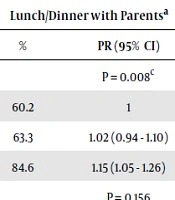
Noll M, Rodrigues AP, Silveira EA. Sport Types and Time Spent Playing Sport Are Associated with Eating Pattern Among Young Brazilian Athletes. Asian J Sports Med. 2019;10(4):e96561. doi: https://doi.org/10.5812/asjsm.96561
Seif Barghi T, Halabchi F, Dvorak J, Hosseinnejad H. How the Iranian Football Coaches and Players Know About Doping?. Asian J Sports Med. 2015;6(2):e24392. doi: https://doi.org/10.5812/asjsm.6(2)2015.24392
Last Update: 3 weeks ago
Last Update: 3 weeks ago
Last Update: 3 weeks ago
Last Update: 6 days ago
Last Update: 7 hours ago
Last Update: 4 days ago