INTRODUCTION
Smoking is among the main causes of morbidity and mortality in the world. At present, more than 5 million deaths occur annually as the result of smoking. This rate is estimated to reach 10 million by the year 2030 [1]. Based on most recent statistics, 15% of our country's population are smokers (3% of women and 27.2% of men) and annually, more than 75,000 deaths occur as the result of smoking in Iran [2].
Professional athletes of a country are usually in the spotlight. They can be role models for their fans who are mostly young adults. Exercise and sports in general have a protective and preventive effect on high risk behaviors like smoking [3, 4]. However, many studies have demonstrated that some athletes have had a tendency to unhealthy habits like smoking especially when they were younger [5].
Tobacco consumption by these individuals can damage their health and lower their performance in sport competitions. Various studies have shown that smoking decreases the performance of athletes. For example, inhaling cigarette smoke (of any type) can change air capacity of lungs in athletes during physical exercise and sport activity (it decreases VO2Max) [6].
Smoking increases the blood level of carbon monoxide and consequently results in decreased tolerance of exercise and air capacity of lungs. Also, glycolysis increases during exercise. All these factors result in development of early fatigue in smokers in comparison to non-smokers during sport activities [7].
As mentioned before smoking by athletes decreases their performance to a great extent resulting in failing in international tournaments and attracting negative public attitude and since they are role models, these bad habits can adversely affect public health.
In this study, we aimed at evaluating tobacco consumption among professional athletes in our country. We also assessed their knowledge towards smoking.
METHODS AND SUBJECTS
Samples
We studied Iranian professional athletes who were member of the super league clubs from 10 different types of sports. Sports were studied including swimming, cycling, track and field, wrestling, ping pong, martial arts, football, basketball and volleyball. All athletes who participated in this study were men.
Procedure
Participants were asked to fill a 23 items questionnaire in front of the research assistant when athletes were resting or during their routine practices at the sports clubs or camp.
Testing was anonymous and on a volunteer basis. The questionnaire took about 15 min to complete. We contacted the Physical Education Organization, explained our objectives, obtained their consent and asked for data regarding super league clubs including number and name of sports clubs and their members. The Physical Education Organization then introduced us to the sports clubs and we started from there.
Survey Tool
Our data gathering was a self-administered anonymous questionnaire which included a section on demographics, a section on tobacco history and a section on knowledge toward smoking. Demographic variables assessed included age, education, type of sport and age of sport initiation; Tobacco-related variables included current Smoking history, daily cigarette use, and awareness of the effects of tobacco use. The awareness of the effects of tobacco use was evaluated by use of a questionnaire designed by the tobacco free department of WHO with the collaboration of the center for disease control of this organization [8]. These questions helped us to obtain data regarding smoking status in athletes and their knowledge about smoking.
In order to assess the reliability of this questionnaire, a pilot study was conducted on 40 professional athletes and Cronbach's alpha was calculated to be 0.99 for the questions.
Data analysis
Data were analyzed using SPSS version 16 software. This was a descriptive study and quantitative variables were reported as mean± SD and qualitative variables as percentage. Chi square test was used to evaluate smoking status based on the type of sport and age group. Mann-Whitney u test was employed to assess the correlations between mean score of knowledge and smoking status. P≤ 0.05 was considered statistically significant.
Ethical considerations
Understudy subjects were not asked for their personal information and it was not recorded. Subjects willingly participated in the study and an informed consent was obtained from them, data were confidential and used only for study purposes and no physical or mental harm was done to subjects.
Table 1
Table 1
| Parameter | Mean (SD) | |
|---|---|---|
| Age (years) | 28.4 (2.7) | |
| Education | Under high school diploma | 117 (15.9%) |
| High school diploma | 283 (44.7%) | |
| Bachelor's degree | 202 (31.9%) | |
| Higher than BS degree | 31 (4.2%) | |
| Smoking status | Smoker | 64 (9%) |
| Non smoker | 674 (91%) | |
| Number of cigarettes per day | <10 | 21 (44.7%) |
| 10-15 | 12 (25.5%) | |
| 15-20 | 4 (8.5%) | |
| >20 | 10 (21.3%) |
RESULTS
A total of 738 individuals from 10 different sports clubs were evaluated. All understudy subjects were male, 64(9%) of them were smokers. Table (1) shows descriptive information in all participants. Among current smokers, 26 (47.3%) reported a history of quit attempt whereas, 29 (52.7%) had no history of previous quit attempts. A total of 26 (66.7%) current smokers stated that smoking helps them in sport competitions but 13 (33.3%) believed otherwise. Finally, 534 (88.6%) non-smoker athletes mentioned sport as an important factor that prevented them from initiation of smoking. However, 69 (11.4%) were against it.
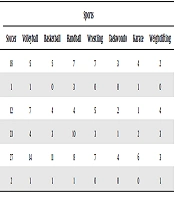
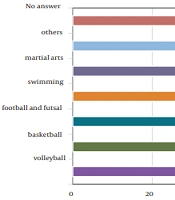
Cigarette smoking rate among athletes according to type of specific sports is shown in (Table 2).
Table 2
Table 2
| Parameter | Smokers | Non smokers | Total | P value | |
|---|---|---|---|---|---|
| Age group | <25 (years) | 18 (6.4%) | 271 | 289 (57%) | 0.002 |
| 26-40 | 15 (10.1%) | 138 | 153 (30.2%) | ||
| >40 | 19 (30.2%) | 11 | 65 (12.8%) | ||
| Knowledge | Knowledge score | 5.6 (0.9) | 7.9 (0.5) | 7.8 (0.6) | 0. 04 |
DISCUSSION
According to our study results, 9% of professional athletes in our country are current smokers. This rate is lower than the national rate of tobacco consumption prevalence among males (27.2%) [5].
In a study by Alarant A et al. in 2006, 11.4% of Olympic athletes were smokers. This rate was 38.3% among control subjects. Therefore, rate of daily smoking among athletes was 1/7 of this rate among general population [9].
Lower rate of smoking among professional athletes compared to general population was expected but considering the role of athletes as outstanding citizens of society that we all look up to and their influence on younger population, this result requires further attention and specific programs should be designed to encourage and help athletes quit smoking and increase their knowledge in this regard. In our study, prevalence of smoking had a significant correlation with type of sport playing. Percentage of smoker athletes was significantly higher in individual sports compared to team sports. The highest rate of smokers belonged to shooting sport/archery, wrestling, martial arts, and ping pong.
The results of a study in Greece showed the highest numbers of male smokers were volleyball players, boxers and handball players whereas the highest rate of female smokers were volleyball players, dancers, gymnasts and basketball players [10].
Results of a study by Holmen TL et al in Norway showed that although exercise is inversely related to smoking, rate of daily smoking was higher among athletes in individual sports especially body building and fishing compared to other sports [11].
Our study could show that rate of smoking was lower in athletes compared to general population. Prevalence of smoking among various age groups was different in this study. The highest percentage of smoker athletes were in the age group over 40 yrs. Rate of smoking was higher among older athletes. There is a theory that athletes may grow a tendency to hazardous behaviors like smoking when they approach their final years of athletic career.
Stopping exercise and physical activity can be a predictive factor for initiation of many unhealthy behaviors. Wrong mentality and lack of adequate knowledge in this field can attract the subjects towards the habit of smoking. According to the results of a study which has been done in North America older athletes were significantly more likely to have smoked [12].
As mentioned earlier, exercise can decrease stress and help creating a sense of calmness. Therefore, when someone stops or cut down exercising, they develop a crisis inside their body and that is why they should seek professional help. Many previous athletes are considered pioneers and are now working as couch or team managers. Smoking by this group can have a negative impact on team members and the public.
Another matter of discussion is good level of knowledge among athletes regarding the hazards of smoking (mean knowledge score of 7.8 out of 8). The mean score of knowledge in smoker athletes was significantly lower than that of non-smoker athletes. Therefore, we can conclude that having adequate knowledge in this regard can prevent athletes from becoming a smoker.
As mentioned before smoking by athletes has a negative impact on the public, quitting smoking by them and reflecting it in the mass media can create motivation among young smokers to quit smoking.
Type of study was cross sectional so causative association wasn't detected. Sportswomen weren't studied; our information about smoking was based on self report therefore bias is possible.
CONCLUSION
Rate of smoking among professional athletes is lower than the rate among males in general population. Exercise has a preventive effect on unhealthy habits. Therefore, it is important to encourage adolescents to exercise as part of smoking prevention programs. Also, considering the position of athletes in the society as role models, it is important to address smoking among athletes and increase their knowledge about hazards of smoking. Further studies are required to investigate reasons of cigarette and hookah smoking among athletes.