Full Text
Full text is available in PDF
Asian Journal of Sports Medicine
Sports Medicine Research Center, TUMS
Authors
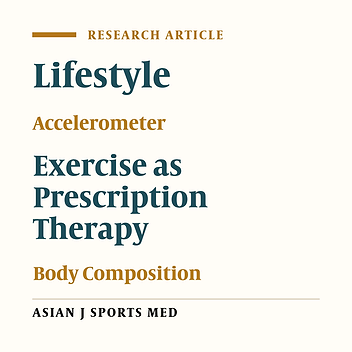
Sedentary habits are strongly associated with increase of cardiovascular risk factors. The present study aimed to verify the role of accelerometry in identifying sedentary behavior, and the possible short term positive effect of this intervention on some anthropometric variables in a group of patients with cardiovascular risks factors.
To quantify daily Spontaneous Motor Activity (SMA) levels and identify sedentary behavior, an accelerometer was employed, in addition to a simple questionnaire, in a group of overweight, hypertensive subjects. A personalized unsupervised 3 month long physical exercise program was planned. After this time, acceleroometry was again undertaken to analyze the impact of the intervention on some life style parameters, including the number of the steps taken daily, and Physical Activity Level (PAL). In addition, body water balance, weight, and Body Mass Index (BMI) were also evaluated.
Assessment of physical activity by accelerometry identifies sedentary behaviors in a larger number of individuals. After three months of regular unsupervised aerobic exercise, PAL improved from 1.56 0.1 to 1.680.2 with
Accelerometry allows to objectify PAL, and can be used to monitor improvement of variables strongly related to cardiovascular risk.
© 2013, Author(s). This open-access article is available under the Creative Commons Attribution 4.0 (CC BY 4.0) International License (https://creativecommons.org/licenses/by/4.0/), which allows for unrestricted use, distribution, and reproduction in any medium, provided that the original work is properly cited.
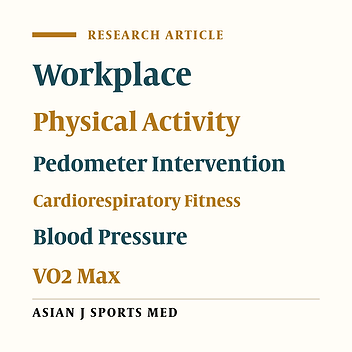
Soroush A, Der Ananian C, Ainsworth BE, Belyea M, Poortvliet E, et al. Effects of a 6-Month Walking Study on Blood Pressure and Cardiorespiratory Fitness in U.S. and Swedish Adults: ASUKI Step Study. Asian J Sports Med. 2013;4(2):34492. doi: https://doi.org/10.5812/asjsm.34492
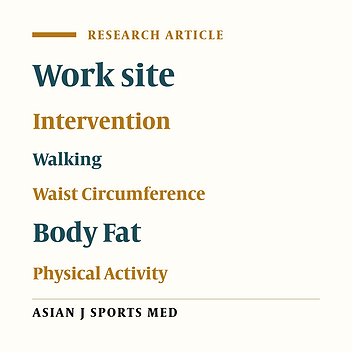
Walker JR, Soroush A, Ainsworth BE, Belyea M, Swan PD, et al. U.S. Cohort Differences in Body Composition Outcomes of a 6-Month Pedometer-Based Physical Activity Intervention: The ASUKI Step Study. Asian J Sports Med. 2014;5(4):e25748. doi: https://doi.org/10.5812/asjsm.25748
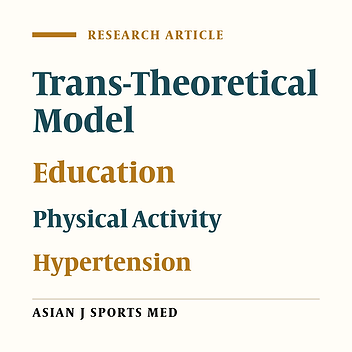
Motlagh Z, Hidarnia A, Kaveh MH, Kojuri J. Influence of a Trans-Theoretical Model Based Intervention on Physical Activity in Hypertensive Patients: A Randomised Clinical Trial. Asian J Sports Med. 2017;8(2):e42655. doi: https://doi.org/10.5812/asjsm.42655
Riva S, Masiero M, Mazzocco K, Pravettoni G. Optimistic Bias in Physical Activity: When Exercise Flows into Addiction. Int J High Risk Behav Addict. 2018;7(3):e67697. doi: https://doi.org/10.5812/ijhrba.67697
Pourarshad M, Sarlak A. The Effects of Physical Activity on Body Composition, Lipid Profile, Leptin, and Adiponectin Levels in Women: A Systematic Review Study. Compr Health Biomed Stud. 2022;1(2):e142868. doi: https://doi.org/10.22034/hmrj.2022.337240.1046
Last Update: 1 week ago
Last Update: 1 week ago
Last Update: 1 week ago
Last Update: 1 hour ago
Last Update: 8 hours ago
Last Update: 5 days ago