Full Text
Full text is available in PDF
Asian Journal of Sports Medicine
Sports Medicine Research Center, TUMS
Authors
Estimating wind chill index as one of the indexes effective in body comfort, specifically for athletes and tourists interested in winter sports.
Meteorology data including temperature and the percentage of relative humidity of 6 synoptic stations of Chaharmahal-Bakhtiyrai province, Iran from 1990 to 2007 were extracted from Iranian Meteorology Site. In order to calculate the values of wind chill, the innovative formula of NOAA Meteorology Services Center [T (WC)= 35.74+0.6215T-35.75V+0.4275TV] was used.
After analyzing wind in all stations, it became evident that the great percentage of wind calm related to fall, and spring had the most wind distortions. In studying the mean temperature during this studying period, Koohrang station with mean of 9.8C was identified as the coldest station and Lordegan with a mean of 17C represented the warmest station of the region observed. According to degrees derived from wind chill index, Koohrang station in January with a mean of ?28.75 was known as the coldest and roughest station.
Among the studied stations, Koohrang had the most intensive degrees of wind chill occurrence and Lordegan had the calmest conditions. Therefore, athletes and tourists should use warmer clothes and covers in cold seasons in Koohrang in comparison with other studied regions, in order to protect themselves from the negative effects of sudden cold and occurrence of intense wind chills.
© 2010, Author(s). This open-access article is available under the Creative Commons Attribution 4.0 (CC BY 4.0) International License (https://creativecommons.org/licenses/by/4.0/), which allows for unrestricted use, distribution, and reproduction in any medium, provided that the original work is properly cited.
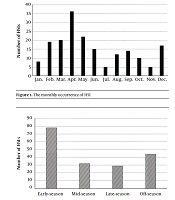
Tokutake G, Kuramochi R. Association of Hamstring Strain Injuries with Season and Temperature in Track and Field Collegiate Athletes in Japan: A Descriptive Epidemiological Study. Asian J Sports Med. 2020;11(1):e96743. doi: https://doi.org/10.5812/asjsm.96743
Zare S, Hasheminejad N, Ahmadi S, Bateni M, Baneshi MR, et al. A Comparison of the Correlation Between ESI and Other Thermal Indices (WBGT, WBDT, TWL, HI, SET, PET, PSI, and PSIHR): A Field Study. Health Scope. 2019;8(1):e63827. doi: https://doi.org/10.5812/jhealthscope.63827
Habibi P, Dehghan H, Haghi A, Shakerian M. The Relationship Between Wet Bulb Globe Temperature and Physiological Strain Index in Muslim Women in Hot-Dry Condition in the Climatic Chamber. Health Scope. 2015;4(1):e19349. doi: https://doi.org/10.17795/jhealthscope-19349
Azad A, Mousavi M, Gorzi A, Ghasemnian A. The Effect of Precooling on Exhaustive Performance in the Hot Environment. Asian J Sports Med. 2016;7(3):e33125. doi: https://doi.org/10.5812/asjsm.33125
Salehi SZ. Heatstroke During Arbaeen Walking and Its Prevention: A Review Study. Mass Gather Med J. 2024;1(2):e148850. doi: https://doi.org/10.69107/mgmj-148850
Last Update: 3 weeks ago
Last Update: 3 weeks ago
Last Update: 3 weeks ago
Last Update: 5 hours ago
Last Update: 12 hours ago
Last Update: 4 days ago