
1. Background
Medical students constitute the core human capital of the healthcare sector, and their learning processes during undergraduate and graduate training are uniquely intense, complex, and high-stakes. Medical education requires not only the acquisition of large volumes of evolving theoretical knowledge but also the rapid mastery of complex clinical competencies and practical skills necessary for safe patient care (1).
A critical determinant of academic success and professional competence is students’ learning style, defined as an individual’s preferred cognitive framework for receiving, processing, and retaining information (2, 3). Prior literature indicates that educational efficiency is maximized when instructional modalities closely align with the learner’s preferred learning style (4). Conversely, a mismatch may lead to cognitive overload and reduced engagement.
Concurrently, artificial intelligence (AI) has emerged as an important technological force in higher education. The adoption, acceptance, and effective use of these tools depend on several student-level factors, including baseline digital literacy and prior technological experience (5). Recent evidence indicates that generative AI and large language models (LLMs), a subset of deep-learning architectures trained on large, heterogeneous text corpora to generate contextually relevant and coherent responses, are reshaping medical education. By leveraging probabilistic pattern recognition and natural language understanding, these models enable adaptive tutoring, dynamic clinical scenario generation, and real-time feedback, creating opportunities for personalized learning pathways, automated clinical skill simulations, and on-demand access to synthesized medical knowledge (6, 7). However, how medical students actively manage these systems, and the learning challenges they encounter, require rigorous evaluation (1, 8). Successful integration of these technologies requires a deep understanding of learners’ individual characteristics, particularly their underlying learning structures.
Considerable effort has been directed toward bridging the gap between educational theory and AI application (9). Systematic reviews highlight David Kolb’s Experiential Learning Theory as a robust framework for predicting learning behaviors and designing adaptive recommendation systems (9). Kolb’s theory characterizes learning as a cyclical process spanning four distinct stages: Concrete Experience (CE; feeling), Reflective Observation (RO; watching), Abstract Conceptualization (AC; thinking), and Active Experimentation (AE; doing) (10). Institutions have also developed AI-driven frameworks that dynamically adapt clinical content according to Kolb’s stages, with reported improvements in student satisfaction.
This experiential foundation is not limited to theoretical models; it is increasingly reflected in a new wave of interactive educational technologies. For example, gesture recognition technology has emerged as a tool that facilitates immersive, hands-on practice in anatomy, surgical simulation, and medical image interpretation (11).
Given the integration of theory and real-world clinical application in medicine, understanding student perspectives is important. Although generative AI creates opportunities for personalized learning, medical educators have expressed concern that overreliance on public, general-purpose tools may bypass essential reflective stages, erode deep analytical skills, and promote shallow learning (12).
A structured, critical, and ethically informed approach to technology management is therefore important. This reinforces the need to evaluate not only students’ technical skills but also their broader capacity for AI management: the ability to critically filter, verify, and strategically govern these tools to mitigate inherent limitations and prevent cognitive overreliance (13).
2. Objectives
The present study aimed to evaluate the relationships between specific AI dimensions (AI management, decision-making, infrastructure, skills, and tendency) and the learning styles of students at Qazvin University of Medical Sciences based on Kolb's model. The findings are intended to address the implementation gap (3, 6) and to support the design of theoretically grounded, personalized AI architectures in medical education.
3. Methods
3.1. Study Design and Setting
This descriptive-analytical cross-sectional study was conducted at Qazvin University of Medical Sciences. Data were collected over a 9-month period from March 2025 to December 2025.
3.2. Participants and Sampling
The required sample size was calculated using G*Power software (version 3.1.9.7). Based on multiple linear regression analysis, with an alpha level of 0.05, statistical power (1 - beta) of 0.95, a medium effect size (f2 = 0.15), and 10 potential predictors, the minimum required sample size was determined to be 354 participants.
To ensure a representative sample, multistage cluster sampling was conducted across the Faculties of Medicine, Dentistry, Nursing and Midwifery, Public Health, and Allied Medical Sciences at Qazvin University of Medical Sciences. In the first stage, each faculty was considered a primary cluster, and proportional allocation was applied based on the total student population in each faculty. In the second stage, specific fields of study and academic years were randomly selected, and participants were recruited from the selected classes.
The inclusion criteria were active university enrollment and completion of at least one academic semester to ensure baseline academic adaptation. Guest and transfer students from other universities and individuals who declined to provide written informed consent were excluded.
3.3. Data Collection and Instruments
Data were collected face-to-face using anonymous questionnaires to ensure confidentiality. Data collection was performed by a team of four trained research assistants. To maintain data quality, the principal investigator monitored questionnaire completion, and ambiguities in responses were resolved. Owing to this close supervision, no participants were excluded because of incomplete or erroneous responses.
Three validated instruments were used.
Demographic Questionnaire: This 7-item form captured age, sex, marital status, academic level, preceding-semester grade point average, active AI use status, and the specific types of AI applications used.
Artificial Intelligence Questionnaire: Developed by Chen et al. (14) to measure organizational and individual technological adaptation, the original instrument demonstrated high reliability (overall Cronbach alpha = 0.913; subscales > 0.70) and was adapted into Persian by Amirkhaninia et al. (Cronbach alpha = 0.77). It assesses 22 items across five dimensions using a 5-point Likert scale ranging from "too little" to "too much": AI Management (3 items), AI-Based Decision-Making (4 items), AI Infrastructure (5 items), AI Skills (5 items), and AI Tendency (5 items). Higher subscale scores indicate greater capacity within the corresponding domain.
Kolb's Learning Style Inventory (LSI): This 12-item inventory evaluates preferences across the CE-AC and RO-AE structural axes and categorizes individuals into four dominant learning styles: Converging, Diverging, Assimilating, and Accommodating (14). Respondents rank four options per item from 1 (least descriptive) to 4 (most descriptive) based on their actual learning habits. The instrument's construct validity and reliability have been documented internationally.
Internal consistency was calculated using Cronbach alpha in SPSS version 22, with a threshold of > 0.70. Chen's AI questionnaire achieved an alpha of 0.80. The Kolb inventory subscales also demonstrated strong internal consistency: Concrete Experience (alpha = 0.80), Reflective Observation (alpha = 0.90), Abstract Conceptualization (alpha = 0.85), and Active Experimentation (alpha = 0.86).
Following institutional approval, the research team visited the respective faculties, where eligible participants were identified and sampled according to the predefined inclusion criteria. Before data collection, the study objectives were explained to all eligible participants during an initial briefing session, and written informed consent was obtained from all participants.
3.4. Statistical Analysis
Data were analyzed using SPSS version 22 (IBM Corp, Armonk, NY). Normality was assessed using the Kolmogorov-Smirnov test. As the variables followed a normal distribution, descriptive statistics, including means, standard deviations, and frequencies, were calculated. Inferential analyses used one-way ANOVA to compare AI dimensions across learning styles and Pearson correlation coefficients to assess relationships between specific technological dimensions and experiential learning stages. Statistical significance was established a priori at P < 0.05.
3.5. Ethical Considerations
All procedures adhered to institutional ethical review board standards and the Declaration of Helsinki. The study was approved by the Ethics Committee of Qazvin University of Medical Sciences (IR.QUMS.REC.1403.461). Written informed consent was obtained, and strict anonymity was maintained throughout.
4. Results
4.1. Sample Characteristics
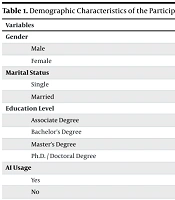
The study cohort had a mean age of 22.31 ± 3.4 years; 50.8% were male, and 90.7% were single. Active use of AI tools was reported by 81.4% of participants (n = 288), with ChatGPT as the predominant primary platform (57.1%), followed by the use of multiple tools (13.0%) (Table 1).
Table 1.
Demographic Characteristics of the Participants (N = 354)
| Variables | No. (%) |
|---|---|
| Gender | |
| Male | 180 (50.8) |
| Female | 174 (49.2) |
| Marital Status | |
| Single | 321 (90.7) |
| Married | 33 (9.3) |
| Education Level | |
| Associate Degree | 8 (1.7) |
| Bachelor's Degree | 302 (85.6) |
| Master's Degree | 7 (2.0) |
| Ph.D. / Doctoral Degree | 38 (10.7) |
| AI Usage | |
| Yes | 288 (81.4) |
| No | 66 (18.6) |
| Type of AI Tool | |
| None | 49 (13.8) |
| ChatGPT | 202 (57.1) |
| DeepSeek | 32 (9.0) |
| Gemini | 6 (1.7) |
| Copilot | 12 (3.4) |
| Multiple Tools | 46 (13.0) |
| Grok | 2 (0.6) |
| Open Ai | 2 (0.6) |
| Perplexity | 3 (0.8) |
The mean total AI score was 56.78 ± 13.3, placing it below the median in the second quartile. Detailed subscale scores are presented in Table 2.
Table 2.
Mean Scores and Descriptive Statistics of AI Questionnaire Subscales (N = 354)
| Dimensions | Mean | Standard Deviation | Minimum | Maximum |
|---|---|---|---|---|
| AI Management | 5.42 | 2.3 | 3.00 | 14.00 |
| AI-Based Decision-Making | 11.92 | 3.1 | 2.92 | 20.42 |
| AI Infrastructure | 11.63 | 3.9 | 4.28 | 25.28 |
| AI Skills | 14.97 | 4.2 | 4.13 | 25.53 |
| AI Tendency | 12.82 | 3.9 | 3.51 | 27.31 |
| Total AI Score | 56.78 | 13.3 | 19.69 | 94.04 |
Although learning styles varied among participants and different styles were used to understand different concepts, 74% of participants demonstrated a dominant converging learning style. Learning through thinking and doing (Abstract Conceptualization and Active Experimentation) was more prevalent than learning through watching and feeling (Concrete Experience and Reflective Observation) (Table 3).
Table 3.
Frequency Distribution of Participant Learning Styles via Kolb's LSI
| Learning Style | No. (%) |
|---|---|
| Accommodating | 17 (4.8) |
| Converging | 263 (74.3) |
| Diverging | 26 (7.3) |
| Assimilating | 48 (13.6) |
One-way ANOVA showed significant associations between learning style and AI-based decision-making (P < 0.001), AI skills (P = 0.006), and AI tendency (P < 0.001) (Table 4).
Table 4.
Comparative Analysis of AI Dimensions and Total AI Competence Across Learning Styles (One-Way ANOVA) a
| Learning Style Profile | AI Management | AI Decision-Making | AI Infrastructure | AI Skills | AI Tendency | Total AI Score |
|---|---|---|---|---|---|---|
| Accommodating | 5.47 ± 2.3 | 11.07 ± 2.8 | 11.30 ± 3.4 | 17.09 ± 5.0 | 15.69 ± 3.2 | 60.65 ± 13.11 |
| Converging | 5.38 ± 2.4 | 11.59 ± 3.0 | 11.60 ± 3.9 | 14.53 ± 4.1 | 12.29 ± 3.7 | 55.40 ± 13.20 |
| Diverging | 9.00 ± 2.3 | 12.20 ± 3.4 | 11.76 ± 3.7 | 15.66 ± 3.9 | 15.18 ± 4.5 | 60.51 ± 13.20 |
| Assimilating | 5.50 ± 2.3 | 13.87 ± 2.8 | 11.81 ± 4.3 | 16.29 ± 4.1 | 13.43 ± 4.0 | 60.92 ± 12.70 |
| F-value | 0.156 | 8.004 | 0.087 | 4.241 | 8.420 | 3.719 |
| P-value | 0.926 | < 0.001 b | 0.967 | 0.006 b | < 0.001 b | 0.012 b |
a Values are expressed as mean ± SD.
b Statistically significant at P < 0.05.
Pearson correlation analysis demonstrated associations between Kolb's learning cycle stages and AI subscales (Table 5). AI-based decision-making correlated negatively with concrete experience (r = -0.185, P < 0.001) and positively with abstract conceptualization (r = 0.323, P < 0.001). AI skills correlated negatively with concrete experience (r = -0.225, P < 0.001) and positively with abstract conceptualization (r = 0.180, P = 0.001) and active experimentation (r = 0.166, P = 0.002). AI tendency was strongly negatively associated with concrete experience (r = -0.311, P < 0.001) and positively with active experimentation (r = 0.350, P < 0.001). Finally, the total AI capacity score demonstrated a significant negative correlation with concrete experience (r = -0.212, P < 0.001) and positive correlations with abstract conceptualization (r = 0.175, P = 0.001) and active experimentation (r = 0.143, P = 0.007). No AI dimension showed a statistically significant correlation with reflective observation.
Table 5.
Pearson Correlation Between Kolb Learning Cycle Stages and AI Subscales
| Learning Stage Dimensions | AI Management | AI Decision-Making | AI Infrastructure | AI Skills | AI Tendency | Total AI Score |
|---|---|---|---|---|---|---|
| Concrete Experience (CE) | r = -0.009; P = 0.864 | r = -0.185; P < 0.001 a | r = -0.080; P = 0.881 | r = -0.225; P < 0.001 a | r = -0.311; P < 0.001 a | r = -0.212; P < 0.001 a |
| Reflective Observation (RO) | r = -0.040; P = 0.946 | r = -0.014; P = 0.799 | r = 0.023; P = 0.668 | r = -0.054; P = 0.315 | r = -0.068; P = 0.200 | r = -0.033; P = 0.532 |
| Abstract Conceptualization (AC) | r = 0.323; P = 0.889 | r = 0.323; P < 0.001 a | r = 0.066; P = 0.213 | r = 0.180; P = 0.001 a | r = 0.067; P = 0.211 | r = 0.175; P = 0.001 a |
| Active Experimentation (AE) | r = 0.000; P = 0.993 | r = 0.002; P = 0.966 | r = -0.050; P = 0.346 | r = 0.166; P = 0.002 a | r = 0.350; P < 0.001 a | r = 0.143; P = 0.007 a |
a Statistically significant at P < 0.05.
5. Discussion
The present study examined the relationship between dimensions of artificial intelligence and learning styles among students at Qazvin University of Medical Sciences, based on Kolb's model.
The findings revealed that 81.4% of students used AI, highlighting the substantial penetration of this technology among the new generation of medical sciences students. These results are consistent with the scoping review by Verghese et al. (6) and the findings of Kassab et al. (1). Among the tools used, ChatGPT accounted for the largest share at 57.1%, demonstrating its marked popularity among students at Qazvin University of Medical Sciences.
This high level of adoption indicates a fundamental shift in the information-seeking behavior of medical students. The substantial volume of basic and clinical coursework, coupled with demanding medical curricula, may drive students to use these tools as readily accessible assistants. However, excessive reliance on general-purpose platforms that are not specifically tailored to specialized medical literature may lead to superficial learning or the acquisition of inaccurate clinical information. Educational systems should therefore prioritize the development of localized and specialized AI platforms tailored to the healthcare domain.
The mean overall AI score was 56.78, reflecting a favorable level of baseline familiarity and positive attitudes toward AI among students; however, their ability to manage this technology in a structured and purposeful manner remains unsatisfactory. This finding, which aligns with aspects of the study by Khanian Najafabadi et al. (9), indicates that students understand what AI is and are highly motivated to use it, yet may lack essential competencies in areas such as precise prompt engineering, clinical verification of outputs, adherence to ethical protocols, and the safe integration of these tools into diagnostic and learning processes.
This gap between awareness and management is important in medical education because students may remain vulnerable when encountering large volumes of machine-generated information. Consequently, educational curricula should move beyond introductory technology familiarization and strategically focus on developing higher-order cognitive skills for the critical management, evaluation, filtering, and governance of AI tools.
The predominance of the converging learning style (74.3%) indicates that medical students strongly favor abstract logic and active, hands-on application over watching or feeling. This finding is consistent with reports by Zareen et al. (15) and Dehghani and Ghaffarifar (16), but contrasts with Rahman et al. (17), who reported an activist-style predominance (79.6%) in Pakistan, possibly because of differences in assessment tools, sampling, or institutional culture. The preference for the converging style is consistent with the problem-solving nature of clinical training. Because these students actively seek practical, real-world solutions rather than purely theoretical texts, long, abstract textual outputs from AI may be less efficient. Educational algorithms could instead present clinical information through interactive case simulations, algorithmic problem-solving blocks, and virtual clinical decision-making environments.
The findings revealed significant associations between learning styles and three AI dimensions: AI-based decision-making, AI skills, and tendency toward AI. These results align with the findings of Montag et al. (3) and Özdemir et al. (18). This finding underscores the importance of understanding the relationship between learning styles and interaction with AI. The adoption of emerging technologies may depend not only on computer literacy but also on cognitive structures and information-processing mechanisms. Current AI tools may therefore be more compatible with some cognitive patterns than others. Rather than imposing a standardized model, future efforts should focus on developing adaptive systems capable of tailoring their structure to the user's cognitive style.
All AI dimensions except AI management and infrastructure demonstrated a significant negative correlation with Concrete Experience. Students who prefer learning through feeling and direct engagement with experience may show lower levels of AI tendency, skills, and decision-making and may rely more heavily on human interaction, empathy, and face-to-face communication—needs that screen-based AI may not fully address. This finding highlights a current limitation of these tools and aligns with the results reported by Hmoud et al. (19).
Furthermore, this finding underscores that, in medical education, AI should not replace faculty members or clinical interactions; rather, it should serve a complementary role through technologies such as augmented reality.
Another notable finding was a significant positive correlation between Abstract Conceptualization and AI-based decision-making, AI skills, and the overall AI score. This indicates that students who favor logical thinking and theoretical analysis in their learning process engage more extensively with various dimensions of AI. These results align with the findings of Villarroel Henríquez et al. (10). For students seeking to identify patterns and analyze data, AI may provide an environment for testing hypotheses; however, caution is needed to ensure that such reliance does not lead to detachment from real-world clinical practice.
The study also demonstrated significant positive correlations between Active Experimentation and AI skills, tendency toward AI, and the overall AI score. This suggests that students who prefer learning through hands-on application and active execution have a greater inclination toward, and higher competency in, using AI. These students may perceive AI as a virtual environment for trial and error, providing an algorithm-based space in which they can simulate and evaluate the consequences of therapeutic decisions.
Based on the findings of this study, merely introducing this technology into universities and providing internet access are insufficient. Educational administrators and curriculum planners should move toward personalized systems that can identify each student's cognitive style and customize the learning pathway, clinical content delivery method, and nature of feedback to maximize educational efficiency.
The practical implications of these findings for medical education are fourfold. First, personalized AI-based learning systems should be developed to accommodate distinct learning styles (9). Second, AI literacy training should be integrated into the medical education curriculum (3, 6, 10), with instructional design tailored to different learning preferences. Third, faculty members and educational planners should remain aware of individual differences among students in AI adoption and use and employ diverse instructional strategies accordingly (1, 10). Fourth, given the high prevalence of the converging learning style among medical students, designing AI tools that emphasize practical application and problem-solving may be particularly useful.
5.1. Study Limitations
This cross-sectional study was restricted to Qazvin University of Medical Sciences, which limits the generalizability of the findings. In addition, reliance on self-reported questionnaires may introduce response bias. Future longitudinal studies with larger sample sizes across multiple universities are recommended to validate and extend these results. This study did not examine differences according to students' specific fields of study or distinguish between the theoretical and practical phases of medical education. Future studies should investigate these factors separately to provide a more detailed understanding of the relationship between learning styles and AI use across different educational settings.
5.2. Conclusions
The findings of this study demonstrate that students' learning styles play an important role in how they manage, adopt, and use AI. Given the significant correlations of AI-related skills and decision-making with Abstract Conceptualization and Active Experimentation, students with analytical and pragmatic approaches appear to engage more extensively with AI technologies. Conversely, the negative correlation between AI dimensions and Concrete Experience highlights the need to design educational programs that accommodate diverse learning styles. Addressing these cognitive differences may assist universities and educational policymakers in integrating and managing AI more effectively within the learning process.