
1. Background
Knowledge is regarded as the most valuable source of competitive economy production and dynamic progress in the path to development (1). Knowledge is a proven belief that enhances the capacity of an institution to operate efficiently (2). Knowledge formation occurs at an individual or group level; at an individual level, individuals could form knowledge independently, while knowledge formation within a group requires the collaboration of the members and the transformation of individual knowledge into group knowledge depending on the members’ desire to share their knowledge (1). Since the inadequate management of any resource leads to its waste, considerable budget and effort are allocated to the issues revolving around knowledge and its better management in developed countries (3).
There are two perspectives regarding the way knowledge sharing occurs. One is the view that considers knowledge sharing to be an individual matter arising from the particular circumstances of an individual without considering it manageable from the outside. The second view considers knowledge sharing to be a programmable and manageable matter as long as its reinforcing factors are identified and addressed (4). Managing a critical resource such as knowledge is influenced by multiple components, such as selecting the methods of knowledge classification, storage, collection, and sharing (5). Despite the undeniable role of knowledge sharing in the development and progression of scientific production, no individual or organization has the necessary experiences to survive. The budget and expenses dedicated to discovering strategies in developed countries to facilitate knowledge sharing are a testament to the key role of this issue in various areas (6).
Despite the benefits of knowledge sharing, several studies have confirmed that obstacles such as a lack of motivation and proper context hinder the widespread improvement of this area in different organizations. Recently, knowledge sharing has been recognized as a major challenge in knowledge management (7-9). On the other hand, the advancement of science and technology necessitate more teamwork, and the new forms of teamwork are associated with an increasing need to adopt strategies for the optimal utilization of opportunities and collaboration of knowledgeable individuals (10-12).
Universities are the main centers of knowledge production and management in every country, taking great steps along the path of developing a knowledge-based economy through the integration of education and research (13). By creating space for the collaboration of the owners of knowledge and skills, universities provide the opportunity for teamwork between these individuals whose productivity will increase by sharing their information as well (3). However, the misconception regarding the uselessness of knowledge sharing, the desire to work independently and compete, and the academic culture that urges researchers to constantly use repetitive patterns of thought rather than shared unique information are major obstacles to knowledge sharing (14, 15). Therefore, determining the reinforcing factors of knowledge sharing is essential in the field of knowledge management (16).
Recognizing the influential factors in knowledge sharing builds a proper guide for educational planners. Furthermore, using theories of behavior analysis could be beneficial in this regard. The theory of planned behavior (TPB) is a pattern established for behavioral changes, which has been used in several studies (17-20). Accordingly, intention is the major determinant of behavior and is influenced by the three factors, including one's attitude and beliefs toward doing a task, subjective norms of what others think about one's behavior, and the perceived behavioral control that shows one's perception of their ability to display an intended behavior (17).
2. Objectives
The present study aimed to predict the level of knowledge sharing intention among the faculty members of Kermanshah University of Medical Sciences (KUMS), Iran.
3. Methods
3.1. Participants and Procedures
This descriptive, cross-sectional study was conducted on 154 faculty members of KUMS in the spring of 2019. The sample size was determined based on a pilot study of the standard deviation of the dependent variable (i.e., knowledge sharing intention score), which was estimated to be 1.79, the significance level of the test (α = 5%), and the error rate of 1/10 unit. The final sample size was determined to be 129 samples. Considering the probability of 20% attrition, 154 participants were enrolled in the study.
For sample selection and data collection, different schools of KUMS were initially considered as clusters, and the participants were selected via simple random sampling with a probability proportional to the size of each cluster. Research objectives and procedures were explained to the participants, and they were enrolled willingly. The study protocol was approved by the Research Ethics Committee of KUMS (ethics code: IR.KUMS.REC.1397.1002). Among 154 subjects, 140 faculty members voluntarily agreed to participate in the study. The response rate was estimated at 91%, and data were collected using a self-report questionnaire.
3.2. Measures
The questionnaire consisted of two sections, and data were collected in a self-report manner.
3.2.1. Section One: Demographic Variables
The first section of the questionnaire was demographic information of the subjects, including age (year), gender (male/female), school (medicine, dentistry, pharmacy, health and nutrition, nursing and midwifery, paramedics), education status (master's degree, PhD, medicine doctor), marital status (single/married), academic rank (lecturer, assistant/associate professor, full professor), work experience (year), and employment status (formal, contractual, coefficient K).
3.2.2. Section Two: TPB Components
Prior to the main study, a pilot study was conducted to assess the utility of the instrumentation. The participants of the pilot study were 20 faculty members of KUMS, which was similar to those who participated in the main study. In order to facilitate the participants’ responses to the instrument items, all the items were standardized to a five-point Likert scale, ranging from score one (strongly disagree) to score five (strongly agree). The reliability of the questionnaire was confirmed using the Cronbach's alpha coefficient, and the content validity was confirmed by a panel of experts.
The items that assessed the components of the TPB were designed based on standard questionnaires in the field of knowledge sharing (18, 21, 22). In total, 13 items were designed based on four TPB components, including attitude, subjective norms, perceived behavioral control, and intention. In addition, four items measured attitudes toward knowledge sharing (e.g., in my opinion, knowledge sharing with others is valuable.). Four other items were also designed to assess the subjective norms toward knowledge sharing (e.g., knowledge sharing at our university is common among my colleagues.). Two items evaluated the perceived behavioral control regarding knowledge sharing (e.g., knowledge sharing is always possible for me.). Finally, the intention of knowledge sharing was measured by three items (e.g., I intend to share my knowledge with my colleagues.).
3.3. Statistical Analysis
Data analysis was performed in SPSS version 16 using bivariate correlations to ensure the magnitude and direction of the associations between the TPB components. In addition, linear regression analysis was used to explain the variations in knowledge sharing intention based on attitude, subjective norms, and perceived behavioral control. Independent t-test and one-way analysis of variance (ANOVA) were also applied to assess the correlations between knowledge sharing intention and demographic variables. Cronbach’s alpha coefficient was used to estimate the internal consistency of various measures.
4. Results
The mean age of the faculty members was 41.73 ± 7.49 years (age range: 27 - 59 years). The details of the demographic variables of the participants are shown (Table 1).
Table 1.
Distribution of Demographic Variables among KUMS Faculty Members
| Variables | No. (%) |
|---|---|
| Gender | |
| Male | 87 (37.9) |
| Female | 53 (62.1) |
| Marital status | |
| Married | 113 (80.7) |
| Single | 26 (18.6) |
| No answer | 1 (0.7) |
| Academic rank | |
| Lecturer | 16 (11.4) |
| Assistant professor | 87 (62.1) |
| Associate professor | 31 (22.1) |
| Full professor | 4 (2.9) |
| No answer | 2 (1.4) |
| Education level | |
| MSc | 11 (7.9) |
| PhD | 79 (56.4) |
| MD | 48 (34.3) |
| No answer | 2 (1.4) |
| School | |
| Medicine | 80 (57.1) |
| Dentistry | 11 (7.9) |
| Pharmacy | 14 (10) |
| Health and nutrition | 19 (13.6) |
| Nursing and midwifery | 11 (7.9) |
| Paramedics | 5 (3.6) |
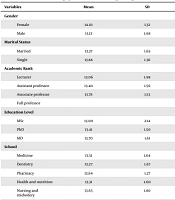
The correlations between the demographic variables and knowledge sharing intention are shown (Table 2). Accordingly, only gender had a significant correlation with knowledge sharing intention, and knowledge sharing intention was significantly higher among the female faculty members compared to the males.
Table 2.
Correlations Between Demographic Variables and Knowledge Sharing Intention
| Variables | Mean ± SD | t/F | P-Value |
|---|---|---|---|
| Gender | 3.413 | 0.001 | |
| Female | 14.01 ± 1.32 | ||
| Male | 13.13 ± 1.68 | ||
| Marital Status | -1.629 | 0.110 | |
| Married | 13.37 ± 1.65 | ||
| Single | 13.88 ± 1.36 | ||
| Academic Rank | 1.225 | 0.297 | |
| Lecturer | 13.06 ± 1.98 | ||
| Assistant professor | 13.40 ± 1.56 | ||
| Associate professor | 13.78 ± 1.53 | ||
| Full professor | |||
| Education Level | 1.021 | 0.363 | |
| MSc | 13.00 ± 2.14 | ||
| PhD | 13.41 ± 1.50 | ||
| MD | 13.70 ± 1.61 | ||
| School | 0.214 | 0.956 | |
| Medicine | 13.51 ± 1.64 | ||
| Dentistry | 13.27 ± 1.67 | ||
| Pharmacy | 13.64 ± 1.27 | ||
| Health and nutrition | 13.31 ± 1.60 | ||
| Nursing and midwifery | 13.63 ± 1.80 | ||
| Paramedics | 13.00 ± 2.00 |
The bivariate associations between the TPB components, which were all considered significant at 0.01 are shown (Table 3). Furthermore, knowledge sharing intention was associated with positive attitudes toward knowledge sharing (r = 0.496), subjective norms regarding knowledge sharing (r = 0.234), and perceived behavioral control regarding knowledge sharing (r = 0.362).
Table 3.
Bivariate Associations between TPB Components
| Variables | Attitude | Subjective Norms | Perceived Behavioral Control | Mean ± SD |
|---|---|---|---|---|
| Attitude | 18.54 ± 1.89 | |||
| Pearson's correlation-coefficient | 1 | |||
| P-value | ||||
| Subjective norms | 13.94 ± 3.26 | |||
| Pearson's correlation-coefficient | 0.288 a | 1 | ||
| P-value | 0.001 | |||
| Perceived behavioral control | 6.89 ± 1.73 | |||
| Pearson's correlation-coefficient | 0.358 a | 0.465 a | 1 | |
| P-value | < 0.001 | < 0.001 | ||
| Knowledge sharing intention | 13.47 ± 1.60 | |||
| Pearson's correlation-coefficient | 0.496 a | 0.234 a | 0.362 a | |
| P-value | < 0.001 | 0.007 | < 0.001 |
a Significant correlation at 0.01 (two-tailed).
A hierarchical multiple regression analysis was performed to explain the variation in knowledge sharing intention based on the TPB components of attitudes, subjective norms, and perceived behavioral control. The TPB components accounted for 25% of the variation in knowledge sharing intention (Table 4). In addition, the optimal model was identified in the second step, and attitude was observed to be the optimal predictor of knowledge sharing intention among the participants.
Table 4.
Predictors of Knowledge Sharing Intention among Faculty Members Based on Attitudes, Subjective Norms, and Perceived Behavioral Control a
| Models | Unstandardized Coefficients B | Std. Error | Standardized Coefficients Beta | t | P-value |
|---|---|---|---|---|---|
| Step 1 | |||||
| Attitudes | 0.338 | 0.073 | 0.387 | 4.643 | < 0.001 |
| Subjective norms | -0.001 | 0.043 | -0.001 | -0.012 | 0.990 |
| Perceived behavioural control | 0.197 | 0.083 | 0.215 | 2.368 | 0.019 |
| Step 2 | |||||
| Attitudes | 0.337 | 0.072 | 0.387 | 4.707 | < 0.001 |
| Perceived behavioural control | 0.197 | 0.075 | 0.215 | 2.611 | 0.010 |
a Adjusted R2 = 0.25; F = 21.492; P < 0.001.
5. Discussion
The present study aimed to predict the level of knowledge sharing intention among the faculty members of KUMS and health services. Correlations were observed between all the constructs of the TPB in terms of knowledge sharing. Attitudes predicted the most significant variance of knowledge sharing intention, followed by perceived behavioral control to a lower extent despite the significant effect of this factor. However, subjective norms were excluded from the model. Our findings are quite consistent with the other studies in this regard. For instance, the study by Chen et al. (2012) collected the data of 134 large IT companies in Taiwan and stated that attitude and subjectivity were the most significant influential factors in knowledge sharing intention (19). Moreover, the studies conducted by Islam et al. (21), Kim and Ko (22), and Ibragimova et al. (23) confirm the correlation between attitude and knowledge sharing intention. According to the literature, attitudes toward the knowledge sharing phenomenon refer to individuals' estimation of profit/loss, and the effect of attitude on knowledge sharing intention is greater in the environments where one could be successful in influencing the managers and leaders of the organization and attain a mutual response. In the environments where changing managers' perceptions do not result in a particular practical result, attitudes toward specific behaviors do not significantly change the intention for these behaviors (21-23). Therefore, it seems that designing interventions to promote a positive attitude toward the usefulness of knowledge sharing in organizations and encouraging the faculty managers who are more involved in the knowledge sharing process could largely contribute to the development of knowledge sharing in Iranian universities, thereby yielding satisfactory outcomes in this regard.
Our findings indicated that perceived behavioral control was the second determinant of knowledge sharing intention among the faculty members, which is in line with the results obtained by Yih-Tong and Scott, demonstrating enumerated perceived behavioral control to be a significant influential factor in knowledge sharing (24). On the other hand, the studies by Alajmi (25) and Ryu et al. (26) indicated no significant correlation between perceived behavioral control and knowledge sharing. Since perceived behavioral control refers to the level of self-confidence in actualizing a behavior (17), it seems to be effective in promoting the educational programs in this regard.
In the present study, no significant association was observed between subjective norms and knowledge sharing intention. Consistent with our findings, So and Bolloju reported that subjective norms had no significant correlation with knowledge sharing (27). In contrast, the results obtained by Alajmi (25) and Ryu et al. (26) showed that subjective norms were the strongest predictor of knowledge sharing intention. This discrepancy could be due to the fact that in some environments, pressure from others may be more influential in exhibiting a specific behavior, whereas in our sample population, this variable was not a significant predictor of knowledge sharing.
Among the demographic variables evaluated in our research, only gender had a significant correlation with knowledge sharing intention, and knowledge sharing intention was more common among the female faculty members. This is in congruence with the study by Lin, which assessed the differences in the patterns of male and female behavior in organizations, and it was concluded that women's presence in large groups positively influenced the degree of knowledge sharing due to greater altruism and better understanding of women regarding others' demands compared to men, who often focus on themselves and work in a goal-oriented manner (28).
In another study, Chai et al. investigated the effects of gender on the level of knowledge sharing and its mechanism. Although women had more confidence in the system, more social bonds with the group, more interactions, and a greater intention to share knowledge compared to men, no significant difference was observed between men and women in their intention to share knowledge in the mentioned study (29). Given the importance of knowledge sharing in every organization, it seems essential to design interventions for men and women regarding the possible key role of women in this area.
5.1. Limitations of the Study
The main limitations of our study were the inaccessibility of a large number of KUMS faculty members and lack of cooperation on behalf of some faculty members to accurately complete the questionnaires, which could have potentially compromised the generalizability of our findings in some components of the TPB. Additionally, the unwillingness of some KUMS faculty members to cooperate might be regarded as their unwillingness to share knowledge, which could not be verified. Further studies should be performed on larger sample sizes. It is also suggested that new studies be designed focusing on the positive role of female faculty members in knowledge sharing.
5.2. Conclusion
Considering the significant effects of attitude and perceived behavior control on the prediction of knowledge sharing behavior among faculty members, it seems that focusing on the design of interventions based on these structures could be beneficial in promoting knowledge sharing among faculty members.