
1. Background
e-learning is a method of designing, developing, presenting, and evaluating education that provides a flexible learning environment. It allows students to learn at their own pace, without time or place restrictions, through various educational content (using digital technology such as text, images, sound, and video) (1). e-learning was considered a supplement to traditional learning (face-to-face classes) in 1990 (2). This method was developed as a result of increasing progress in communication science, leading to an increasing number of students being involved in it in the modern digital world (3).
During the COVID-19 pandemic, three primary teaching and learning methods were used: Integrated, electronic/online education, and digital simulation-based. The digital tools and learning environments used were very different. The use of digital technology in the learning and teaching process can help students develop their skills, knowledge, motivation, and attitude (4).
In the successful virtual learner theory, Piskurich classified the skills needed for courses into two categories: Technical and human skills. He argued that technical skills include access to and use of computers, the internet, and secondary tools, while human skills include cognitive, metacognitive, and communication skills (5). Nowadays, given the customer-oriented nature of the higher education market, educational centers carefully consider the academic satisfaction and success of their students. Continuous monitoring of the satisfaction and success of virtual learners helps designers, managers, instructors, and supporters identify and improve weaknesses (6). The quality of training courses can be estimated by evaluating their external and internal efficiency. Academic satisfaction is a psychological characteristic related to students' perceptions of their learning experiences and the value of the training course. Academic success refers to the rate of learning and cognitive, attitudinal, and skill changes, often assessed based on students' grades (7).The sudden onset of the COVID-19 pandemic caused unprecedented challenges for the health and educational systems. Concerns were raised about the possibility of students being infected with COVID-19 during training and becoming potential carriers of the virus (4). e-learning was considered an appropriate alternative to face-to-face education in most countries. It could continue the learning and education process and protect students from the risk of COVID-19 infection in the university environment (8). Several studies have indicated the efficiency and effectiveness of using e-learning compared to conventional methods of education (1, 9). A review study by Naciri et al. revealed that most students have a positive perception of e-learning during the COVID-19 pandemic (6). However, implementing e-learning during the COVID-19 pandemic caused some problems and limitations. The sudden transition to distance education hindered its practical implementation (10). Moreover, some faculty members had limited skills in e-learning-based educational methods. Other disadvantages of this method included a lack of motivation and a lack of interaction between instructors and students (10, 11). Higher education, including medical education, requires providing extensive knowledge, attitudes, and skills. Students must achieve many educational goals to acquire job qualifications. When students have high self-regulation skills and academic self-efficacy, they are more engaged in online courses. Participation in online courses can also increase when students believe they can effectively communicate using digital media (12). By evaluating the e-learning skills of students as customers of the educational system and examining their level of satisfaction with these courses and their impact on their learning, a better understanding of the effectiveness of these trainings can be achieved. The results can be used to improve the quality of students' education. Given the possibility of the continuation of the COVID-19 pandemic or similar conditions, the potential for permanent or temporary implementation of e-learning in the future seems likely. Therefore, the results of this study can be applied by relevant officials to revise educational programs based on e-learning.
2. Objectives
This study aims to investigate the role of e-learning skills in the academic satisfaction and success of medical students during the COVID-19 pandemic.
3. Methods
This study was applied research conducted using a descriptive-correlational method. The statistical population included all medical students at Ahvaz Jundishapur University of Medical Sciences in southwest Iran in 2021. Ultimately, 260 people participated in this study. The sample size of 260 was determined based on information obtained from similar studies (11), a 23% report regarding satisfaction with e-learning in achieving success, a power of 95%, a type 1 error probability of 0.03, and the following formula.
All medical students who had experienced e-learning during the COVID-19 pandemic and were willing to participate in this study were invited. Students who did not want to participate or who completed the questionnaires incompletely were excluded from the review process.
Data were collected using two researcher-made questionnaires: The e-learning Skills Assessment Questionnaire and a questionnaire for measuring students' academic satisfaction. Additionally, the GPA from the previous three semesters was used to assess the academic success of the students.
A: e-learning Skills Assessment Questionnaire
This researcher-made questionnaire was developed based on previous studies (Seraji, 2015) and includes 38 questions scored on a 5-point Likert scale (strongly disagree, disagree, no opinion, agree, strongly agree). Its validity and reliability have been confirmed in previous studies in Iran (5). e-learning skills in this questionnaire are divided into four parts: Working with computers and the internet (questions 1 - 10), communication skills (questions 11 - 15), cognitive skills (questions 16 - 22), and metacognitive skills (questions 23 - 38).
B: Questionnaire for Measuring Students' Academic Satisfaction
This researcher-made questionnaire was developed based on previous studies (Seraji, 2015) and includes 26 questions scored on a 5-point Likert scale (strongly disagree, disagree, no opinion, agree, strongly agree). Its validity and reliability have been approved in previous studies in Iran (5). The academic satisfaction of students in this questionnaire is divided into four parts: Content (questions 1 - 5), access to learning resources (questions 6 - 10), social interactions (questions 11 - 18), and independent learning (questions 19 - 26).
C: Academic Success Measurement
To measure the academic success of the students, the GPA from their previous three semesters was used. A GPA below 12 is considered very low, a GPA between 13 and 14 is considered low, a GPA between 15 and 16 is considered average, a GPA between 17 and 18 is considered good, and a GPA between 19 and 20 is considered very good.
4. Results
In this study, 260 medical students participated. Among them, 147 were female, and 113 were male. Additionally, 85 were between 19 and 24 years old, 157 were between 25 and 34 years old, 30 were between 35 and 44 years old, and 18 were over 45 years old. The students reported their GPAs from previous courses (out of a maximum score of 20). Two had a GPA of less than 12, 27 had a GPA between 12 and 14, 142 had a GPA between 15 and 16, and 89 had a GPA between 17 and 18. Furthermore, 162 of them were infected with the virus during the COVID-19 pandemic, while 98 were not infected.
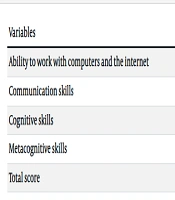
According to the results in Table 1 and using a one-sided t-test, the mean and standard deviation of the students' e-learning skills (Mean ± SD = 3.79 ± 0.68) were calculated. This was significantly greater than the statistical mean of 3, with a significance level of less than 0.05. Thus, it can be stated with 95% confidence that the e-learning skills of the studied students are above average. Moreover, the areas of ability to work with computers and the internet (3.98 ± 0.83), communication skills (3.73 ± 0.71), cognitive skills (3.79 ± 0.76), and metacognitive skills (3.47 ± 0.94) were all significant at a level of less than 0.05, with a statistical mean of 3.
Table 1.
Investigating Students' e-Learning Skills
| Variables | Observed Mean ± SD | P-Value |
|---|---|---|
| Ability to work with computers and the internet | 3.98 ± 0.83 | 0.00 |
| Communication skills | 3.73 ± 0.71 | 0.00 |
| Cognitive skills | 3.79 ± 0.76 | 0.00 |
| Metacognitive skills | 3.47 ± 0.94 | 0.00 |
| Total score | 3.79 ± 0.68 | 0.00 |
According to the results in Table 2 and using a one-sided t-test, the mean and standard deviation of students' academic satisfaction (Mean ± SD = 3.88 ± 0.65) were calculated, which is greater than the statistical mean of 3. This difference is significant at a level of less than 0.05. Thus, it can be stated with 95% confidence that the level of academic satisfaction of the studied students is higher than the average level. Additionally, the differences in content (3.28 ± 0.71), access to learning resources (3.32 ± 0.75), social interactions (3.34 ± 0.76), and independent learning (3.40 ± 0.87) with a statistical mean of 3 were significant at the 0.05 level.
Table 2.
Investigating the Level of Academic Satisfaction of Students who Used e-Learning
| Variables | Observed Mean ± SD | P-Value |
|---|---|---|
| Content | 3.28 ± 0.71 | 0.00 |
| Access to learning resources | 3.32 ± 0.75 | 0.00 |
| Social interactions | 3.34 ± 0.76 | 0.00 |
| Independent learning | 3.40 ± 0.87 | 0.00 |
| Total score | 3.88 ± 0.65 | 0.00 |
Table 3 shows the frequency and percentage of students' GPAs, considered as the measure of students' success (out of a maximum score of 20). As seen, two students have a very low GPA (below 12), 27 students have a low GPA (12 to 14), 142 students have a moderate GPA (15 to 17), and 89 students have a good GPA (16 to 18). Moreover, the mean and standard deviation of all students was Mean ± SD = 15.8 ± 1.62, with the lowest GPA being 11 and the highest being 18.
Table 3.
Frequency and Frequency Percentage of GPA of Students
| Classification of Success Measurement Criteria (Average) | No. (%) |
|---|---|
| Very low | 2 (0.4) |
| Low | 27 (12.3) |
| Moderate | 142 (50.8) |
| Good | 89 (34.2) |
Table 4 shows the relationship between e-learning skills and students' academic success levels (r = 0.160, P < 0.05). The results revealed a significant relationship between the ability to work with computers and the internet, communication skills, cognitive skills, and e-learning skills of students, and their academic success. However, no significant relationship was found between metacognitive skills and academic success. Additionally, a positive and significant relationship was found between e-learning skills and academic success (r = 0.160, P < 0.05).
Table 4.
The Relationship Between e-Learning Skills Areas and Students' Academic Success Level
| Variable | The Correlation Coefficient | P-Value |
|---|---|---|
| Academic Success | ||
| Ability to work with computers and the internet | 0.128 | 0.04 |
| Communication skills | 0.164 | 0.008 |
| Cognitive skills | 0.158 | 0.012 |
| Metacognitive skills | 0.012 | 0.84 |
| Total score | 0.160 | 0.01 |
Table 5 shows the relationship between the areas of e-learning skills and the level of academic satisfaction of students. The results revealed a significant and positive correlation between the ability to work with computers and the internet, communication skills, cognitive and metacognitive skills, and students' academic satisfaction. Additionally, a significant and positive correlation was found between e-learning skills and students' academic satisfaction (r = 0.33, P < 0.05).
Table 5.
The Relationship Between e-Learning Skills Areas and Students' Academic Satisfaction
| Variable | The Correlation Coefficient | P-Value |
|---|---|---|
| Academic Satisfaction | ||
| Ability to work with computers and the internet | 0.32 | 0.03 |
| Communication skills | 0.25 | 0.02 |
| Cognitive skills | 0.17 | 0.01 |
| Metacognitive skills | 0.14 | 0.04 |
| Total score | 0.32 | 0.01 |
Table 6 shows the relationship between e-learning skills, students' academic satisfaction, and their infection with COVID-19. It was measured using an independent t-test, and a significant relationship was found between the two areas.
Table 6.
The Relationship Between e-Learning Skills, Students' Academic Satisfaction, and Their Infection with COVID-19.
| Variables | Mean ± SD | P-Value |
| Academic satisfaction | 0.00 | |
| Yes | 2.92 ± 0.69 | |
| No | 2.80 ± 0.57 | |
| e-learning Skills | 0.05 | |
| Yes | 3.87 ± 0.70 | |
| No | 3.71 ± 0.56 |
5. Discussion
According to the results, e-learning skills, academic satisfaction, and student success were above average levels. Additionally, a significant relationship was reported between students' learning skills, academic satisfaction, and academic success. Accordingly, students' academic satisfaction and success increased as their e-learning skills improved.
A meta-analysis revealed that student satisfaction with e-learning during the COVID-19 pandemic worldwide ranged from 26.4% (Jordan) to 82% (Saudi Arabia). In this study, the highest satisfaction was related to students in Saudi Arabia, Poland, and South Korea, while the lowest satisfaction was related to students in Jordan, Iran, and the United States (13). Another meta-analysis showed that the levels of satisfaction with e-learning among students, their parents, and professors before and after the COVID-19 pandemic were 59.5%, 75.3%, and 70.7%, respectively. A significant difference was found between the levels of satisfaction of students, their parents, and professors. Moreover, a significant number of students in countries with developed digital infrastructure were less satisfied with e-learning before the pandemic than after (3).
In a study by Ibrahim et al., about three-fifths of medical students in Saudi Arabia during the COVID-19 pandemic confirmed that e-learning replaced classical learning, with the acceptance of e-learning reported at an average level (1). A meta-analysis found that 72% of students stated that e-learning improved their academic performance during the COVID-19 pandemic, while 14% stated it had no effect. An increase in clinical skills and communication skills was also reported. Evaluation based on Kirkpatrick's model revealed that 80% of the studies were evaluated at level 1 (response), 8% at level 2 (learning), 12% at level 3 (behavior), and none at level 4 (results) (14).
Studies by Younas et al. in Pakistan and Rahman et al. in Bangladesh revealed a positive relationship between academic satisfaction and student success. Students who used e-learning reported higher academic satisfaction and success (15, 16). Jiang et al. in China found that Chinese students' satisfaction with e-learning, as an emergency educational tool, is directly and indirectly affected by computer self-efficacy, and the perceived ease and usefulness of these platforms (17). Kerzic et al. conducted a study on a sample of 10,092 higher education students from 10 countries on four continents during the first wave of the pandemic. The results revealed that the quality of e-learning primarily depends on the quality of services, the active role of the teacher in the online education process, and the overall quality of the system. The study found a positive and significant correlation between the quality of e-learning and students' performance and their satisfaction with e-learning (18).
Jou et al. in the Philippines showed that the instructor's background, experience, behavior, and interactions positively affect students' satisfaction. Students' performance, perception, and perceived effectiveness were directly associated with their academic success (19). Prosen et al. found that positive e-learning experiences contribute to greater satisfaction with learning and, thus, better learning engagement (20). The study by Dost et al. revealed that e-learning made it possible to continue medical education during the COVID-19 pandemic in the UK. A significant difference was observed between the time spent on online platforms before and after the COVID-19 pandemic (21). A study by Montero in Chile revealed that satisfaction with academic performance is significantly associated with satisfaction with grades, learning, and the perceived quality of online classes (22). A study by Mohammed et al. in Malaysia revealed a significant relationship between instructor performance, student factors, course evaluation, system quality, and student satisfaction (23).
A study by Ngah et al. in Saudi Arabia showed that students' preparation, performance, and satisfaction with e-learning positively affect their willingness to continue learning online. This study revealed a relationship between the quality of the online learning system and the willingness to continue learning online (24). A study by Teng in China revealed a direct association between internet self-efficacy, satisfaction with instructors and assignments, and students' satisfaction with e-learning (25). The results of a study by Do et al. in Vietnam indicated that perceived usefulness, perceived ease of use, system and technical dimensions, and instructors' characteristics are significant factors affecting students' satisfaction with e-learning (26). The results of the above studies are in line with those of the present study.
A study by Li et al. in Kenya revealed that 80% of students prefer face-to-face learning, while 20% prefer e-learning. In this study, a positive correlation was found between students' satisfaction with the perceived quality of the online class, gaining self-confidence, teaching performance, and preference for online learning. However, a negative relationship was found between the mentioned variables and internet access and costs (27). Similar studies in Thailand and Jordan also revealed that students were dissatisfied with e-learning during the COVID-19 pandemic. The results of these studies are inconsistent with those of our study (28, 29).
At the end of this study, it is necessary to point out that students need more support and equipment to maximize learning opportunities in areas where they are less satisfied with e-learning. Other problems include the lack of interaction between teachers and students, the occurrence of some mental problems, issues with internet connectivity, and restrictive laws in some countries (such as low internet speed and the blocking of popular social networks).
5.1. Conclusions
The academic and social life of students changed significantly during the COVID-19 pandemic. Face-to-face and clinical education were severely disrupted, and e-learning became an irreplaceable emergency educational tool to continue learning. The present study showed relative satisfaction with e-learning compared to traditional teaching techniques. It also revealed that having e-learning skills increased satisfaction and thus improved the academic success of students. This method helps medical students improve their academic performance as well as their clinical and communication skills. Comparing the results of our study with those of other studies suggests that although the majority of students prefer face-to-face or integrated methods, they were generally satisfied with new educational experiences, including e-learning. This indicates a cultural shift towards the acceptance of e-learning.