
1. Background
Academic achievement and academic failure are key criteria to assess the efficiency of the educational system of universities (1). Evidently, educational conditions are essential to the success of students in acquiring scientific and professional skills to achieve the missions of the university (2). Identifying these conditions and the influential factors in students' academic achievement could provide an effective approach to planning and developing educational programs, thereby leading to optimal outcomes for both the educational institution and students (3).
The constant development of information and communication technologies is a landmark of the modern era, which has brought about extensive and profound changes in various aspects of human life, as well as the introduction of e-learning as a new approach in educational systems (4). E-learning refers to the use of electronic systems with the aim of saving time and money (5). Since e-learning students have more control and focus on their learning compared to traditional learning, they can enjoy new learning opportunities and improve the quality of learning by facilitating access to educational resources and services (6).
E-learning has been accepted as the main method in the teaching-learning process and affects students' academic achievement (7). According to Barrow et al., the performance of computer-trained students has been superior to the performance of the students trained traditionally (8). Furthermore, the study by Elliot indicated that the performance of the group trained by multimedia was above average and better than the performance of the control group (9). In another research, Deryakulu et al. reported a significant correlation between students' academic achievement and teaching methods with information and communication technology (10). Keshavarz et al. also observed that e-learning had a positive effect on students' academic achievement (11).
According to Parkes et al., students were not well prepared in practice for electronic learning activities (12). On the other hand, Golband et al. introduced the four factors of course content, teacher and instructor, student and learner, and an available e-learning system to be influential in this regard (13). In addition to preparedness for e-learning, the participation of learners in an e-learning experience is associated with their specific attitude toward such training, which may be positive or negative depending on the quality of this experience (14). Therefore, attitude plays a key role in e-learning courses (15) and is a major predictive factor of students' academic achievement with e-learning (16).
Attitude depends on increasing the knowledge and awareness of the audience about e-learning programs, which increases students' insight and understanding, reduces resistance, and lays the groundwork for their acceptance of e-learning systems (17, 18). According to the findings of Kazemi Gharajeh and Amin Khandaghi, students gained a proper understanding and attitude toward e-learning after participating in these courses (19). Moreover, the findings of Azizi et al. indicated that the attitude toward e-learning and self-regulation has a positive and significant effect on the academic achievement of medical students (20).
2. Objectives
The present study aimed to investigate the correlation between e-learning attitudes and academic achievement in medical students.
3. Methods
This cross-sectional study was conducted on medical students in clinical levels who had educational activity and at least six months of attendance in Shahid Beheshti Educational Hospital in Kashan, Iran in 2020, and their educational activities were performed through Navid or Adobe Connect software.
Considering the total number of the medical students in this center (n = 392), who were selected via convenience sampling, as well as Cochran's formula and an error rate of 0.05, the sample size of the study was determined to be 194, including 50 clerkships, 94 interns, and 50 residents. In total, 154 students (nearly 80% of the sample size) participated in the study.
The exclusion criteria were the students’ attendance in other teaching hospitals and incomplete questionnaires.
Data collection tools were self-administered online questionnaire, and the participants were asked to complete the questionnaires honestly and without concerns regarding the disclosure of their opinions.
E-learning Ability Questionnaire was used for data collection, which has been developed and validated by Watkins et al. (2004) (21). This 25-item questionnaire is scored based on a five-point Likert Scale (strongly agree-strongly disagree) in six dimensions, including skills and online communication, access to technology, ability to learn through the media, internet group discussions, important issues for success in e-learning and motivation, and assessing the ability of e-learning. Scores below 27 indicated poor e-learning ability, scores 27 - 81 showed moderate ability, and scores above 81 indicated favorable e-learning ability. The validity (opinions of professors and experts) and reliability (Cronbach's alpha coefficient: 0.86) of the questionnaire were previously confirmed in Iran by Ahangar (2014) (22). In the present study, the Cronbach's alpha coefficient was estimated at 0.885.
Another data collection tool was the e-learning attitude questionnaire based on the study by Naghavi, which consists of 15 items scored based on a Likert Scale (strongly agree-strongly disagree) in four dimensions, including e-learning as an independent learning environment, e-learning as an effective learning environment, e-learning as a multimedia learning environment, and e-learning as an instruction-based learning environment. In the study by Naghavi, the validity of the questionnaire was confirmed by graduate students and several professors, and the reliability was also confirmed at the Cronbach's alpha coefficient of 0.92 (18). In the present study, the Cronbach's alpha coefficient of the scale was calculated to be 0.933.
In order to assess the academic achievement of the students, we considered the GPA of the clerkships and interns at the end of the semester, as well as the GPA of the residents at the end of three months.
3.1. Statistical Analysis
Data analysis was performed in SPSS version 26 using descriptive statistics (frequency distribution, central indices, and dispersion) and inferential statistics, including independent t-test to compare the attitude toward e-learning between the male and female students, analysis of variance (ANOVA) to compare the attitude toward e-learning between the residents, interns, and clerkships, and correlation-coefficients to assess the correlation of attitude toward e-learning with age, academic achievement and e-learning rate. In all the statistical analyses, the significance level was set at P < 0.05.
4. Results
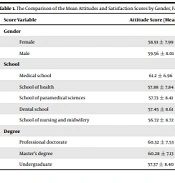
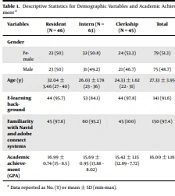
In total, 154 students including 45 clerkships, 63 interns, and 46 residents were enrolled in the study (Table 1). The ability and understanding of e-learning was considered favorable in more than 90% of the participants (Table 2). Furthermore, the score of attitude toward e-learning was 77.5, which was also considered acceptable (Table 3). Attitude toward e-learning had a significant correlation with gender and the rate of e-learning. However, attitude toward e-learning had no significant correlation with the students' academic achievement (Table 4).
Table 1.
Demographic Variables and Academic Achievement in 3 Groups of Medical Students a
| Variables | Resident (N = 46) | Intern (N = 63) | Clerkship (N = 45) | Total |
|---|---|---|---|---|
| Gender | ||||
| Female | 23 (50) | 32 (50.8) | 24 (53.3) | 79 (51.3) |
| Male | 23 (50) | 31 (49.2) | 21 (46.7) | 75 (48.7) |
| Age (y) | 32.04 ± 3.46 (27 - 40) | 26.03 ± 1.78 (23 - 36) | 24.33 ± 1.62 (22 - 31) | 27.33 ± 3.95 |
| E-learning background | 44 (95.7) | 53 (84.1) | 44 (97.8) | 141 (91.6) |
| Familiarity with Navid and adobe connect systems | 45 (97.8) | 60 (95.2) | 45 (100) | 150 (97.4) |
| Academic achievement (GPA) | 16.99 ± 0.74 (15 - 8.5) | 15.69 ± 0.95 (13.88 - 8.02) | 15.42 ± 1.15 (12.89 - 7.72) | 16.00 ± 1.16 |
a Data reported as No. (%) or mean ± SD (min-max).
Table 2.
Learners' E-learning Rate in Medical Students a
| Variables | Values |
|---|---|
| Skills and online communication | 37.11 ± 4.42 |
| Motivation | 9.78 ± 2.69 |
| Access to technology | 12.77 ± 1.95 |
| Ability to learn through media | 12.51 ± 2.30 |
| Internet group discussions | 12.62 ± 1.86 |
| Important issues in e-learning success | 13.36 ± 3.86 |
| Total e-learning score | 98.15 ± 12.21 |
| Poor (< 27) | 0 |
| Moderate (27 - 81) | 15 (9.7) |
| Good (> 81) | 139 (90.3) |
a Data reported as No. (%) or mean ± SD.
Table 3.
Learners' Attitude Toward E-learning in Medical Students a
| Variables | Mean ± SD | Percentage Score |
|---|---|---|
| Independent learning environment | 32.36 ± 6.92 | 77.08 |
| Effective learning environment | 13.58 ± 3.87 | 64.7 |
| Multimedia learning environment | 18.01 ± 3.35 | 85.7 |
| Instructor-based learning environment | 17.45 ± 3.85 | 83.09 |
| Attitude to e-learning | 81.39 ± 15.00 | 77.5 |
a Percentage score of < 50: unfavorable attitude to e-learning; scores 50 - 70: semi-desirable attitudes; scores > 70: desirable attitude
Table 4.
Correlations Between Learners' Attitude toward E-learning and Demographic Variables, Academic Achievement, and E-learning
| Variables | Attitude Toward E-learning | |||
|---|---|---|---|---|
| Resident | Intern | Clerkship | Total | |
| Gender | ||||
| Female | 82.56 ± 10.81 | 79.44 ± 11.45 | 74.54 ± 20.48 | 78.86 ± 14.79 |
| Male | 86.82 ± 6.35 | 84.45 ± 15.99 | 80.47 ± 19.14 | 84.07 ± 14.86 |
| P-value | 0.110 | 0.157 | 0.323 | 0.031 |
| Total | 84.69 ± 9.03 | 81.90 ± 13.99 | 77.31 ± 19.87 | P= 0.064 |
| Age (y) | ||||
| Correlation-coefficient | 0.122 | -0.034 | -0.177 | 0.121 |
| P-value | 0.419 | 0.794 | 0.244 | 0.136 |
| Academic achievement (GPA) | ||||
| Correlation-coefficient | 0.046 | 0.123 | -0.065 | 0.111 |
| P-value | 0.760 | 0.338 | 0.672 | 0.169 |
| E-learning rate | ||||
| Correlation-coefficient | 0.438 | 0.564 | 0.695 | 0.576 |
| P-value | 0.002 | < 0.001 | < 0.001 | < 0.001 |
5. Discussion
Due to the COVID-19 pandemic crisis in the world and to comply with health protocols, e-learning has become the most important application of information technology in various educational systems across the world. According to the results of the present study, the rate of e-learning had a significant correlation only with the gender of the learners. Based on education levels, the rate of e-learning had a significant correlation with gender only in the residents, which is consistent with the study by Okhovati (23).
Our findings also indicated that the rate of e-learning was excellent in more than 90% of the learners. In the virtual environment, students and faculties are separated from each other in terms of time and place (24). Therefore, information technology skills must be prioritized for students to be able to participate in e-learning (25). This highlights the need to enhance the online skills of these individuals by measures such as implementing workshops. Our findings in this regard are consistent with the studies by Hedayati et al. (26) and Okhovati (23).
According to the current research, the mean score of motivation was 9.2, which indicated that the participants lacked high motivation to receive e-learning. Meanwhile, the motivation of the medical students in designing effective e-learning courses is paramount (27). E-learning is a novel approach, and most students are unfamiliar with this method (28). According to Shabani, three main factors could explain learners’ lack of motivation to partake in e-learning, including unfamiliarity with e-learning, lack of a clear goal to participate in e-learning, and resistance to change (29). In order to reduce resistance to change regarding the type of education, students' real interests, beliefs, and desires should be derived from their everyday life needs (30). Our findings in this regard are consistent with the results obtained by Parkes et al. (12), Zegordi et al. (31), Hedayati et al. (26), and Maleki Marasht et al. (32), while inconsistent with the studies by Puljak et al. (33) and Kamalian and Fazel (34).
Regarding access to technology, the mean score was estimated at 12.1, indicating the poor learning of the students. This is inconsistent with the study by Hedayati et al. (26), while consistent with the studies by Kamalian and Fazel (34), Maleki Marasht et al. (32), and Parkes et al. (12). Technology plays a key role in the development of e-learning (35). Virtual education is more dependent on information and communication than other open and distance learning approaches (36), and without proper equipment, implementing e-learning is extremely difficult (37).
With regard to internet group discussions, the mean score was determined to be 12.1 in the present study, indicating the poor learning of the students. This is consistent with the studies by Hedayati et al. (26) and Parkes et al. (12), while inconsistent with the studies by Kamalian and Fazel (34) and Maleki Marasht et al. (32). Poor interaction between students and professors is considered to be a major learning challenge in virtual educational environments.
According to the results of the present study, attitude toward e-learning had a significant correlation with gender and the rate of e-learning. This is consistent with the studies by Puljak et al. (33), Jović et al. (38), and Azizi et al. (20), while inconsistent with the studies by Okhovati (23) and Dikmen (39). This discrepancy could be due to differences in environments, geographical conditions for access to electronic resources, other research, variables, and the use of different tools. Furthermore, the attitude of learners toward e-learning was considered satisfactory in the current research, which is consistent with the studies by Pakseresht et al. (40), Okhovati (23), Jović et al. (38), Puljak et al. (33), Dikmen (39), and Azizi et al. (20).
Our findings demonstrated no significant correlation between e-learning and the academic achievement of the medical residents, interns, and clerkships, which is inconsistent with the studies by Deryakulu et al. (10) and Keshavarz et al. (11). This discrepancy could be attributed to the differences in the research environment and the influential factors in academic achievement.
5.1. Limitations of the Study
This study was only performed in a teaching hospital, and the students' participation was optional. Although the obtained results cannot be generalized, they could be employed as a general model.
5.2. Suggestions
Medical universities should develop proper e-learning, technical, and communication infrastructures, thereby encouraging students to turn to e-learning with the aim of improving their academic achievement.
5.3. Conclusions
According to the results, participation in various e-learning courses positively affected the learners' attitude toward such novel training. The capacities and strengths of e-learning could be exploited to overcome the obstacles and limitations of traditional education, especially during the COVID-19 pandemic. Therefore, it is recommended that further investigations in this regard evaluate the efficacy of virtual education on a clinical level.