1. Background
The COVID-19 pandemic led to the closure of classrooms throughout the world, forcing 1.5 billion students and 63 million professors to suddenly modify their face-to-face academic practices (1, 2). Medical schools and universities of medical sciences were not an exception in this regard. The main result of the current health crisis was the development of a new framework for the teaching-learning system, which is known as e-learning (3). E-learning is an important tool in higher education in the digital age. This type of education could lay the foundation for improving the quality of education, extending learning opportunities, gaining easy and quick access to education for all learners (4), and creating a learner-oriented learning environment and flexibility in teaching methods, thereby leading to changes in the learning-teaching process of the higher education system (5).
As students are the most important and main recipients of academic services, constant monitoring of their academic satisfaction at any time (especially in the current crisis) will contribute to their academic progress and success, while also resulting in the preservation and survival of universities in a competitive environment (6-9). Therefore, medical schools must inevitably attempt to exploit limited resources to achieve educational goals during the COVID-19 pandemic in order to improve the quality of their services and increase students’ satisfaction with these services so that they could attract the desired resources and human capital (10, 11).
Some researchers define quality as a transparent set, which implies the feasibility of the measures taken to improve quality. On the other hand, quality could be defined based on factors such as an intellectually motivating environment, the minimum favorable conditions, educational materials, and instructors motivating the participation and desire of learners, which play a pivotal role in the cognitive, emotional, and sensory-motor function of humans (12).
Considering the definitions above, the teaching materials used in e-learning as an asynchronous learning tool play a key role in learners' satisfaction so that they could focus on the educational content (13, 14). In a study in this regard, Gaftandzhieva and Doneva (2020) argued that since the quality of the educational system is a function of social, economic, cultural, and political factors and the conditions governing the society, proper quality standards should be developed due to the special role and mission of this system in the environment (15). Furthermore, Gholipour Mofrad Dashtaki et al. (2020) stated that in the e-learning environment, factors such as professors, courses, technology, system design, and learning environments could affect the users’ satisfaction (16). The mentioned study also indicated that the developed materials have no direct effect on the users' satisfaction, which reflects the fair behavior of the users. On the other hand, access to a platform has a significant impact on user satisfaction. In terms of accessibility, the most important issues are the performance design and performance of an online learning platform. In terms of the quality of interactive learning activities, feedback on the homework assigned by professors has also been reported to be a major influential factor in this regard (17).
According to the studies conducted in Iran, the quality of e-learning affects students' satisfaction with e-learning. For instance, a study conducted at Zahedan University of Medical Sciences by Zwart et al. (2021) concluded that students perceived a significant difference between the current situation and the desired educational services in the service quality model, which consisted of five dimensions, including reliability, responsiveness, assurance, empathy, and tangibility. In the mentioned study, the majority of the students (81.6%) perceived a negative quality gap (18). According to other reports, learners' participation in an e-learning course could affect their attitude toward e-learning given their different learning styles (19, 20).
According to Osmani (2021), lack of technical skills adversely affects the learning process in e-learning (21). In addition, Gholipour Mofrad Dashtaki et al. (2020) stated that learners' perception of e-learning is influenced by their basic computer skills and sustainable internet access (16). In another research, Kibuku et al. (2020) reported significant correlations between teaching methods, the educational technology, and the quality of education (22). Arasteh & Mahmoudirad (2003) also concluded that four key factors affect proper education, including lesson presentation, organization, evaluation, and specialized skills (23). According to Seldin (2005), when a professor behaves well and treats students respectfully, the enthusiasm and motivation of students to learn better will improve remarkably (24).
Although the quality of the e-learning process is important in terms of structural, functional, and conceptual aspects, multiple challenges are faced in the improvement and development of this process, which reduce students’ satisfaction with the teaching and learning process. Therefore, medical schools must strive to exploit limited resources to achieve their educational goals during the COVID-19 pandemic, improve the quality of e-learning, and increase students’ satisfaction so that they could operate efficiently and attract the desired resources and human capital.
2. Objectives
The present study aimed to evaluate this structure from the perspective of students as the main audience and product of e-learning. Our findings could provide reliable data on the satisfaction of medical students with various dimensions of e-learning to managers and educational planners of medical schools so that they could modify, improve, or develop the quality of e-learning in the medical schools of Zahedan, Iran.
3. Methods
This survey was conducted on the students of Shiraz University of Medical Sciences in Shiraz, Iran. In total, 240 students were selected via convenience sampling.
Field data on the students' satisfaction with the quality of e-learning during the COVID-19 pandemic were collected using a researcher-made questionnaire. The questionnaire consisted of seven dimensions, including the students' satisfaction with the quality of professors’ lesson plans, students' satisfaction with the quality of their professors, students' satisfaction with the quality of professors' teaching methods, students' satisfaction with the quality of facilities and equipment, students' satisfaction with the quality of the teaching time, students' satisfaction with the quality of the teaching atmosphere, and students' satisfaction with the quality of the assessment of academic achievement. The items in the questionnaire were scored based on a five-point Likert scale. Factor analysis was used to measure the validity of the questionnaire, and the reliability was measured using the Cronbach's alpha. As is shown in Figure 1 and Table 1, the questionnaire had high validity and reliability.
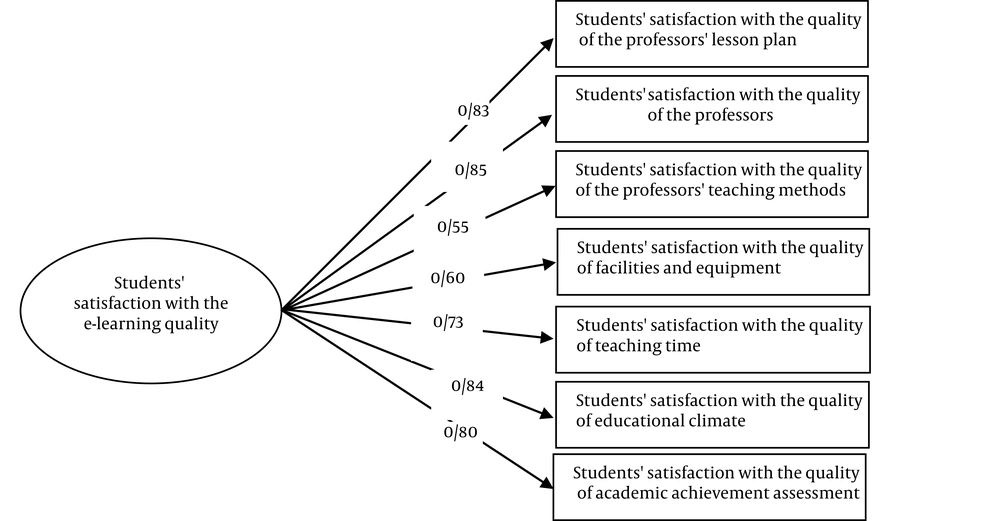
Figure 1.
Confirmation factor of dimensions of students' satisfaction with quality of e-learning during COVID-19 pandemic
Table 1.
Reliability of Student Satisfaction Questionnaire with Quality of Each Dimension of Virtual Education
| Dimensions of Students’ Satisfaction with Quality of E-learning | Cronbach’s Alpha (%) |
|---|---|
| Students' satisfaction with quality of professors' lesson plans | 80 |
| Students' satisfaction with quality of professors | 98 |
| Students' satisfaction with quality of professors' teaching methods | 79 |
| Students' satisfaction with quality of facilities and equipment | 70 |
| Students' satisfaction with quality of teaching time | 73 |
| Students' satisfaction with quality of educational atmosphere | 91 |
| Students' satisfaction with quality of academic achievement evaluation | 93 |
3.1. Statistical Analysis
One-sample t-test was used to analyze the first research question, and the second research question was analyzed using repeated measures analysis of variance (ANOVA) and Bonferroni post-hoc test. As for the third research question, analysis was performed using Pearson’s correlation-coefficient. In all the statistical analyses, the cutoff point was set at 3.75 (25).
4. Results
4.1. Analysis of the Research Questions
The results of one-sample t-test indicated that the mean score of the students’ satisfactions with e-learning during the COVID-19 pandemic was lower than the cutoff points, which implies a significant difference in the measured t-value at 136 degrees of freedom (Table 2). Therefore, it could be concluded that the students' satisfaction with the quality of e-learning during the COVID-19 pandemic was moderate.
Table 2.
Assessment of Students' Satisfaction with E-learning During COVID-19 Pandemic a
| Variable | Mean | SD | t | df | Sig. |
|---|---|---|---|---|---|
| Students' satisfaction | 3.2 | 0.5 | 11.6 | 136 | 0.0001 |
a Cutoff point: 3.75
The results of repeated measures ANOVA showed that the highest mean students’ satisfaction with the dimensions of e-learning during the COVID-19 pandemic belonged to the dimension of students’ satisfaction with the quality of facilities and equipment (mean: 3.4), followed by students' satisfaction with the quality of professors (the quality of professors reflects students' evaluation of professors’ personality, expertise, communication patterns, and management of class in cyberspace) and the teaching time (mean: 3.3), students' satisfaction with the quality of the professors' lesson plans (mean: 3.2), students' satisfaction with the quality of the educational atmosphere and the quality of the assessment of academic achievement (mean: 3.1), and students' satisfaction with the quality of their professors' teaching methods (mean: 3) (Table 3).
Table 3.
Comparison of Students' Satisfaction with Dimensions of E-learning Quality During COVID-19 Pandemic
| Dimensions of Students' Satisfaction with Quality of E-learning | Mean | SD | f | df | Sig. |
|---|---|---|---|---|---|
| Students' satisfaction with quality of the professors' lesson plans | 3.2 | 0.56 | 6.4 | 6, 136 | 0.0001 |
| Students' satisfaction with quality of professors | 3.3 | 0.61 | |||
| Students' satisfaction with quality of professors' teaching methods | 3 | 0.78 | |||
| Students' satisfaction with quality of facilities and equipment | 3.4 | 0.92 | |||
| Students' satisfaction with quality of teaching time | 3.3 | 0.78 | |||
| Students' satisfaction with quality of educational atmosphere | 3.1 | 0.98 | |||
| Students' satisfaction with quality of academic achievement evaluation | 3.1 | 0.65 |
With the f-value calculated at six and 136 degrees of freedom, a significant difference was observed in this regard. As such, Bonferroni post-hoc test was used to evaluate and distinguish the differences between the calculated means. The obtained results indicated a significant difference between the students' satisfaction with the quality of professors, as well as their satisfaction with the quality of teaching methods and the assessment of academic achievement. In addition, a significant difference was observed between the students' satisfaction with the quality of teaching methods, as well as their satisfaction with the quality of facilities and equipment and the quality of the teaching time. However, no significant difference was denoted between the other means.
The results of Pearson’s correlation-coefficient indicated no significant correlation between the students' satisfaction with the quality of e-learning and their academic achievement based on the students’ grade point average.
5. Discussion
The COVID-19 pandemic has shocked the world and dominated large and small enterprises and thousands of businesses on which people were dependent in their daily lives. Meanwhile, the education sector has been affected by this pandemic, and the face-to-face classrooms of universities have been closed, which has become a major concern of education administrators and staff and students. Although e-learning was employed in universities before the COVID-19 pandemic, the current outbreak and the subsequent closure of classrooms have intensified the issue of students' academic satisfaction with e-learning, which should be addressed directly. E-learning has attracted great attention due to the current pandemic, and medical schools have launched e-learning systems for their students. The present study aimed to investigate the academic satisfaction of medical students with the quality of e-learning in Iran.
Our findings indicated that the students' satisfaction with the quality of e-learning and each of its dimensions was moderate during the COVID-19 pandemic. This finding could have been affected by several factors, such as the quality of communication patterns and a lack of face-to-face communication with professors, the scientific and practical abilities and skills of professors in using the technologies of e-learning and the virtual teaching of sciences, the quality of the defined platform for e-learning and its updates, and applicability for teaching university courses.
In this regard, Eiszler (2000) argued that the quality of professors' teaching is a significant influential factor in the quality of e-learning (26). The quality of e-learning was perceived as moderate by the students in the present study. Given the importance of the quality of e-learning in training specialized, capable, and skilled manpower to enter medical centers, university administrators and planners must take the necessary steps toward improving the quality of e-learning and prioritizing the development of this process in the development plans of the university.
According to the current research, the highest mean perception of the students regarding the desirability of e-learning belonged to the dimension of students' perception of the quality of facilities and equipment (
Consistent with our findings, the results obtained by Wu and Lin (2012) indicated that the efficient implementation of e-learning largely depends on the provision of technology, capital, and equipment infrastructures to teachers and learners (27). The dimensions of students' perception of the quality of professors and the quality of class time are of secondary importance in this regard. According to the study by Prasetyo et al. (2021), personal traits of university professors affect the quality of education (28). On the same note, Hussin et al. (2009) argued that providing a platform for interaction and participation in e-learning and facilitating communication between learners and professors in the teaching process may lead to students' relaxation, development, and positive orientation toward learning, thereby positively influencing the quality of education (29).
Considering the key role of professors in e-learning, they should be provided with the necessary platform to improve the quality of their teaching and enhance students’ satisfaction with e-learning through acquiring communication and educational skills and abilities and promoting the greater participation and effort of students in the learning and teaching process (30). Given the importance of organizing training courses in improving the quality of e-learning, it is emphasized that holding such courses at the right time is inevitable. Since learning requires an appropriate time spent on the subject, as well as the adequate and realistic allocation of the teaching time, to attain effective teaching and learning (31), therefore, e-learning professors and process facilitators should support students' learning through providing regular courses and the rational use of the available time.
In the present study, the students’ perception of the quality of professors' lesson plans was the third calculated mean. In another study, Seldin (2005) reported that the ability of efficient professors to express their expectations clearly and design classroom activities accurately and regularly is paramount in student satisfaction with the e-learning process (24). Therefore, professors have the responsibility to help students by establishing a clear and transparent curriculum, while also informing students of their expectations by targeting and guiding the behavioral goals that are set for students in areas related to different subjects.
In the current research, the fourth priority regarding the desirability of the dimensions of e-learning was observed in the dimensions of students' perception of the quality of the educational atmosphere and the assessment of academic achievement. The nature of the classroom learning environment and its dominant psychosocial interactions separate classes and affect the quality of the learning-teaching process (32). In general, it is argued that since the educational atmosphere is a factor that guides the actions and behaviors of students, it is essential to improve and develop the atmosphere and change it into the desired educational atmosphere. This issue must be taken into account by professors or facilitators of e-learning at the micro level and education managers and planners at the macro level. On the other hand, assessment determines learners' learning and provides valuable information on how they learn to achieve their educational goals. Therefore, it is an important step toward enhancing the teaching-learning process. The quality of assessment and the information obtained from the assessment of students’ academic achievements have a decisive effect on the quality of this process. In this context, some researchers regard the definition of the assessment index and the provision of feedback to students as major influential factors in the quality of university e-services (27). Since the quality of assessment and the conduction of such tests determine the quality of professors and students, the design of virtual tests and providing feedback to students are paramount in this regard.
The last mean in the present study was the dimension of students' perception of the quality of professors’ teaching methods, which might be due to the nature of most disciplines in medical sciences. Since most of the disciplines in medical sciences have a practical and skillful aspect and students play a more important role in this matter than professors (professors have a guidance and consultant role), professors’ teaching methods may not have a significant effect on students’ learning regarding the quality of facilities and equipment, as well as professors’ personal/scientific capabilities and skills. Therefore, the dimension of the quality of professors’ teaching methods was the last priority in the viewpoint of the students in the present study. Since this dimension is regarded as an effective aspect of the quality of e-learning, professors should choose optimal teaching methods to further improve the teaching process and students’ learning.
5.1. Conclusions
Although the use of e-learning systems during the COVID-19 pandemic has increased to reduce commutes, maintain social and physical distancing, and prevent the spread of the virus in various universities (including medical universities), this type of education is still associated with different challenges, which are mainly attributed to the sudden and unforeseen changes in the educational process and the transition from traditional learning to e-learning, as well as the practical nature of medical science courses. Therefore, it is recommended that e-learning managers, planners, and implementers take the required measures to improve the quality of e-learning and provide the necessary conditions to enhance the image of e-learning and increase students’ satisfaction in this regard.
5.2. Limitations of the Study
(1) Relatively difficult access to the students and problems in their cooperation;
(2) Lack of cooperation in completing the questionnaires in some students;
(3) Lengthy administrative process to obtain the required permit to distribute the questionnaires.
5.3. Research Implications
(1) The need to examine the correlations between the variables of the current research with other organizational factors in further studies;
(2) Conducting similar research in more medical universities;
(3) Since the satisfaction of students, as the main members of universities, plays a key role in maintaining the survival and success of universities in the educational environment, special attention should be paid to identifying expectations and the influential factors in student satisfaction and addressing these factors by education administrators and university officials.