
1. Background
Clinical trials are the cornerstone of medical research, providing evidence for new treatments, interventions, and healthcare policies. As these trials involve human subjects, adherence to ethical principles is paramount to ensure participants’ safety, dignity, and rights (1-3). Health professionals involved in clinical trials play a crucial role in upholding these ethical standards, making their awareness and understanding of ethical principles a matter of utmost importance (4, 5). Despite reliable guidelines, ethical breaches in clinical trials continue to occur, often due to insufficient awareness or misunderstanding of ethical principles among health professionals (6, 7).
The effectiveness of proper training programs remains an active area of research and debate. While it is generally accepted that education in research ethics is necessary, the optimal methods for delivering this training and measuring its impact on health professionals’ awareness and behavior are unclear (8, 9). Training programs must equip health professionals with the skills to engage with vulnerable populations ethically, balancing the need for protection with the importance of representation in research (10). Factors such as the content of training programs, delivery methods, duration, and reinforcement strategies may all influence the effectiveness of ethical training (11-13).
The globalization of clinical research presents another significant challenge. As trials increasingly span multiple countries and cultures, researchers face the difficult task of harmonizing ethical standards across diverse regulatory environments and cultural contexts (14, 15). This globalization raises questions about the universality of ethical principles and how to respectfully apply them in different settings without imposing cultural biases. Training programs must address these cross-cultural ethical considerations, preparing health professionals to navigate the nuances of conducting ethically sound research globally (16, 17).
The rapid advancement of technology in clinical trials introduces new ethical considerations, particularly around data privacy, confidentiality, and the use of artificial intelligence in research. Training health professionals to understand and address these technological ethical issues is crucial but challenging, given the fast-paced nature of technological advancement (18, 19). Moreover, the COVID-19 pandemic highlighted the need for flexible yet robust ethical frameworks and the importance of rapid, effective ethical training for health professionals in crisis situations (20, 21).
2. Objectives
Developing meaningful metrics for ethical competence and creating training programs that lead to lasting behavioral change should be considered in the medical curriculum. This study aimed to evaluate the effectiveness of a training program on ethical principles in clinical trials on the awareness of health professionals.
3. Methods
This cross-sectional study was approved by the Ethics Committee of the Guilan University of Medical Sciences, Rasht, Iran (IR.GUMS.REC.1401.034). Participants were selected through a convenience sampling method, and the study’s sample size was calculated as 50 (22). The participants included health professionals from various fields (pharmacy, nursing, general practice, gynecology, internal medicine, orthopedics, biochemistry, forensic medicine, nuclear medicine, general surgery, dentistry, and physiology) at the Guilan University of Medical Sciences, Rasht, Iran, in 2022, and all consented to participate in the study.
Inclusion criteria required participants to be health professionals from medical and biomedical departments affiliated with the Guilan University of Medical Sciences. Individuals who were not health professionals or did not belong to medical or biomedical fields were excluded from the study. Health professionals who declined to provide informed consent or participate in the training workshop were also excluded. Data collected from participants included gender, age, level of education, academic degree, field of study, employment status, and history of attendance in similar workshops.
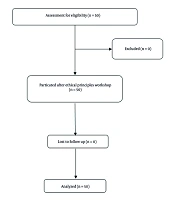
The ethical principles workshop (conducted both in-person and virtually) lasted 8 hours and covered the following domains: Medical research laws, international regulations, ethical guidelines on human subjects, and national laws. The status of awareness of ethical principles in clinical trials was assessed before and after the workshop using a self-designed questionnaire consisting of ten questions, each scored from 0 to 10 (one point for each correct answer). Figure 1 shows the flow diagram of the studied participants.

Figure 1.
Flow diagram of the studied patients
3.1. Instruments
The questionnaire covers ten key domains of ethical principles in clinical trials: "The necessity of a scientific protocol for conducting clinical trials", "the requirement for obtaining informed consent", "the standardization of testing procedures for all interventions", "considerations for including female participants", "age restrictions for healthy volunteers in radiation-based trials", "the regulatory process for clinical studies involving unapproved drugs", "the acceptability of placebo use when standard treatments exist", "conditions under which placebo use is permissible in clinical trials", "the responsibility for compensating participants for study-related injuries", and "the nature of compensation for trial-related injuries, specifically whether it is contingent on proving researcher negligence".
Each question’s content validity ratio (CVR) was calculated based on responses from seven research ethics specialists. Questions with coefficients below 0.7 were eliminated, resulting in the removal of one question. The overall CVR for the ten remaining questions was 0.88. The Content Validity Index (CVI) was assessed regarding relevance, clarity, and acceptability, achieving a CVI score above 0.8, with the overall CVI calculated at 0.931. Subsequently, a pilot study was conducted involving 35 Guilan University of Medical Sciences faculty members to determine the questionnaire’s reliability and validity. The reliability of the questionnaire was evaluated using Cronbach’s alpha, yielding a coefficient of 0.83.
3.2. Statistical Analysis
Data were presented as numbers (percentages) and mean ± standard deviation (SD). The Shapiro-Wilk test was used to assess the normality of the data. To evaluate the differences between variables, paired samples and independent sample t-tests, Kruskal-Wallis, Mann-Whitney U, and ANOVA were performed. Data were analyzed using SPSS version 26, and the significance level was set at < 0.05.
4. Results
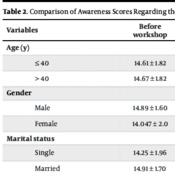
The mean age of participants was 41.88 ± 12.58 years (range, 22 - 71 years). The majority of the participants were female (46%), held PhD.s (40%), were nurses (30%), and were faculty members (58%) (Table 1). The awareness scores before and after the workshop were 5.16 ± 1.57 (range, 2 - 8) and 8.62 ± 0.99 (range, 5 - 10), respectively, illustrating a significant difference (P < 0.001). Age-wise, both younger (< 41 years) and older (≥ 41 years) participants showed significant improvements (P < 0.001) in awareness scores. Similarly, both male and female participants significantly increased their awareness scores (P < 0.001). Across educational levels, all groups except those with master’s degrees showed significant improvements (P < 0.05). Most medical specialties, including pharmacy, nursing, general practice, gynecology, and internal medicine, exhibited significant increases in awareness scores (P < 0.05) (Table 2).
Table 1.
Demographical, Educational, and Occupational Data of Health Professionals of the Guilan University of Medical Sciences (n = 50)
| Variables | No. (%) |
|---|---|
| Age (y) | |
| < 41 | 24 (48.0) |
| 40 ≤ | 26 (52.0) |
| Gender | |
| Male | 27 (54.0) |
| Female | 23 (46.0) |
| Educational status | |
| Bachelor | 9 (18.0) |
| Master | 3 (6.0) |
| MD. | 18 (36.0) |
| PhD. | 20 (40.0) |
| Occupation | |
| Pharmacy | 15 (30.0) |
| Nursing | 15 (30.0) |
| General practitioner | 7 (14.0) |
| Gynecology | 3 (6.0) |
| Internal medicine | 3 (6.0) |
| Orthopedic | 1 (2.0) |
| Biochemistry | 1 (2.0) |
| Forensic medicine | 1 (2.0) |
| Nuclear medicine | 1 (2.0) |
| General surgery | 1 (2.0) |
| Dentistry | 1 (2.0) |
| Physiology | 1 (2.0) |
| Faculty member | |
| Yes | 21 (58.0) |
| No | 29 (58.0) |
| Academic degree | |
| Assistant professor | 9 (18.0) |
| Associate professor | 10 (20.0) |
| Trainer | 2 (4.0) |
| Other | 29 (58.0) |
Table 2.
| Variables | Score of Awareness | Compared Mean Score (Before and After) | ||||
|---|---|---|---|---|---|---|
| Age (y) | Before Workshop | P-Value | After Workshop | P-Value | Statistics | P-Value c |
| < 41 | 5.38 ± 1.38 | 0.343 d | 8.46 ± 8.77 | 0.334 d | 10.70 | < 0.001 |
| 40 ≤ | 4.96 ± 1.73 | 8.77 ± 0.91 | 12.32 | < 0.001 | ||
| Gender | ||||||
| Male | 5.26 ± 1.65 | 0.633 d | 8.68 ± 0.88 | 0.959 d | 10.75 | < 0.001 |
| Female | 5.04 ± 1.49 | 8.57 ± 1.12 | 11.97 | < 0.001 | ||
| Educational status | ||||||
| Bachelor | 6.11 ± 0.78 | 0.071 e | 8.56 ± 0.88 | 0.906 e | 5.92 | < 0.001 |
| Master | 3.67 ± 1.15 | 8.0 ± 2.65 | 3.60 | 0.069 | ||
| MD | 5.11 ± 1.94 | 8.78 ± 0.88 | 9.25 | < 0.001 | ||
| PhD | 5.0 ± 1.34 | 8.60 ± 0.82 | 12.25 | < 0.001 | ||
| Occupation | ||||||
| Pharmacy | 4.87 ± 1.64 | 0.680 e | 8.67 ± 0.62 | 0.465 f | 9.12 | < 0.001 |
| Nursing | 5.20 ± 1.42 | 8.47 ± 1.25 | 7.39 | < 0.001 | ||
| General practitioner | 5.71 ± 2.06 | 9.14 ± 1.21 | 6.49 | 0.001 | ||
| Gynecology | 4.33 ± 0.58 | 8.0 ± 1.0 | 11.00 | 0.008 | ||
| Internal medicine | 4.67 ± 1.53 | 9.0 ± 1.0 | 4.91 | 0.039 | ||
| Orthopedic | 4.0 ± 0.0 | - | 8.0 ± 0.0 | - | - | - |
| Biochemistry | 7.0 ± 0.0 | - | 8.0 ± 0.0 | - | - | - |
| Forensic medicine | 8.0 ± 0.0 | - | 10.0 ± 0.0 | - | - | - |
| Nuclear medicine | 5.0 ± 0.0 | - | 8.0 ± 0.0 | - | - | - |
| General surgery | 7.0 ± 0.0 | - | 8.0 ± 0.0 | - | - | - |
| Dentistry | 5.0 ± 0.0 | - | 9.0 ± 0.0 | - | - | - |
| Physiology | 4.0 ± 0.0 | - | 8.0 ± 0.0 | - | - | - |
| Faculty member | ||||||
| Yes | 4.67 ± 1.53 | 0.036 d | 8.43 ± 1.12 | 0.593 f | 11.39 | < 0.001 d |
| No | 5.52 ± 1.53 | 8.76 ± 0.87 | 11.42 | < 0.001 d | ||
| Academic degree | ||||||
| Assistant professor | 4.89 ± 1.05 | 0.900 d | 8.44 ± 0.88 | 0.567 d | 9.43 | < 0.001 d |
| Associate professor | 4.80 ± 1.87 | 8.70 ± 0.82 | 7.13 | < 0.001 d | ||
| Trainer | 3.0 ± 0.0 | - | 7.0 ± 2.83 | - | 2.00 | 0.295 d |
a Values are expressed as mean ± SD.
b A P-value ≤ 0.05 is considered statistically significant.
c Paired sample t-test unless otherwise indicated.
d Mann-Whitney.
e Kruskal-Wallis.
fANOVA.
The results indicated that the average awareness score of participants regarding the ethical principles of clinical trials was not associated with age, gender, education level, academic rank, type of employment, field of study, or whether the workshop was held online or in person (P > 0.05).
5. Discussion
The findings from the present study demonstrated a significant increase in awareness of ethical principles after training. Similarly, Khandaghi and Pakmehr illustrated a significant difference in awareness of professional ethics between trained and untrained groups (23). Shrestha et al. showed the impact of education on physicians’ knowledge, attitudes, and practices regarding medical ethics and highlighted the importance of educational workshops (24). We found no significant differences in awareness improvements regarding ethical principles between in-person and virtual participants. Ozgonul and Alimoglu compared medical ethics education through lectures and group-based learning among medical students and found that long-term learning was significantly higher with the group-based approach compared to lectures. Their study underscored the importance of education in increasing students’ awareness of research ethics principles and highlighted the effectiveness of group-based educational workshops in this context (25).
Professionalism and various interpersonal skills are often regarded as integral elements of the hidden curriculum within medical schools. Studies indicated a significant connection between the cultivation of professionalism and the hidden curriculum, which are delivered indirectly and unconsciously by words and practices, highlighting the negative effects of the hidden curriculum. Some communicative aspects linked to it are related to the informal curriculum, a topic that has been largely overlooked in medical education (26-28). The imperative for teaching research ethics in university workshops underscores a potentially overlooked dimension in academic curricula, particularly in clinical trials. Education and supervision are considered two critical aspects for improving ethical standards in research. The inherently deterrent nature and complexity of ethical guidelines necessitate continuous education in this area (29, 30).
We found no statistically significant association between the demographic, educational, and occupational characteristics of the participants and the score of awareness of ethical principles in clinical trials. Evidence suggests that teaching ethical issues in research should be seriously integrated into education, starting at the undergraduate level. This perspective is supported by the American Psychological Association’s (APA) ethical guidelines, which stress the importance of instilling ethical principles in researchers and students (31-33). The advent of novel research methodologies, such as internet-based studies, necessitates enhancing academic researchers’ awareness of emerging ethical challenges. While awareness of ethical guidelines can stimulate individuals’ ethical sensitivity in practice, other variables also influence researchers’ practical commitment to adhering to or disregarding ethical guidelines (34, 35).
Practical commitment to ethics also involves social and institutional dimensions. From an institutional perspective, the shift from individual researcher ethics to organizational research ethics highlights the ethical leadership role of universities and their moral responsibilities. As research organizations, universities should embed ethical practices across all research activities. While the current study highlighted the effectiveness of the training in enhancing awareness of research ethics principles among a diverse group of health professionals, regardless of their personal or professional characteristics, this study has some limitations. One limitation was the small sample size, and another was the failure to evaluate the long-term impact of the training on awareness, which is suggested to be considered in future studies.
5.1. Conclusions
These findings suggest that the training was broadly practical, highlighting the importance of such educational creativities in improving ethical awareness in clinical trials.