Fulltext
The body of the article can be found in the PDF file.
Journal of Medical Education for Future Demands
Former Title: Journal of Medical Education | The Official Journal of School of Medical Education and Learning Technologies
Image Credit:J Med Edu
Authors
Introduction: In the medical community, ethics is important in this profession and pharmacy, like other branches of medical sciences, and requires attention. We aimed to examine the level of students’ knowledge of the Pharmacy Faculty of Shiraz University of Medical Sciences from the principles of professional ethics recommended by the American Pharmacy Association in their ethical codes, especially the principles of patient rights.Methods: This was a descriptive-observational cross-sectional study. The study population consisted of 162 Pharmacy students from the 7, 8, 9, 10, 11 and final semesters of the Faculty of Pharmacy, Shiraz University of Medical Sciences who were willing to participate in the study. To collect data, a questionnaire containing 18 questions was used. The validity and reliability of this questionnaire was confirmed by expert faculty members of the Medical Ethics Department and the Faculty of Pharmacy, as well as the statistics expert. Data analysis was performed using SPSS software (version 23).Results: According to Pearson test, there was a significant relationship between knowledge level and academic semester and year of entrance (P<0.05). 87 (53.7%) students participated in the workshop and 75 (46.3%) did not participate in the workshop. According to the K2 test, there was a significant relationship between knowledge and participation in the workshop (P<0.05). 14 (8.6%) students had moderate knowledge level, 68 (42%) had good knowledge level and 80 (49.4%) had very good knowledge.Conclusion: Because of the necessity and importance of observing ethics and behavior in their professional and job scopes, pharmacy service providers, especially pharmacists, should be aware of the principles of professional ethics and patient rights, and adhere to it. Accordingly, in addition to the necessity of quantitative and qualitative improvement of continuing education in the PhD degree course in pharmacy, the training framework should be arranged and planned in a way that, in additionto transferring knowledge to students, leads to the creation of a positive attitude and, ultimately, an increase in their skills.
© 2018, Author(s). This open-access article is available under the Creative Commons Attribution 4.0 (CC BY 4.0) International License (https://creativecommons.org/licenses/by/4.0/), which allows for unrestricted use, distribution, and reproduction in any medium, provided that the original work is properly cited.
Mostafaei Mehr M, Afshar L, Rajati F, Shahbazi F. Comparison of Professional Ethics Course in Pharm. D. Curriculum of Selected Pharmacy Faculties. Educ Res Med Sci. 2018;6(2):e79653. doi:
Javadi M, Ashrafi N, Salari P. Assessment of Pharmacists Experiences and Attitudes Toward Professionalism and its Challenges in Pharmacy Practice. Iran J Pharm Res. 2018;17(Suppl):e124746. doi: https://doi.org/10.22037/ijpr.2018.2245
Kiani M, Bazmi S. Teaching Medical Ethics in Iran: A Quantitative Study. J Med Edu. 2016;15(3):e105521. doi: https://doi.org/10.22037/jme.v15i3.11266
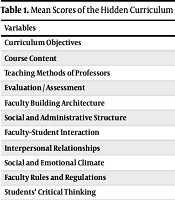
Rafiee H, Vahedi H, Vahedi H, Mehryar HR, Jafarisani M, et al. Perceptions of the Hidden Curriculum and Professional Ethics Among Medical Interns: A Cross-Sectional Study at Shahroud University of Medical Sciences. Educ Res Med Sci. 2026;15(2):e173609. doi: https://doi.org/10.69107/ermsj-173609
Niromand E, Sadeghi M, Ataei S, Khazaei MM, Khazaei MR. Factors Affecting the Learning of Medical Ethics and Etiquette from the Perspective of Medical Teachers and Students of Kermanshah Medical School in 2019. Educ Res Med Sci. 2022;11(2):e126427. doi: https://doi.org/10.5812/erms-126427
Last Update: 1 month ago
Last Update: 1 month ago
Last Update: 1 month ago
Last Update: 6 days ago
Last Update: 10 hours ago
Last Update: 4 days ago