Fulltext
The full text of this article is available on PDF.
Image Credit:Educ Res Med Sci
Authors
Introduction: Emotional Intelligence (EI) is the capacity to handle one’s and the others’ feelings and reactions, and is important for achieving pleasant social interaction and success in life. The purpose of the present assessment was to explore the connection between the EI of psychiatric residents and their outcomes in objective scholastic evaluations.
Methods: A cross-sectional study was used in the present assessment. 31 psychiatric residents of the University of Social Welfare and Rehabilitation Sciences (grade 1 to 4) were requested to answer the Schutte Self Report Emotional Intelligence Test (SSEIT) for probing the relationship between EI and objective structured examinations, like Mini-Clinical Examination Exercise (Mini-CEX), Objective Structured Clinical Examination (OSCE), and Chart-Stimulated Recall (CSR) scores, which had been taken in the previous six months. SSEIT score of 90 was taken as demarcating point for dividing the sample population into two target groups, including the 1st group with SSEIT score lower than 90, and the 2nd group with SSEIT score equal to or more than 90. Demographic characteristics were analyzed by comparison of proportions regarding gender and year of study and comparison of means (t-test) regarding age, scholastic evaluative scores and EI. Data analysis was conducted using MedCalc Statistical Software version 15.2. Statistical significance was determined as a P≤0.05.
Results: 29 participants (93.54%) responded to the assessment and answered the SSEIT. According to the findings, there was no significant difference between the aforesaid groups regarding Mini-CEX, OSCE and CSR (P=0.101, P=0.091 and P=0.156, respectively). Post-hoc power analysis showed an intermediary power equal to 0.36 on behalf of this trial.
Conclusion: According to the findings, while a significant difference, with respect to SSEIT score, was evident between two groups of psychiatric residents with higher and lower SSEIT scores, no significant difference was evident between them regarding the objective structured examinations.
© 2017, Educational Research in Medical Sciences. This open-access article is available under the Creative Commons Attribution-NonCommercial 4.0 (CC BY-NC 4.0) International License (https://creativecommons.org/licenses/by-nc/4.0/), which allows for the copying and redistribution of the material only for noncommercial purposes, provided that the original work is properly cited.
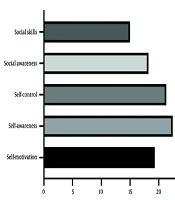
Haghighat-Manesh E, Ghasemzadeh Ajirlou F, Hamedi-Shahraki S, Shahriari F. Investigating the Relationship Between Emotional Intelligence (EI) and Academic Performance Among Medical Student. Compr Health Biomed Stud. 2025;3(3):e161245. doi: https://doi.org/10.5812/chbs-161245
Solimani Z, Ahmadi M, Khazaei M, Ansarian A, Khamoushi F. Correlation of Emotional Intelligence with Evaluation Score of the Faculty Members of Kermanshah University of Medical Sciences in 2014. Educ Res Med Sci. 2014;3(2):e77251. doi:
Boden AL, Staley CA, Boissonneault AR, Bradbury TL, Boden SD, et al. Emotional Intelligence in Medical Students is Inversely Correlated with USMLE Step 1 Score: Is there a Better Way to Screen Applicants?. J Med Edu. 2017;16(4):e105594. doi: https://doi.org/10.22037/jme.v16i4.19528
Radfar S, Aghaie M, Motashaker-Arani M, Noohi S, Saburi A. Evaluation of Emotional Intelligence and Its Relation to the Academic Achievement in Medical Students. Thrita J Neu. 2013;2(2):113-9. doi: https://doi.org/10.5812/thrita.8605
Heidari Gorji AM, Shafizad M, Soleimani A, Darabinia M, Goudarzian AH. Path Analysis of Self-Efficacy, Critical Thinking Skills and Emotional Intelligence for Mental Health of Medical Students. Iran J Psychiatry Behav Sci. 2018;12(4):e59487. doi: https://doi.org/10.5812/ijpbs.59487
Last Update: 2 days ago
Last Update: 2 days ago
Last Update: 2 days ago
Last Update: 5 hours ago
Last Update: 7 hours ago
Last Update: 4 days ago