
1. Background
Gliomas remain among the most challenging primary brain tumors to treat, largely because of their diffuse growth pattern and complex interactions with the surrounding brain microenvironment (1). In addition to intrinsic genetic alterations, increasing evidence indicates that glioma cells actively adapt to immune pressure within the tumor microenvironment (2). Although immune cell infiltration can be detected in many gliomas, effective antitumor immunity is often limited, suggesting the presence of local inhibitory mechanisms that dampen cytotoxic activity rather than a complete absence of immune recognition (3).
One mechanism by which tumors evade immune destruction involves alterations in cell-surface glycosylation. Sialic acids are terminal sugar residues commonly added to glycoproteins and glycolipids on the cell membrane and play a crucial role in cell-cell recognition (4, 5). Altered sialic acid levels have been reported in a variety of pathological conditions and are considered important indicators of tumor progression, metastasis, and immune evasion (6). The biological activity of sialic acids is mediated through several mechanisms that directly and indirectly influence molecular and cellular processes (7). Notably, the brain has the highest concentration of sialic acids in the body, making them key contributors to immune interactions (8). In several malignancies, tumor-surface hypersialylation has been linked to immune suppression through the engagement of inhibitory receptors expressed on cytotoxic T cells and natural killer (NK) cells (9).
Among the enzymes involved in this process, the sialyltransferase ST6GAL1 plays an important role. ST6GAL1 promotes the addition of α2,6-linked sialic acids to membrane proteins, potentially modifying how tumor cells are perceived by immune cells (10). Beyond immune modulation, this modification enhances tumor cell survival and resistance to apoptosis. In glioblastoma, ST6GAL1 is overexpressed in tumor stem cells, where it promotes self-renewal and tumorigenicity, whereas its suppression inhibits cell growth (11). Furthermore, ST6GAL1 facilitates tumor angiogenesis by activating the Met/Akt/PI3K pathway through sialylation of the c-Met receptor (12). Collectively, these findings highlight ST6GAL1 as a pivotal regulator in glioblastoma and a potential therapeutic target.
Because ST6GAL1 catalyzes the addition of sialic acid residues to membrane glycoproteins, increased ST6GAL1 expression may be associated with a greater abundance of sialylated ligands capable of interacting with inhibitory Siglec receptors on immune cells. Sialic acid-binding immunoglobulin-like lectins, or Siglecs, are immunoregulatory proteins distinguished by their capacity to bind sialoglycans, which are sialic acid-containing glycans on the surface of target cells. These receptors are expressed across diverse immune lineages, including T lymphocytes, NK cells, neutrophils, macrophages, dendritic cells, and B cells (13). Functionally, most Siglecs mediate immune suppression through immunoreceptor tyrosine-based inhibitory motifs located in their intracellular regions. Notably, the engagement of Siglec family members by sialic acid within the tumor microenvironment represents a critical pathway for immune evasion (14). These interactions activate downstream inhibitory pathways, such as SHP-1/2 and PI3K/Akt, ultimately reducing T-cell activity while promoting cancer cell survival and invasion (15).
Preclinical studies have shown that blocking the Siglec-sialic acid axis can restore immune cell activity and improve antitumor responses. SIGLEC7 is an inhibitory receptor expressed on subsets of cytotoxic lymphocytes and NK cells and has been implicated in regulating antitumor cytotoxic responses (16, 17). Upon binding to sialylated ligands, SIGLEC7 transduces inhibitory signals that attenuate cytotoxic activity (18, 19). Despite increasing evidence linking tumor hypersialylation to immune modulation, the relationship between tumor sialylation pathways and Siglec-associated immune regulatory signaling in glioma remains poorly understood (20).
2. Objectives
This study investigated whether exposure to exogenous sialic acid influences the expression of the sialyltransferase ST6GAL1 and the inhibitory receptor SIGLEC7 in astrocytic tumor cells. In addition, transcriptomic data from the TCGA lower-grade glioma (TCGA-LGG) cohort were examined to determine whether tumors with elevated ST6GAL1 and SIGLEC7 expression are associated with the expression of selected cytotoxic lymphocyte-associated transcripts, including CD8A, PRF1, NCAM1, and GZMB.
3. Methods
3.1. Cell Culture and Maintenance
The human astrocytoma cell line 1321N1 (catalog number C118) was obtained from the Pasteur Institute of Iran. Cells were cultured in low-glucose Dulbecco Modified Eagle Medium (Gibco) supplemented with 10% fetal bovine serum (Gibco) and antibiotics, including streptomycin, penicillin, and amphotericin. Before the experiments, cultures were routinely screened to confirm the absence of Mycoplasma contamination. Cells were maintained in a humidified incubator at 37°C with 5% carbon dioxide.
3.2. Cell Treatment and MTT Assay
Sialic acid (Neu5Ac; Sigma-Aldrich, A0812) was dissolved in PBS (pH 7.4) to a final concentration of 5 mM and filter-sterilized. 1321N1 cells (8,000/well) were seeded in 96-well plates and treated the following day with 20 - 1400 µM sialic acid for 24 hours. Cell viability was measured at 570 nm using an ELISA reader, with untreated cells serving as controls. Survival was calculated as formazan absorbance relative to controls. Data are presented as the mean ± SEM from three independent experiments, with eight replicates per experiment. Based on these results, 300, 500, and 1000 µM sialic acid were selected for further studies. For gene expression analysis, cells were seeded in 6-well plates (1.4 × 10⁵/well), treated with the selected concentrations for 24 hours, and incubated under standard conditions (37°C, 5% CO2). The MTT assay was performed according to a published protocol (Figure S1 in Supplementary File) (21).
3.3. RNA Extraction and cDNA Synthesis
RNA was manually extracted from treated and control cells using YTzol Pure RNA reagent (Yektatajhiz, YT9064), according to the manufacturer's protocol. The procedure included phase separation with chloroform (Merck) and RNA precipitation with isopropanol (Merck). The RNA pellet was then washed with 75% ethanol (Merck). RNA concentration and purity were evaluated using a NanoDrop spectrophotometer; A260/A280 ratios between 1.8 and 2.0 were considered acceptable (22). RNA integrity was also confirmed by electrophoresis on a 2% agarose gel. For reverse transcription, 2000 ng of RNA from each specimen was converted to cDNA using the cDNA Synthesis Kit (Yektatajhiz, YT4500) in a total reaction volume of 20 µL. Random hexamers and oligo(dT) primers were used according to the standard protocol.
3.4. Quantitative Real-time PCR
Specific primers for ST6GAL1, SIGLEC7, and the housekeeping gene β-actin were designed using NCBI Primer-BLAST and Oligo Analyzer software and synthesized by Gene Fanavaran Co. (Iran). Primer specificity was confirmed by the presence of a single band of the expected size on a 2% agarose gel after conventional PCR. Quantitative real-time PCR (qPCR) was performed using a LightCycler 96 instrument (Roche, Switzerland). Each reaction had a final volume of 10 µL and contained 5 µL of SYBR Green Master Mix (Yektatajhiz), 0.3 µL of each forward and reverse primer (10 µM), 3.6 µL of DEPC-treated water, and 1 µL of cDNA template. A no-template control, containing 1 µL of DEPC-treated water instead of cDNA, was included in each run. Each qPCR reaction was performed in technical triplicate, and experiments were independently repeated three times as biological replicates. The PCR program consisted of initial denaturation at 95°C for 4 minutes, followed by 40 cycles of denaturation at 95°C for 10 seconds, annealing at 58°C for ST6GAL1 or 62°C for SIGLEC7 for 10 seconds, and extension at 72°C for 20 seconds. Relative gene expression levels were calculated using the 2-ΔΔCt method, with β-actin as the internal reference. Statistical analysis and figure preparation were performed using GraphPad Prism, with differences between groups assessed by one-way ANOVA. P < 0.05 was considered statistically significant (Table 1).
3.5. Western Blotting
Proteins were extracted from cells using RIPA lysis buffer containing Tris-HCl, EDTA, NaCl, sodium deoxycholate, SDS, NP40, and a protease inhibitor cocktail. To remove cell debris, lysates were centrifuged at 12,000 rpm for 10 minutes at 4°C, and the supernatants were collected. Protein concentrations were measured using the Bradford assay and a standard curve generated with BSA. After denaturation, equal amounts of protein were loaded onto a 10% SDS-PAGE gel. The separated proteins were then transferred to polyvinylidene fluoride membranes at 120 mV for 90 minutes. To prevent nonspecific binding, membranes were blocked with nonfat dry milk and incubated overnight at 4°C with primary antibodies against ST6GAL1 (Santa Cruz Biotechnology, sc-32233), SIGLEC7 (Cell Signaling Technology, #55851), and GAPDH (Santa Cruz Biotechnology, sc-517582); GAPDH served as the loading control. After washing with TBS-T, membranes were incubated with a mouse anti-rabbit IgG-HRP secondary antibody (Santa Cruz Biotechnology, sc-2357) at a dilution of 1:1000 for 75 minutes. Protein bands were visualized using a chemiluminescent reagent kit and exposed to X-ray film. Band densitometry was performed using ImageJ software. For reprobing, membranes were stripped with a buffer containing mercaptanol, Tris, and SDS at 37°C for 2 - 3 minutes, reblocked, and the detection process was repeated. The experiment was conducted in three independent replicates.
3.6. Bioinformatic Analysis
3.6.1. Data Acquisition and Differential Expression Analysis
For tumor versus normal comparisons of ST6GAL1 and SIGLEC7 expression, transcriptomic data were obtained from GEPIA2 (http://gepia2.cancer-pku.cn/), a web-based platform that integrates TCGA tumor data and GTEx normal tissue data. Expression data were retrieved for TCGA-LGG tumor samples (n = 163) and GTEx normal brain samples (n = 207). Expression levels are shown as log2(TPM + 1). Statistical significance was determined using one-way ANOVA (P < 0.05). For correlation and heatmap analyses, RNA-seq expression z scores for ST6GAL1, SIGLEC7, CD8A, PRF1, GZMB, and NCAM1 were obtained from cBioPortal for Cancer Genomics (https://www.cbioportal.org/) using the Brain Lower Grade Glioma (TCGA, PanCan Atlas 2018) study (cBioPortal study ID: lgg_tcga_pan_can_atlas_2018). This dataset includes 514 patients with LGG. Expression z scores were downloaded and analyzed using R software (version 4.5.1). Data were accessed on February 20, 2026.
3.6.2. Survival and Correlation Analysis
The association between gene expression and patient prognosis was assessed using Kaplan-Meier survival analysis via GEPIA2. Patients were stratified into high- and low-expression groups based on median ST6GAL1 and SIGLEC7 expression levels. Overall survival curves were generated, and the log-rank test was used to assess statistical significance. For correlation analysis, the Spearman rank correlation coefficient was calculated using R software (version 4.5.1) with the cor.test(x, y, method = "spearman") function. Scatter plots were generated using the base plot(x, y) function in R. The analysis was performed using the cBioPortal dataset.
3.6.3. Immune Infiltration and Pathway Enrichment
To investigate the tumor immune microenvironment, the correlation between ST6GAL1/SIGLEC7 expression and key cytotoxic immune markers (CD8A, PRF1, GZMB, and NCAM1) was analyzed using the same cBioPortal dataset (n = 514). A heatmap was generated using R software with the pheatmap package (version 1.0.13) to visualize the expression patterns of these genes across the cohort. Z scores are shown, with red indicating higher expression and blue indicating lower expression. In addition, functional enrichment analysis was conducted using the KEGG and Gene Ontology databases to identify biological pathways significantly associated with the ST6GAL1-SIGLEC7 axis.
3.7. Statistical Analysis
Statistical analyses were performed using R (version 4.5.1) and GraphPad Prism (version 11.0.0). One-way ANOVA with Tukey post hoc test was used for qPCR data. The Spearman correlation coefficient (r) was calculated using the cor.test function in R. Kaplan-Meier survival curves were compared using the log-rank test. For enrichment analysis, the Benjamini-Hochberg false discovery rate correction was applied (q < 0.05). The significance threshold was P < 0.05 for all other analyses. Data are presented as the mean ± SEM from at least three independent experiments unless otherwise specified.
4. Results
Table 1.
Primer Sequences Used in Real-Time qPCR a
| Gene | Forward Primer | Reverse Primer | Size (bp) | Efficiency (%) |
|---|---|---|---|---|
| ST6GAL1 | GCC TGA TGA ACT CTC AGT TGG TTA C | ATC ATG ATG ATG ATA CCA AGC ATC C | 307 | 100 |
| SIGLEC7 | GTG TCA TCT TCA TTG TAG TGA GGT C | CCA GGA CTC AGT CAG GTT ACC | 134 | 100 |
| β-actin | GAG CAT CCC CCA AAG TTC ACA | GGG ACT TCC TGT AAC AAC GCA | 103 | 100 |
a The housekeeping β-actin gene was used as an internal control.
4.1. Sialic Acid Upregulates ST6GAL1 and SIGLEC7 mRNA Expression
We evaluated the mRNA expression levels of ST6GAL1 and SIGLEC7 in response to sialic acid treatment using qPCR. Analysis of the three tested concentrations showed that sialic acid induced the expression of both genes. As shown in Figure 1A and B, ST6GAL1 and SIGLEC7 expression increased in a dose-dependent manner after sialic acid treatment. Based on the viability profile, 500 µM was selected as the optimal concentration for subsequent experiments because it showed significant biological activity without compromising cell viability.
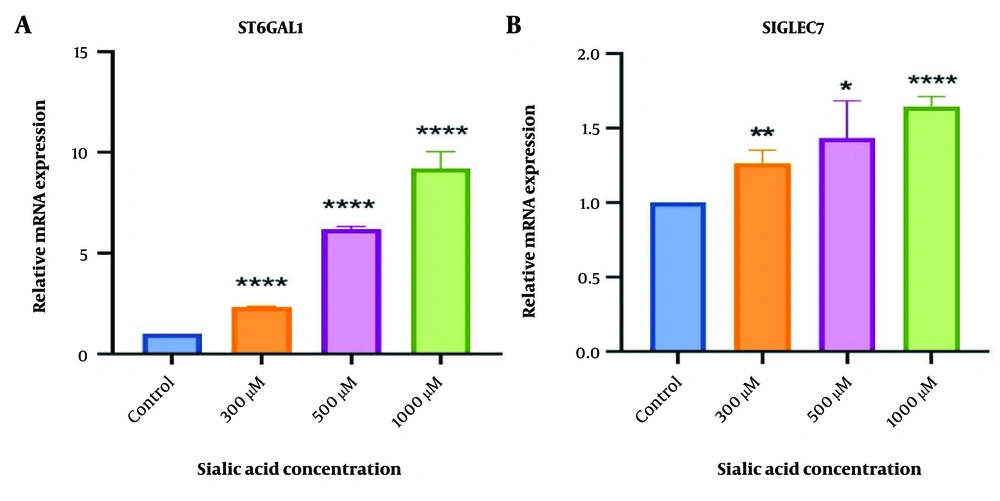
Figure 1.
Sialic acid induces mRNA expression of ST6GAL1 and SIGLEC7 in 1321N1 cells. Cells were treated with sialic acid (300, 500, and 1000 µM) for 24 hours, and expression levels were analyzed by qPCR. A, Expression levels of ST6GAL1 across the three concentrations. B, Expression levels of SIGLEC7 across the three concentrations. Data are shown as the mean ± SEM of three independent experiments. * P < 0.05, ** P < 0.01, and **** P < 0.001 versus control.
4.2. Validation of Protein Expression by Western Blotting
To determine whether changes in mRNA levels were reflected at the protein level, western blot analysis was performed on cells treated with the optimal concentration of 500 µM sialic acid. Consistent with the qPCR data, protein levels of both ST6GAL1 and SIGLEC7 were significantly higher in the sialic acid-treated group than in the control group (Figure 2). Densitometric analysis confirmed this significant increase, supporting the transcriptional increase observed in the previous step.
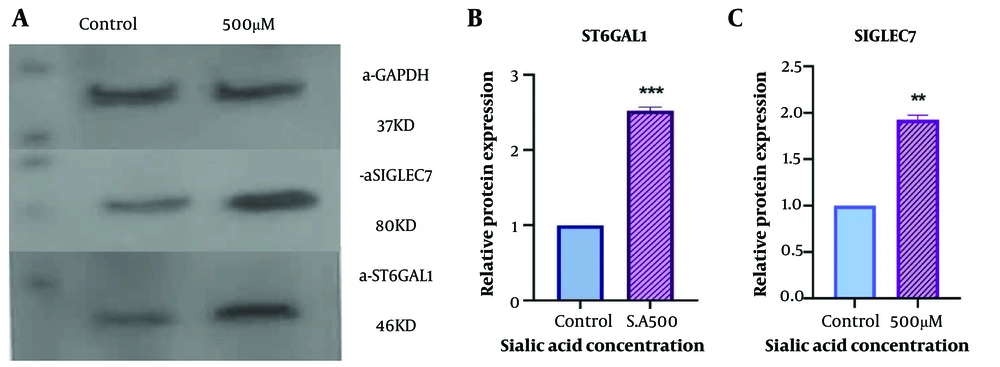
Figure 2.
Validation of ST6GAL1 and SIGLEC7 protein expression using western blotting. A, Western blot images showing ST6GAL1, SIGLEC7, and GAPDH protein levels in 1321N1 cells that were untreated or treated with 500 µM sialic acid. B and C, Quantitative densitometric analysis of band intensities normalized to GAPDH. Data are shown as the mean ± SEM from three independent experiments. ** P < 0.01, and *** P < 0.001 versus the control group.
4.3. ST6GAL1 and SIGLEC7 Are Upregulated in Patients With LGG
To assess the clinical relevance of the in vitro findings, we analyzed transcriptomic data from patients with lower-grade glioma. Analysis of TCGA-LGG data revealed significant upregulation of both ST6GAL1 and SIGLEC7 compared with normal controls (Figure 3A and B). Expression distribution plots indicated that transcript levels of these genes were markedly elevated in LGG samples, confirming the clinical relevance of the in vitro findings. Kaplan-Meier survival analysis was also performed using GEPIA2 to evaluate the prognostic value of these genes. For ST6GAL1, the log-rank P value was 0.23 (HR = 1.2). For SIGLEC7, the log-rank P value was 0.41 (HR = 1.2). Kaplan-Meier plots included the default 95% confidence interval bands generated by GEPIA2. No significant association was found between the expression levels of these genes and overall survival in this cohort (Figure S2 in Supplementary File).
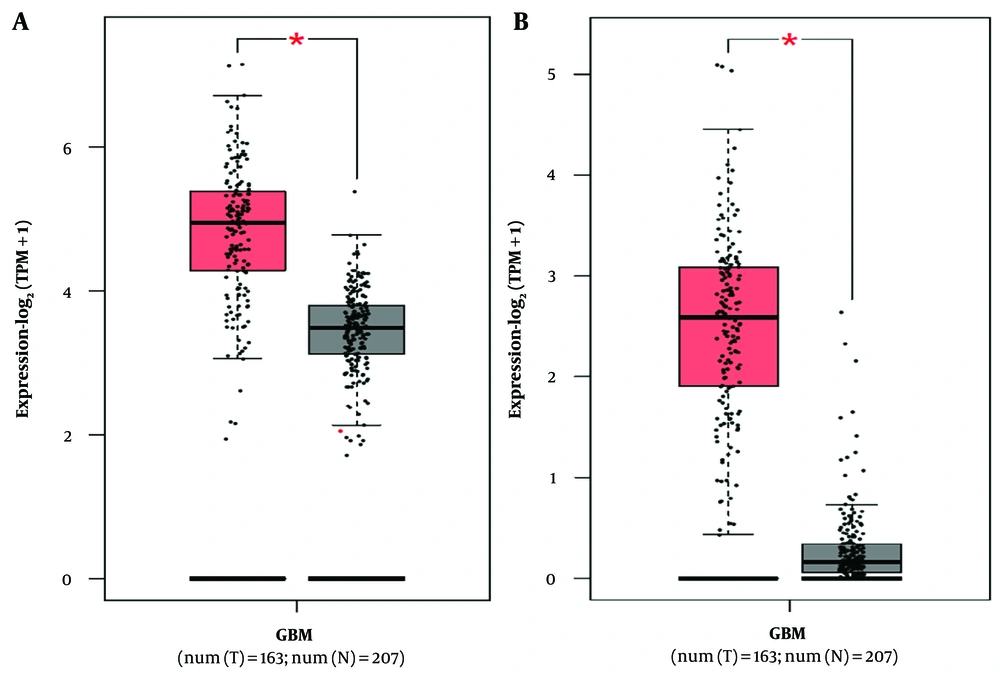
Figure 3.
Upregulation of A, ST6GAL1 and B, SIGLEC7 in lower-grade glioma. Box plots compare the mRNA expression levels of ST6GAL1 and SIGLEC7 between tumor tissues (n = 163) and normal controls (n = 207) using TCGA data. The analysis shows significantly higher expression levels of both genes in patients with LGG than in normal tissues (* P < 0.05).
4.4. Positive Correlation Between ST6GAL1 and SIGLEC7 in Patient Samples
We investigated the relationship between ST6GAL1 and SIGLEC7 expression in LGG patient samples. Spearman correlation analysis revealed a significant, moderate positive correlation between ST6GAL1 and SIGLEC7 expression (Spearman r = 0.5; P = 6.843e-34) (Figure 4). These findings support a transcriptomic co-expression pattern between ST6GAL1 and SIGLEC7 in LGG that may be associated with simultaneous overexpression of the sialyltransferase and its cognate inhibitory receptor in glioma.
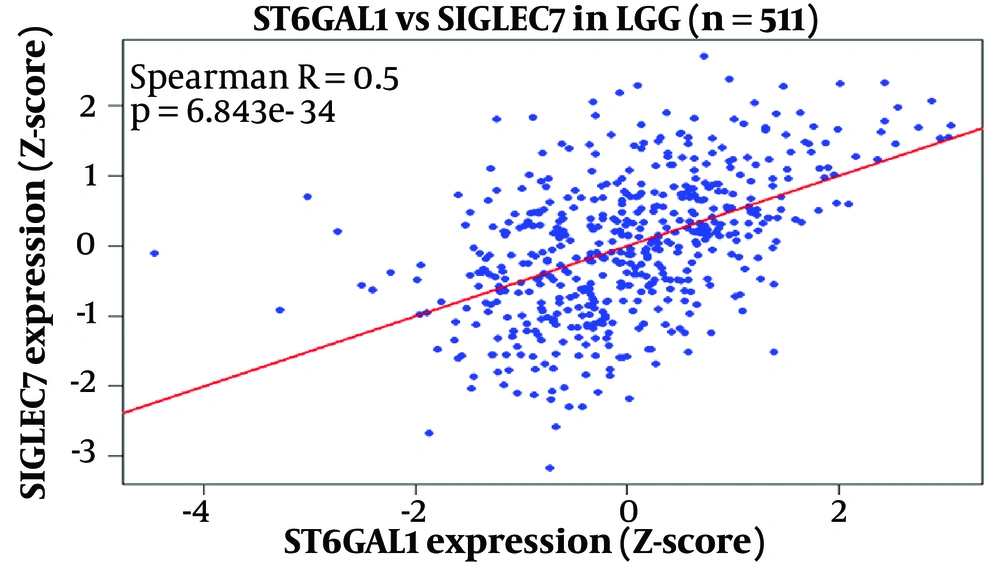
Figure 4.
Positive correlation between ST6GAL1 and SIGLEC7 expression in patients with LGG. The scatter plot shows the Spearman correlation between ST6GAL1 and SIGLEC7 mRNA levels in the lower-grade glioma TCGA-LGG cohort (n = 514). A significant positive correlation was observed between the two genes (r = 0.5; P = 6.843e-34), suggesting a significant positive association between their expression levels in LGG.
4.5. Association of ST6GAL1-SIGLEC7 Expression with Selected Cytotoxic Immune-Related Transcripts
To explore the potential immune-related context associated with ST6GAL1 and SIGLEC7 expression, we analyzed their associations with selected cytotoxic immune-related transcripts. Heatmap analysis revealed that tumors with higher expression of ST6GAL1 and SIGLEC7 also had elevated levels of cytotoxic immune cell markers, including CD8A, PRF1, NCAM1, and GZMB (Figure 5). These results suggest that increased ST6GAL1 and SIGLEC7 expression is associated with tumors exhibiting higher expression of selected cytotoxic immune markers. Pathway enrichment analysis further highlighted significant enrichment of biological processes related to glycosylation and sialylation, supporting an association between glycosylation-related pathways and the observed transcriptomic patterns (Figure S3 in Supplementary File).
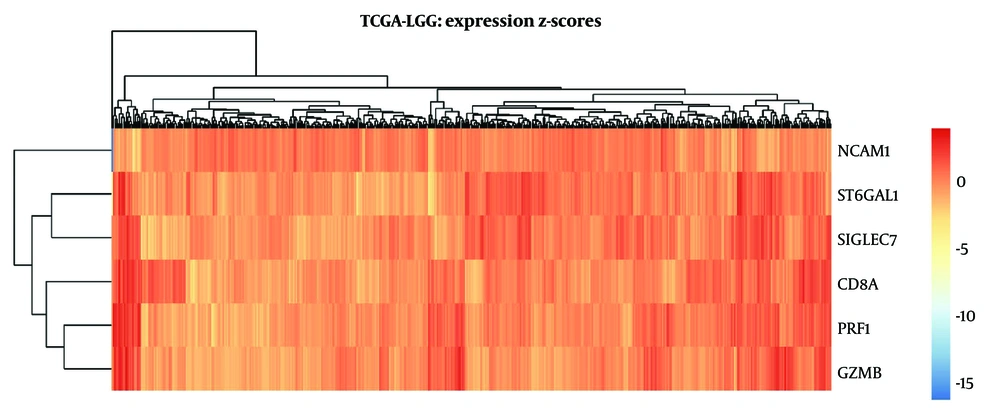
Figure 5.
Heatmap analysis of ST6GAL1, SIGLEC7, and selected cytotoxic immune-related transcripts in patients with LGG. The heatmap displays the expression profiles of ST6GAL1, SIGLEC7, and selected cytotoxic immune-related genes (CD8A, PRF1, NCAM1, and GZMB) across the LGG cohort. The clustering illustrates that tumors with increased ST6GAL1 and SIGLEC7 expression also tend to exhibit elevated expression of these selected immune-related transcripts.
5. Discussion
The present study provides integrated experimental and transcriptomic evidence suggesting that tumor-associated sialylation may contribute to immune regulation in glioma. Exposure of human astrocytoma 1321N1 cells to exogenous sialic acid increased the expression of the sialyltransferase ST6GAL1 and the inhibitory immune receptor SIGLEC7. Importantly, analysis of TCGA-LGG datasets revealed that tumors with elevated expression of these genes also exhibited increased expression of cytotoxic lymphocyte-associated markers, including CD8A, PRF1, NCAM1, and GZMB. CD8A, PRF1, and GZMB were selected as well-established markers of cytotoxic lymphocyte infiltration and activity, with CD8A reflecting CD8+ T-cell presence and PRF1 and GZMB reflecting cytotoxic function. Notably, the TCGA-LGG findings are observational and hypothesis-generating, whereas the in vitro results provide direct experimental evidence. Collectively, these findings suggest that the observed association between ST6GAL1 and SIGLEC7 expression may be related to immune-associated features within the tumor microenvironment rather than intrinsic tumor aggressiveness.
Altered sialylation is a well-established feature of malignant transformation and has increasingly been recognized as an important regulator of tumor–immune interactions (23, 24). Sialic acids are terminal monosaccharides on glycoproteins and glycolipids that contribute to self-recognition and immune tolerance (25, 26). In cancer, hypersialylation of the tumor cell surface has been associated with reduced immune-mediated clearance and enhanced immune suppression (27). Within this framework, ST6GAL1 has a central role by catalyzing α2,6-linked sialylation of membrane proteins (28). Increased ST6GAL1 expression has been reported in multiple solid tumors and hematologic malignancies and has been linked to tumor progression, metastasis, and therapy resistance (29). Beyond its tumor-intrinsic effects, emerging evidence indicates that ST6GAL1 can influence immune recognition by modifying the glycosylation status of immune-regulatory proteins and receptors. Notably, ST6GAL1-mediated sialylation has been shown to stabilize immune checkpoint molecules such as PD-L1, thereby promoting immune evasion in colorectal and breast cancers (30-33). These observations support the idea that increased ST6GAL1 expression may contribute to an immunoregulatory tumor phenotype rather than simply reflecting metabolic changes. Consistent with these observations, previous studies have indicated that sialic acid exposure can modulate key inflammatory and growth-related pathways in glial cells, including the regulation of miRNAs, NF-κB, MMPs, and PDGF-D signaling, and may contribute to drug-resistance mechanisms in glioma (34-36, 21).
Several studies have demonstrated that sialylated glycans can engage inhibitory receptors of the Siglec family on immune cells, thereby attenuating cytotoxic responses (37). SIGLEC7, which acts as an immune checkpoint receptor, is primarily present on NK cells and selected subsets of cytotoxic T cells (38). Upon binding to sialylated ligands, SIGLEC7 transduces inhibitory signals through immunoreceptor tyrosine-based inhibitory motif-dependent recruitment of phosphatases, resulting in reduced cytotoxicity and cytokine production (39, 16). Tumor-associated sialylated ligands capable of engaging SIGLEC7 have been identified in several cancer types, and blockade of Siglec–sialic acid interactions has been shown to restore NK-cell activity in preclinical models (40). Furthermore, emerging evidence highlights that dysregulated sialylation is pivotal not only for immune escape but also for tumor cell migration and invasion, particularly in aggressive cancers such as glioblastoma (41). Consequently, targeting the sialic acid–Siglec axis has become a promising therapeutic strategy, with recent reviews emphasizing the potential of Siglec-targeted therapeutics to reverse immunosuppression and improve clinical outcomes.
In the context of glioma, however, the functional relevance of SIGLEC7-mediated signaling remains poorly defined. Although SIGLEC7 is primarily expressed by immune cells, its evaluation in the 1321N1 model was intended to assess whether exposure to exogenous sialic acid could influence the expression of genes associated with sialylation-related immune signaling. Therefore, the in vitro findings should be interpreted as exploratory observations rather than evidence of a functional SIGLEC7-mediated pathway in glioma cells. The observation that SIGLEC7 expression positively correlates with ST6GAL1 in patient-derived glioma datasets suggests a potential association between these genes within the glioma tumor microenvironment. Importantly, because SIGLEC7 expression in bulk RNA-seq data likely reflects immune cell infiltration rather than tumor cell-intrinsic expression, the findings do not imply that glioma cells directly express SIGLEC7. Instead, they are consistent with a model in which tumor-cell sialylation creates an environment permissive to inhibitory Siglec signaling on infiltrating immune cells.
An important aspect of the clinical analysis is the association between high ST6GAL1/SIGLEC7 expression and increased levels of cytotoxic immune markers. CD8A, PRF1, NCAM1, and GZMB are widely used indicators of cytotoxic lymphocyte infiltration and activity. The coexistence of cytotoxic immune signatures with increased expression of immunoregulatory glycosylation-related genes suggests an association between ST6GAL1–SIGLEC7 co-expression and selected cytotoxic immune-related transcripts rather than definitive evidence of immune-cell infiltration. Similar patterns have been described in other malignancies, in which immune-infiltrated tumors simultaneously activate compensatory inhibitory pathways to limit immune-mediated damage. In this scenario, enhanced tumor sialylation may be associated with processes that contribute to reduced immune activation. This concept aligns with the emerging idea of glyco-immune checkpoints, in which glycans and glycan-binding receptors fine-tune immune responses within the tumor microenvironment (42, 15).
This study has limitations. The heatmap analysis was based on a limited set of four immune markers (CD8A, PRF1, NCAM1, and GZMB) and does not constitute comprehensive immune deconvolution or cell-type quantification. Therefore, the findings should be interpreted as exploratory and hypothesis-generating regarding the association between ST6GAL1 and SIGLEC7 expression and selected cytotoxic immune-related transcripts. Broader immune profiling or single-cell studies would be needed to definitively characterize the immune microenvironment in relation to ST6GAL1 and SIGLEC7 expression patterns. These findings reflect transcriptomic associations with selected cytotoxic immune-related transcripts and should not be interpreted as definitive evidence of immune-cell infiltration or immune-state architecture.
In conclusion, the present data suggest that tumor sialylation may be associated with immune regulatory pathways in glioma. The observed co-expression of ST6GAL1 and SIGLEC7, together with selected cytotoxic immune-related transcripts, supports the possibility that glycan-mediated immune modulation may contribute to the complex immune landscape of gliomas. Further functional studies are required to determine whether targeting tumor sialylation could enhance antitumor immunity in the glioma microenvironment.