1. Context
Medical errors (MEs) in hospital care represent a leading cause of preventable morbidity and mortality worldwide (1). These errors include medication, diagnostic, surgical, and communication errors (2, 3). Most of these errors often arise from the use of inappropriate care methods or the incorrect execution of suitable ones by healthcare providers, which can cause physical harm to patients (4, 5). According to a report by the U.S. Institute of Medicine, medical mistakes in American hospitals cause about 98,000 deaths each year — more than deaths from car accidents (6). This finding and subsequent research initiated the patient safety movement. For example, a global study found that medical care-related adverse events significantly contribute to morbidity and mortality, underscoring the urgent need to prioritize patient safety (7). Collectively, this history of evidence highlights the enormous human and economic costs of MEs and the critical need to improve hospital safety systems.
The WHO estimates that in high-income countries, roughly one in ten hospitalized patients experience harm, whereas extensive research in low- and middle-income settings reports an adverse event rate of around 8%. Notably, about two-thirds of all these hospital adverse events occur in poorer nations. WHO reports show that many adverse events in hospitals — nearly half — could have been prevented with appropriate medical care. These statistics highlight the widespread nature of MEs in hospital settings across both high- and low-resource health systems, with a disproportionately greater burden observed in under-resourced environments (8, 9).
To address the global threat of MEs, health authorities have implemented major patient safety initiatives, including the 2002 World Health Assembly resolution on patient safety, WHO-led campaigns such as “Medication without Harm” and the 2021 - 2030 Global Patient Safety Action Plan. These efforts collectively highlight the global prioritization of reducing MEs (10-12). Despite significant policy efforts, substantial knowledge gaps persist regarding MEs, particularly in low-income countries, which contribute less than 1% of the existing research in this area (13).
2. Objectives
Although research has shifted from merely describing the prevalence of MEs to assessing interventions, a significant gap remains in rigorous studies evaluating the underlying causes of MEs in hospitals, particularly across different income settings. Therefore, the present review aims to identify the primary causes of MEs and assess their relative significance across both low- and high-income settings.
3. Methods
3.1. Design
This systematic review was conducted in five steps: Problem identification, literature search, data evaluation, data analysis, and presentation. The review followed the PRISMA guidelines (14). Ethical approval for this study was obtained from Tabriz University of Medical Sciences (IR.TBZMED.REC.1401.786).
3.2. Search Methods
Relevant keywords were identified following a pilot search, after which four databases (PubMed, Scopus, Web of Science, and SID) were searched from January 2000 to May 2025. Each author independently tailored the search strategy to each database, conducted searches, and screened the retrieved documents based on the inclusion criteria. Discussions were held to resolve any disagreements. The search strategy incorporated the keywords “medical error”, “cause”, “underlying reason”, and “hospital” to retrieve documents. The specific search strategies for each database were:
- PubMed: ((("medical error*"[Title/Abstract]) AND ("hospital*"[Title/Abstract])) AND ("cause*"[Title/Abstract])) OR ("underlying reason*"[Title/Abstract])
- Web of Science (WOS): TITLE-ABS (("medical error*") AND ("hospital*") AND ("cause*" OR "underlying reason*"))
- Scopus: TITLE-ABS-KEY (("medical error*") AND ("hospital*") AND ("cause*" OR "underlying reason*"))
In the SID database, due to limitations in advanced search functionality, a manual search was carried out using Persian equivalents of the keywords.
3.3. Inclusion Criteria
- Original studies, book chapters, and clinical or educational guidelines
- Published in English or Persian
- Focused on the types and causes of MEs
- Conducted in hospital settings
3.4. Exclusion Criteria
- Reviews, editorials, letters, commentaries, or abstracts
- Lacking full-text access
- Focused on non-hospital settings or unrelated to MEs
- Published in other languages
3.5. Study Selection
A two-stage screening process followed the inclusion criteria. First, two independent reviewers screened the titles and abstracts of all retrieved studies. Then, they independently assessed the full texts of potentially eligible articles to determine final inclusion. Discussions were held to resolve any disagreements. No automation tools supported the screening or analysis processes.
3.6. Quality Appraisal
Two reviewers independently evaluated the risk of bias in the included studies using Joanna Briggs Institute (JBI) standardized critical appraisal tools (15). They resolved any disagreements through discussion. The review process did not involve any automation tools.
3.7. Data Abstraction
EndNote X9 software facilitated the management of the retrieved articles. Data extraction utilized Excel 2013. Collected data included the article title, author name, study country, year of study, study type, sample size, and information on the causes of MEs and overall study findings.
3.8. Data Synthesis
The included studies exhibited a range of study designs, contributing to data heterogeneity that precluded the possibility of conducting a meta-analysis. The authors engaged in data synthesis, resolving discrepancies through discussion to achieve consensus. The thematic grouping of findings into conceptual categories formed the basis of the narrative synthesis. This process drew on patterns and frameworks from the literature and did not involve formal coding.
4. Results
4.1. Search and Study Selection
The search strategy retrieved a total of 3339 studies. After eliminating duplicate studies and screening titles and abstracts, 376 articles underwent full-text review. In total, 42 studies met the inclusion criteria (Figure 1 and Table 1).
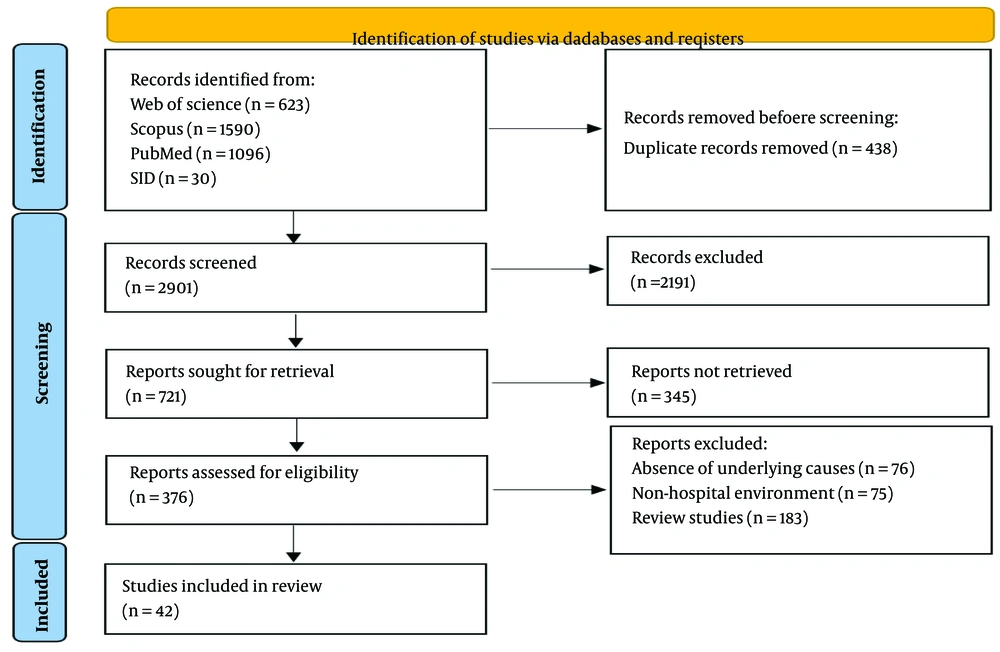
Figure 1.
PRISMA diagram showing the identification, screening, eligibility, and inclusion process of documents retrieved from databases
Table 1.
Data Extraction Table
| Studies | Year | Study Design | Country | Sample Size | Key Findings Summary | Risk of Bias |
|---|---|---|---|---|---|---|
| Arbous et al. (16) | 2001 | Cohort | Netherlands | 119 | Human error, communication, supervision, organizational problems | Low |
| Tanaka et al. (17) | 2012 | Cohort | Japan | 789 | Feeling unskilled, job stress, sleep disturbance | Low |
| Baines et al. (18) | 2013 | Cohort | Netherlands | 4023 | Multi-specialty care complexity, diagnostic errors | Low |
| Ashcroft et al. (19) | 2003 | Qualitative | UK | 93 | Communication issues, junior staff, workload | Moderate |
| Odegard and Hallberg (20) | 2003 | Qualitative | Sweden | 28 | Patient influx, inexperience, inter-professional gaps | Moderate |
| Gurses et al. (21) | 2009 | Qualitative | USA | 15 | Practice variation, workload, guideline non-compliance | Low |
| Ross et al. (22) | 2011 | Qualitative | Scotland | 40 | Environment, team and task factors, documentation | Low |
| Mankaka et al. (23) | 2012 | Qualitative | Switzerland | 8 | Fatigue, overload, safety culture | Low |
| Mousavi Roknabadi et al. (24) | 2019 | Qualitative | Iran | 18 | Fatigue, workload, poor staffing, fear of blame | Moderate |
| Ghezeljeh et al. (25) | 2022 | Qualitative | Iran | 17 | Accreditation, management, environment, staff inexperience | Low |
| Yilmaz and Sönmez (26) | 2024 | Qualitative | Turkey | 15 | Overwork, staff shortage, lack of training | Low |
| Najafpour et al. (27) | 2018 | Qualitative | Iran | 110 | Patient, task, environment, drug-related factors | Low |
| Suresh et al. (28) | 2004 | Descriptive | USA | 739 | Policy failure, distraction, inexperience | Low |
| Grayson et al. (29) | 2005 | Descriptive | USA | 112 | Hectic work environment, Distractions, Fatigue, High patient acuity | Low |
| McGillis Hall et al. (30) | 2010 | Descriptive | Canada | 32 | Communication, alarms, distractions | Moderate |
| Rabol et al. (31) | 2011 | Descriptive | Denmark | 84 | Handover errors, staff miscommunication | Moderate |
| Baloochi et al. (32) | 2014 | Descriptive | Iran | 150 | Workload, illegible orders, Kardex errors | Moderate |
| Mohammadnahalet al. (33) | 2022 | Descriptive | Iran | 800 | Overload, fatigue, team conflict, poor infrastructure | Low |
| Tourgeman-Bashkin et al. (34) | 2008 | Observational | Israel | 62 | Environment, workload, system/human factors | Low |
| Gurses et al. (35) | 2011 | Observational | USA | 22 | Noise, overcrowding, communication gaps | Low |
| Vazin and Delfani (36) | 2012 | Observational | Iran | 38 | Errors in prescribing, administration, transcription | Low |
| Ghazanfar et al. (37) | 2012 | Observational | Denmark | 17 | Interruptions during care | Low |
| Symons et al. (38) | 2013 | Observational | UK | 50 | Communication failures, missed care | Low |
| Duruk et al. (39) | 2016 | Observational | Turkey | 122 | Interruptions, information exchange, social factors | Low |
| Wagner et al. (40) | 2016 | Observational | Netherlands | 2028 | Human, technical, organizational, patient-related causes | Low |
| Corwin et al. (41) | 2017 | Observational | USA | 70 | Policy issues, equipment, training gaps, culture | Low |
| Zhao et al. (42) | 2018 | Observational | China | 43 | Environment, caregivers, physicians, communication | Low |
| Abraham et al. (43) | 2021 | Observational | France | 293 | No ID process, emergency context, language barrier | Low |
| Ryan et al. (44) | 2013 | Cross-sectional | Scotland | 548 | High workload, prescribing interruption | Low |
| Kaboodmehri et al. (45) | 2019 | Cross-sectional | Iran | 281 | Poor lighting, noise, space and equipment limits | Low |
| Alyahya et al. (46) | 2021 | Cross-sectional | Jordan | 400 | Workload, stress, organizational culture | Low |
| Mul Fedele et al. (47) | 2023 | Cross-sectional | Turkey | 661 | Long shifts, insufficient sleep | Low |
| Nagasaki et al. (48) | 2024 | Cross-sectional | Japan | 5579 | > 90 h duty/wk, insomnia linked to errors | Low |
| Li et al. (49) | 2024 | Cross-sectional | China | 7197 | Workplace violence, mental illness, physician role | Moderate |
| Hijazi et al. (50) | 2025 | Cross-sectional | Jordan | 400 | Gaps in skills, training needs | Moderate |
| Aksel Demir and Kocasli (51) | 2025 | Cross-sectional | Turkey | 192 | Sleep disturbance, shift fatigue, medications | Moderate |
| Donchin et al. (52) | 2003 | Case-crossover | Israel | 554 | Physician-nurse communication breakdown | Low |
| White (53) | 2011 | Case-study | UK | 1 | Poor team coordination, human factors | Low |
| Calderbank et al. (54) | 2011 | Case-study | UK | 1 | Drug similarity, storage issues, final check missing | Low |
| Freundlich et al. (55) | 2012 | Case-study | USA | 1 | Team miscoordination, poor communication | Moderate |
| Shojaeian et al. (56) | 2016 | Case-study | Iran | 1 | Isolation neglect, poor consultation, weak training | Low |
| DeLancey et al. (57) | 2017 | Case-study | USA | 1 | Training deficits, communication breakdown | Moderate |
4.2. General Characteristics of Selected Studies
Of the 42 studies, 26 were conducted in high-income countries and 16 in low-income countries, spanning from 2001 to 2025. Regarding the types of errors, researchers investigated MEs in 17 studies, adverse events in 10 studies, medication errors in four studies, interruptions in three studies, harm in two studies, human errors in two studies, and nursing errors, patient identification errors, communication errors, and functional barriers were each studied in one study. Regarding research methodology, eight studies employed root cause analysis, 11 used questionnaires, nine used observation methods, three used event reporting, and eight used interview methods. Various clinical departments conducted studies in hospitals, including five in intensive care units (ICU), four in pediatrics, two in the NICU, one in the maternity ward, one in the anesthesia unit, one in the operating room, one in postoperative care, and the remaining studies covered the entire hospital. The researchers investigated a total of 242 hospitals, 37% of which were educational/university hospitals.
4.3. Risk of Bias Assessment
The assessment of study quality used the JBI tool. Among the 42 studies, 33 demonstrated a low risk of bias (scores > 70%), and 9 showed a moderate risk (scores between 50% and 69%).
4.4. Summary of Key Findings
An analysis of contributing factors to MEs identified eight main categories (Figure 2).
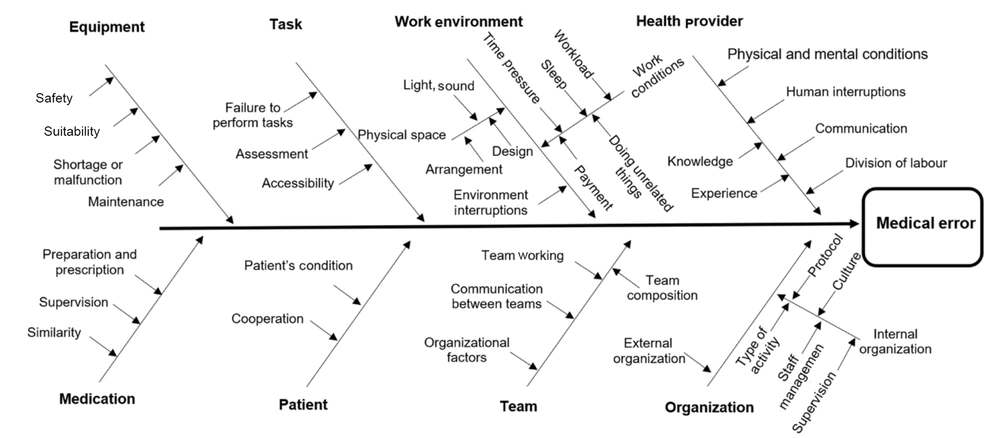
Figure 2.
Fishbone diagram illustrating the key factors contributing to medical errors (MEs)
- Patient-related factors: Patient conditions (high clinical complexity, language barriers, ICU stays) (16, 27, 43); cooperation issues (noncompliance, disruptive behavior) (25, 33).
- Team-related factors: Individual issues (multidisciplinary coordination challenges) (22, 53, 55); organizational shortcomings (structural support deficiencies) (21, 24, 32).
- Medication-related factors: Drug storage/delivery issues, look-alike/sound-alike confusion, prescribing errors (32, 36, 54).
- Organizational factors: External challenges (accreditation, regulations) (25); internal issues (lack of protocols, weak supervision, poor safety culture, staffing shortages) (24, 32, 33).
- Healthcare provider-related factors: Communication failures, knowledge/skill deficits, experience gaps, interruptions, distractions (16, 17, 22, 53); physical and mental health issues, inappropriate task allocation, work stressors (workload, sleep deprivation, time pressure) (33, 46-48).
- Work environment factors: Frequent interruptions (alarm fatigue), physical space deficiencies (lighting, layout, ergonomics) (30, 34, 35).
Figures 3 and 4 use fishbone diagrams to illustrate the causal pathways of MEs. Level one includes direct causes such as fatigue, lack of knowledge, and communication issues (17, 22, 52). Second-level factors, such as staffing shortages, inadequate training, and poor team communication, contribute to shaping these causes (24, 29, 50). Level three involves root organizational causes, including a punitive culture and resource limitations, which affect nurses’ behavior and motivation (27, 33, 41).
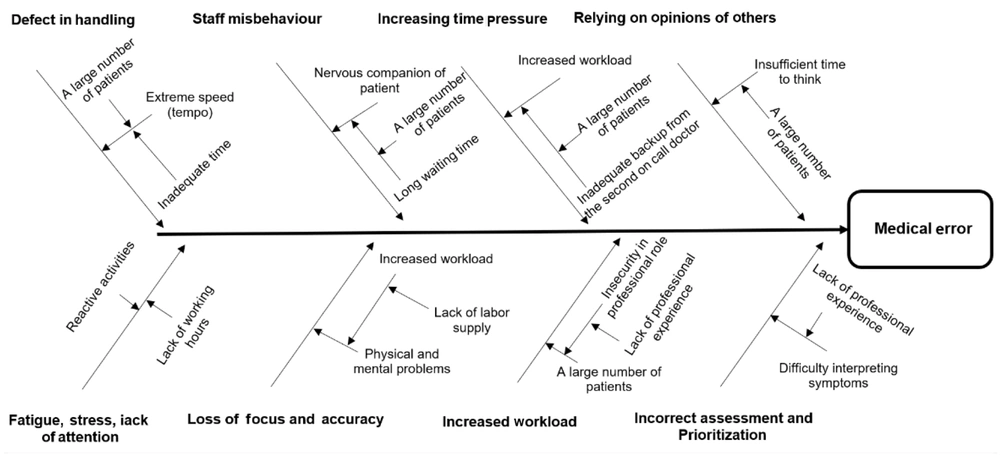
Figure 3.
Fishbone diagram illustrating the underlying causes categorized into levels one, two, and three
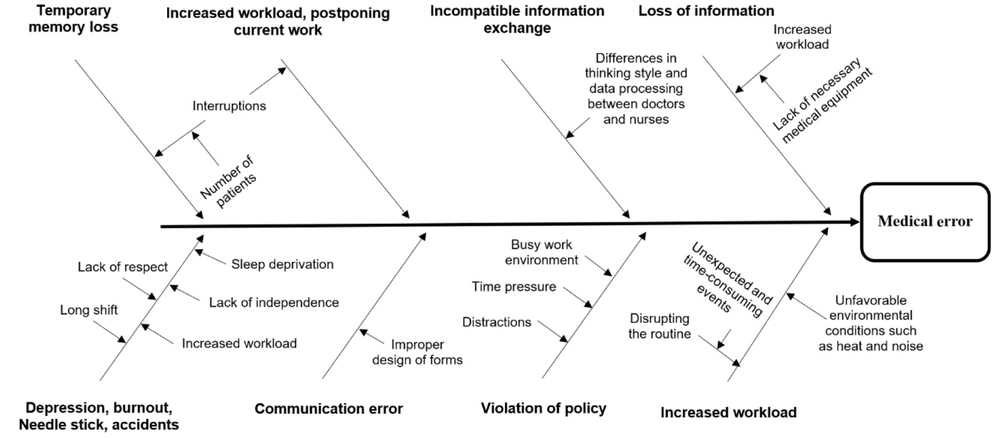
Figure 4.
Continuation of the fishbone diagram showing the detailed underlying causes distributed across three levels
The frequency of mentions in the reviewed articles determined the ranking of contributing factors to MEs. Average rankings, when available, refined the final order to provide a more precise reflection of each factor’s relative significance. The categorization of countries into low-income or high-income groups followed World Bank criteria.
5. Discussion
This systematic review demonstrates that multiple factors contribute to the occurrence of MEs in hospitals.
5.1. Factors Related to Healthcare Providers
The findings reveal that healthcare provider-related factors are the primary contributors to MEs. Lack of knowledge is the leading cause in low-income countries, while communication failures are more prevalent in high-income settings. Rashudy classified influential factors in medication prescription errors using the Eindhoven model into five categories. Prescribers contribute most to these errors due to insufficient drug knowledge, poor skills, and limited experience, aligning with the findings of the present study (58). Moreover, Najafi illustrated that within the ICU, novice nurses or those with limited experience are more susceptible to errors due to insufficient knowledge and experience. Inadequate clinical knowledge, reduced sensitivity, and insufficient attention during patient care also increase the likelihood of errors (25).
Amaniyan’s study identified factors contributing to safety incidents in the emergency department and categorized them into five classes using the Vincent model. Inadequate communication among staff, such as failing to report changes in vital signs to the attending physician, was identified as a key factor in communication-related incidents in the emergency department (59). Donchin et al. found that many errors resulted from communication issues between physicians and nurses, with oral communication mistakes being the most frequently reported cause of errors (52). Rabol revealed that errors in verbal communication among medical staff constitute the primary cause of patient safety incidents, with information transfer errors during shift handovers being the most common type of incident (31). These results are consistent with the findings of the present study.
5.2. Factors Related to the Organization
This study’s findings indicate that organizational factors were the second leading cause of MEs in low-income countries and the third in high-income countries. Critical factors contributing to MEs include the absence, inadequacy, or non-adherence to protocols, guidelines, and policies in high-income countries, as well as the shortage of human resources in low-income countries. Suresh et al. identified non-compliance with policies or protocols as the most common contributing factor to MEs, emphasizing that failure to follow protocols can lead to mistakes in the treatment process, drug administration, and laboratory tests, resulting in errors and even harm to patients. These results align with the findings of the present study (28). According to Mosadeghrad and Woldemichael, factors such as defective work processes, absence of clinical protocols and guidelines, and incorrect team procedures contribute to MEs, consistent with the findings of the present study (60). Using evidence-based clinical protocols and guidelines tailored to the needs and ideas of each working group can simplify and standardize hospital processes, reducing the likelihood of errors (9, 61). Ghezeljeh et al., as well as Mousavi -Roknabadi et al., found that insufficient staffing, combined with heavy workloads and long, busy schedules, is associated with increased physical and mental problems such as fatigue. These conditions lead to a decrease in the ability to concentrate and focus on providing care, ultimately increasing the likelihood of errors, which aligns with the results of the present study (24, 25).
5.3. Factors Related to the Work Environment
This study shows that work environment factors rank third among the causes of MEs in low-income countries and second in high-income countries. The workload is the most critical factor within this category. Studies conducted in Canada, Australia, Turkey, Iran, and Jordan confirm that heavy workloads, fatigue, lack of sleep, and staff shortages are associated with MEs. For example, both Alyahya et al. and Bagheri et al. found that a high patient-to-nurse ratio, heavy workload, and nurse fatigue due to excessive work are associated with increased occurrence of medication errors (46, 62). Mankaka’s study demonstrated that when nurses and healthcare staff face a large volume of tasks within a limited time frame, stress increases, work quality declines, fatigue sets in, and the likelihood of errors rises. Similarly, Lane’s findings — based on the Reason model — identified work environment factors as the primary cause of errors, with workload and time pressure being the most common contributors (23, 63). These results align with those of the present study.
Given the association between heavy workloads and physical and mental health issues, improvements in the work environment are essential. Nursing managers should ensure sufficient staffing to minimize the risk of MEs (25). Contributing factors may include inadequate nurse staffing, high patient-to-nurse ratios, and excessive workload demands, all of which increase the likelihood of mistakes. Reducing high workload is challenging (61); however, emergency measures and management training can be effective in minimizing errors (59). An organizational approach to workload management and reduction of time pressure is essential for preventing errors. Measures such as decreasing the number of patients per physician, increasing physician availability during peak hours, minimizing multitasking, and eliminating non-essential tasks during busy periods can be effective (22).
5.4. Factors Related to the Patient
According to this study, patient-related factors ranked fourth in low-income countries and fifth in high-income countries as causes of MEs, with patient conditions playing the most significant role in error occurrence. Ghezeljeh et al. identified critically ill patients as being more prone to errors due to the complexity of care they require (25). Similarly, Duarte et al. reported that factors such as severe illness, older age, use of multiple medications, and the need for precise dose calculations increase the risk of MEs in ICUs (64). Patients admitted to the ICU require continuous and complex care due to their critical conditions, and the unit’s stressful environment contributes to the occurrence of both overt and latent errors (25). Baines emphasizes that complex illnesses require involvement from multiple specialties, increasing the risk of MEs. As the number of specialists involved in patient care rises, coordination and communication become more critical, elevating the likelihood of information transfer errors and preventable mistakes (18). Schwappach states that the number of care providers involved is a significant predictor of MEs (65). These findings align with the results of the present study.
5.5. Factors Related to Equipment
According to recent research, equipment-related factors rank fifth among causes of MEs in low-income countries and fourth in high-income countries. The primary issue is the shortage or malfunction of medical equipment, which can significantly impact patient care. Moyimane et al. found that inadequate equipment can lead to negligence, malpractice, adverse outcomes, and patient fatalities, consistent with our findings (66). Ghezeljeh et al.’s study highlighted that lack of awareness about advanced equipment, transferring patients with devices outside the ward, and technical failures contribute to errors (25). This difference reflects the critical role advanced equipment plays in nursing care within ICUs.
5.6. Factors Related to Medication
The study reveals that medication-related factors rank sixth among causes of MEs in low-income countries and eighth in high-income countries. The primary contributor to medication errors is the similarity in drug appearance and packaging. Calderbank et al. explain that similarity in drug packaging or appearance can lead to confusion and prescription errors. Our study’s results align with these findings, showing that placing products with similar packaging from the same supplier next to each other in the pharmacy or ward increases the likelihood of errors. Cheragi et al. also reported that the use of drug name abbreviations and similarities in drug names frequently caused medication errors, aligning with the findings of our study (54, 67). To minimize such errors, hospitals should adopt targeted strategies, including storing look-alike medications in clearly designated areas, using color-coded labels on packaging and syringes, implementing a dual-verification process before medication administration, and collaborating with healthcare organizations and pharmaceutical manufacturers to address packaging similarities (68).
5.7. Factors Related to Task
Our review indicates that task-related factors rank seventh among the causes of MEs. In low-income countries, failure to carry out assigned duties is more prevalent, while in high-income countries, limited access to necessary resources occurs more frequently. These differences may reflect disparities in workforce training, workload distribution, and infrastructure. Similarly, Lane, Ross, and McGillis identified inadequate access to or unavailability of medication information as a key task-related issue. Such deficiencies can result in insufficient data for clinical decision-making, ultimately increasing the likelihood of MEs. These findings support the patterns observed in our analysis (22, 30, 63). DeLancey’s study and Najafpour et al.’s findings are similar to our results in that the failure to perform duties contributes to patient harm, such as falls from beds and readmissions (27, 57).
5.8. Factors Related to the Team
Team-related factors rank eighth in low-income countries and sixth in high-income countries as causes of MEs. Among these, communication failures within teams are the most significant contributors. Dietz et al. and Reader et al. reported that effective teamwork — encompassing communication, coordination, decision-making, and leadership — is essential for overcoming barriers to adherence to care protocols and processes in the ICU. For example, implementing a mandatory checklist of care protocols and goals during rounds improved compliance with best practices (69-71). Similarly, Brady and Goldenhar and Partheyet al. reported that poor communication results in inconsistent understanding among team members regarding clinical situations and appropriate responses, which can increase the risk of serious safety events (72, 73). Moreover, Endacott et al. and Lyons and Popejoy found that ineffective communication delays the response to patient deterioration. For instance, poor communication during surgery can compromise patient safety, leading to adverse outcomes such as wrong-site procedures or surgical site infections (3, 74).
5.9. Conclusions
Identifying the root causes of MEs is crucial in reducing their occurrence. The results of our study indicate that a substantial portion of these factors is preventable through process revisions. Healthcare provider-related factors have the most impact on MEs. Interventions such as revising educational curricula and conducting training courses to enhance scientific skills, along with individual skill development (e.g., effective communication) and innovative teaching methods (such as simulation-based learning and virtual reality technologies), can reduce errors. Standardizing the provider-to-patient ratio and reducing working hours are paramount for reducing high rates of errors and avoidable harm in hospitals. Implementing these strategies requires fundamental changes in planning, investment, and efforts to create new infrastructures and policy changes by healthcare policymakers.
In summary, the multifactorial nature of MEs restricts the effectiveness of single-dimensional interventions. Accordingly, multifaceted, system-level strategies are required to mitigate their impact.
5.10. Limitations
The present study had several limitations. First, we included only studies published in English and Persian, which may have resulted in the exclusion of relevant research in other languages. Second, our searches were limited to four major databases: PubMed, Scopus, Web of Science, and SID. Finally, despite careful screening and quality assessment by two independent reviewers, some risk of bias may still be present.