


1. Context
With improvements in living standards and increased life expectancy, the global elderly population is steadily growing and is expected to reach 2.1 billion by 2050. Developing countries like Iran will also face significant aging trends, with projections of around 30 million older adults by mid-century (1). This demographic shift poses major economic, social, and healthcare challenges, highlighting the critical impact of population aging beyond just its size (2). Population aging has a significant impact on healthcare systems, driven by increased demand for services and a higher prevalence of age-related conditions (3). In developed countries, healthcare spending for individuals aged 65 and older generally surpasses that of younger age groups (4). In countries such as the United States, Japan, Canada, and Australia, per capita medical expenses for seniors can be up to twice as high as those for individuals aged 45 to 64. China is also experiencing similar trends, with rising healthcare costs closely tied to its aging population (4).
Iran is facing a rapid demographic transition marked by a growing elderly population, which is placing increasing strain on its healthcare system. Older adults are more likely to suffer from chronic illnesses and require frequent, intensive, and costly medical care, including LTC and greater dependence on others. The United Nations has identified Iran, along with Mongolia and Cuba, as undergoing some of the fastest demographic changes worldwide, leading to significantly higher healthcare demands and expenditures (5-8). This trend underscores the urgent need for strong, sustainable health financing strategies. However, Iran’s status as a low- to middle-income country, combined with limited resources and underdeveloped health financing infrastructure, presents serious challenges in addressing the rising costs and care needs of its aging population (9-11).
Addressing the growing needs of Iran’s aging population requires proactive planning and lessons from successful international elderly care models (12). Key Iranian institutions, including the Ministry of Health and various social support organizations, play vital roles in providing care and insurance coverage (13). The Imam Khomeini Relief Committee supports over 1.7 million elderly individuals, focusing on low-income and marginalized populations (14). It provides a range of medical and insurance services, including coverage for uninsured treatments, assistive devices, rehabilitation, and specialized care for economically disadvantaged elderly patients (15). Strengthening these systems and implementing targeted support plans can significantly improve health outcomes for older adults in Iran.
To the best of our knowledge, there has been no systematic review and comparative analysis conducted within this field. Therefore, conducting research on financing elderly healthcare is crucial to develop strategies that can address the growing demands of the elderly population and the resulting financial challenges, especially in countries like Iran that are undergoing rapid demographic transition. This study aimed to analyze the financing structures of elderly healthcare in selected countries to derive insights applicable to the context of Iran.
2. Evidence Acquisition
2.1. Search Strategy
This comparative study was conducted in 2025 to analyze the existing policies and programs for the care of the elderly in the countries under investigation, utilizing the following keywords: “Elderly”, “financing”, “health system”, “health services”, and “management”. Accordingly, PubMed, Scopus, and Web of Science databases were searched, employing a suitable search strategy for each database. Although this study was conducted in 2025, the research and investigations were conducted in two consecutive searches based on publication date. The first, limited from inception to December 30, 2023, was carried out from January 10 to 16, 2023. The second, covering January 1, 2024, to April 30, 2025, was performed in an updated search from July 8 to 10, 2025. The search strategies for the databases are provided in Table 1.
Table 1.Search Strategies for Databases
| Database | Search Strategies |
|---|---|
| Web of Science | TS=[("aging" OR "aged" OR "old" OR "geriatric" OR "Gerontological" OR "elder*")] AND TS=[("economic*" OR "financ*")] AND TS=(health-care OR health care OR health system OR health services) AND TS=[(collect* OR management OR pool* OR purchas* OR allocat* OR coverage OR access* OR accept* OR afford* OR avail*)] and Article or Review Article or Book Chapters (Document Types) and Article or Review Article or Book Chapters (Document Types) and English (Languages) and Health Policy Services or Economics (Web of Science Categories) and All Open Access (Open Access) |
| PubMed | ["aging"(Title/Abstract) OR "aged"(Title/Abstract) OR "old"(Title/Abstract) OR "geriatric"(Title/Abstract) OR "Gerontological"(Title/Abstract) OR "elder*"(Title/Abstract)] AND ["economic*"(Title/Abstract) OR "financ*"(Title/Abstract)] AND ["health-care"(Title/Abstract) OR "health-care"(Title/Abstract) OR "health system"(Title/Abstract) OR "health services"(Title/Abstract)] AND ["collect*"(Title/Abstract) OR "management"(Title/Abstract) OR "pool*"(Title/Abstract) OR "purchas*"(Title/Abstract) OR "allocat*"(Title/Abstract) OR "coverage"(Title/Abstract) OR "access*"(Title/Abstract) OR "accept*"(Title/Abstract) OR "afford*"(Title/Abstract) OR "avail*"(Title/Abstract)] |
| Scopus | [TITLE-ABS-KEY (aging OR aged OR old OR geriatric OR gerontological OR elder*)] AND ([TITLE-ABS-KEY (economic*) OR TITLE-ABS-KEY (financ*)]) AND ([TITLE-ABS-KEY (health-care)]) OR ([TITLE-ABS-KEY (health) AND TITLE-ABS-KEY (care)]) OR ([TITLE-ABS-KEY (health) AND TITLE-ABS-KEY (system)]) OR ([TITLE-ABS-KEY (health) AND TITLE-ABS-KEY (services)]) AND [TITLE-ABS-KEY (collect* OR management OR pool* OR purchas* OR allocat* OR coverage OR access* OR accept* OR afford* OR avail*)] AND [LIMIT-TO (SUBJAREA, "DECI") OR LIMIT-TO (SUBJAREA , "ECON")] |
Additionally, to enhance access to other scientific texts, such as books, book chapters, published and unpublished reports, and theses, a manual search was performed using Google and Google Scholar. After retrieving articles from the aforementioned databases, they were imported into Endnote software. Subsequently, the PRISMA guideline was applied to determine the final studies. The resources published up to 2025 in English were extracted. Studies were included if (1) they addressed the financing structure of elderly healthcare, (2) they were written in English, and (3) the full text was accessible. Studies were excluded if they (1) were published in other languages, (2) involved models designed for emergency departments, (3) focused on specific diseases related to the elderly, or (4) were letters to the editor or editorials.
2.2. Selection Criteria
EndNote was used for bibliographic control and data extraction. Duplicates were identified and removed first using EndNote’s "find duplicate" feature, followed by manual checking. Two independent reviewers screened titles, abstracts, and full texts for inclusion. In case of disagreements, they discussed and consulted a third reviewer to reach a consensus. Data were charted from the included studies using a data extraction tool developed in Excel by the review team members. Two reviewers independently extracted the data, and any uncertainties were clarified through consultation.
2.3. Analytical Framework
To extract specialized information from the collected sources and documents, a researcher-developed tool based on the framework of the health financing system was utilized. The main functions of the health financing system include revenue collection, pooling of funds, and purchasing of health services (16). Using this tool, the following information was extracted from the articles: The name of the model, the minimum age of participants, the state of financial resource collection within the model, and the management of accumulation, allocation, and purchase of services at both national and local levels.
In this study, the policies and programs of the selected countries were carefully examined, identifying those with superior programs and policies or those comparable to Iran in terms of financing the health system and specific financing of elderly care programs. Programs and activities from the Imam Khomeini Relief Committee for the elderly were incorporated into this analysis. Since this institution provides services to the elderly through insurance, the present review focused on programs and countries that explicitly use insurance models to finance their elderly health systems. The flowchart of the search process for this study is illustrated in Figure 1. Finally, a total of 39 relevant articles with available full texts were examined to extract information, and the countries analyzed included Germany, Japan, China, South Korea, France, Ghana, and India. A comparison of health and treatment structures of selected countries is listed in Table 2.
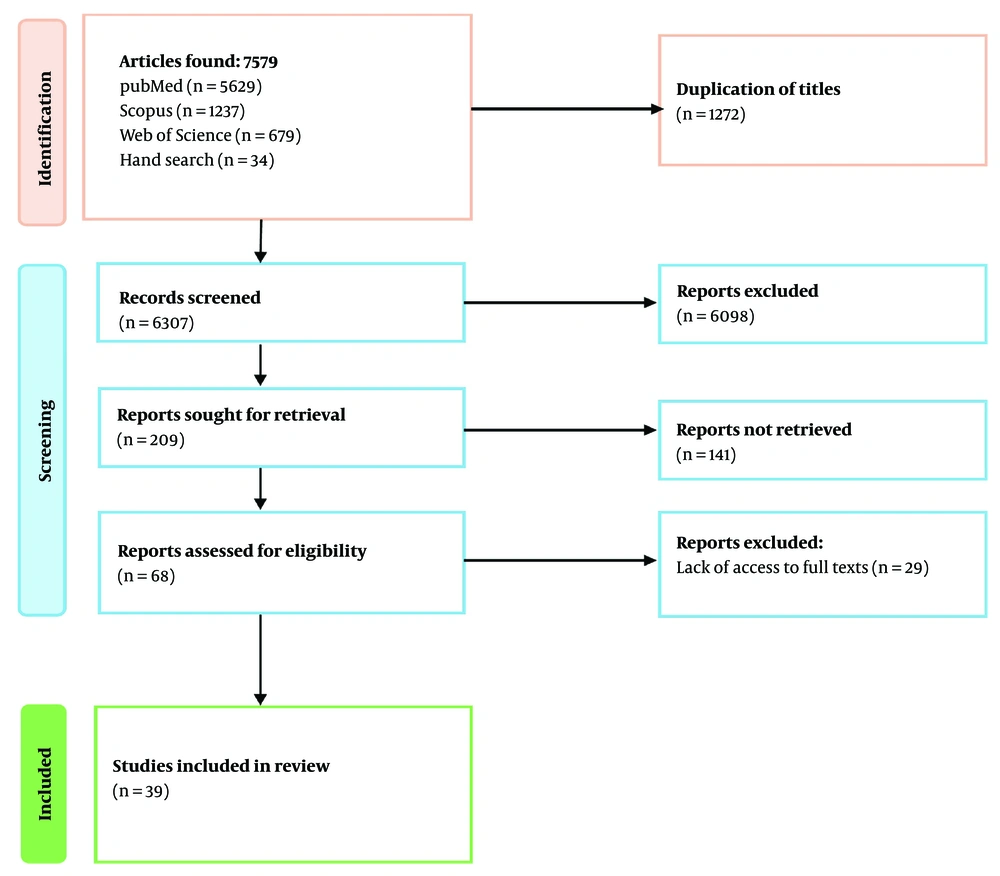
Figure 1.
Flowchart of searching for articles
Table 2.Comparison of Health and Treatment Structures of Selected Countries
| Countries | Health and Treatment Structures |
|---|---|
| Germany | The Federal Joint Committee includes the Emergency Care, Dental Care, Hospital Care, and Physician Affairs Committees, Department of Health and Social Security |
| Japan | The health system of Japan includes healthcare, health insurance, and national health insurance |
| India | The Ministry of Health and Family Welfare is responsible for health management and policy implementation in India. |
| Ghana | The GHS, established in 1996, oversees health services under the Ministry of Health. |
| China | China’s healthcare system features three government-funded social insurance programs that enhance access to care, including for the elderly. |
| South Korea | South Korea’s national health insurance system covers nearly all citizens, providing comprehensive care funded by employee, employer contributions, and the government. |
| France | France’s healthcare system features a national insurance program funded by public and private sources, covering nearly all citizens with comprehensive services. |
| Iran | Health management in Iran is overseen by the Ministry of Health and Medical Education, the Welfare Organization, the Social Security Organization, and the Imam Khomeini Relief Committee. |
Abbreviation: GHS, Ghana Health Service.
3. Results
Long-term care (LTC) encompasses health services and social support for older adults with chronic conditions or disabilities to help maintain their health and independence (8). This study examined LTC policies and programs across selected countries, emphasizing LTC as a crucial component of elderly care delivered through various approaches. By analyzing health system frameworks and financing strategies, the study provides insights into how countries address the growing needs of aging populations. Sustainable healthcare financing is essential for supporting LTC, as it ensures long-term resources, reduces reliance on short-term solutions, and promotes consistent, quality care. Many countries implement LTC policies to meet both current and future demands, securing continued access to vital services for older adults (17-19).
In Iran, the Ministry of Health and Medical Education is the primary authority responsible for managing the healthcare system, with a focus on ensuring effective health service delivery for the entire population (13). Elderly care, however, involves additional institutions such as the Welfare Organization and the Imam Khomeini Relief Committee, which contribute significantly to supporting older adults. The country's healthcare financing system for the elderly is largely public, relying on various government-backed insurance programs such as Iranian health insurance, social security insurance, and armed forces health insurance that cover the majority of medical expenses, with minimal out-of-pocket costs for the elderly. Since its launch in 2014, Iranian health insurance has helped extend coverage to previously uninsured older adults.
Beyond insurance, the government provides subsidies for medications and other medical services to ease financial burdens. The Welfare Organization offers supplementary rehabilitation services, while the Imam Khomeini Relief Committee delivers extensive support, including monthly pensions, essential goods, and healthcare funding (20). This includes assistance with treatments, medications, diagnostic exams, and the provision of medical equipment. The Committee also supplies comprehensive rehabilitation services such as physiotherapy, occupational therapy, mobility aids, housing support, and psychological and spiritual care to promote the well-being and quality of life of elderly individuals (21, 22). Accordingly, the methods for allocating resources and managing costs in the countries under study were compared. Table 3 provides the comparison of the financial components of health and rehabilitation systems in selected countries.
Table 3.Comparison of the Financial Components of Health and Rehabilitation Systems in Selected Countries
| Country; Model/Plan/Program | Financing Functions | National/Local- | Included- | ||
|---|---|---|---|---|---|
| Revenue Collection | Accumulation Management | Allocation and Purchase | |||
| India | |||||
| NPHCE | Central budget/insurance plans | MoHFW | Primary, secondary, and tertiary healthcare | National | ≥ 60 |
| SCHIS | Division of insurance premium payments between central and state governments (entitlement assessment) | Ayushman Bharat | Secondary admissions and coverage of many hospitals | National/ Local | The elderly |
| PFHI | Publicly funded health insurance | PFHI | Strengthening private and public hospitals and free inpatient services/achieving UHC | National | ≥ 45 |
| Ghana | |||||
| NHIS | Personal income, family support, livelihood empowerment grants against poverty and participation in the NHIS | NHIS | Increasing access and use of healthcare services | Local | ≥ 70 |
| China | |||||
| LTC | Medical insurance surplus funds (Qingdao, Jiangsu, and Changchun, medical insurance insured persons)/Beijing pilot LTCI system in Haidian district (through voluntary commercial insurance*)/Shanghai, financial subsidies and individual contributions/current LTC system borne by individuals and families | Medical insurance/government insurance (voluntary)/individuals and families | China's LTCs are dominated by family-centered care and supplemented by institutional care provided by the public or private sector/home care for the elderly and disabled* | Local | ≥ 65 |
| Japan | |||||
| Japan's national health insurance system and LTCI | General income subsidies/insurance premiums/co-payments | Municipal governments | Medical care (hospital) | Local | ≥ 65 |
| Germany | |||||
| Insurer's sickness funds (social insurance) | Insured participation | Insurer's sickness funds | Healthcare and LTC | National | Elderly/all disabled people in society |
| South Korea | |||||
| LTCI | Social insurance/social insurance contribution, government subsidy (tax) and contribution payment/contribution of all age groups | Social health insurance | Disability and LTC coverage | National | ≥ 65 |
| Iran | |||||
| Shahid Rajaei project of the Relief Committee | Government assistance/health insurance | Health insurance/subsidy | Provision of a part of health and treatment costs/the cost of providing assistive devices | National | ≥ 65 |
| France | |||||
| "Allocation personnalisée d'autonomie" (APA) | Social insurance and taxes CNSA, government aid, local and regional aid | CNSA | Home care services, support and care services, specialized services, social and welfare services | National | ≥ 60 |
Abbreviations: UHC, universal health coverage; NHIS, National Health Insurance; LTC, long-term care; LTCI, long-term care insurance; CNSA, national solidarity fund for autonomy.
Germany’s elderly care system is managed by the Ministry of Health and Social Security, the Federal Social Committee, and the Federal Joint Committee (Gemeinsamer Bundesausschuss or G-BA), which includes four specialized bodies: The Emergency Care, Dental Care, Hospital Care, and Physician Affairs Committees (13). Operating under the “Bismarck system”, a statutory social insurance model, Germany funds healthcare primarily through a mix of public and private health insurance (23). This system covers key social risks, including old age and the need for LTC. The study highlights Germany’s health system as one of the most advanced globally, with a structured and multilayered approach to elderly care (24).
As noted in another study, healthcare services for the elderly in Germany are primarily funded through public and private health insurance. The public insurance scheme, Gesetzliche Krankenversicherung (GKV), covers over 90% of the population, while Pflegeversicherung specifically finances LTC and home care services. Elderly care services include primary care, specialist treatment, hospital and dental services, and 24/7 emergency care. Family physicians play a central role in chronic disease management and care coordination. Through its strong regulatory framework, integrated insurance models, and high service availability, Germany ensures that elderly individuals receive comprehensive care without significant financial burden. Its system stands as a benchmark for effective, equitable, and sustainable elderly healthcare (24).
In Japan, the Ministry of Health, Labor, and Welfare oversees health management within a universal public insurance system (13). This system guarantees relatively equal access to medical services, with costs regulated by a government committee to maintain affordability. All residents are legally required to have health insurance; those without employer-sponsored plans enroll in the national health insurance program managed by local governments (25). Patients pay 10%, 20%, or 30% of treatment costs based on family income and age, while the government covers the remainder.
Japan faces significant challenges in financing and delivering healthcare to its growing elderly population. The system addresses these needs through a mix of public and private health insurance and specialized elderly programs. As supported by this study, elderly healthcare financing primarily depends on the public health insurance system (Shakai Hoken) and long-term care insurance (LTCI, Kaigo Hoken). Public health insurance includes employee insurance for workers and national health insurance for the unemployed, both covering most treatment costs with patients paying only a small share (26, 27). The LTCI, introduced in 2000, serves adults aged 65 and over, offering services such as home care, day centers, and nursing homes. Funded by taxes and premiums, LTCI aims to ease the financial burden on elderly individuals.
Elderly healthcare services in Japan encompass primary care, specialized treatments, hospital care, and dental services. Family doctors and community clinics play a key role in chronic disease management and are easily accessible to the elderly. Hospitals, both public and private, provide advanced and specialized care with skilled staff to meet complex needs. The LTCI further supports the elderly by funding LTC services that improve quality of life and reduce family caregiving burdens (26, 28).
In China, the Ministry of Health and Medical Services is responsible for programs and policies related to public health (29), with a basic health insurance system that covers over 95% of the population. In 2018, the National Health Care Security Administration was established to manage all basic health insurance schemes in China. As of 2020, about 95% of the population had at least basic health insurance coverage, which included both employee health insurance and resident health insurance, with the former covering the urban working population and the latter covering the urban non-working and rural populations (30).
Healthcare services for the elderly in China are primarily funded through the public health insurance system, LTCI, and private payments. Key programs include the Urban Employee Basic Medical Insurance (UEBMI), which covers urban employees and is financed by premiums from both employers and employees. Additionally, the Urban and Rural Resident Basic Medical Insurance (URRBMI) serves urban and rural residents not covered by UEBMI, funded by premiums from the government and residents. The LTC program addresses elderly needs by offering services such as home care, daycare centers, and nursing homes, financed through government funds, insurance premiums, and private payments (31, 32).
Healthcare services available to the elderly in China include primary care, specialized services, hospital care, and dental services. These services are provided through a wide network of public and private health centers.
However, the Ghana Health Service (GHS), established in 1996 under the Ministry of Health, manages government health services and implements healthcare policies. Support programs for the elderly include the National Health Insurance Scheme (NHIS), Social Security and National Insurance Trust (SSNIT), and Livelihood Empowerment Against Poverty (LEAP) (33). Ghana’s health system faces challenges but strives to provide elderly care through national insurance programs and government and international aid. The NHIS, launched in 2003, covers primary care, inpatient, and some specialized services, funded by annual premiums, taxes, and international aid, with senior citizens receiving discounted premiums. Government and international contributions improve healthcare access, especially in rural areas (34).
Elderly healthcare includes primary care at community clinics and primary health centers, specialized services at public and private hospitals, and advanced hospital care, though specialized services are less accessible in underserved rural areas. The LTC remains underdeveloped, relying mainly on family, community support, and non-governmental organizations (NGOs). Despite these efforts, challenges persist, including service access disparities, low service quality in some areas, and high costs for the elderly, indicating a need for further reforms (34).
The Indian health system is among the most complex and diverse health systems in the world (35). Despite numerous challenges, efforts are underway to provide proper healthcare services for the elderly. The results of this study align, indicating that financing and providing services to the elderly in India is a collaborative effort among government, private organizations, and NGOs. Healthcare for the elderly in India is financed mainly through governmental sources, health insurance, and private payments, with various government programs developed to support older adults.
The National Program for Health Care of the Elderly (NPHCE), launched in 2010, aims to offer comprehensive healthcare services to the elderly and improve their quality of life. The program is funded by both central and state governments. Another initiative, the Rashtriya Swasthya Bima Yojana (RSBY), is a health insurance scheme for low-income families, which partially covers the medical expenses of the elderly. Besides, the Ayushman Bharat - Pradhan Mantri Jan Arogya Yojana (PM-JAY) is one of the largest government health insurance schemes in the world that provides financial coverage for hospitalization and major surgeries, with particular emphasis on the needs of the elderly (36).
South Korea’s healthcare system is universal but involves significant private funding and is administered by the Ministry of Health and Welfare through the National Health Insurance Service (NHI) (37). Residents with sufficient income are required to purchase health insurance for themselves and their families, while social welfare programs support those unable to afford NHI contributions. The central government sets health policy, supported by regional governments, with 34 regional medical centers and 254 municipal health centers implementing programs (37).
In 2008, South Korea introduced compulsory LTCI to assist older adults with physical disabilities and reduce family caregiving burdens. Healthcare financing for the elderly relies primarily on NHI and LTCI. The NHI covers nearly the entire population and is funded by premiums from employees, employers, and government grants, with patients paying a small share of costs (37). The LTCI, funded by premiums, government aid, and taxes, covers services such as home care, daycare, and nursing homes, with the elderly paying a portion of expenses (38).
In a comparative analysis of LTC systems across France, Germany, and Japan, the French elderly support scheme known as the "Allocation personnalisée d'autonomie" (APA) was highlighted. The plan is financed through general taxes, social insurance, and the national solidarity fund for autonomy (CNSA). The APA resources are allocated to various services, including home care, support and care services, day centers, residential care, specialized services, and social welfare services (39).
Iran can improve elderly healthcare by creating a LTCI system, strengthening community and primary care, expanding preventive programs, integrating health and social services, reducing out-of-pocket costs, fostering public-private partnerships, and investing in geriatric workforce training, drawing lessons from successful models in Japan, Germany, South Korea, and China. Addressing these healthcare challenges requires urgent national policy focus and improved financing to prevent worsening social inequalities. The government must ensure equitable access and involve diverse stakeholders in decision-making.
Key reforms such as LTCI and expanded community services are essential to build public trust, while strengthening partnerships with the private sector and NGOs can help overcome resource limitations. Together, these strategies will enable Iran to better meet the complex needs of its aging population and promote social equity.
4. Discussion
The aim of this study is to compare LTC policies and programs between Iran and selected countries, with an emphasis on LTC as a vital component of elderly care through various approaches. The findings of this study indicate that each of the selected countries has designed their LTC systems in accordance with their specific conditions, and there is no consensus on the ideal type of LTC system (24, 25, 30, 39).
The results of the present study indicate that in the countries examined, such as Germany (24), Japan (27, 40), South Korea (37), China (30), India (35, 36), France (39), and Ghana (34), there have been diverse and complementary strategies aimed at sustainable financing of LTC, as well as promoting service delivery to the elderly. One prevailing trend observed among successful models, particularly in Germany, Japan, and South Korea, is the integration of LTCI schemes within comprehensive universal health coverage systems, alongside the involvement of both public and private sectors and decentralization of service provision (26, 27, 37).
In contrast, although Iran has managed to increase health insurance coverage for the elderly population (20), the lack of an integrated, dedicated LTCI system remains a significant gap (41). While Iran's use of subsidies and general public insurance appears necessary, it has been largely inadequate in meeting the growing needs for chronic disease management, rehabilitation, and social support (21). The multifaceted roles of the Imam Khomeini Relief Foundation have partially addressed this gap; however, due to the fragmented and at times uncoordinated nature of its interventions with the formal healthcare infrastructure, a comprehensive resolution of the gap has yet to be achieved (20).
The findings of the study indicate that countries such as Germany and Japan have established independent and specialized LTC funds (such as Pflegeversicherung in Germany and Kaigo Hoken in Japan), which are financed through mandatory insurance contributions and serve to protect older adults and their families from financial risk (24, 26). Moreover, studies by Kim and Kwon, as well as Seong et al. in South Korea, demonstrate how mandatory LTCI, combined with public government subsidies, can reduce the caregiving burden on families and promote equitable access to both home-based and institutional care services (37, 38).
Moreover, the experiences of countries such as China and India demonstrate that under resource constraints, hybrid models combining public insurance schemes, community-based care, and selective government programs can be effective. For example, a study by Vaishnav et al. showed that the NPHCE, launched in India in 2010 with the aim of providing comprehensive healthcare services for the elderly, had promising outcomes. Similarly, research by Li et al. indicates that pilot LTC programs in China can expand the coverage of care for the elderly under supervision. Such models emphasize the role of primary care, social integration, and cost-sharing mechanisms adapted to local socio-economic contexts (30, 31, 36).
Based on the experiences of other countries, the policy implications from this comparative review for Iran are as follows: First, the development of a national LTCI system could establish a sustainable mechanism to finance elderly care beyond medical services. Second, moving towards integrated care models that combine medical and social services, such as France’s APA program (39), can address the multifaceted needs of the elderly population. Third, expanding community-based prevention programs and developing a specialized elderly care workforce comprising psychologists, nurses, social workers, and even gerontological sociologists are crucial to reducing future healthcare costs (42). Finally, fostering cross-sectoral collaboration with other organizations, including the private sector and NGOs, can enhance diversity, innovation, and the reach of services provided to older adults (43).
Despite the aforementioned points, contextual barriers in Iran such as budget constraints, inadequate regional accessibility, and insufficient information regarding health outcomes for the elderly must be taken into consideration (44, 45). Therefore, policy reforms should be adapted to the capacities of Iran’s healthcare service providers, cultural contexts, and demographic dynamics. Addressing the LTC financing gap through evidence-based approaches is not only a health policy challenge but also essential for ensuring social equity and the dignity of the elderly.
4.1. Conclusions
Addressing the challenges of elderly care requires context-specific policy reforms that account for local economic, cultural, and institutional factors. Sustainable financing, integrated care models, and expanded community-based services are essential to meet the diverse needs of aging populations. Disparities in care systems reflect deeper structural and resource differences, with high-income countries typically offering more comprehensive support, while low- and middle-income countries face fragmentation and limited resources. To promote social equity and improve health outcomes, there is an urgent need for inclusive policymaking, cross-sector collaboration, and strategies such as LTCI and strengthened public-private partnerships to ensure equitable access to quality care for all socioeconomic groups.

