
1. Background
Clonal disorders arise from a single abnormal cell or a small group of genetically identical cells that acquire a growth advantage and expand over time. In hematology, these disorders often originate from mutated hematopoietic stem or progenitor cells and may lead to clonal hematopoiesis, myelodysplastic syndromes, myeloproliferative neoplasms, or leukemia. Although some clonal disorders remain clinically silent for long periods, others can progress to overt malignancy or cause substantial functional impairment (1, 2).
Myelodysplastic syndromes (MDS) are a heterogeneous group of clonal disorders affecting hematopoietic stem cells, characterized by ineffective blood cell production, dysplasia in one or more myeloid lineages, and an increased risk of transformation to acute myeloid leukemia (AML) (3-5). The disease arises from a complex array of genetic and epigenetic alterations, including chromosomal abnormalities such as deletions, monosomies, and trisomies, all of which interfere with normal blood cell formation (6).
Globally, the age-standardized incidence rate of myelodysplastic syndromes and related myeloproliferative neoplasms (MPNs) in 2021 was estimated at approximately 4 to 6 cases per 100,000 person-years (7). Despite improvements in diagnostic tools and supportive care, the long-term prognosis for many patients remains poor, with 5-year overall survival still approximately 30% (8).
Large registries in Europe, North America, and Australia have provided important insights into the clinical, molecular, and prognostic features of MDS; however, data from the Middle East, including Iran, remain sparse. Studies from the region, such as one from Upper Egypt, suggest that patients are often diagnosed in middle age, with normal cytogenetics being relatively common and MDS-MLD emerging as the most prevalent subtype (9). One of the few Iranian studies, conducted between 2014 and 2018 in Ahvaz, reported that most patients with MDS were 62 to 66 years old, which is substantially younger than the average age at diagnosis in Western cohorts (10). The same study also reported a higher prevalence among men working in agriculture and petrochemical industries, suggesting a possible association between occupational exposures (eg, pesticides and hydrocarbons) and disease risk, consistent with similar findings worldwide (10, 11).
Genetic patterns in Iranian patients also appear to differ from those commonly reported in Western populations. A recent Iranian study identified trisomy 8 as the most frequent cytogenetic abnormality and found MDS-MLD and MDS-SLD to be the predominant clinical subtypes (12). These differences suggest potential influences of ethnic, environmental, and occupational factors on the pathophysiology of MDS in the region.
Given the lack of comprehensive national data, a clearer understanding is needed of how the MDS/MPN burden varies across Iran and evolves over time. Although GBD provides valuable estimates, applying advanced spatial and temporal modeling to these data may yield more granular insights into Iran's epidemiologic landscape.
2. Objectives
This study used ecological data from the GBD 2021 study to analyze the spatial and temporal patterns of MDS/MPN across Iran. We applied the Local Getis-Ord Gi* statistic to characterize geographic clustering and used ARIMAX time-series modeling to project trends in incidence, prevalence, mortality, and DALYs through 2030. By providing a nationwide assessment of the spatial distribution of MDS/MPN and forecasting future trends, this study aimed to inform policymakers and public health planners, support resource allocation, and enhance understanding of regional disparities in the disease burden.
3. Methods
3.1. Study Design and Data Sources
This ecological study used data from the GBD 2021 study (13), accessed through the GBD Compare Data Visualization and GBD Results tools (14). Annual estimates for MDS/MPN, including age-standardized incidence rates (ASIRs), age-standardized mortality rates (ASMRs), and disability-adjusted life years (DALYs), were extracted for Iran at the national and provincial levels for 1990 - 2021. Data were disaggregated by sex, enabling sex-based comparisons. GBD estimates integrate multiple data sources, including cancer registries, vital statistics, surveys, and published literature, using CODEm and DisMod-MR modeling. The MDS/MPN burden followed the GBD 2021 cause definitions (ICD-10 codes D45, D46, and D47).
3.2. Age Standardization and Data Characteristics
All rates were age-standardized by the GBD team using the GBD world standard population to account for differences in age structures across provinces and over time, thereby enabling valid comparisons. Rates are reported per 1,000,000 population.
3.3. Spatial Analysis
The spatial distribution of 2021 MDS/MPN incidence, mortality, and DALY rates (per 1,000,000 population) across Iran's 31 provinces was analyzed for both sexes using ArcGIS version 10.8.2. Global spatial autocorrelation was assessed using Moran's I and Getis-Ord's G statistics to evaluate spatial dependence and clustering patterns. Moran's I was first applied to determine whether provinces with similar rates were spatially clustered or randomly distributed and was calculated as:
Where N = 31 (provinces), xi represents the variable-value and spatial-weight terms, and S0 is the sum of all spatial weights.
Local Moran's I was used to identify province-specific spatial clusters and outliers. High-high clusters indicated provinces with high values surrounded by high-value neighbors, and low-low clusters indicated low values surrounded by low-value neighbors. High-low and low-high patterns represented spatial outliers. Getis-Ord's G statistic was applied to detect clustering of high or low values:
Local Getis-Ord Gi* was then used to identify significant hot and cold spots (P < 0.05), verified through permutation tests. Spatial relationships were defined using the Zone of Indifference conceptualization in ArcGIS version 10.8.2, in which neighboring provinces within a critical distance receive equal weights, whereas those beyond that distance receive decreasing weights. The optimal critical distance was determined using Incremental Spatial Autocorrelation analysis by selecting the first statistically significant peak.
3.4. Temporal Trend Analysis
An ARIMAX approach was used to forecast MDS/MPN rates in Iran through 2030. The general model form was:
The autoregressive order p, differencing degree d, and moving-average order q were selected automatically using the auto.arima function in R, guided by the corrected Akaike Information Criterion. A binary indicator for the COVID-19 years (2020 - 2021) was included to account for healthcare disruptions.
The calendar-year covariate form was determined empirically. A linear specification was sufficient for mortality and DALYs (Ljung-Box P > 0.05). For incidence and prevalence, a natural cubic spline with knots at 2005 and 2019 was fitted to capture nonlinear dynamics. Model adequacy was assessed using Ljung-Box tests and autocorrelation function (ACF) plots; additional transformations were applied as needed. Forecasts were projected through 2030.
4. Results
4.1. Descriptive Epidemiology
In 2021, the MDS/MPN burden in Iran showed notable variation by sex and geography. Nationally, there were 14,943 prevalent cases (170.84 per million; 95% UI, 141.30–210.80), 1,447 DALYs (17.98 per million), 757 incident cases (8.52 per million), and 32 deaths (0.48 per million) (Table 1). Males had higher rates than females across all indicators: prevalence (176.94 vs 164.62 per million), incidence (9.54 vs 7.48), DALYs (19.99 vs 16.05), and mortality (0.54 vs 0.42) (Tables S1 and S2 in the Supplementary File).
Table 1.
National Burden of Myeloproliferative and Myelodysplastic Syndromes in Iran in 2021, Including Age-Standardized Rates (per 1,000,000 Population) and Absolute Case Counts for Incidence, Prevalence, Mortality, and Disability-Adjusted Life Years (DALYs), with 95% Uncertainty Intervals
| Province | Incidence Count | ASIR | Prevalence Count | ASPR | Mortality Count | ASMR | DALY Count | ASDR |
|---|---|---|---|---|---|---|---|---|
| Iran (Islamic Republic of) | 757.24 (606.31 - 934.62) | 8.52 (7.20 - 10.20) | 14943.27 (12290.33 - 18613.66) | 170.84 (141.30 - 210.80) | 32.46 (19.19 - 63.31) | 0.48 (0.28 - 0.94) | 1446.75 (975.26 - 2160.90) | 17.98 (12.20 - 27.20) |
| Alborz | 27.21 (21.68 - 34.49) | 8.56 (7.10 - 10.20) | 544.07 (441.30 - 685.78) | 173.19 (142.50 - 216.60) | 1.38 (0.89 - 2.42) | 0.69 (0.44 - 1.22) | 58.72 (42.04 - 87.62) | 21.97 (15.70 - 32.20) |
| Ardebil | 12.53 (10.00 - 15.80) | 9.32 (7.80 - 11.30) | 245.47 (199.71 - 311.01) | 183.11 (151.20 - 228.30) | 0.38 (0.21 - 0.86) | 0.35 (0.20 - 0.80) | 20.43 (13.49 - 32.93) | 16.22 (10.80 - 25.90) |
| Bushehr | 11.51 (9.35 - 14.53) | 9.44 (7.90 - 11.30) | 215.55 (174.28 - 266.70) | 185.67 (152.00 - 229.50) | 0.31 (0.20 - 0.69) | 0.40 (0.27 - 0.92) | 18.12 (12.49 - 29.57) | 17.21 (12.00 - 29.50) |
| Chahar Mahaal and Bakhtiari | 9.81 (7.98 - 12.15) | 9.52 (7.90 - 11.40) | 189.72 (154.37 - 236.97) | 189.37 (155.00 - 234.20) | 0.16 (0.09 - 0.24) | 0.21 (0.11 - 0.31) | 12.60 (8.59 - 17.78) | 13.07 (9.10 - 18.30) |
| East Azarbayejan | 38.25 (30.02 - 47.31) | 8.59 (7.00 - 10.30) | 754.28 (600.33 - 950.53) | 169.49 (137.10 - 208.60) | 1.28 (0.83 - 3.08) | 0.39 (0.26 - 0.90) | 65.29 (44.46 - 110.08) | 15.97 (11.10 - 27.30) |
| Fars | 45.86 (36.42 - 57.92) | 8.46 (7.10 - 10.30) | 896.21 (719.34 - 1123.86) | 167.12 (136.20 - 207.40) | 1.29 (0.71 - 3.51) | 0.32 (0.18 - 0.84) | 73.48 (47.72 - 126.71) | 14.75 (9.60 - 26.10) |
| Gilan | 26.14 (20.66 - 32.46) | 8.67 (7.20 - 10.50) | 554.71 (437.55 - 702.11) | 174.47 (142.10 - 216.50) | 0.85 (0.51 - 2.24) | 0.31 (0.19 - 0.80) | 43.75 (28.58 - 75.62) | 14.35 (9.60 - 25.10) |
| Golestan | 17.40 (13.87 - 21.66) | 8.63 (7.20 - 10.30) | 328.30 (264.58 - 408.78) | 170.82 (139.50 - 211.10) | 0.83 (0.47 - 1.34) | 0.60 (0.35 - 0.99) | 37.29 (25.35 - 52.12) | 21.34 (14.40 - 30.20) |
| Hamadan | 16.19 (12.97 - 20.07) | 8.62 (7.20 - 10.40) | 322.85 (260.11 - 406.47) | 169.84 (138.10 - 209.70) | 1.23 (0.57 - 1.73) | 0.70 (0.33 - 0.99) | 43.28 (24.56 - 57.55) | 24.08 (13.50 - 32.10) |
| Hormozgan | 16.06 (12.81 - 20.29) | 8.65 (7.20 - 10.50) | 288.11 (226.80 - 360.76) | 171.26 (138.90 - 214.40) | 0.73 (0.41 - 1.27) | 0.66 (0.39 - 1.17) | 33.71 (23.29 - 48.44) | 22.42 (15.40 - 33.20) |
| Ilam | 6.90 (5.37 - 8.63) | 11.22 (9.20 - 13.50) | 128.18 (102.90 - 160.96) | 213.12 (175.60 - 262.80) | 0.00 (0.00 - 0.02) | 0.01 (0.00 - 0.05) | 5.97 (3.54 - 9.12) | 9.91 (5.90 - 15.10) |
| Isfahan | 49.60 (38.96 - 61.05) | 8.44 (7.00 - 10.10) | 1005.85 (809.60 - 1254.78) | 170.02 (138.70 - 210.40) | 3.42 (1.66 - 5.06) | 0.71 (0.34 - 1.05) | 124.86 (75.58 - 169.03) | 23.15 (13.80 - 31.00) |
| Kerman | 28.82 (23.05 - 36.20) | 8.54 (7.00 - 10.30) | 541.13 (433.00 - 682.28) | 168.95 (134.80 - 209.50) | 1.12 (0.60 - 2.26) | 0.50 (0.27 - 1.02) | 53.82 (34.35 - 82.36) | 18.62 (11.70 - 28.70) |
| Kermanshah | 18.36 (14.43 - 22.98) | 8.53 (7.00 - 10.30) | 363.71 (289.78 - 456.29) | 168.17 (135.80 - 207.10) | 0.56 (0.32 - 1.38) | 0.32 (0.18 - 0.79) | 30.35 (19.89 - 49.62) | 14.85 (9.80 - 24.60) |
| Khorasan-e-Razavi | 59.37 (47.05 - 72.89) | 8.55 (7.10 - 10.20) | 1112.91 (889.05 - 1377.09) | 167.84 (134.20 - 204.90) | 2.18 (1.33 - 4.53) | 0.43 (0.27 - 0.90) | 106.72 (72.02 - 161.60) | 17.41 (11.80 - 27.40) |
| Khuzestan | 41.45 (32.82 - 51.29) | 8.36 (6.90 - 9.90) | 775.69 (623.12 - 956.68) | 167.22 (136.30 - 205.60) | 1.06 (0.59 - 2.49) | 0.31 (0.18 - 0.74) | 64.27 (41.66 - 102.89) | 14.90 (9.70 - 24.50) |
| Kohgiluyeh and Boyer-Ahmad | 7.73 (6.25 - 9.83) | 10.52 (8.70 - 12.50) | 136.93 (111.07 - 171.90) | 198.05 (163.10 - 245.30) | 0.00 (0.00 - 0.02) | 0.01 (0.00 - 0.04) | 6.43 (3.74 - 9.79) | 9.23 (5.50 - 13.80) |
| Kurdistan | 15.44 (12.17 - 19.12) | 8.70 (7.20 - 10.40) | 301.74 (244.05 - 373.35) | 171.80 (139.70 - 210.20) | 0.77 (0.44 - 1.39) | 0.54 (0.31 - 0.98) | 32.43 (22.11 - 46.98) | 19.93 (13.50 - 29.30) |
| Lorestan | 15.98 (12.79 - 20.00) | 8.65 (7.20 - 10.30) | 308.34 (244.70 - 389.27) | 172.38 (140.10 - 213.10) | 0.61 (0.41 - 1.20) | 0.46 (0.29 - 0.89) | 28.94 (20.48 - 44.77) | 17.53 (12.40 - 27.80) |
| Markazi | 13.58 (10.79 - 16.63) | 8.74 (7.20 - 10.50) | 277.43 (224.66 - 343.21) | 174.15 (142.10 - 214.00) | 0.73 (0.29 - 1.24) | 0.48 (0.19 - 0.81) | 28.84 (16.29 - 41.03) | 18.83 (10.50 - 26.50) |
| Mazandaran | 33.08 (26.18 - 40.70) | 8.38 (6.90 - 10.00) | 690.07 (556.90 - 859.48) | 169.98 (139.00 - 208.10) | 1.35 (0.86 - 2.85) | 0.39 (0.25 - 0.84) | 62.33 (43.69 - 98.90) | 16.33 (11.50 - 26.20) |
| North Khorasan | 8.50 (6.91 - 10.55) | 9.77 (8.10 - 11.80) | 156.70 (125.01 - 197.31) | 186.29 (148.60 - 232.60) | 0.20 (0.06 - 0.46) | 0.29 (0.09 - 0.69) | 12.24 (6.93 - 18.51) | 15.30 (8.80 - 24.00) |
| Qazvin | 12.55 (9.85 - 15.65) | 8.95 (7.50 - 10.70) | 246.22 (199.95 - 307.99) | 178.31 (145.90 - 219.60) | 0.27 (0.10 - 0.75) | 0.26 (0.09 - 0.73) | 17.91 (10.89 - 31.27) | 13.90 (8.60 - 25.30) |
| Qom | 12.53 (10.01 - 15.80) | 8.80 (7.30 - 10.70) | 243.66 (196.53 - 310.15) | 177.42 (146.10 - 222.50) | 0.19 (0.07 - 0.73) | 0.19 (0.07 - 0.74) | 15.98 (9.63 - 29.39) | 12.35 (7.40 - 23.70) |
| Semnan | 7.54 (6.05 - 9.41) | 9.68 (7.90 - 11.70) | 152.37 (122.64 - 191.34) | 191.93 (155.10 - 238.40) | 0.19 (0.06 - 0.44) | 0.30 (0.09 - 0.70) | 11.64 (6.77 - 18.50) | 15.57 (8.90 - 24.80) |
| Sistan and Baluchistan | 22.56 (18.17 - 28.50) | 8.31 (6.80 - 10.10) | 366.08 (293.89 - 459.03) | 163.36 (131.80 - 202.30) | 0.29 (0.11 - 0.86) | 0.19 (0.07 - 0.59) | 26.73 (16.56 - 43.44) | 12.13 (7.70 - 21.70) |
| South Khorasan | 8.25 (6.74 - 10.13) | 9.53 (7.90 - 11.40) | 156.64 (127.71 - 192.67) | 186.31 (151.80 - 228.40) | 0.43 (0.17 - 0.61) | 0.58 (0.23 - 0.83) | 17.38 (9.67 - 22.79) | 21.61 (11.80 - 28.30) |
| Tehran | 122.62 (95.13 - 153.85) | 7.79 (6.40 - 9.40) | 2652.59 (2148.12 - 3358.18) | 165.39 (134.90 - 204.80) | 9.22 (5.22 - 18.85) | 0.68 (0.38 - 1.39) | 311.06 (209.76 - 526.43) | 21.05 (14.10 - 35.90) |
| West Azarbayejan | 30.69 (24.34 - 38.15) | 8.62 (7.10 - 10.40) | 582.02 (461.35 - 738.79) | 169.93 (136.20 - 210.40) | 1.16 (0.62 - 2.02) | 0.50 (0.27 - 0.87) | 57.31 (36.58 - 84.16) | 18.68 (11.80 - 27.50) |
| Yazd | 10.51 (8.46 - 13.02) | 8.78 (7.40 - 10.50) | 202.32 (164.55 - 254.50) | 176.29 (145.70 - 218.50) | 0.14 (0.10 - 0.19) | 0.17 (0.12 - 0.22) | 12.52 (8.66 - 17.45) | 11.36 (8.00 - 15.50) |
| Zanjan | 10.21 (8.08 - 12.74) | 8.99 (7.40 - 10.90) | 203.43 (160.43 - 254.44) | 179.75 (144.20 - 222.30) | 0.13 (0.09 - 0.18) | 0.14 (0.10 - 0.19) | 12.35 (8.23 - 17.47) | 11.22 (7.70 - 15.50) |
Geographic distribution was heterogeneous. The highest incidence rates occurred in Ilam and Kohgiluyeh and Boyer-Ahmad, and prevalence was highest in these provinces and Bushehr. Mortality was highest in Tehran, Hormozgan, Golestan, Alborz, and Isfahan. DALY rates were highest in Tehran, Hamedan, Golestan, Alborz, South Khorasan, Hormozgan, and Isfahan (Figure 1).
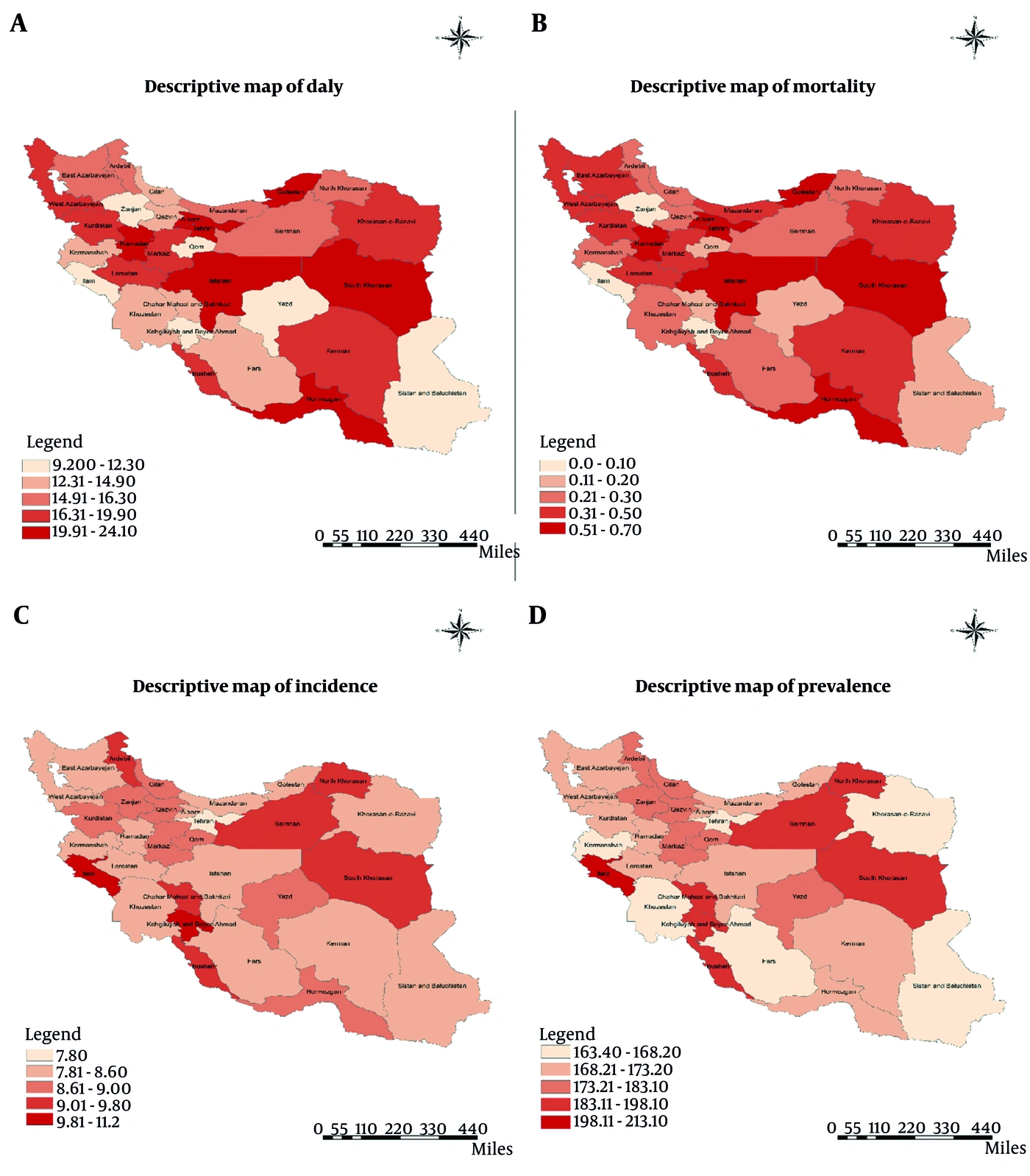
Figure 1.
Provincial variation in age-standardized rates of Myeloproliferative and Myelodysplastic Syndromes in Iran, 2021. Panel A: Disability-adjusted life years (DALYs); Panel B: Mortality; Panel C: Incidence; Panel D: Prevalence. Rates are expressed per 1,000,000 population.
4.2. Local Cluster Analysis (Anselin Local Moran's I)
Local Moran's I analysis identified distinct geographic clustering patterns. For incidence, Zanjan was a high-low (HL) outlier; Qazvin and Gilan formed low-low (LL) clusters; and Khuzestan was a low-high (LH) outlier (Figure 2).
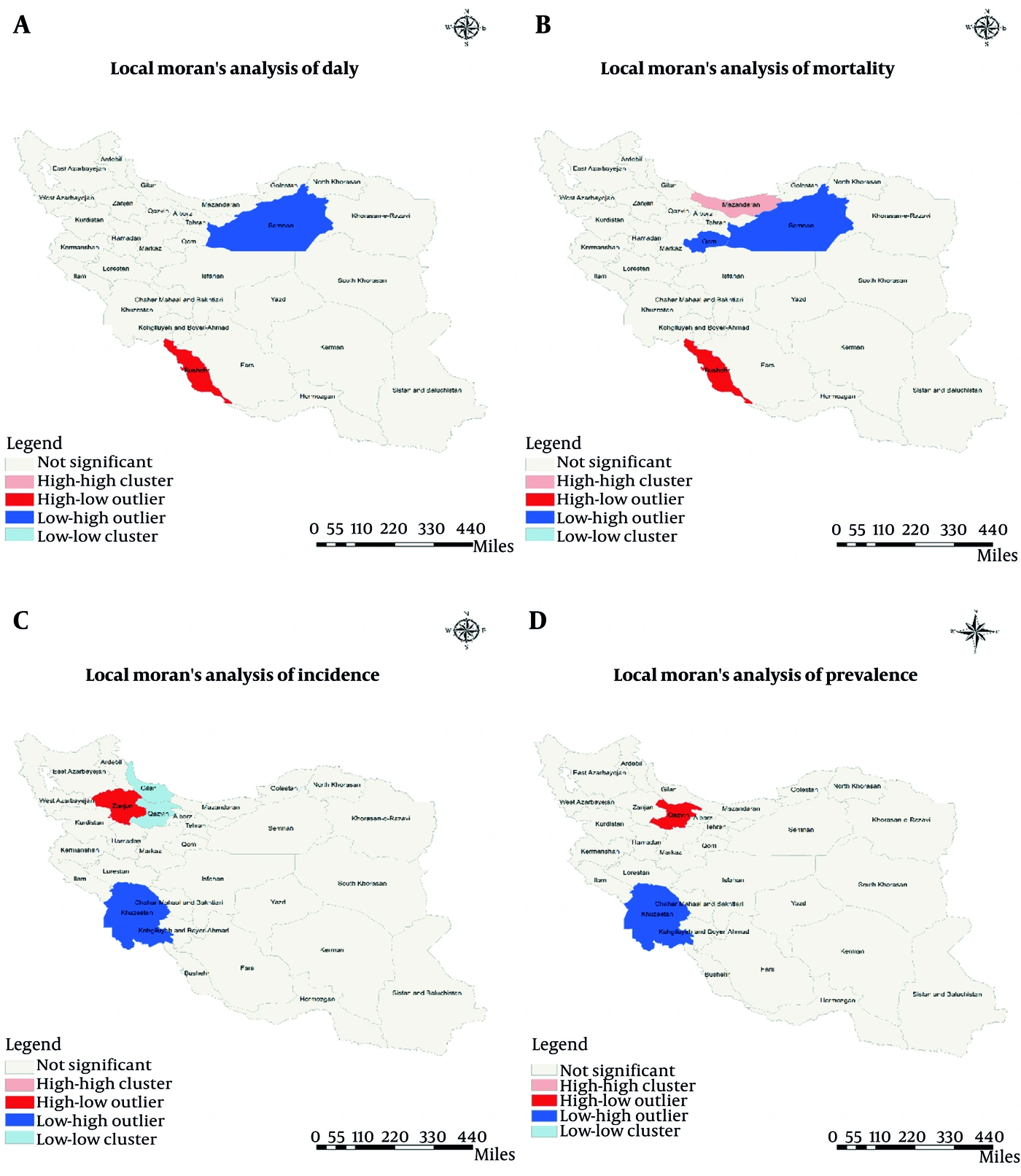
Figure 2.
Local Moran's I cluster map for age-standardized Myelodysplastic and Myeloproliferative Syndromes (MDS/MPN) in Iran, 2021. Panel A: DALYs; Panel B: Mortality; Panel C: Incidence; Panel D: Prevalence. Spatial clusters are categorized as high-high (high burden surrounded by high), low-low, high-low, or low-high, with significance at P < 0.05.
Mortality patterns differed: Bushehr was an HL outlier; Mazandaran formed a high-high (HH) cluster; Qom and Semnan were LH outliers; and Qazvin was an HL outlier. Khuzestan remained consistently classified as an LH outlier for mortality, which may reflect differences in case ascertainment, diagnostic practices, reporting completeness, or other unmeasured regional factors. For DALYs, Semnan was an LH outlier and Bushehr was an HL outlier, with no significant clusters detected in the central provinces.
4.3. Local Hotspot and Cold Spot Detection (Getis-Ord Gi*)
Getis-Ord Gi* hotspot analysis provided additional spatial insights. For incidence, Khuzestan was a significant hotspot (95%); Zanjan and Qazvin were cold spots (95% and 90%, respectively). Mortality analysis identified no significant hotspots; however, Ilam and Kohgiluyeh and Boyer-Ahmad were cold spots (95%). The absence of hotspot classification does not indicate low mortality because Gi* identifies spatial clustering of similar values rather than isolated high-rate provinces (Figure 1, Panel B). Tehran and Hormozgan lack similarly high-mortality neighbors, which explains their absence as hotspots (Figure 3).
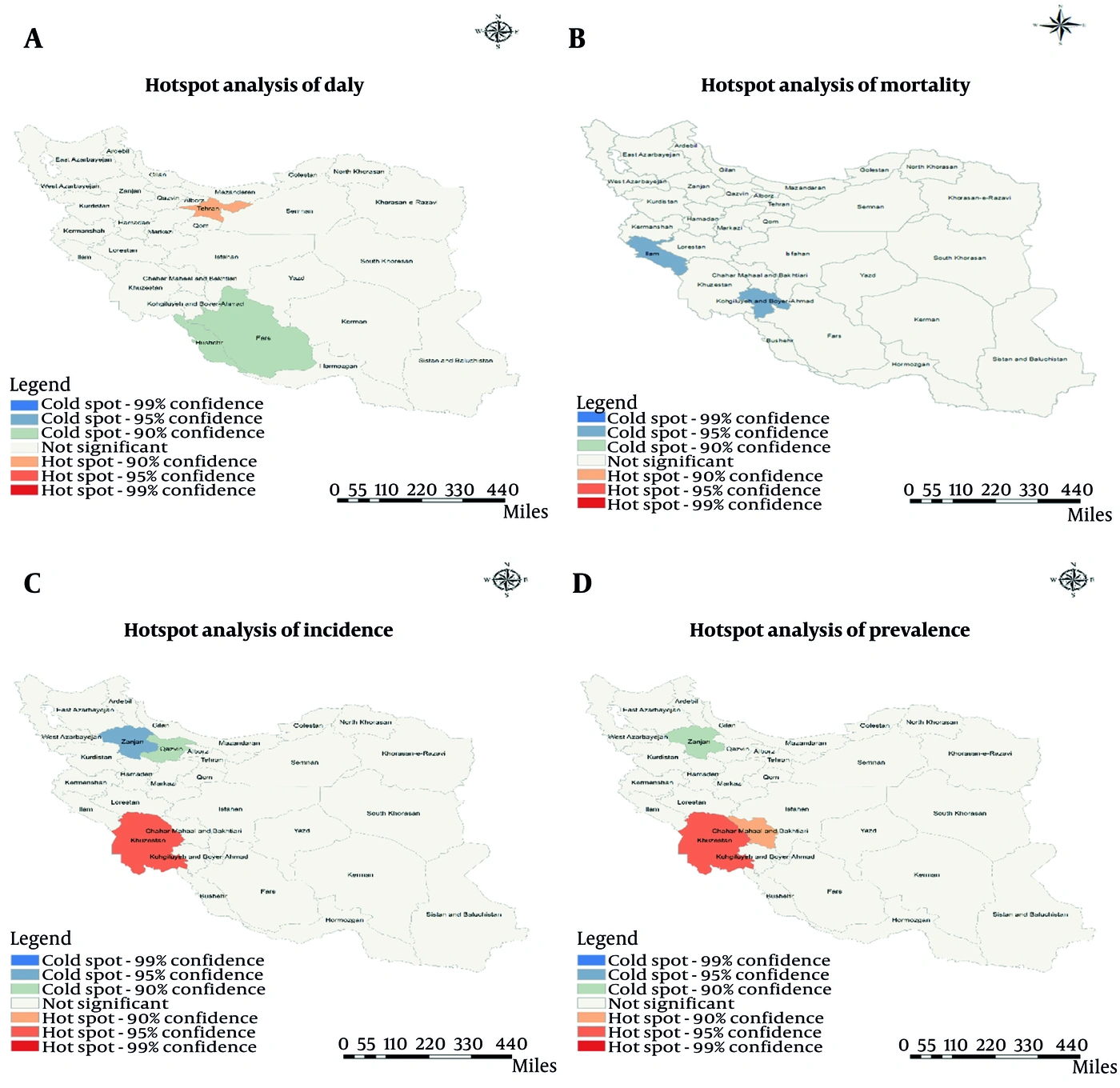
Figure 3.
Hotspot analysis of age-standardized Myelodysplastic and Myeloproliferative Syndromes (MDS/MPN) burden in Iran, 2021. Panel A: Disability-adjusted life years (DALYs); Panel B: Mortality; Panel C: Incidence; Panel D: Prevalence. Colors indicate statistically significant hotspots (red) and cold spots (blue), based on the Getis-Ord Gi* statistic at P < 0.05.
For prevalence, Khuzestan was a hotspot (95%), and Chaharmahal and Bakhtiari was also a hotspot (90%); Zanjan was a cold spot (90%). For DALYs, Tehran was a hotspot (90%), whereas Fars and Bushehr were cold spots (90%). To assess whether GBD uncertainty influenced our findings, we repeated the analysis using the 95% uncertainty bounds (Figures S1-S8 in the Supplementary File). Although provincial classifications showed minor variation, the overall geographic patterns remained consistent.
4.4. Temporal Trends
4.4.1. Trends in Mortality Rates
ARIMAX projects overall mortality from 0.41 (0.19 - 0.84) in 1990 to 0.48 (0.28 - 0.94) in 2021 and 0.54 (0.51 - 0.57) by 2030 (Figure 4). Positive calendar coefficients (0.0029 overall, 0.0038 for females, and 0.0030 for males) confirm long-term increases. Male rates exceeded female rates (0.51 to 0.62 vs 0.32 to 0.48) (Table 2). Negative pandemic coefficients indicate modest temporary declines (Table S3 in the Supplementary File).
Table 2.
Age-Standardized Incidence, Prevalence, Mortality, and Disability-Adjusted Life Years (DALYs) for Myeloproliferative and Myelodysplastic Syndromes in Iran Across Three Time Points: Historical Estimates for 1990, Current Estimates for 2021, and ARIMAX-Modeled Projections for 2030 a
| Gender and Year | DALY | Mortality | Incidence | Prevalence |
|---|---|---|---|---|
| Both Genders | ||||
| 1990 | 19.01 (12.04 - 28.70) | 0.41 (0.19 - 0.84) | 9.76 (8.07 - 11.74) | 192.58 (157.88 - 235.22) |
| 2005 | 23.05 (16.11 - 33.73) | 0.49 (0.29 - 0.97) | 12.02 (9.80 - 14.70) | 248.66 (200.29 - 309.06) |
| 2021 | 17.98 (12.17 - 27.21) | 0.48 (0.28 - 0.94) | 8.52 (7.16 - 10.20) | 170.84 (141.28 - 210.79) |
| 2030 | 17.06 (16.59 - 17.53) | 0.54 (0.51 - 0.57) | 8.83 (8.12 - 9.54) | 185.34 (163.18 - 207.49) |
| Female | ||||
| 1990 | 16.08 (10.06 - 21.46) | 0.32 (0.17 - 0.45) | 7.65 (6.10 - 9.37) | 171.79 (138.68 - 214.05) |
| 2005 | 21.08 (15.98 - 26.56) | 0.43 (0.29 - 0.50) | 10.15 (8.14 - 12.47) | 236.04 (187.70 - 296.75) |
| 2021 | 16.05 (12.08 - 20.21) | 0.42 (0.29 - 0.51) | 7.48 (6.12 - 9.01) | 164.62 (133.85 - 202.81) |
| 2030 | 15.38 (14.66 - 16.10) | 0.48 (0.43 - 0.53) | 7.81 (6.76 - 8.86) | 176.52 (149.33 - 203.70) |
| Male | ||||
| 1990 | 21.76 (12.25 - 39.26) | 0.51 (0.17 - 1.43) | 11.73 (9.84 - 14.00) | 212.29 (174.23 - 259.73) |
| 2005 | 24.83 (14.66 - 43.12) | 0.55 (0.19 - 1.45) | 13.80 (11.35 - 16.77) | 260.14 (210.70 - 322.34) |
| 2021 | 19.99 (11.43 - 38.22) | 0.54 (0.20 - 1.46) | 9.54 (8.03 - 11.40) | 176.94 (145.61 - 216.53) |
| 2030 | 18.49 (17.94 - 19.04) | 0.62 (0.61 - 0.64) | 10.05 (9.17 - 10.93) | 189.11 (167.64 - 210.59) |
a Values are presented per 1,000,000 population with 95% uncertainty intervals.
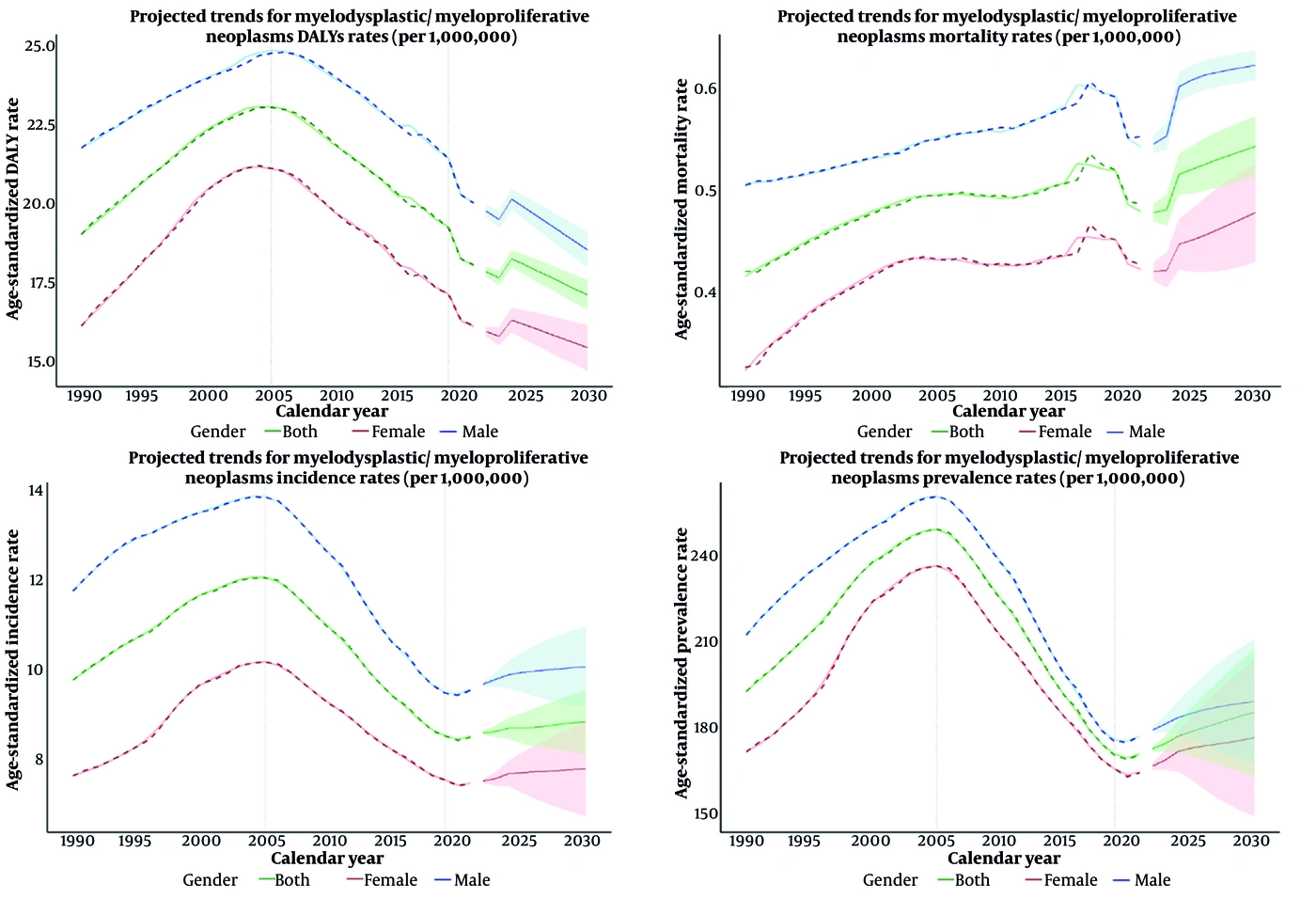
Figure 4.
Temporal trends in age-standardized incidence, mortality, and DALY rates of MDS/MPN in Iran, 1990 - 2021, with forecasts to 2030. Rates are expressed per 1,000,000 population.
4.4.2. Trends in DALY Rates
The age-standardized DALY rate for MDS/MPN in Iran peaked in 2005 and has since declined, with forecasts indicating a continued reduction by 2030 (Figure 4). For both sexes, rates increased from 19.01 per 1,000,000 population in 1990 to 23.05 in 2005 and then decreased to 17.98 in 2021 (projected to be 17.06 in 2030). Males consistently had higher rates than females throughout the period, and both sexes followed similar temporal trends. Pandemic coefficients were negative across all models, indicating measurable reductions in DALYs during the pandemic years. Model diagnostics confirmed a good fit, with small RMSEs, very low MAPEs (0.27%-0.31%), and no residual autocorrelation. Overall, the burden increased to a peak in 2005 and then declined, with an accelerated post-2019 decrease expected to persist (Table S4 in the Supplementary File).
4.4.3. Trends in Incidence Rates
Incidence followed a nonmonotonic course, peaking in 2005, declining through 2021, and showing a modest projected rebound by 2030 (Figure 4). For both sexes, rates increased from 9.76 per million in 1990 to 12.02 in 2005, decreased to 8.52 in 2021, and are forecast to reach 8.83 in 2030. Males consistently had higher incidence rates than females, although both followed the same temporal pattern. Higher-order ARIMA models captured short-term dynamics, with small negative pandemic coefficients indicating a transient decline during the pandemic years. Model diagnostics confirmed a good fit, with low RMSEs, very low MAPEs (0.14% - 0.18%), and no significant residual autocorrelation (P > 0.05), except for a borderline result in males (P = 0.080). Overall, incidence peaked in 2005, declined through 2021, and is projected to increase modestly by 2030, with the rebound most pronounced in males (Table S5 in the Supplementary File).
4.4.4. Trends in Prevalence Rates
The age-standardized prevalence of MDS/MPN increased from 1990, peaked in 2005, declined through 2021, and is projected to increase slightly by 2030 (Figure 4). For both sexes, rates increased from 192.58 per million in 1990 to 248.66 in 2005 and then decreased to 170.84 in 2021 (forecast, 185.34 in 2030). Males consistently had higher prevalence rates than females throughout the period. Negative pandemic coefficients indicated temporary reductions during the pandemic years. Model diagnostics confirmed a good fit, with modest RMSEs, very low MAPEs (0.13%-0.19%), and no significant autocorrelation, although the result was borderline for males. Overall, prevalence peaked in 2005, declined through 2021, and is expected to show a small rebound by 2030 (Table S6 in the Supplementary File).
4.4.5. Diagnostic Assessment of Models
Diagnostic assessment indicated satisfactory performance of the final ARIMAX models (Tables S3-S6 in the Supplementary File). Across all incidence, prevalence, mortality, and DALY models, residual autocorrelation was not statistically significant according to the Ljung-Box test (all P > 0.05), suggesting that temporal dependence was adequately captured. Residual ACF1 values were small and close to zero, indicating limited remaining serial correlation. Forecast accuracy metrics demonstrated good model fit, with low RMSE and MAE values across the models. MAPE values ranged from 0.13% to 0.69% across the incidence, prevalence, mortality, and DALY models, indicating satisfactory performance within the observed period. Collectively, these findings support the adequacy of the selected ARIMAX models for forecasting, although uncertainty increased with longer forecast horizons, as reflected by widening prediction intervals toward 2030.
5. Discussion
This nationwide study provides a comprehensive assessment of the spatial and temporal patterns of MDS/MPN burden across Iran. Our findings show substantial geographic disparities against a background of evolving epidemiologic trends. The 2021 burden estimates, including an age-standardized incidence rate of 8.52 per million and an ASMR of 0.48 per million, align with figures reported from other middle-income countries, which may partly reflect differences in case ascertainment, registry completeness, and diagnostic capacity between Iran and Western registry systems (7, 8). More informative than the national estimate, however, is the pronounced heterogeneity among provinces. We identified high-burden clusters in the south and southwest, contrasting with cold spots in the northwest and central regions.
The observed geographic heterogeneity is consistent with findings from other Iranian studies. An analysis of salivary sarcoma showed provincial variation in disease occurrence, highlighting the value of subnational assessments of disparities in cancer burden. Bladder cancer research reported temporal fluctuations in incidence, emphasizing that disease burden is influenced by demographics, healthcare access, diagnostic practices, and environmental conditions. A geographic information system-based study of fascioliasis identified distinct geographic patterns, illustrating the utility of spatial analysis for identifying high-rate areas and informing targeted interventions. Collectively, these findings support combined spatial and temporal analyses to elucidate the distribution of MDS/MPN in Iran (15-17).
Interpretation of these geographic patterns requires careful consideration of healthcare system influences. Provinces such as Tehran, Isfahan, and Fars (Shiraz) are major referral hubs with advanced tertiary care centers that receive severe cases from surrounding areas, potentially inflating local mortality and DALY rates while reducing recorded incidence in referring provinces, a well-characterized challenge in cancer epidemiology (18). This referral dynamic may explain the apparently paradoxical data from Kohgiluyeh and Boyer-Ahmad and Ilam, which show high incidence and prevalence alongside low mortality; however, this hypothesis requires validation using individual-level registry data and cannot be confirmed with aggregate data.
Where referral patterns do not fully explain the observed patterns, environmental and occupational exposures warrant investigation. Khuzestan and Bushehr, centers of Iran's petrochemical and oil industries, are notable hotspots, and chronic benzene exposure, a known leukemogen, is a serious concern (19, 20). Khuzestan's extensive agricultural sector may also contribute through pesticide exposure (21). In contrast, cold spots in Zanjan and Qazvin could indicate genuinely lower environmental risk or, alternatively, underdiagnosis due to limited local diagnostic capacity.
Temporally, our models reveal a distinct peak in incidence and prevalence around 2005, followed by a gradual decline. This pattern may partly reflect changes in registry practices and diagnostic criteria in Iran during the mid-2000s, when improved data recording and more comprehensive cancer registries may have contributed to the initial increase in reported cases, followed by stabilization or decline resulting from improved case confirmation and classification (22). Similar trends have been observed in other countries following improvements in healthcare infrastructure (8, 18).
The subsequent decline may reflect improvements in supportive care and disease-modifying therapies (eg, hypomethylating agents), which delay progression and reduce morbidity, contributing to the observed decline in DALYs. The transient decline across all indicators during COVID-19 is likely an artifact of healthcare disruption, a globally documented phenomenon (23, 24). This decline should not be interpreted as a true biological reduction; rather, the negative pandemic coefficients likely reflect systemic disruptions to cancer registration, diagnostic services, and healthcare access during 2020 - 2021, including reduced patient willingness to seek care, reallocation of resources, clinic closures, and interruptions in bone marrow biopsy and cytogenetic testing essential for MDS/MPN diagnosis. The projected modest rebound by 2030 is likely driven by population aging and continued improvements in case detection, consistent with global projections (7).
The consistent male predominance across all indicators is notable and mirrors global epidemiology (25). In Iran, this pattern may plausibly reflect higher smoking rates among men and their greater representation in industries involving exposure to hematotoxic agents, such as oil, petrochemicals, and agriculture (20, 26, 27).
5.1. Limitations
This study has several important limitations. The ecological design precludes inferences about individual-level risk factors, such as specific genetic mutations or personal exposure histories. Consequently, the suggestion that clusters of higher observed burden in the industrially dense south and southwest may reflect environmental or occupational exposures risks an ecological fallacy by attributing group-level associations to individual disease risk. Without provincial-level data on industrial emissions, ambient pollutants, or individual occupational and exposure histories, we cannot confirm causal links between specific exposures and MDS/MPN burden in these regions. Although GBD methods are robust, estimates may still underestimate the true burden in regions with weaker health infrastructure. Finally, our forecasting models assume a return to prepandemic healthcare norms, which may not occur.
5.2. Future Directions
Several steps are important to build on this work. First, establishing a national patient-level registry is essential for accurate subtype classification and outcome tracking. Second, spatial regression techniques could help quantify the relative contributions of environmental, occupational, and socioeconomic factors to the observed hotspots. Finally, international collaborative studies using harmonized data are needed to distinguish true biological and environmental disparities from differences in reporting and diagnostic practices.
5.3. Conclusions
This nationwide assessment of MDS/MPN across Iran reveals significant and evolving geographic disparities, with higher-burden clusters in the south and southwest and lower observed rates in several northwestern and central provinces. Temporal trends, including a 2005 peak in incidence followed by a decline and a projected rebound, reflect the complex interplay of improving diagnostics, evolving therapeutics, and healthcare disruptions. The consistent male predominance, relatively stable mortality rates through 2021, and projected increase in mortality by 2030 highlight the need for continued attention to populations experiencing higher disease burden. Although limited by its ecological design, this study provides actionable information for public health planning and serves as a hypothesis-generating foundation for targeted resource allocation and future etiologic research into regional risk factors.