
1. Background
Measles remains one of the most contagious viral diseases worldwide and a major public health concern in many countries, including Iran, despite the availability of a safe and effective vaccine (1). The virus spreads rapidly in communities with low vaccination coverage, primarily through respiratory droplets or direct contact, and can cause severe complications such as pneumonia, encephalitis, and death. Vulnerable populations, particularly children younger than 5 years, pregnant women, and immunocompromised individuals, are at the highest risk of severe outcomes (2). Although global efforts to eliminate measles through widespread vaccination programs have been ongoing, the incidence of the disease has increased in recent years, particularly in low- and middle-income countries (3).
In Iran, the measles vaccination program has been implemented for decades and has achieved substantial success in disease control. However, recent reports indicate a resurgence of cases in certain provinces, particularly in border areas (4). This upward trend may be attributable to several factors, including vaccine hesitancy, limited access to health services, weaknesses in surveillance systems, and population movements related to internal and international migration (5). For instance, Hassani Azad et al. (6) reported that 151 of 1,291 clinically suspected cases were laboratory confirmed as measles in southern Iran. These findings underscore that, despite notable progress in national vaccination programs, outbreaks continue to occur, highlighting the critical need to strengthen preventive measures, enhance public awareness, and address challenges such as vaccine hesitancy and surveillance gaps (7, 8). Consequently, investigating the epidemiological drivers of these outbreaks and evaluating the effectiveness of current control strategies are important (9).
The cities under the jurisdiction of Zahedan University of Medical Sciences may be particularly vulnerable to the spread of infectious diseases such as measles because of their geographic location, high population density, and unique socioeconomic conditions. However, no comprehensive study has examined the long-term epidemiological trends of measles in this region. This knowledge gap poses significant challenges for planning and implementing effective disease-control interventions.
2. Objectives
This study aimed to analyze epidemiological trends in measles over a 12-year period in cities under the coverage of Zahedan University of Medical Sciences.
3. Methods
3.1. Study Design, Setting, and Population
This retrospective descriptive study included all individuals suspected of measles who were registered in the measles patient surveillance and data analysis system in Sistan and Baluchestan Province, specifically in areas overseen by Zahedan University of Medical Sciences, between 2014 and 2025. According to national measles surveillance guidelines, suspected cases were defined as individuals with a fever exceeding 38°C and a maculopapular rash, as well as physician-confirmed cases. Only confirmed measles cases in the registry were included in the analysis. Individual vaccination status was also obtained from the registry.
3.2. Eligibility Criteria and Data Collection
The inclusion criteria comprised all confirmed measles cases registered in the surveillance database from counties under the jurisdiction of Zahedan University of Medical Sciences between 2014 and 2025. Cases outside this period or not documented in the national measles surveillance system were excluded. Census sampling was used. Data were collected using a standardized checklist derived from the measles patient registration and analysis system. The extracted variables included city, registration date, marital status, sex, age, nationality, area of residence, history of measles-related hospitalization, and laboratory results.
3.3. Case Classification
Reported cases were classified as confirmed, unconfirmed, or indeterminate. Confirmed cases were identified by detection of anti-measles immunoglobulin M antibodies in serum samples using enzyme-linked immunosorbent assay (ELISA). Unconfirmed cases included individuals who tested negative for anti-measles immunoglobulin M antibodies using ELISA. Indeterminate cases included individuals with unavailable ELISA results or those who declined testing.
3.4. Statistical Analysis
Statistical analysis was performed using SPSS software, version 22.0. Quantitative variables are presented as mean ± standard deviation (SD), and qualitative variables are presented as frequencies and percentages.
4. Results
4.1. Demographic and Clinical Characteristics
A total of 488 confirmed measles cases were identified by the Centers for Disease Control. The mean age of individuals with measles was 9.28 ± 12.8 years. The 1 - 4-year age group had the highest frequency of measles. Among the confirmed cases, 487 (99.8%) had a history of fever, whereas only 1 patient had no history of fever. Cough was reported in 232 patients (47.5%), and coryza was documented in 181 (37.1%). The study population comprised 219 males (44.9%) and 269 females (55.1%). Most participants lived in urban areas (53.9%), followed by rural areas (41.4%) and nomadic communities (4.7%). Most patients were Iranian; however, the cohort also included 9 Pakistani patients (1.8%) and 30 Afghan migrants (6.1%). A history of contact with a person diagnosed with measles was reported in 12.9% of cases, and 14.3% had a history of vaccination. Overall, 2.5% of patients had received the measles (M) vaccine, 11.5% had received the measles, mumps, and rubella (MMR) vaccine, and 0.4% had received the measles-rubella (MR) vaccine. Among vaccinated patients, 44.3% had received 1 dose, and 55.7% had received 2 doses. Detailed demographic characteristics are presented in Table 1.
Table 1.
Demographic Characteristics of Patients with Confirmed Measles a
| Characteristics | Values |
|---|---|
| Sex | - |
| Male | 219 (44.9) |
| Female | 269 (55.1) |
| Place of residence | - |
| Urban | 263 (53.9) |
| Rural | 202 (41.4) |
| Nomadic | 23 (4.7) |
| Nationality | - |
| Iranian | 449 (92.0) |
| Afghan | 30 (6.1) |
| Pakistani | 9 (1.8) |
| Age group (y) | - |
| < 1 | 79 (16.2) |
| 1 - 4 | 191 (39.1) |
| 5 - 9 | 31 (6.4) |
| 10 - 14 | 108 (22.1) |
| 15 - 19 | 18 (3.7) |
| 20 - 24 | 6 (1.2) |
| ≥ 25 | 55 (11.3) |
| Vaccination history | - |
| Yes | 70 (14.3) |
| No | 380 (77.9) |
| Unknown | 38 (7.8) |
| Number of vaccine doses | - |
| 1 dose | 31 (44.3) |
| 2 doses | 39 (55.7) |
| History of contact with a person with measles | - |
| Yes | 65 (12.9) |
| No | 410 (84.0) |
| Unknown | 13 (2.6) |
| Hospitalization history | - |
| Yes | 372 (76.2) |
| No | 116 (23.8) |
| Vaccine type | - |
| M | 12 (2.5) |
| MR | 2 (0.4) |
| MMR | 56 (11.5) |
a Values are expressed as No. (%). Abbreviations: M, measles; MR, measles-rubella; MMR, measles, mumps, and rubella.
4.2. Annual Trends in Suspected and Confirmed Cases
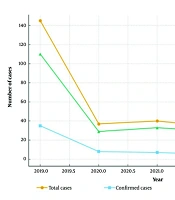
In 2014, of 186 suspected measles cases, 49 (26.3%) were laboratory-confirmed, 135 (72.6%) were unconfirmed, and 2 (1.1%) were indeterminate. In 2015, of 169 suspected cases, 94 (55.6%) were laboratory-confirmed, 69 (40.8%) were unconfirmed, and 6 (3.6%) were indeterminate. In 2016, of 91 suspected cases, 6 (6.6%) were laboratory-confirmed, 82 (90.1%) were unconfirmed, and 2 (2.2%) were indeterminate. In 2017, of 158 suspected cases, 2 (1.3%) were laboratory-confirmed, 154 (97.5%) were unconfirmed, and 2 (1.3%) were indeterminate. In 2018, of 115 suspected cases, 4 (3.5%) were laboratory-confirmed and 111 (96.5%) were unconfirmed. In 2019, of 86 suspected cases, 1 (1.2%) was laboratory-confirmed and 85 (98.8%) were unconfirmed. In 2020, all 58 suspected cases were unconfirmed. In 2021, of 92 suspected cases, 13 (14.1%) were laboratory-confirmed and 79 (85.9%) were unconfirmed. In 2022, of 196 suspected cases, 18 (9.2%) were laboratory-confirmed, 176 (89.8%) were unconfirmed, and 1 (0.5%) was indeterminate. In 2023, of 395 suspected cases, 164 (41.5%) were laboratory-confirmed, 227 (57.5%) were unconfirmed, and 3 (0.8%) were indeterminate. In 2024, of 363 suspected cases, 68 (18.7%) were laboratory-confirmed, 222 (61.2%) were unconfirmed, and 7 (1.9%) were indeterminate. In 2025, of 250 suspected cases, 69 (27.6%) were laboratory-confirmed, 176 (70.4%) were unconfirmed, and 9 (3.6%) were indeterminate. Overall, the number of suspected measles cases varied annually between 2014 and 2025. The highest numbers were observed in 2015 and during 2023 - 2025, whereas the lowest numbers were reported during 2016 - 2020.
4.3. Age Distribution by Year
Table 2 shows a shift in the age distribution of measles cases over the study period. In 2014, most cases occurred in the 10 - 14-year and > 25-year age groups. In 2015, the 10 - 14-year age group predominated, followed by a shift to the 5 - 9-year age group in 2020. Subsequently, the 1 - 4-year age group was most affected during 2021 - 2022, and by 2023 - 2025, the highest frequency was observed in children younger than 1 year. Overall, among the 488 cases, the 1 - 4-year age group accounted for the largest proportion (39.1%), followed by those younger than 1 year (16.3%) and those aged > 25 years (11.4%) (Table 2).
Table 2.
Distribution of Confirmed Measles Cases by Age Group and Year
| Year | < 1 (y) | 1 - 4 (y) | 5 - 9 (y) | 10 - 14 (y) | 15 - 19 y | 20 - 24 (y) | ≥ 25 (y) | Total |
|---|---|---|---|---|---|---|---|---|
| 2014 | 0 | 0 | 0 | 26 | 6 | 0 | 17 | 49 |
| 2015 | 0 | 0 | 0 | 72 | 8 | 4 | 10 | 94 |
| 2016 | 0 | 0 | 4 | 2 | 0 | 0 | 0 | 6 |
| 2017 | 0 | 0 | 2 | 0 | 0 | 0 | 0 | 2 |
| 2018 | 0 | 0 | 3 | 0 | 0 | 0 | 1 | 4 |
| 2019 | 0 | 0 | 1 | 0 | 0 | 0 | 0 | 1 |
| 2020 | 0 | 0 | 0 | 0 | 0 | 0 | 0 | 0 |
| 2021 | 0 | 4 | 8 | 0 | 0 | 0 | 1 | 13 |
| 2022 | 0 | 17 | 1 | 0 | 0 | 0 | 0 | 18 |
| 2023 | 0 | 144 | 8 | 3 | 4 | 1 | 4 | 164 |
| 2024 | 41 | 12 | 2 | 3 | 0 | 1 | 9 | 68 |
| 2025 | 38 | 14 | 2 | 2 | 0 | 0 | 13 | 69 |
| Total | 79 | 191 | 31 | 108 | 18 | 6 | 55 | 488 |
4.4. Vaccination Status by Age Group
Among all confirmed measles cases, most unvaccinated individuals were in the 1 - 4-year age group (33.2%), followed by the 10 - 14-year age group (19.9%). In the ≥ 25-year age group, most individuals were either unvaccinated or had an unknown vaccination status. Regarding vaccination history among confirmed cases, 3.1% of those in the 1 - 4-year age group had received 2 vaccine doses. Among those aged ≤ 1 year, most confirmed cases (2.3%) had received only 1 vaccine dose (Table 3).
Table 3.
Distribution of Confirmed Measles Cases by Age Group and Vaccination Frequency a
| Vaccination status | ≤ 1 (y) | 1 - 4 (y) | 5 - 9 (y) | 10 - 14 (y) | 15 - 19 (y) | 20 - 24 (y) | ≥ 25 (y) | Total |
|---|---|---|---|---|---|---|---|---|
| Vaccinated once | 11 (2.3) | 14 (2.9) | 0 (0.0) | 4 (0.8) | 0 (0.0) | 0 (0.0) | 2 (0.4) | 31 (6.4) |
| Vaccinated twice | 0 (0.0) | 15 (3.1) | 6 (1.2) | 6 (1.2) | 6 (1.2) | 1 (0.2) | 5 (1.0) | 39 (8.0) |
| Unknown | 0 (0.0) | 0 (0.0) | 4 (0.8) | 1 (0.2) | 6 (1.2) | 3 (0.6) | 24 (4.9) | 38 (7.8) |
| Unvaccinated | 68 (13.9) | 162 (33.2) | 21 (4.3) | 97 (19.9) | 6 (1.2) | 2 (0.4) | 20 (4.1) | 376 (77.7) |
| Total | 79 (16.2) | 191 (39.1) | 31 (6.4) | 108 (22.1) | 18 (3.7) | 6 (1.2) | 55 (11.3) | 488 (100) |
a Values are expressed as No. (%).
5. Discussion
This study analyzed 488 confirmed measles cases in the catchment area of Zahedan University of Medical Sciences from 2014 to 2025. Cases were more frequent among females (55.1%) than among males (44.9%). This finding is consistent with that of Alizadeh-Nodehi et al. in Babol (10) but contrasts with the findings of Kurata et al. in Japan (11), who reported a male predominance. These differing sex patterns suggest that measles epidemiology may be influenced by social determinants, including cultural dynamics, social roles, and vaccination behaviors (12).
Most confirmed measles cases were reported from urban areas (53.9%), whereas rural areas and nomadic populations accounted for 41.4% and 4.7% of cases, respectively. This finding is consistent with the report by Ghaderkhani et al. in Tehran (13) but contrasts with the study by Baiasu et al. in Romania, which identified a predominance of cases in rural settings (14).
Iranian nationals comprised most confirmed measles cases (92%), whereas Afghan and Pakistani nationals accounted for 6.1% and 1.8%, respectively. Given that the foreign-born population represents a relatively small proportion of the total population of Sistan and Baluchestan Province, the occurrence of 8% of cases in this group suggests a disproportionately high burden among these vulnerable populations. This finding is consistent with Razizadeh (2), who reported a high prevalence of measles among Afghan immigrants in Tehran and attributed it to suboptimal vaccination coverage of less than 60% in their country of origin. Conversely, Gorrell et al. (15) reported that foreign nationals accounted for less than 2% of measles cases in an Australian province, which contrasts with the present findings.
Regarding immunization status, most patients (77.9%; n = 380) were unvaccinated, whereas 14.3% (n = 70) had a documented history of vaccination, and 7.8% (n = 38) had unknown status. These findings are consistent with previous reports. Ghammari and Jalilian (4) reported that 61% of cases occurred among unvaccinated individuals, and Endalamaw et al. (16) observed that more than 70% of affected individuals in Ethiopia had no previous vaccination history.
Most patients with measles (76.2%; n = 372) required hospitalization, whereas 23.8% (n = 116) were managed in outpatient settings. This high hospitalization rate is consistent with the findings of Pourakbari et al. (7), who reported an admission rate of 71.4% in Tehran. Conversely, Bokop et al. (17) reported an admission rate of only 42% in sub-Saharan Africa. This disparity may reflect differences in health care-seeking behavior, admission criteria across clinical settings, or disease severity in the study populations.
5.1. Strengths
The strengths of this study include: 1) its 12-year duration; 2) the use of census sampling to investigate all confirmed measles cases; 3) its focus on a high-risk border region that previously lacked comprehensive research; 4) the simultaneous examination of multiple variables, including age, sex, place of residence, nationality, vaccination status, and hospitalization; and 5) the potential application of its findings as a scientific basis for health policy and targeted interventions in similar high-risk areas.
5.2. Limitations
This study has several limitations. First, incomplete reporting of suspected cases in the surveillance system may have led to an underestimation of the true incidence of measles. Second, reliance on secondary registry data may have resulted in incomplete documentation of vaccination history, particularly among immigrants and foreign nationals. Third, because of the cross-sectional descriptive design, causal relationships between the investigated variables could not be established.
The substantial discrepancy between the number of suspected (n = 2,159) and laboratory-confirmed (n = 488) measles cases suggests a low positive predictive value (PPV) of clinical suspicion in this setting. Several interrelated factors may explain this discrepancy: 1) the broad clinical case definition used in surveillance systems is designed to maximize sensitivity and minimize missed cases but inevitably captures other febrile exanthematous illnesses, thereby increasing false-positive clinical suspicions; 2) suboptimal timing of specimen collection, potential breaches in the cold chain during transport, and limitations of available serological or molecular diagnostic assays may contribute to false-negative laboratory results; and 3) in settings with high vaccination coverage, the PPV of clinical suspicion decreases as other viral etiologies become more prevalent.
5.3. Conclusions
Sistan and Baluchestan Province remains a high-risk measles hotspot, primarily because of its proximity to countries with low vaccination coverage and the persistent influx of migrant populations. The high hospitalization rate observed in this study underscores disease severity and the substantial burden it places on the regional health care system.
Fluctuations in measles incidence during the 12-year study period appear to have been influenced by several factors. Changes in the sensitivity of active surveillance and reporting systems may have contributed, along with persistent immunity gaps, population mobility in border areas, and the formation of susceptible clusters. Collectively, these factors suggest that observed increases in cases were likely driven by viral introduction or sustained transmission within vulnerable groups.
Sustainable measles control in this region requires a multipronged approach, including strengthening the existing surveillance system, implementing supplementary vaccination programs targeting children younger than 15 years, and proactively vaccinating foreign nationals at entry points.