Use of C-Reactive Protein as a Diagnostic Tool for Early Detection of Bacterial Infection After Liver Transplantation

Author(s):
Kamran Bagheri LankaraniKamran Bagheri Lankarani1, Seyede Amine HojatiSeyede Amine Hojati2,*, Seyed Taghi HeydariSeyed Taghi Heydari1
1Health Policy Research Center, Shiraz University of Medical Sciences, Shiraz, IR Iran
2Gastroenterohepatology Research Center, Shiraz University of Medical Sciences, Shiraz, IR Iran
*Corresponding Author: Seyede Amine Hojati, Gastroenterohepatology Research Center, Shiraz University of Medical Sciences, Shiraz, IR Iran, E-mail: Email: [email protected]

Hepatitis Monthly:Vol. 16, issue 9; e41054
Published online:Aug 20, 2016
Article type:Letter
Received:Jul 25, 2016
Accepted:Aug 13, 2016
How to Cite:Bagheri Lankarani K, Hojati SA, Heydari ST. Use of C-Reactive Protein as a Diagnostic Tool for Early Detection of Bacterial Infection After Liver Transplantation. Hepat Mon. 2016;16(9):e41054. doi: https://doi.org/10.5812/hepatmon.41054

Dear Editor,
Bacterial infection is one of the major causes of mortality in the first two weeks after liver transplantation (LT) (1). Even in the presence of the gravest bacterial infections, fever can be absent and other symptoms and signs of infection may only be trivial (2). There are other important causes of fever 3 - 10 days after LT, including viral infection and rejection (3, 4).
C-reactive protein (CRP) has been proposed as an early marker of inflammation. Quantitative measures of this protein have been used to diagnose a variety of inflammatory diseases, including bacterial infections (5, 6).
In a prospective study at the organ transplantation center (OTC) in Nemazi hospital, Shiraz, all adult liver recipients from May to September 2015 were evaluated for possible infections 3 - 10 days after LT. All patients with fever, new-onset abdominal pain, cough, deterioration of oxygenation, deterioration of mental status, or new-onset laboratory abnormalities (increased liver enzymes, increased BUN, leukocytosis) were evaluated for possible bacterial infections with chest X ray and cultures from blood, urine, sputum, and abdominal taps, with Gram staining of the latter two when appropriate. Patients were also evaluated for other causes of symptoms, including hepatic artery thrombosis, cytomegalovirus (CMV), herpes simplex (HSV) infection, and organ rejection.
The exclusion criteria were known infections (bacterial, fungal, or viral) before transplantation, hemodialysis before or after transplantation, hepatocellular carcinoma or cholangiocarcinoma, indications for liver transplantation other than cirrhosis, and therapy with antithymocyte globulin (ATG) as an induction immunosuppressive drug.
For all patients, the white blood cell count (WBC) and CRP level (Biorex Diagnostic Ltd., Antrim Technology Park, Muckamore, Antrim, United Kingdom) were checked at the time of the first clinical suspicion of a bacterial infection.
Written consent was obtained from all participants, and the data were anonymized before the analysis.
During the study period, 188 patients received LT, of whom 152 were older than 18 years. In 51 patients, there was clinical suspicion of a bacterial infection, which was later confirmed in 25 patients. In 36 others, the final diagnosis was rejection in five, CMV infection in three, HSV in five, and no specific cause in 13. Using a CRP cutoff value of 52 mg/L, there was sensitivity of 68.0% (95% CI 46.5 - 85.1) and specificity of 80.77% (95% CI 60.6 - 93.4), with a positive predictive value of 72.4% and a negative predictive value of 77.3% for bacterial infection. The area under the ROC curve (AUC) was 0.704 (95% CI 0.560 - 0.823) (Figure 1). This AUC for leukocytosis (WBC > 10,000/µL) in the diagnosis of a bacterial infection was 0.624 (95% CI 0.477 - 0.756).
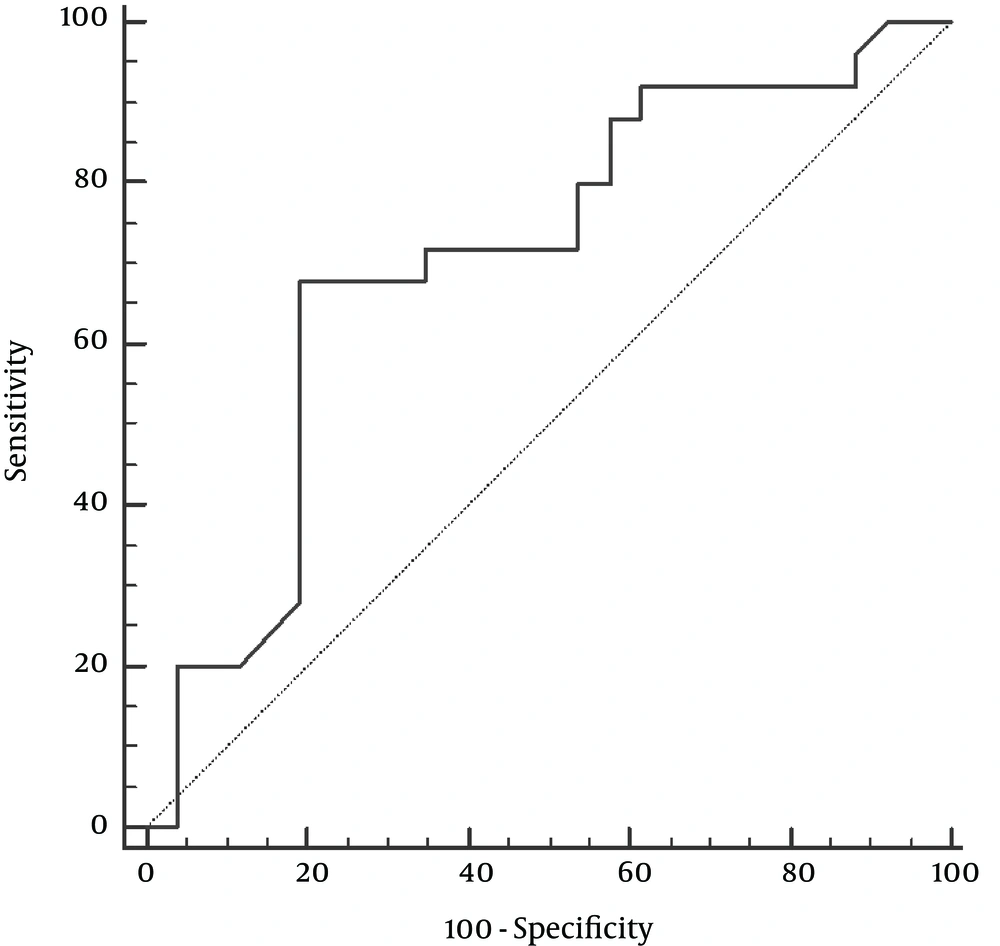
Receiver Operating Characteristic (ROC) Curve for CRP and Bacterial Infections in the Early Post-Liver Transplantation Period
Figure 1.

Receiver Operating Characteristic (ROC) Curve for CRP and Bacterial Infections in the Early Post-Liver Transplantation Period

There have been reports on post-LT elevated CRP levels due to surgery, hepatocellular carcinoma, rejection, and viral infections, but the highest levels have been reported with bacterial infections (7, 8). This makes CRP an attractive biomarker for the early detection of sepsis in these patients (7, 9, 10).
In this study, we attempted to determine a cutoff level to aid in decision-making for the initiation of antibiotics in the early post-LT period. At a cutoff value of 52 mg/L, the AUC was 0.743, which was far better than that of leukocytosis for the diagnosis of bacterial infections. This could save the patient’s life while reducing the cost of the hospital stay due to delayed diagnosis of a bacterial infection.
There have been reports on the use of other biomarkers for the early detection of sepsis in the post-LT period, including procalcitonin and interleukin-6 (IL-6) (10). The former showed a poor correlation with sepsis, and the latter is not widely available.
We propose that CRP levels 72 hours after liver transplantation could help physicians diagnose bacterial infections more rapidly. The dynamics of such increases might be of interest, as an increasing level within hours might be more alarming. This needs to be evaluated in further studies.
Acknowledgments

References

  • 1.
    Fishman JA. Infection in solid-organ transplant recipients. N Engl J Med. 2007;357(25):2601-14. [PubMed ID: 18094380]. https://doi.org/10.1056/NEJMra064928.
  • 2.
    O'Shea DT, Humar A. Life-threatening infection in transplant recipients. Crit Care Clin. 2013;29(4):953-73. [PubMed ID: 24094386]. https://doi.org/10.1016/j.ccc.2013.06.012.
  • 3.
    De Gasperi A, Feltracco P, Ceravola E, Mazza E. Pulmonary complications in patients receiving a solid-organ transplant. Curr Opin Crit Care. 2014;20(4):411-9. [PubMed ID: 24979712]. https://doi.org/10.1097/MCC.0000000000000120.
  • 4.
    Arslan H. Infections in liver transplant recipients. Experimental and clinical transplantation. J Middle East Society Organ Transplant. 2014;12:24-7.
  • 5.
    Albrich WC, Harbarth S. Pros and cons of using biomarkers versus clinical decisions in start and stop decisions for antibiotics in the critical care setting. Intensive Care Med. 2015;41(10):1739-51. [PubMed ID: 26194026]. https://doi.org/10.1007/s00134-015-3978-8.
  • 6.
    Stubljar D, Skvarc M. Effective Strategies for Diagnosis of Systemic Inflammatory Response Syndrome (SIRS) due to Bacterial Infection in Surgical Patients. Infect Disord Drug Targets. 2015;15(1):53-6. [PubMed ID: 25809624].
  • 7.
    Their M, Ronnholm K, Sairanen H, Holmberg C, Jalanko H. Serum C-reactive protein in pediatric kidney and liver transplant patients. Pediatr Transplant. 2002;6(2):153-60. [PubMed ID: 12000473].
  • 8.
    Kornberg A, Witt U, Kornberg J, Muller K, Friess H, Thrum K. Postoperative peak serum C-reactive protein is a predictor of outcome following liver transplantation for hepatocellular carcinoma. Biomarkers. 2016;21(2):152-9. [PubMed ID: 26643974]. https://doi.org/10.3109/1354750X.2015.1118548.
  • 9.
    Ashkenazi-Hoffnung L, Mozer-Glassberg Y, Bilavsky E, Yassin R, Shamir R, Amir J. Children post liver transplantation hospitalized with fever are at a high risk for bacterial infections. Transpl Infect Dis. 2016;18(3):333-40. [PubMed ID: 26989885]. https://doi.org/10.1111/tid.12528.
  • 10.
    Zant R, Melter M, Knoppke B, Ameres M, Kunkel J. Kinetics of interleukin-6, procalcitonin, and C-reactive protein after pediatric liver transplantation. Transplant Proc. 2014;46(10):3507-10. [PubMed ID: 25498081]. https://doi.org/10.1016/j.transproceed.2014.08.048.

Copyright

Copyright © 2016, Kowsar Corp. This is an open-access article distributed under the terms of the Creative Commons Attribution-NonCommercial 4.0 International License (http://creativecommons.org/licenses/by-nc/4.0/) which permits copy and redistribute the material just in noncommercial usages, provided the original work is properly cited.

Similar Articles

23
Jul
2016

Serum C-Reactive Protein in Children with Liver Disease and Ascites

Gholamreza Kalvandi,
Naser Honar,
Bita Geramizadeh,
Maryam Ataollahi,
Asghar Rahmani,
Hazhir Javaherizadeh

Kalvandi G, Honar N, Geramizadeh B, Ataollahi M, Rahmani A, et al. Serum C-Reactive Protein in Children with Liver Disease and Ascites. Hepat Mon. 2016;16(8):e38973. doi: https://doi.org/10.5812/hepatmon.38973

19
Nov
2016

Diagnostic Value of the Quantitative Titer of High-Sensitivity C-Reactive Protein in the Detection of Clinical Stages of Chronic Hepatitis B Infection

Maliheh Metanat,
Seyed Mehdi Tabatabaei,
Anita Alenabi,
Mohamad Hasan Amirian Mojarad,
Nahid Sepehri Rad,
Elham Pahlavani

Metanat M, Tabatabaei SM, Alenabi A, Amirian Mojarad MH, Sepehri Rad N, et al. Diagnostic Value of the Quantitative Titer of High-Sensitivity C-Reactive Protein in the Detection of Clinical Stages of Chronic Hepatitis B Infection. Int J Infect. 2017;4(2):e39736. doi: https://doi.org/10.5812/iji.39736

20
May
2019
fig

Positive Role of Procalcitonin Level in the Diagnosis of Infectious Diseases After Liver Transplantation

Fereshteh Ghiasvand,
Simin Dashti-Khavidaki,
Bobak Moazzami,
Amirpasha Ebrahimi,
Zeynab Malekzadeh,
Zinat Mohammadpour
,et al.

Ghiasvand F, Dashti-Khavidaki S, Moazzami B, Ebrahimi A, Malekzadeh Z, et al. Positive Role of Procalcitonin Level in the Diagnosis of Infectious Diseases After Liver Transplantation. Hepat Mon. 2019;19(5):e85668. doi: https://doi.org/10.5812/hepatmon.85668

24
Apr
2019
63893

Relationship Between the Serum Level of C-Reactive Protein and Severity and Outcomes of Community-Acquired Pneumonia

Farhad Malek,
Ali Gohari,
Majid Mirmohammadkhani,
Farnaz Ardiani

Malek F, Gohari A, Mirmohammadkhani M, Ardiani F. Relationship Between the Serum Level of C-Reactive Protein and Severity and Outcomes of Community-Acquired Pneumonia. Arch Clin Infect Dis. 2019;14(2):e63893. doi: https://doi.org/10.5812/archcid.63893

30
Sep
2025
Ann Mil Health Sci Res

Evaluating the Pre-transplant Serum Levels of C-reactive Protein as a Prognostic Factor for Allogeneic Hematopoietic Stem Cell Transplantation Outcomes

Mahshid Mehdizadeh,
Hossein Bonakchi,
Amirhossein Izadpanah,
Sayeh Parkhideh,
Abbas Hajifathali

Mehdizadeh M, Bonakchi H, Izadpanah A, Parkhideh S, Hajifathali A. Evaluating the Pre-transplant Serum Levels of C-reactive Protein as a Prognostic Factor for Allogeneic Hematopoietic Stem Cell Transplantation Outcomes. Ann Mil Health Sci Res. 2025;23(3):e165017. doi: https://doi.org/10.5812/amh-165017

Download PDF97.73 KB

Crossmark

Crossmark

Checking

Share on
Cited by
Metrics

Ordering Reprints

Articles are published under the Creative Commons license stated on each article. No permission or royalty fee is required for uses permitted by that license. CCC handles optional bulk and customized reprint orders. Any quotation covers production and delivery services only, not copyright permission. > Request Reprints from CCC 

Search Relations

Author(s):

Related Articles