1. Background
Chronic hepatitis B (CHB) and metabolic dysfunction-associated steatotic liver disease (MASLD) frequently coexist in up to 40% of patients, synergistically accelerating fibrosis progression and hepatocellular carcinoma development (1, 2). Although antiviral therapy effectively suppresses viral replication and improves survival (3), recent evidence indicates that MASLD in patients receiving treatment for CHB significantly increases the risk of cirrhosis and liver cancer (4), highlighting metabolic liver injury as an important prognostic factor (5). Therefore, early identification of individuals at risk of developing MASLD in the context of CHB is essential for personalized prevention strategies and improved long-term outcomes.
Although liver biopsy remains the gold standard for diagnosing MASLD, it is invasive, costly, and unsuitable for routine screening (6). Several inflammatory–lipid composite indices derived from routine blood tests, including the platelet-to-high-density lipoprotein cholesterol ratio (PHR), monocyte-to-high-density lipoprotein cholesterol ratio (MHR), lymphocyte-to-high-density lipoprotein cholesterol ratio (LHR), and neutrophil-to-high-density lipoprotein cholesterol ratio (NHR), have been associated with MASLD in the general population (7-10). However, their predictive accuracy is limited, and they have not been adequately validated in patients with CHB (11). Therefore, simple, low-cost, noninvasive indices with improved predictive performance are needed.
The triglyceride-glucose (TyG) index and its derivative, TyG-BMI, which incorporates body mass index (BMI), have emerged as simple and cost-effective metabolic markers (12). TyG-BMI integrates fasting glucose, triglycerides, and obesity and has demonstrated strong predictive value for MASLD in the general population (13). However, most evidence originates from non-CHB cohorts; viral replication, antiviral therapy, and hepatic immune status in patients with CHB may confound the predictive capacity of metabolic indices (14). Consequently, whether TyG-BMI can predict incident MASLD in patients with CHB remains unclear.
Established metabolic scores, such as the Fatty Liver Index (FLI), Hepatic Steatosis Index (HSI), lipid accumulation product (LAP), and metabolic score for insulin resistance (METS-IR), have been validated for MASLD screening in general populations (15), but their calculation relies on variables that are not routinely collected across all CHB cohorts. In contrast, TyG-BMI requires only fasting glucose, triglycerides, and BMI, and its predictive performance for MASLD is comparable to or better than that of these established scores. However, most available evidence is derived from non-CHB populations. Given its practical simplicity and favorable performance in the general population, TyG-BMI warrants dedicated evaluation in the CHB setting.
2. Objectives
This study evaluated TyG-BMI and six other indices for predicting incident MASLD in patients with CHB and without baseline MASLD. We compared their predictive performance and assessed whether the performance of TyG-BMI varied by antiviral treatment, HBeAg status, and HBV DNA burden.
3. Methods
3.1. Study Design
This retrospective cohort study screened electronic medical records of patients with CHB who attended the Department of Infectious Diseases at our hospital between August 2023 and August 2024. The baseline index date was defined as the first visit at which patients met the diagnostic criteria for CHB and had no evidence of preexisting MASLD. Eligible patients underwent a FibroTouch examination as part of routine clinical care, enabling simultaneous assessment of hepatic fibrosis and steatosis. Reassessments were scheduled at 3-, 6-, and 9-month intervals in accordance with local clinical monitoring protocols. Follow-up ranged from 3 to 9 months.
3.2. Participants
The inclusion criteria were age 18 - 80 years, a diagnosis of CHB according to the 2022 Chinese guidelines (16), and complete baseline clinical data and FibroTouch results.
The exclusion criteria were coinfection with other hepatitis viruses (hepatitis A, C, D, or E) or other causes of chronic liver disease, including autoimmune liver disease, drug-induced liver injury, alcoholic liver disease, and hereditary metabolic liver disease; decompensated cirrhosis (ascites, esophagogastric variceal bleeding, or hepatic encephalopathy), hepatocellular carcinoma or other hepatic malignancy, or post-liver-transplant status; and secondary endocrine disorders that could interfere with metabolic or inflammatory profiles, including uncontrolled thyroid dysfunction, Cushing syndrome, and polycystic ovary syndrome. Primary hypertension and type 2 diabetes mellitus were not exclusion criteria because they are established metabolic risk factors for MASLD. Additional exclusion criteria were use, within the preceding 3 months, of medications that alter lipid, glucose, or body weight homeostasis, including systemic glucocorticoids, estrogen, tamoxifen, and amiodarone; active malignancy; severe cardiac, pulmonary, or renal insufficiency; acute or chronic uncontrolled infection; systemic autoimmune diseases, such as rheumatoid arthritis and systemic lupus erythematosus; pregnancy or lactation; missing core clinical data required to calculate study indices, including triglycerides, fasting plasma glucose, high-density lipoprotein cholesterol, ultrasound attenuation parameter (UAP), or liver stiffness measurement (LSM); follow-up shorter than 3 months; or loss to follow-up. Patients were screened strictly according to these predefined criteria.
3.3. MASLD Diagnostic Criteria
Hepatic steatosis was assessed by transient elastography (FibroTouch), with UAP ≥ 244 dB/m considered diagnostic of steatosis (17). FibroTouch examinations were performed by operators with formal manufacturer-led training after at least 8 hours of overnight fasting. Final UAP results were generated from multiple internal acquisitions filtered by the device's built-in quality-control algorithm. Operators were blinded to participants’ TyG-BMI values and the study hypotheses. Incident MASLD was defined as a follow-up UAP value of at least 244 dB/m. This threshold was derived from published literature and adopted for routine local clinical reporting. Although FibroTouch UAP has been validated against liver biopsy and MRI-PDFF, it remains an imaging-based surrogate rather than the histological gold standard. MASLD was defined according to APASL guidelines (18) as hepatic steatosis plus at least one of the following: 1) overweight/obesity (BMI ≥ 23 kg/m2 for Asian populations); 2) type 2 diabetes mellitus; or 3) ≥ 2 metabolic abnormality indicators (increased waist circumference, elevated blood pressure, elevated triglycerides, reduced HDL-C, or prediabetes with HOMA-IR ≥ 2.5 and hs-CRP > 2 mg/L). For participants who already met one or more metabolic risk criteria at baseline but had no hepatic steatosis, incident MASLD was confirmed when new-onset hepatic steatosis was detected during follow-up by FibroTouch.
3.4. Antiviral Treatment Regimen
Treatment-naive status was defined as not having initiated antiviral therapy at study baseline. Treatment-experienced status was defined as receiving ongoing nucleos(t)ide analogue antiviral therapy at the baseline enrollment visit. Antiviral status was classified solely on the basis of baseline information and was not updated for treatment-related events during follow-up. Antiviral status was treated as a time-fixed baseline variable in all regression models because the short observation window and limited number of incident events precluded reliable time-varying covariate modeling. In accordance with local clinical practice and current CHB guidelines, tenofovir-class antiviral agents were preferentially prescribed at our center (16).
3.5. Clinical Data Collection
Demographic, laboratory (HBV DNA, HBeAg, liver enzymes, lipid profile, glucose, uric acid, creatinine, and complete blood count), imaging (UAP and LSM), and clinical (hypertension, diabetes, and antiviral history) data were collected.
3.6. Indices and Related Definitions
1) Patients were stratified by baseline HBV DNA into low (< 2000 IU/mL) and moderate-to-high (≥ 2000 IU/mL) groups, using a cutoff recommended by current guidelines (16, 19).
2) CHB treatment: Patients were classified as treatment-naive or treatment-experienced according to whether they were receiving antiviral therapy at baseline.
3) Liver fibrosis indices:
4) Metabolic indices:
5) Novel composite inflammatory markers:
3.7. Study Endpoints
Primary outcome: Incident MASLD, defined as new-onset metabolic dysfunction-associated steatotic liver disease during follow-up among patients with CHB without baseline MASLD.
Primary predictor: TyG-BMI.
Secondary analyses:
1) Head-to-head comparison of predictive performance between TyG-BMI and six inflammatory-lipid composite indices (PHR, LHR, MHR, NHR, TyG, and BMI).
2) Evaluation of model discrimination using time-dependent ROC curves, calibration curves, and decision curve analysis (DCA).
3) Stratified subgroup analyses according to antiviral treatment status, HBeAg status, and HBV DNA load strata.
3.8. Statistical Analysis
Patients lacking core variables for index calculation (anthropometric measurements, laboratory results, or FibroTouch data) were excluded from the analysis. No data imputation was performed. Continuous variables were presented as median (interquartile range) or mean ± standard deviation according to their distribution, whereas categorical variables were reported as counts and percentages. Between-group comparisons were performed using the χ2 test, Mann-Whitney U test, or independent-samples t test, as appropriate, with Bonferroni correction for multiple comparisons.
This was an exploratory retrospective cohort analysis. TyG-BMI was prespecified as the primary index of interest for predicting incident MASLD across the 3- to 9-month follow-up window, with Model 3 defined as the preplanned fully adjusted Cox regression model. Cross-index comparisons, quartile-stratified regression, time-dependent predictive performance assessments, and subgroup analyses were predefined as exploratory secondary analyses.
The Cox proportional hazards model was used to identify predictors of incident MASLD. Each metabolic and inflammatory-lipid index was assessed in a separate adjusted model rather than being combined in a single model. Covariates were selected a priori as potential confounders; constituent variables, including TyG and BMI, were not readjusted for when TyG-BMI was evaluated, and the number of covariates per model was constrained by the observed number of events to avoid excessive model complexity. Patients without incident MASLD were censored at their final valid FibroTouch assessment. Event onset was defined as the date of the first follow-up visit with elevated UAP values. Interval censoring was inherent to this design because true MASLD onset may have occurred at any time between baseline and confirmed detection.
Restricted cubic spline (RCS) functions were used to explore dose-response relationships between TyG-BMI and incident MASLD risk. Three knots were placed at the 10th, 50th, and 90th percentiles of the TyG-BMI distribution, generating two spline-derived parameters. Given the limited number of outcome events, this spline-based dose-response assessment was considered exploratory. Potential nonlinear trends were tested using the P value for nonlinearity. Owing to the limited number of incident events, subgroup analyses were subject to low statistical power and potential multiplicity concerns. Time-dependent ROC, calibration-curve, and DCA analyses were performed to evaluate predictive performance. All statistical tests were 2-sided, and statistical significance was defined as P < 0.05. Analyses were performed using SPSS version 26.0 and R version 4.2.1.
4. Results
4.1. Baseline Characteristics
Among 131 patients with CHB without baseline MASLD, 41 (31.3%) developed incident MASLD. Baseline characteristics were comparable between groups, except for LSM (P = 0.003). After Bonferroni correction, only TyG-BMI and creatinine remained significantly higher in the incident MASLD group (both P < 0.001). Most inflammatory-lipid composite indices did not reach statistical significance between groups, and the other metabolic and inflammatory-lipid indices did not differ (Table 1).
Table 1.
Baseline Characteristics of Patients with CHB According to Incident MASLD Status a
| Variables | CHB Without Incident MASLD (n = 90) | Incident MASLD (n = 41) | Test Statistic (χ2/t/Z) | P-Value | Effect Size | Significance |
|---|---|---|---|---|---|---|
| Sex | χ2 = 1.41 | 0.236 | V = 0.104 | ns | ||
| Male | 50 (55.6) | 28 (68.3) | ||||
| Diabetes | 10 (11.1) | 9 (22.0) | χ2 = 1.87 | 0.172 | V = 0.119 | ns |
| Hypertension | 19 (21.1) | 10 (24.4) | χ2 = 0.04 | 0.848 | V = 0.017 | ns |
| CHB treatment status | χ2 = 1.41 | 0.235 | V = 0.104 | ns | ||
| Initial | 33 (36.7) | 10 (24.4) | ||||
| Treated | 57 (63.3) | 31 (75.6) | ||||
| HBV DNA | χ2 = 0.85 | 0.357 | V = 0.081 | ns | ||
| Low | 74 (82.2) | 37 (90.2) | ||||
| Moderate to high | 16 (17.8) | 4 (9.8) | ||||
| HBeAg | χ2 = 0.13 | 0.723 | V = 0.031 | ns | ||
| Negative | 57 (63.3) | 28 (68.3) | ||||
| Positive | 33 (36.7) | 13 (31.7) | ||||
| Age (y) | 41.50 (34.00, 54.75) | 45.00 (33.00, 50.00) | Z = 0.15 | 0.885 | r = 0.013 | ns |
| UAP (dB/m) | 227.14 (213.60, 236.88) | 227.58 (217.71, 233.74) | Z = 0.46 | 0.650 | r = 0.040 | ns |
| LSM (kPa) | 6.58 (5.08, 8.25) | 7.77 (6.70, 9.23) | Z = 3.00 | 0.003 | r = 0.262 | b |
| BMI (kg/m2) | 22.30 (21.05, 23.40) | 23.53 (21.55, 24.58) | Z = 2.76 | 0.006 | r = 0.241 | b |
| AST (U/L) | 18.95 (16.52, 22.98) | 20.00 (18.70, 26.80) | Z = 1.57 | 0.116 | r = 0.137 | ns |
| ALT (U/L) | 17.45 (13.05, 24.05) | 19.60 (15.90, 28.80) | Z = 1.90 | 0.057 | r = 0.166 | ns |
| γ-GGT (U/L) | 15.10 (15.00, 21.38) | 16.80 (15.00, 26.80) | Z = 1.72 | 0.077 | r = 0.151 | ns |
| ALP (U/L) | 69.50 (59.55, 81.72) | 72.60 (62.30, 95.50) | Z = 1.58 | 0.115 | r = 0.138 | ns |
| TBIL (μmol/L) | 15.35 (11.69, 18.98) | 16.90 (13.80, 27.91) | Z = 1.65 | 0.100 | r = 0.144 | ns |
| DBIL (μmol/L) | 4.45 (3.10, 5.70) | 5.70 (3.40, 7.30) | Z = 2.00 | 0.045 | r = 0.175 | c |
| ALB (g/L) | 45.20 (43.60, 46.68) | 46.30 (44.10, 48.50) | Z = 2.14 | 0.033 | r = 0.187 | c |
| TC (mmol/L) | 4.45 (4.01, 4.99) | 4.91 (4.46, 5.33) | Z = 2.60 | 0.009 | r = 0.227 | b |
| HDL-C (mmol/L) | 1.28 (1.10, 1.51) | 1.25 (1.00, 1.40) | Z = 0.80 | 0.424 | r = 0.070 | ns |
| LDL-C (mmol/L) | 2.67 ± 0.67 | 3.11 ± 0.79 | t = -3.08 | 0.003 | d = 0.616 | b |
| TG (mmol/L) | 0.94 (0.73, 1.30) | 1.21 (0.95, 1.43) | Z = 2.97 | 0.003 | r = 0.260 | b |
| FPG (mmol/L) | 5.25 (5.01, 5.72) | 5.40 (4.97, 5.79) | Z = 0.60 | 0.550 | r = 0.052 | ns |
| UA (μmol/L) | 298.73 ± 66.00 | 336.70 ± 67.90 | t = -2.99 | 0.004 | d = 0.570 | b |
| Cr (μmol/L) | 62.30 (52.68, 71.95) | 73.10 (68.50, 82.70) | Z = 3.73 | < 0.001 | r = 0.325 | d, e |
| PLT (109/L) | 195.37 ± 56.12 | 191.61 ± 48.06 | t = 0.39 | 0.695 | d = -0.070 | ns |
| WBC (109/L) | 5.35 (4.46, 6.34) | 5.81 (4.97, 7.29) | Z = 1.12 | 0.262 | r = 0.098 | ns |
| Hb (g/L) | 143.00 (131.25, 154.00) | 146.00 (130.00, 155.00) | Z = 0.44 | 0.664 | r = 0.038 | ns |
| HCT (L/L) | 0.43 (0.39, 0.45) | 0.44 (0.39, 0.46) | Z = 0.53 | 0.597 | r = 0.046 | ns |
| FIB-4 | 0.95 (0.67, 1.52) | 0.97 (0.68, 1.32) | Z = 0.03 | 0.978 | r = 0.003 | ns |
| APRI | 0.31 (0.21, 0.42) | 0.31 (0.26, 0.45) | Z = 0.86 | 0.389 | r = 0.075 | ns |
| TyG | 8.26 (8.06, 8.62) | 8.54 (8.31, 8.77) | Z = 2.84 | 0.004 | r = 0.248 | b |
| TyG-BMI | 184.95 (172.61, 198.02) | 198.07 (186.86, 211.16) | Z = 3.56 | < 0.001 | r = 0.311 | d |
| PHR | 150.87 (112.69, 182.54) | 151.61 (128.57, 176.00) | Z = 0.36 | 0.717 | r = 0.032 | ns |
| LHR | 1.38 (1.04, 1.77) | 1.67 (1.27, 1.84) | Z = 2.00 | 0.046 | r = 0.174 | c |
| MHR | 0.28 (0.21, 0.37) | 0.33 (0.25, 0.40) | Z = 1.23 | 0.220 | r = 0.107 | ns |
| NHR | 2.39 (1.74, 3.12) | 2.38 (1.78, 3.22) | Z = 0.65 | 0.517 | r = 0.057 | ns |
a Values are expressed as mean ± SD, median (IQR), or No. (%), as appropriate. Abbreviations: CHB, chronic hepatitis B; MASLD, metabolic dysfunction-associated steatotic liver disease; UAP, ultrasound attenuation parameter; LSM, liver stiffness measurement; BMI, body mass index; AST, aspartate aminotransferase; ALT, alanine aminotransferase; GGT, gamma-glutamyl transferase; ALP, alkaline phosphatase; TBIL, total bilirubin; DBIL, direct bilirubin; ALB, albumin; TC, total cholesterol; HDL-C, high-density lipoprotein cholesterol; LDL-C, low-density lipoprotein cholesterol; TG, triglycerides; FPG, fasting plasma glucose; UA, uric acid; Cr, creatinine; PLT, platelet count; WBC, white blood cell count; Hb, hemoglobin; HCT, hematocrit; FIB-4, fibrosis-4 index; APRI, aspartate aminotransferase-to-platelet ratio index; TyG, triglyceride-glucose index; TyG-BMI, triglyceride-glucose index combined with body mass index; PHR, platelet-to-high-density lipoprotein cholesterol ratio; LHR, lymphocyte-to-high-density lipoprotein cholesterol ratio; MHR, monocyte-to-high-density lipoprotein cholesterol ratio; NHR, neutrophil-to-high-density lipoprotein cholesterol ratio; HR, hazard ratio; CI, confidence interval; χ2, chi-square statistic; t, independent-samples t-test statistic; Z, Mann-Whitney U test statistic. ns, not significant (P ≥ 0.05).
b P < 0.01 was considered statistically significant.
c P < 0.05 was considered statistically significant.
d P < 0.001 was considered statistically significant.
e P < 0.0012 after Bonferroni correction; Effect sizes: r for Mann-Whitney U test; d for Cohen d; V for Cramér V.
4.2. Multivariable Cox Regression Analysis
In fully adjusted Cox models evaluating the seven indices separately, TyG-BMI was the only significant predictor, with an HR of 1.021 per 1-unit increment (95% CI, 1.002 - 1.039; P = 0.027). BMI (HR = 1.17, P = 0.094) and TyG (HR = 1.85, P = 0.098) were not significant (Table 2).
Table 2.
Multivariable Cox Regression Analysis of Multiple Indices a
| Variables | Model 1 HR (95% CI) | P-Value | Model 2 HR (95% CI) | P-Value | Model 3 HR (95% CI) b | P-Value |
|---|---|---|---|---|---|---|
| TyG-BMI | 1.03 (1.01, 1.04) | < 0.001 | 1.03 (1.01, 1.04) | < 0.001 | 1.02 (1.00, 1.04) | 0.027 |
| TyG | 2.05 (1.17, 3.59) | 0.012 | 1.87 (1.03, 3.41) | 0.040 | 1.85 (0.89, 3.85) | 0.098 |
| BMI | 1.25 (1.08, 1.45) | 0.003 | 1.25 (1.06, 1.46) | 0.007 | 1.17 (0.97, 1.41) | 0.094 |
| MHR | 2.84 (0.35, 23.43) | 0.332 | 1.35 (0.12, 14.77) | 0.806 | 0.41 (0.02, 7.20) | 0.538 |
| NHR | 1.05 (0.82, 1.33) | 0.718 | 0.99 (0.76, 1.30) | 0.958 | 1.03 (0.76, 1.39) | 0.858 |
| LHR | 1.13 (0.83, 1.53) | 0.444 | 1.10 (0.78, 1.54) | 0.599 | 0.83 (0.45, 1.51) | 0.535 |
| PHR | 1.00 (0.99, 1.01) | 0.771 | 1.00 (0.99, 1.01) | 0.678 | 0.99 (0.99, 1.00) | 0.092 |
a Values are expressed as hazard ratios (HRs) with 95% confidence intervals (CIs). Model 1: adjusted only for quartiles of the exposure variable; Model 2: adjusted for age, sex, AST, ALT, ALP, and γ-GGT based on Model 1; Model 3: further adjusted for hypertension, diabetes mellitus, uric acid, creatinine, and low-density lipoprotein cholesterol based on Model 2. Abbreviations: HR, hazard ratio; CI, confidence interval.
b The HR (95% CI) for TyG-BMI in Model 3 is rounded to 2 decimal places as 1.02 (1.00, 1.04); the actual value is 1.021 (1.002, 1.039).
4.3. Quartile Cox Regression Analysis of TyG-BMI
TyG-BMI showed a stepwise increase in risk across quartiles, with the highest quartile (Q4) reaching statistical significance (HR = 4.12; 95% CI, 1.18 - 14.41; P = 0.027); Q2 and Q3 did not reach significance. In contrast, MHR, NHR, LHR, and PHR showed no significant associations in any model (all P > 0.05) (Table 3).
Table 3.
Quartile Cox Regression Analysis of TyG-BMI a
| Variables | Model 1 HR (95% CI) | P-Value | Model 2 HR (95% CI) | P-Value | Model 3 HR (95% CI) | P-Value |
|---|---|---|---|---|---|---|
| TyG-BMI | ||||||
| Q1 | Reference | Reference | Reference | |||
| Q2 | 2.55 (0.79, 8.29) | 0.119 | 2.34 (0.71, 7.73) | 0.164 | 2.17 (0.61, 7.74) | 0.232 |
| Q3 | 3.30 (1.06, 10.23) | 0.039 | 2.89 (0.91, 9.22) | 0.073 | 2.37 (0.70, 8.08) | 0.168 |
| Q4 | 5.68 (1.90, 17.02) | 0.002 | 5.06 (1.60, 15.93) | 0.006 | 4.12 (1.18, 14.41) | 0.027 |
a Model 1 included only quartiles of the exposure variable. Model 2 was adjusted for age, sex, AST, ALT, ALP, and γ-GGT based on Model 1. Model 3 was further adjusted for hypertension, diabetes mellitus, uric acid, creatinine, and low-density lipoprotein cholesterol based on Model 2. Abbreviations: HR, hazard ratio; CI, confidence interval.
4.4. Dose-Response Relationship
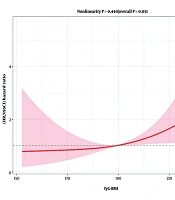
As shown in Figure 1, restricted cubic spline Cox regression analysis of the dose-response relationship between TyG-BMI and the risk of incident MASLD showed a linear association after adjustment for potential confounders (P = 0.440 for nonlinearity), with no significant saturation or threshold effect. The spline curve should be interpreted cautiously in sparsely populated tail regions of the TyG-BMI distribution.
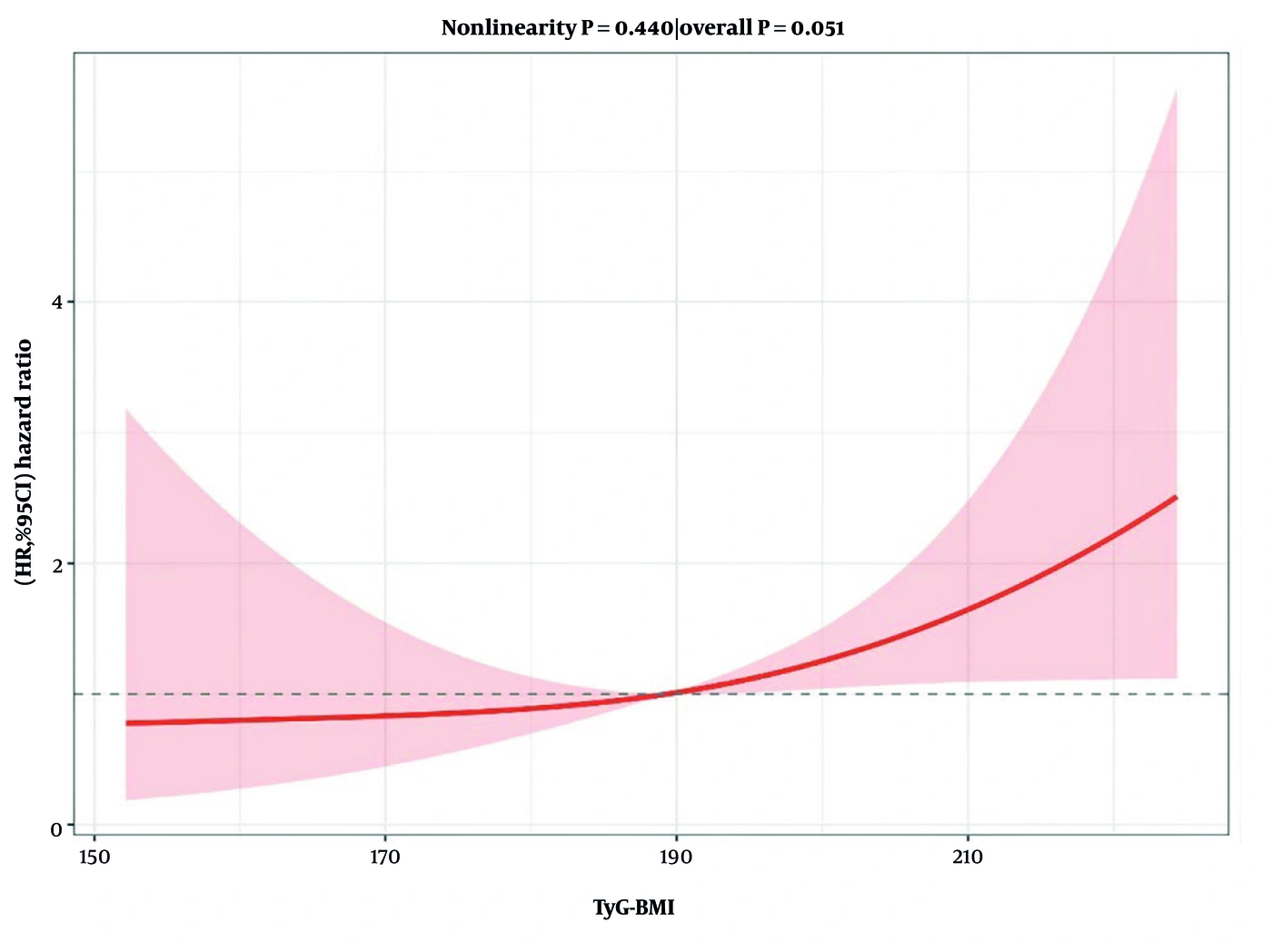
Figure 1.
Dose-response relationship between TyG-BMI and the risk of developing MASLD in patients with CHB.
4.5. Time-Dependent ROC Curves for Multiple Indicators
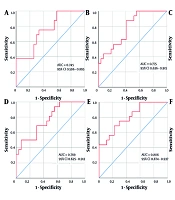
Time-dependent ROC analysis showed that TyG-BMI achieved AUCs of 0.745, 0.703, and 0.738 at 3, 6, and 9 months, respectively, all above 0.70. BMI (0.755, 0.670, and 0.686) and TyG (0.561, 0.653, and 0.677) performed less well. The inflammatory-lipid indices showed low AUCs: MHR, 0.599, 0.465, and 0.525; NHR, 0.45 - 0.51; LHR, 0.54 - 0.59; and PHR, 0.728 at 3 months, declining to 0.545 and 0.509 at 6 and 9 months, respectively (Figure 2).
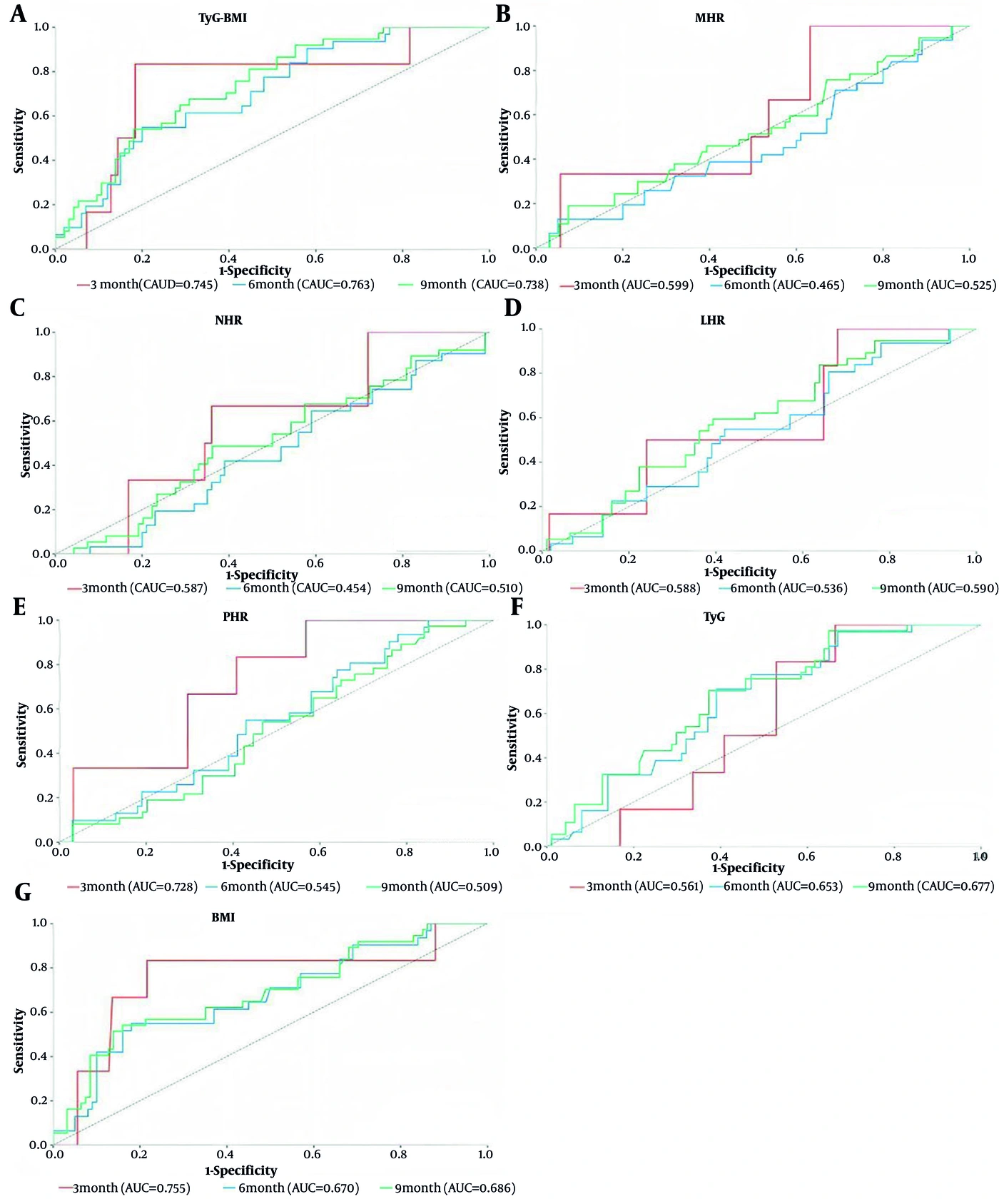
Figure 2.
Time-dependent ROC curves for each indicator in predicting incident MASLD in patients with CHB at 3, 6, and 9 months of follow-up.
4.6. Calibration Curves for Each Index
Calibration-curve analysis showed that TyG-BMI-predicted probabilities agreed with the observed probabilities at each time point. In contrast, the calibration curves for MHR, NHR, LHR, and PHR deviated at some time points (Figure S1 in the Supplementary File).
4.7. Decision Curve Analysis for Each Indicator
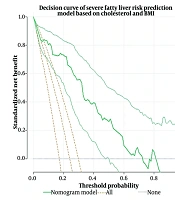
Decision curve analysis showed that TyG-BMI provided a positive net benefit across a wide range of risk thresholds and outperformed the "treat all" and "treat none" strategies. The MHR, NHR, LHR, and PHR curves were below or near the "treat none" strategy at most thresholds. TyG and BMI showed a net benefit, but it was inferior to that of TyG-BMI (Figure S2 in the Supplementary File).
4.8. Subgroup Analysis
Subgroup analyses based on stratified Cox regression for TyG-BMI are presented in Table S1 in the Supplementary File. Among treatment-naive patients, TyG-BMI was associated with incident MASLD, with an HR of 1.040 (95% CI, 1.009 - 1.071; P = 0.010); among treatment-experienced patients, the HR was 1.020 (95% CI, 1.004 - 1.036; P = 0.014). For HBeAg-negative patients, the HR was 1.026 (95% CI, 1.008 - 1.044; P = 0.004), and for HBeAg-positive patients, the HR was 1.026 (95% CI, 1.003 - 1.050; P = 0.028). When stratified by HBV DNA level, the HR was 1.029 (95% CI, 1.014 - 1.044; P < 0.001) in the low-HBV-DNA subgroup and 0.990 (95% CI, 0.950 - 1.031; P = 0.628) in the moderate-to-high-HBV-DNA subgroup. In the combined subgroups, the HR was 1.041 (95% CI, 1.003 - 1.080; P = 0.033) for treatment-naive patients with HBeAg-negative status, 1.020 (95% CI, 1.000 - 1.041; P = 0.056) for treatment-experienced patients with HBeAg-negative status, and 1.022 (95% CI, 0.995 - 1.050; P = 0.106) for treatment-experienced patients with HBeAg-positive status (Table S1 in the Supplementary File).
5. Discussion
CHB and MASLD frequently coexist and synergistically accelerate fibrosis and hepatocellular carcinoma, highlighting the need for early risk stratification (20). In this cohort, TyG-BMI was the only index that reached statistical significance in the fully adjusted Cox model among the seven indices examined, and it showed numerically higher AUC values than the inflammatory-lipid composite indices. Numerical differences in predictive performance were also observed across virological subgroups, with relatively higher estimates among treatment-naive patients, HBeAg-negative patients, and those with low viremia.
BMI and TyG lost significance after adjustment, whereas TyG-BMI remained robust, likely because it integrates insulin resistance and obesity, which are fundamental drivers of MASLD (21). Insulin resistance promotes hepatic free fatty acid accumulation through increased lipolysis and de novo lipogenesis (22), whereas obesity exacerbates insulin resistance and chronic low-grade inflammation (23). TyG correlates closely with clamp-measured insulin resistance (24), and BMI reflects overall adiposity (25); their combination in TyG-BMI may more comprehensively capture metabolic risk.
The inflammatory-lipid indices showed no predictive value, in contrast to cross-sectional reports linking them to fatty liver. Their low AUCs and loss of significance after adjustment suggest that they may be secondary markers arising after MASLD onset rather than antecedent predictors.
We observed numerical differences in the predictive performance of TyG-BMI across virological subgroups. Predictive performance appeared relatively higher in treatment-naive, low-HBV-DNA, and HBeAg-negative patients, whereas it appeared attenuated among patients receiving antiviral therapy, those with moderate-to-high HBV DNA levels, or those with HBeAg-positive status. Active viral replication and associated hepatic inflammation may interfere with metabolic indicators (26). These observations generate the hypothesis that a high HBV DNA load accompanied by intrahepatic immune activation could alter fat metabolism, potentially leading to MASLD that is less dominated by metabolic dysfunction in some patients (27). HBeAg positivity reflects higher viral replication and may obscure metabolic signals (28). Antiviral therapy, particularly tenofovir-based agents, can alter lipid and glucose profiles, further weakening the predictive utility of TyG-BMI (29).
5.1. Practical Considerations
Beyond its statistical predictive performance, several practical considerations should be noted for the real-world application of TyG-BMI in CHB care. FibroTouch transient elastography for MASLD assessment requires specialized hardware and incurs additional costs, and such equipment is often inaccessible in primary-care settings. TyG-BMI has the practical advantage of being calculated from routine CHB follow-up parameters (fasting triglycerides, fasting glucose, height, and body weight), requiring no additional blood tests or dedicated instruments. Importantly, TyG-BMI cannot replace FibroTouch in establishing a definitive diagnosis of MASLD. No optimal study-specific cutoff value was derived in the present analysis. In this exploratory cohort, TyG-BMI may provide preliminary information for risk stratification of incident MASLD in patients with CHB and well-controlled viremia. Its clinical utility requires further external validation before real-world application. The findings suggest that patients with elevated TyG-BMI values might be prioritized for elastography screening and timely metabolic-targeted intervention, whereas liver elastography surveillance intervals might be prolonged for low-risk individuals to optimize limited imaging resources. Its predictive performance appears attenuated in patients with moderate-to-high HBV DNA levels.
5.2. Conclusions
In this cohort, TyG-BMI demonstrated modest predictive value for incident MASLD in patients with CHB, particularly in those who were treatment-naive, HBeAg-negative, and had low viremia. Although it numerically outperformed the inflammatory-lipid composite indices in this cohort, its clinical utility is limited by conditional performance according to virological status and by its modest overall AUC. These findings suggest that TyG-BMI may have potential as a risk-stratification reference in selected CHB populations, but larger prospective multicenter studies are needed to establish valid cutoff thresholds and confirm generalizability before clinical application.
5.3. Study Limitations
This study has several important limitations. First, the single-center retrospective design, relatively small sample size, and limited number of incident MASLD events may introduce selection bias and yield wide confidence intervals. Second, the 3- to 9-month follow-up captures early incident MASLD but cannot reflect long-term disease risk. Third, given the limited number of events, the regression and exploratory analyses carry an inherent risk of model overfitting. Multiple exploratory subgroup analyses were performed without formal interaction testing or multiplicity adjustment, which may inflate type I error. Fourth, steatosis was assessed by FibroTouch UAP rather than liver biopsy, and measurement variability should be acknowledged. Neither bootstrap-based internal validation nor external validation was performed. Fifth, antiviral treatment status was treated as a time-fixed baseline variable, and dynamic changes during follow-up were not modeled. Finally, this was a single-center Chinese cohort; therefore, generalizability to other populations requires further validation. These findings should therefore be interpreted as preliminary observations and require prospective multicenter confirmation before clinical application.