
1. Background
Acute-on-chronic liver failure (ACLF) is a severe clinical syndrome characterized by acute hepatic decompensation, systemic inflammation, immune dysregulation, and coagulation abnormalities, resulting in a high risk of short-term mortality (1-4). Artificial liver support systems (ALSS) are widely used in the management of ACLF (5). By removing circulating toxins and replacing essential plasma components, these systems can temporarily support liver function and serve as a bridge to recovery or liver transplantation (6, 7).
In China, ALSS is commonly performed using combined modalities, such as the double plasma molecular adsorption system (DPMAS) and plasma exchange (PE) (7, 8). This combined approach can reduce circulating bilirubin and inflammatory mediators while replenishing deficient plasma factors, thereby helping to restore metabolic homeostasis and support liver function (6-8). Clinical studies have suggested that DPMAS combined with PE may improve short-term outcomes in patients with ACLF (9-11). However, anticoagulation remains a critical issue during extracorporeal treatment. Contact between blood and the extracorporeal circuit may activate the coagulation cascade and promote circuit clotting, potentially impairing circuit function and treatment delivery (12, 13).
The selection of anticoagulants in patients with ACLF is particularly challenging because of the complex and dynamic changes in hemostasis (14). Increasing evidence indicates that these patients are not simply hypocoagulable but instead exhibit a state of rebalanced hemostasis, in which bleeding and thrombotic risks coexist (15). Insufficient anticoagulation may compromise circuit patency, whereas excessive anticoagulation may increase the risk of bleeding complications (7, 16). Therefore, both efficacy and safety should be considered when selecting an anticoagulation strategy during ALSS.
Heparin (HP) remains the conventional anticoagulant used during artificial liver support therapy (7). However, its anticoagulant effect is not confined to the extracorporeal circuit, potentially increasing the risk of bleeding in patients with severe coagulopathy (17, 18). Moreover, HP may be unsuitable for patients with active bleeding or heparin hypersensitivity and is contraindicated in patients with a history of heparin-induced thrombocytopenia (HIT) (17-19). Regional citrate anticoagulation is an alternative option, but its use is limited by the need for intensive monitoring and concerns regarding citrate metabolism in patients with advanced liver disease (20).
Nafamostat mesilate (NM) has attracted increasing interest as an anticoagulation option for extracorporeal support therapies (21). Its rapid metabolism and short duration of action enable regional anticoagulation while minimizing disturbances in systemic coagulation function (21, 22). Previous studies in continuous renal replacement therapy (CRRT) and extracorporeal membrane oxygenation (ECMO) have shown that NM can provide effective anticoagulation while maintaining a favorable safety profile (23-25). Nevertheless, clinical evidence regarding its use during ALSS remains limited, particularly in patients with ACLF.
2. Objectives
Using a prospective real-world design, we evaluated the relative effectiveness and safety of NM and HP as anticoagulation strategies in patients with ACLF undergoing DPMAS combined with PE. These findings may help inform anticoagulation strategies during ALSS therapy for patients with ACLF.
3. Methods
3.1. Study Design and Ethics
This prospective real-world cohort study was approved by the Ethics Committee of the Public Health Clinical Center of Chengdu (No. YJ-K2024 - 107 - 01) and adhered to the principles of the Declaration of Helsinki. All patients or their legally authorized representatives provided written informed consent before enrollment.
3.2. Study Population
Consecutive patients with ACLF who underwent DPMAS combined with PE in the Department of Hepatology between November 2024 and December 2025 were prospectively enrolled. Each patient served as the unit of analysis throughout the study. Patients could undergo repeated DPMAS plus PE sessions according to clinical need; however, only the first session and its corresponding pre- and posttreatment measurements were included. Subsequent sessions were not treated as independent observations. Accordingly, the study evaluated the immediate anticoagulation efficacy, short-term safety, and laboratory changes associated with the initial treatment session. No formal a priori sample size calculation was performed because all eligible consecutive patients were enrolled during the predefined study period. The final sample size was determined by the number of eligible patients during this period.
3.3. Inclusion and Exclusion Criteria
3.3.1. Inclusion Criteria
Patients were eligible if they: 1) were diagnosed with ACLF according to the “Guidelines for the Diagnosis and Treatment of Liver Failure (2024 Edition)” (6); 2) received DPMAS combined with PE; and 3) received anticoagulation with NM or HP during treatment.
3.3.2. Exclusion Criteria
The exclusion criteria were: 1) severe hemorrhage or disseminated intravascular coagulation; 2) known allergy to NM, HP, membrane materials, or blood products; 3) decompensated heart failure, unstable angina, hemodynamic instability, or recent myocardial infarction (< 3 months); 4) malignancy or severe neuropsychiatric disorders; 5) pregnancy or lactation; and 6) incomplete clinical data.
3.4. Treatment Protocol and Assessments
3.4.1. Artificial Liver Support Therapy
Patients meeting the ACLF diagnostic criteria and without contraindications to ALSS were considered eligible for treatment with DPMAS combined with PE according to routine clinical practice. Before initiation of ALSS, vascular access was obtained by ultrasound-guided cannulation of either the right internal jugular vein or the femoral vein. Treatments were conducted using a continuous blood purification system (B. Braun, Germany). Plasma separation was achieved using an OP-08W membrane plasma separator (Asahi Kasei, Japan), whereas bilirubin adsorption and hemoperfusion were performed with BS330 and HA330-II cartridges, respectively (Jafron Biomedical Co., Ltd., China).
Blood flow was initiated at 60 - 80 mL/min and gradually increased to 120 - 160 mL/min during treatment. The plasma separation fraction was maintained at 20% - 30%. Fresh frozen plasma of the same blood type was used as the replacement fluid at a volume of 1.2 - 2.0 L per session. DPMAS combined with PE was performed according to standard institutional protocols.
3.4.2. Anticoagulation Protocol
Anticoagulant selection was not randomized and was determined by the treating physicians according to routine clinical practice. The choice between NM and HP was based on the patient’s clinical condition, bleeding risk, coagulation status, contraindications to anticoagulation, and the physician’s clinical judgment. No predefined algorithm was used to assign patients to either anticoagulation group. During treatment, patients received either NM (Jiangsu Durui Pharmaceutical Co., Ltd., Yancheng, China) or HP (Chengdu Haitong Pharmaceutical Co., Ltd., Chengdu, China).
For circuit priming, 50 mg of NM (dissolved in 10 mL of 5% glucose solution) or 12,500 IU of HP was added to 3,000 mL of normal saline. The total priming volume ranged from 1 to 3 L. Nafamostat mesilate was infused continuously at 20 - 50 mg/h during treatment. In the HP group, a loading dose of 0.5 - 1.0 mg/kg was administered, followed by a maintenance infusion of 10 - 20 mg/h. Anticoagulant doses were adjusted according to transmembrane pressure, venous pressure, filter clotting, and device alarms.
3.4.3. Outcome Measures
The study was not designed as a formal noninferiority or equivalence trial. Anticoagulation efficacy was defined as the primary endpoint, whereas bleeding events and overall adverse events (AEs) were considered secondary safety outcomes. Changes in laboratory parameters were evaluated as secondary exploratory outcomes.
3.4.3.1. Anticoagulation Efficacy Assessment
Filter clotting was assessed at the end of treatment using a published four-category scale (26). Higher scores reflected progressively greater clot burden within the extracorporeal circuit, ranging from absent or minimal clotting (Grade 0) to extensive clot formation associated with circuit dysfunction or replacement (Grade III). Grades 0 and I were considered to indicate adequate anticoagulation. Because of the open-label design, investigators evaluating filter clotting were not blinded to treatment allocation.
3.4.3.2. Safety Assessment
Adverse events occurring during ALSS or within 24 h after treatment were prospectively documented through routine clinical monitoring, medical records, treatment records, and available laboratory findings. Bleeding events were defined as clinically apparent bleeding occurring during treatment or within 24 h after treatment and were categorized by site as gastrointestinal, catheter- or puncture-site, subcutaneous, gingival, nasal, urinary, pulmonary, or intracranial bleeding. Bleeding severity was not prospectively graded using a formal standardized bleeding classification system, and no independent adjudication committee was involved. Treating physicians and investigators were aware of anticoagulant allocation because of the open-label design. Other AEs included hypotension, nausea, vomiting, rash, allergic reactions, dyspnea, and device alarms. When multiple AEs occurred in the same patient, each event was recorded separately. The overall AE incidence was defined as the proportion of patients experiencing at least one AE during treatment or within 24 h after treatment.
3.4.3.3. Laboratory Parameters
Laboratory assessments were performed before therapy and again within 24 h after treatment and included prothrombin time (PT), activated partial thromboplastin time (APTT), international normalized ratio (INR), prothrombin activity (PTA), alanine aminotransferase (ALT), total bilirubin (TBIL), albumin (ALB), and platelet count (PLT).
3.5. Statistical Analysis
Data management and statistical analyses were performed using SPSS version 22.0 (IBM Corp., Armonk, NY, USA). Normality was assessed using the Shapiro–Wilk test. Normally distributed variables are presented as mean ± standard deviation (SD) and were compared using the independent-samples t-test. Skewed variables are presented as median (interquartile range [IQR]) and were compared using the Mann–Whitney U test. Within-group pre- and posttreatment comparisons were performed using the paired t-test for normally distributed variables and the Wilcoxon signed-rank test for skewed variables. Categorical variables were compared using the χ2 test or Fisher’s exact test, as appropriate.
Univariable and multivariable logistic regression analyses were performed to assess factors associated with bleeding events and overall AEs, with odds ratios (ORs) and 95% confidence intervals (CIs) reported. Given the relatively small sample size and limited number of outcome events, propensity score matching or weighting was not performed. Unadjusted categorical effect estimates were expressed as relative risks (RRs) with 95% CIs.
No adjustment for multiple comparisons was applied because the laboratory analyses were exploratory and hypothesis-generating. These analyses were not intended to provide confirmatory evidence, and statistically significant findings should therefore be interpreted cautiously. All tests were two-sided, with P < 0.05 considered statistically significant.
4. Results
4.1. Baseline Characteristics of the Study Population
Between November 2024 and December 2025, 216 consecutive patients with ACLF were screened. After exclusion of 23 patients with incomplete records and 71 who did not receive DPMAS combined with PE, 122 eligible patients were included in the final analysis: 60 in the NM group and 62 in the HP group (Figure 1). For patients who underwent multiple DPMAS plus PE sessions, only the first session was included in the comparative analyses; thus, each patient contributed one observation.
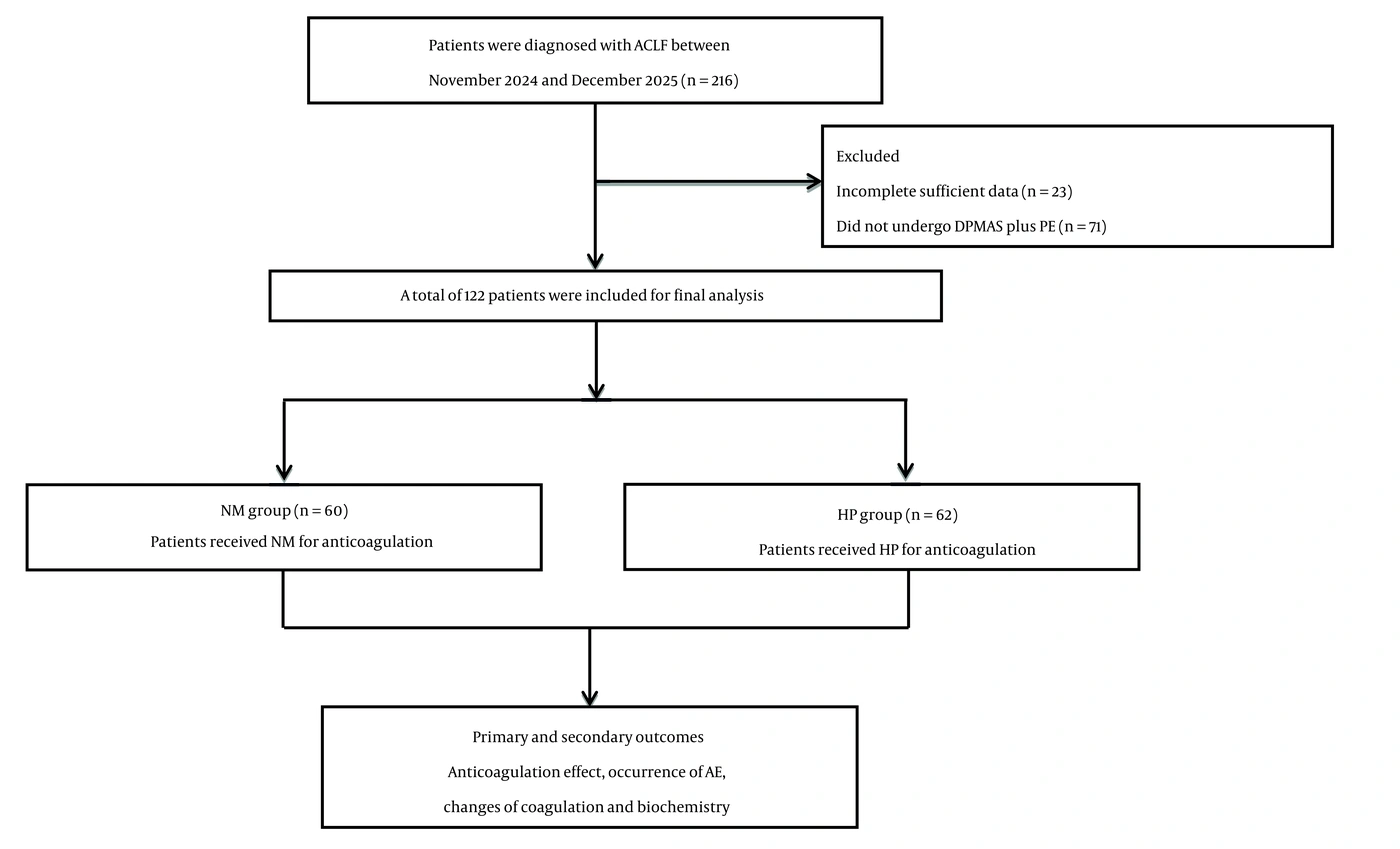
Figure 1.
Flowchart of patient screening and cohort selection.
As shown in Table 1, baseline demographic characteristics, underlying etiologies, and disease severity measures were comparable between the NM and HP groups, with no significant between-group differences (all P > 0.05). Baseline coagulation parameters, PLT, and other clinically relevant laboratory indices were also comparable between the groups (all P > 0.05; Tables 2 and 3).
Table 1.
Baseline Characteristics of Enrolled Patients a
| Variables | NM Group (n = 60) | HP Group (n = 62) | P-Value |
|---|---|---|---|
| Age, y | 48.6 ± 12.1 | 46.9 ± 14.0 | 0.467 |
| Male | 38 (63.3) | 46 (74.2) | 0.195 |
| BMI, kg/m2 | 22.9 ± 3.1 | 22.1 ± 3.3 | 0.205 |
| Etiology | 0.597 | ||
| Hepatitis virus | 48 (80.0) | 43 (69.3) | |
| Alcohol | 7 (11.7) | 9 (14.5) | |
| Autoimmune | 2 (3.3) | 4 (6.5) | |
| Others | 3 (5.0) | 6 (9.7) | |
| MELD score | 23.5 ± 4.9 | 24.5 ± 5.6 | 0.294 |
| Child–Pugh score | 10 (8, 11) | 10 (9, 11) | 0.789 |
| Child–Pugh class | 0.480 | ||
| B | 28 (46.7) | 25 (40.3) | |
| C | 32 (53.3) | 37 (59.7) | |
| ACLF grade | 0.326 | ||
| 1 | 25 (41.7) | 32 (51.6) | |
| 2 | 30 (50.0) | 26 (41.9) | |
| 3 | 5 (8.3) | 4 (6.5) |
a Data are presented as mean ± SD, median (Q25, Q75), or No. (%). Q25 and Q75 indicate the 25th and 75th percentiles, respectively. Abbreviations: NM, nafamostat mesilate; HP, heparin; BMI, body mass index; MELD, Model for End-Stage Liver Disease; ACLF, acute-on-chronic liver failure.
Table 2.
Comparison of Coagulation Function Between the Two Groups a
| Parameters and Time Points | NM Group (n = 60) | HP Group (n = 62) | Between-Group Difference (95% CI) | P-Value |
|---|---|---|---|---|
| PT (s) | ||||
| Pretreatment | 18.7 (15.2, 23.1) | 18.2 (14.3, 23.1) | 0.50 (−1.60, 2.50) | 0.619 |
| Posttreatment | 19.5 (16.2, 22.3) | 18.9 (15.8, 22.9) | 0.50 (−1.20, 2.40) | 0.598 |
| APTT (s) | ||||
| Pretreatment | 38.3 ± 7.1 | 37.4 ± 9.6 | 0.98 (−2.06, 4.02) | 0.523 |
| Posttreatment | 40.3 (33.8, 48.3) b | 48.4 (35.6, 63.8) b | −6.10 (−11.60, −1.30) | 0.013 |
| INR | ||||
| Pretreatment | 1.7 (1.3, 2.0) | 1.6 (1.2, 2.2) | 0.08 (−0.13, 0.30) | 0.435 |
| Posttreatment | 1.8 (1.4, 2.1) | 1.7 (1.3, 2.3) | 0.03 (−0.21, 0.23) | 0.798 |
| PTA (%) | ||||
| Pretreatment | 42.0 (33.4, 50.2) | 43.6 (28.9, 59.7) | −1.60 (−8.40, 4.80) | 0.634 |
| Posttreatment | 36.5 (29.4, 46.1) b | 32.1 (22.9, 41.7) b | 4.90 (0.40, 9.90) | 0.034 |
a Data are presented as mean ± SD or median (interquartile range [IQR]), as appropriate. Between-group differences are reported with 95% CIs. For normally distributed variables, differences represent mean differences; for non-normally distributed variables, differences represent Hodges–Lehmann estimates of location shift. Between-group differences were calculated as the NM group minus the HP group
b P < 0.001 versus the corresponding pretreatment value. Abbreviations: NM, nafamostat mesilate; HP, heparin; CI, confidence interval; PT, prothrombin time; APTT, activated partial thromboplastin time; INR, international normalized ratio; PTA, prothrombin activity
Table 3.
Comparison of Liver Function and Platelet Count Between the Two Groups a
| Parameters and Time Points | NM Group (n = 60) | HP Group (n = 62) | Between-Group Difference (95% CI) | P-Value |
|---|---|---|---|---|
| ALT (U/L) | ||||
| Pretreatment | 316.5 (176.0, 856.0) | 227.5 (102.3, 685.5) | 48.0 (−59.0, 144.0) | 0.331 |
| Posttreatment | 177.5 (87.3, 327.3) b | 144.0 (68.0, 313.3) b | 22.0 (−24.0, 69.0) | 0.288 |
| TBIL (μmol/L) | ||||
| Pretreatment | 334.5 ± 109.1 | 350.0 ± 110.5 | −15.4 (−54.8, 23.9) | 0.439 |
| Posttreatment | 191.5 (121.4, 238.5) b | 193.4 (124.3, 261.2) b | −4.0 (−32.4, 23.3) | 0.757 |
| ALB (g/L) | ||||
| Pretreatment | 31.2 ± 4.6 | 32.4 ± 4.9 | −1.2 (−2.9, 0.5) | 0.163 |
| Posttreatment | 29.1 ± 4.1 b | 29.9 ± 4.0 b | −0.9 (−2.3, 0.6) | 0.239 |
| PLT (× 109/L) | ||||
| Pretreatment | 114.0 (68.5, 169.8) | 125.5 (92.8, 176.5) | −13.0 (−36.0, 10.0) | 0.257 |
| Posttreatment | 106.5 (61.5, 165.5) b | 82.5 (62.5, 100.3) b | 25.0 (6.0, 44.0) | 0.008 |
a Data are presented as mean ± standard deviation (SD) or median (interquartile range [IQR]), as appropriate. Between-group differences are reported with 95% CIs. For normally distributed variables, differences represent mean differences; for non-normally distributed variables, differences represent Hodges–Lehmann estimates of location shift. Between-group differences were calculated as the NM group minus the HP group. Abbreviations: NM, nafamostat mesilate; HP, heparin; CI, confidence interval; ALT, alanine aminotransferase; TBIL, total bilirubin; ALB, albumin; PLT, platelet count.
b P < 0.001 versus the corresponding pretreatment value.
4.2. Comparison of Anticoagulation Efficacy
At treatment completion, Grade 0, I, II, and III filter clotting was observed in 21, 34, 5, and 0 patients in the NM group, respectively, compared with 30, 26, 4, and 2 patients in the HP group.
Effective anticoagulation rates (Grade 0 - I clotting) were high in both groups, reaching 91.7% in the NM group and 90.3% in the HP group. Clotting-grade distributions were comparable between the treatment groups. No statistically significant difference in effective anticoagulation rates was observed between the groups (χ2 = 0.067, P = 0.796; Table 4).
Table 4.
Comparison of Anticoagulation Efficacy Between the Two Groups a
| Group | Grade 0 | Grade I | Grade II | Grade III | Effective Anticoagulation Rate (%) |
|---|---|---|---|---|---|
| NM group (n = 60) | 21 (35.0) | 34 (56.7) | 5 (8.3) | 0 (0.0) | 91.7 |
| HP group (n = 62) | 30 (48.4) | 26 (41.9) | 4 (6.5) | 2 (3.2) | 90.3 |
a Data are presented as n (%). χ2=0.067; P-value = 0.796. Abbreviations: NM, nafamostat mesilate; HP, heparin.
4.3. Comparison of Laboratory Parameters
4.3.1. Coagulation Parameters
Baseline coagulation indices, including PT, APTT, INR, and PTA, were comparable between the NM and HP groups, with no statistically significant differences (all P > 0.05).
After treatment, PT and INR remained comparable between the groups (both P > 0.05). Significant between-group differences were observed for APTT and PTA. Specifically, posttreatment APTT was significantly shorter in the NM group than in the HP group (40.3 vs 48.4 s; between-group difference, −6.1; 95% CI, −11.6 to −1.3; P = 0.013), whereas PTA was significantly higher in the NM group (36.5% vs 32.1%; between-group difference, 4.9; 95% CI, 0.4 - 9.9; P = 0.034).
Within-group analyses showed that APTT increased and PTA decreased significantly after treatment in both groups (all P < 0.001), whereas PT and INR did not change significantly from baseline (all P > 0.05) (Table 2).
4.3.2. Liver Function and Platelet Count
Similarly, baseline liver biochemical parameters (ALT, TBIL, and ALB) and PLT were comparable between the NM and HP groups, with no statistically significant differences (all P > 0.05).
After treatment, ALT, TBIL, and ALB remained comparable between the groups (all P > 0.05). In contrast, PLT was significantly higher in the NM group than in the HP group (106.5 vs 82.5 × 10⁹/L; between-group difference, 25.0 × 10⁹/L; 95% CI, 6.0 - 44.0; P = 0.008).
Compared with baseline values, ALT, TBIL, ALB, and PLT decreased significantly after treatment in both groups (all P < 0.001) (Table 3).
4.4. Comparison of Adverse Events
4.4.1. Bleeding Events
Bleeding events occurred in 2 patients (3.3%) in the NM group and 12 patients (19.4%) in the HP group during treatment and within 24 h after treatment. The incidence of bleeding was significantly lower in the NM group (RR = 0.172, 95% CI, 0.040 - 0.737; χ2 = 7.705, P = 0.006) (Table 5).
Table 5.
Comparison of Adverse Events Between the Two Groups a
| AE Type | NM Group (n = 60) | HP Group (n = 62) | RR (95% CI) | P-Value |
|---|---|---|---|---|
| Bleeding | 2 (3.3) | 12 (19.4) | 0.172 (0.040 - 0.737) | 0.006 |
| Rash | 7 (11.7) | 4 (6.5) | 1.808 (0.558 - 5.862) | 0.315 |
| Nausea | 5 (8.3) | 10 (16.1) | 0.517 (0.188 - 1.423) | 0.190 |
| Hypotension | 9 (15.0) | 16 (25.8) | 0.581 (0.279 - 1.213) | 0.139 |
| Device alarms | 3 (5.0) | 2 (3.2) | 1.550 (0.268 - 8.952) | 0.677 |
| Overall AEs | 22 (36.7) | 36 (58.1) | 0.631 (0.426 - 0.937) | 0.018 |
a Data are presented as No. (%). The incidence of overall AEs was defined as the proportion of patients experiencing at least one AE. Abbreviations: AEs, adverse events; NM, nafamostat mesilate; HP, heparin; RR, relative risk; CI, confidence interval.
In univariable analysis, NM treatment was associated with lower odds of bleeding (OR = 0.144, 95% CI, 0.031 - 0.673, P = 0.014). Given the limited number of bleeding events, the multivariable model was restricted to treatment allocation and the Model for End-Stage Liver Disease (MELD) score to minimize the risk of model overfitting. After adjustment, NM remained significantly associated with lower odds of bleeding (adjusted OR = 0.150, 95% CI, 0.030 - 0.746, P = 0.020), whereas the MELD score was positively associated with bleeding (adjusted OR = 1.187, 95% CI, 1.058 - 1.332, P = 0.003) (Table 6).
Table 6.
Univariable and Multivariable Logistic Regression Analyses of Bleeding Events and Overall Adverse Events a
| Variables | Bleeding | Overall AEs | ||||||
|---|---|---|---|---|---|---|---|---|
| Univariable | Multivariable | Univariable | Multivariable | |||||
| OR (95% CI) | P-value | OR (95% CI) | P-value | OR (95% CI) | P-value | OR (95% CI) | P-value | |
| NM vs HP | 0.144 (0.031 - 0.673) | 0.014 b | 0.150 (0.030 - 0.746) | 0.020 b | 0.418 (0.202 - 0.866) | 0.019 b | 0.397 (0.185 - 0.855) | 0.018 b |
| Age | 1.027 (0.982 - 1.073) | 0.244 | - | - | 1.000 (0.973 - 1.028) | 0.998 | - | - |
| Male | 0.154 (0.019 - 1.223) | 0.077 | - | - | 1.502 (0.687 - 3.282) | 0.308 | - | - |
| MELD score | 1.193 (1.068 - 1.333) | 0.002 b | 1.187 (1.058 - 1.332) | 0.003 b | 1.093 (1.016 - 1.175) | 0.017 b | 1.063 (0.982 - 1.151) | 0.132 |
| ACLF grade | - | 0.030 b | - | - | - | < 0.001 b | - | - |
| Grade 2 vs Grade 1 | 5.266 (1.084 - 25.588) | 0.039 b | - | - | 4.612 (2.082 - 10.217) | < 0.001 b | - | - |
| Grade 3 vs Grade 1 | 13.750 (1.903 - 99.359) | 0.009 b | - | - | 5.125 (1.142 - 23.004) | 0.033 b | - | - |
| PLT | 0.980 (0.967 - 0.994) | 0.004 b | - | - | 0.994 (0.989 - 1.000) | 0.044 b | 0.995 (0.989 - 1.001) | 0.126 |
a Abbreviations: OR, odds ratio; CI, confidence interval; AEs, adverse events; NM, nafamostat mesilate; HP, heparin; MELD, Model for End-Stage Liver Disease; ACLF, acute-on-chronic liver failure; PLT, platelet count. Because of the limited number of bleeding events, the multivariable model for bleeding was restricted to treatment allocation and MELD score to minimize the risk of overfitting.
b P < 0.05 was considered statistically significant.
4.4.2. Overall Adverse Events
Overall AEs occurred in 22 patients (36.7%) in the NM group and 36 patients (58.1%) in the HP group. The incidence of overall AEs was significantly lower in the NM group than in the HP group (RR = 0.631, 95% CI, 0.426 - 0.937; χ2 = 5.598, P = 0.018) (Table 5).
In univariable analysis, NM treatment was associated with lower odds of overall AEs (OR = 0.418, 95% CI, 0.202 - 0.866, P = 0.019). After adjustment for treatment allocation, MELD score, and PLT, NM remained significantly associated with lower odds of overall AEs (adjusted OR = 0.397, 95% CI, 0.185 - 0.855, P = 0.018) (Table 6).
4.4.3. Specific and Serious Adverse Events
Specific AEs observed during treatment included rash, nausea, hypotension, and device alarms. None of these individual AEs differed significantly between the NM and HP groups (all P > 0.05; Table 5). No serious adverse events were observed in either group, and no treatment was discontinued because of AEs.
5. Discussion
In this prospective real-world cohort study, NM and HP achieved comparable anticoagulation efficacy during DPMAS combined with PE in patients with ACLF, whereas NM was associated with lower incidences of bleeding events and overall AEs. In addition, NM appeared to have a smaller impact on systemic coagulation parameters and PLT than HP. These findings suggest that NM may provide effective extracorporeal anticoagulation with a potentially favorable safety profile in this clinical setting.
Maintaining circuit patency is essential during ALSS. Exposure of blood to extracorporeal circuits and adsorption materials can activate coagulation and inflammatory pathways, resulting in filter clotting, treatment interruption, and reduced treatment efficiency (12, 27). In the present study, the effective anticoagulation rate exceeded 90% in both groups, indicating that NM provided anticoagulant efficacy comparable to that of HP. Similar findings have been reported in studies of CRRT and hemodialysis, in which NM effectively maintained circuit function and prolonged filter lifespan without compromising anticoagulant efficacy (28, 29). Our findings extend these observations to patients with ACLF undergoing DPMAS combined with PE.
The observed safety association with NM may be particularly relevant in patients with ACLF. Compared with general critically ill populations receiving CRRT, patients with ACLF often present with profound coagulation abnormalities, thrombocytopenia, systemic inflammation, endothelial dysfunction, and multiorgan failure. Current evidence suggests that ACLF is characterized by a fragile state of rebalanced hemostasis, in which both bleeding and thrombotic complications may occur (30, 31). Under these circumstances, systemic anticoagulation may further increase the bleeding risk.
Nafamostat mesilate has an ultrashort half-life and exerts its anticoagulant effect mainly within the extracorporeal circuit. Consistent with these pharmacological properties, NM anticoagulation was associated with a substantially lower risk of bleeding than HP anticoagulation. Previous studies by Makino et al. (32) and Lee et al. (25) reported similar findings, demonstrating that NM could reduce bleeding complications while maintaining adequate anticoagulation during extracorporeal therapies. Recent meta-analyses have likewise shown a lower bleeding risk with NM than with HP, particularly among patients at high risk of hemorrhage (33, 34). However, the number of bleeding events in the present study was relatively small, particularly in the NM group, and the corresponding 95% confidence interval was relatively wide. Therefore, this finding should be interpreted as an observed association rather than definitive evidence of a causal reduction in bleeding risk. These findings remained consistent after adjustment for key baseline characteristics. In multivariable logistic regression analyses, NM use remained associated with lower odds of bleeding and overall AEs compared with HP use, suggesting that the observed associations were not fully explained by the covariates included in the multivariable models. Laboratory findings in the present study further support the regional anticoagulation characteristics of NM. Compared with HP, patients receiving NM had a shorter APTT and a higher PTA after treatment, suggesting a smaller impact on systemic coagulation function. Although the NM group showed a numerically lower incidence of hypotension, the underlying mechanism remains unclear and warrants further investigation.
Patients in the NM group had higher PLT after treatment than those in the HP group. Platelet consumption during extracorporeal circulation may contribute to bleeding complications. Previous studies have suggested that NM has relatively limited effects on platelet activation and function, with similar observations reported during CRRT (35-37). In patients with chronic liver disease, thrombocytopenia is clinically relevant to bleeding risk, and a recent meta-analysis found that interventions increasing PLT were associated with reduced platelet transfusion requirements and bleeding events (38). However, PLT in patients with ACLF is influenced by multiple factors, including disease severity, hypersplenism, and transfusion therapy. Therefore, this finding should be interpreted with caution.
Beyond its anticoagulant effects, NM has been reported to have anti-inflammatory and immunomodulatory properties. Experimental and extracorporeal circulation studies have suggested that NM may attenuate inflammatory responses by inhibiting multiple protease-mediated pathways (39, 40). Because inflammatory biomarkers were not measured in the present study, it remains unclear whether these potential effects contributed to the observed clinical outcomes.
The lower incidence of bleeding observed with NM may be clinically relevant, particularly in patients with ACLF who have a high baseline bleeding risk. From a health-economic perspective, however, the higher acquisition cost of NM compared with HP should also be considered. Although NM may incur higher direct medication costs, its potential safety advantage may partly offset this difference by reducing the need for additional treatment of bleeding complications. However, we did not perform a formal cost-effectiveness analysis, and the economic impact of NM may vary across healthcare systems. Therefore, the potential clinical benefits of NM should be weighed against its higher cost.
Evidence guiding anticoagulation strategies during ALSS remains limited, and anticoagulant selection is largely based on clinical experience. This study provides prospective real-world data suggesting that NM can achieve reliable anticoagulation and is associated with fewer bleeding complications in patients with ACLF undergoing DPMAS combined with PE. These findings may be particularly relevant for patients with thrombocytopenia, a high bleeding risk, or contraindications to HP.
5.1. Limitations
Several limitations should be acknowledged. First, this was a single-center, nonrandomized real-world cohort study, and anticoagulant selection was based on routine clinical judgment rather than randomization. Therefore, treatment-selection bias and residual confounding cannot be completely excluded. Second, no formal a priori sample size calculation was performed. The relatively small sample size and limited number of bleeding events may have reduced statistical power to detect differences in infrequent safety outcomes; therefore, the observed difference in bleeding events should be interpreted cautiously. Third, multiple laboratory parameters were compared without formal adjustment for multiplicity, which may have increased the risk of type I error; accordingly, these findings should be interpreted cautiously. Fourth, safety outcomes were assessed only during treatment and within 24 h after treatment. Bleeding events and filter clotting were assessed in an open-label setting without blinded outcome assessment or a formal standardized bleeding severity scale; therefore, observer or detection bias cannot be completely excluded. Delayed or less apparent complications may also have been missed. Finally, the single-center setting may limit the generalizability of the findings. Because only the first DPMAS plus PE session was analyzed, the cumulative effects of repeated ALSS sessions could not be assessed. Differences in ALSS equipment, treatment protocols, anticoagulant dosing, patient selection, and local practice may also affect outcomes across institutions and countries. Therefore, the findings should be interpreted in the context of the initial DPMAS plus PE session and our institutional practice. Further large-scale, multicenter randomized trials incorporating formal cost-effectiveness analyses are required to validate the safety and long-term clinical advantages of NM in this patient group.
5.2. Conclusions
In conclusion, NM achieved anticoagulation efficacy comparable to that of HP and was associated with lower incidences of bleeding events and overall AEs during DPMAS combined with PE in patients with ACLF. These associations remained significant after adjustment for selected baseline characteristics. Nafamostat mesilate may be an alternative to HP for anticoagulation during ALSS therapy, particularly in patients at high bleeding risk. However, these findings should be interpreted cautiously given the nonrandomized design, small number of bleeding events, and potential for residual confounding. Prospective multicenter randomized controlled trials are warranted to confirm these findings.