1. Background
Today, hepatitis B virus (HBV) is one of the most important health problems worldwide. HBV infection is the most common cause of chronic infection in humans and can lead to cirrhosis, hepatocellular carcinoma, and death due to liver failure (1). Hepatitis delta virus (HDV) is a defective RNA virus, which is only able to replicate and cause infection in HBV-infected patients, thereby resulting in a coinfection (2, 3). In addition, dual infection with HBV/HDV causes more severe diseases and leads to a higher risk of mortality.
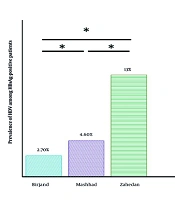
In a previous study by Roshandel et al., anti-HDV antibody was detected in 8 (5.8%) hepatitis B surface antigen (HBsAg)-positive patients in Golestan province, Iran; however, demographic factors, such as age, place of residence, and marital status, had no significant relationship with HDV seropositivity (4). Moreover, in other previous studies, the prevalence of HDV infection was estimated at 3.5% in Isfahan (5), 7.6% in Tabriz (6), and 17% in Zahedan (7) among anti-HBe-positive patients.
The majority of previous studies suggest that most HDV infections are acquired through parenteral and sexual routes. Therefore, patients undergoing hemodialysis and those infected with HIV are at risk of HDV infection (8). The interfamilial transmission of infection is also an important concern for patients and their families, as well as health service providers and policymakers (9). Since HDV virus intensifies acute and chronic HBV infection, it is necessary to determine its prevalence in the region. Also, health authorities should be aware of the risk of disease in patients and develop strategies for disease prevention and treatment.
2. Objectives
The present study was performed to determine the prevalence of HDV and the associated factors among HBsAg-positive patients in Birjand, Iran.
3. Methods
3.1. Patients and Setting
This descriptive, cross sectional study was conducted in line with a previous study on the seroprevalence and risk factors for HBV in South of Khorasan (10). In order to determine the prevalence of HDV infection in Birjand, we used the blood serum of HBsAg-positive patients, who were evaluated in the aforementioned study on the seroprevalence and risk factors for HBV in an adult population in South of Khorasan (2014). In the mentioned study, sampling was carried out systematically among 5235 individuals older than 15 years (range, 15 - 75 years) in 2014.
3.2. HDV Identification Method
Anti-HDV was assessed by ELISA test (BioVendor, Germany) in the blood serum (stored at -70°C) of 85 HBsAg-positive patients. Demographic characteristics and risk factors for hepatitis, such as blood transfusion, surgery, cupping, narcotic abuse, infected family members, and close encounters, were extracted from a questionnaire, which was completed by the patients.
3.3. Ethical Considerations
This study was conducted after obtaining approval from the university ethics committee (N.1394.383) by disclosing the research methods and objectives and gathering written consent forms from all the participants.
3.4. Statistical Analysis
Descriptive statistics were calculated for data analysis, using SPSS version 22.
4. Results
In the present study, the mean age of HBsAg-positive patients was 45.1 ± 12.9 years (minimum, 22 years; maximum, 70 years). In total, 33 (38.8%) and 52 (61.2%) subjects were female and male, respectively. Based on the findings, 1 out of 85 patients was positive for HDV infection. The prevalence of HDV infection among HBsAg-positive patients was 1.2% (95% CI, -1.2 to 3.5).
The anti-HDV-positive patient was a married 55-year-old woman with primary education and history of HBV infection, cupping, surgery, hospitalization, and endoscopy; she also had infected family members. However, no history of vaccination, smoking, alcohol abuse, or blood transfusion was found.
5. Discussion
The results of the present study showed that among 85 HBV-positive patients, only 1 case was positive for HDV infection. Therefore, the prevalence of HDV infection among HBsAg-positive patients was 1.2% (95% CI, -1.2 to 3.5). Evidence from different parts of the country has revealed the disparate prevalence rates of HDV (Table 1). In the present study, comparison of the prevalence of HDV in terms of age, sex, and other risk factors could not be performed, as only 1 anti-HDV-positive patient was detected.
Table 1.
Prevalence of Hepatitis D Virus (HDV) Infection in Patients with Hepatitis B Virus (HBV) in Iranian Studies
| Author(s) | City | Prevalence of HDV |
|---|---|---|
| Ghadir et al., 2012 (11) | Qom (Center of Iran) | 2% |
| Ataei et al., 2011 (5) | Isfahan (Center of Iran) | 2.9% |
| Gholamrezaei et al., 2007 (12) | Golestan (Northeast of Iran) | 5.8% |
| Ziaee et al., 2013 (13) | Birjand (South of Khorasan) | 3.1% |
| Somi et al., 2009 (14) | Tabriz (Northwest of Iran) and Tehran (capital of Iran) | 9.3% |
| Alizadeh et al., 2010 (15) | Hamadan (West of Iran) | 17.3% |
| Amini et al., 2011 (16) | Iran | 6.61% |
| Khazaee et al., 2016 (17) | Birjand (South of Khorasan) | 3.3% |
The results of the current study revealed the lowest prevalence of HDV in Iran. Consistent with the current results, in the neighboring province (Khorasan Razavi), no anti-HDV-positive cases were identified among 3198 normal subjects, including 34 HBsAg-positive patients (18). Moreover, a study in Tabriz, Iran reported that risk of HDV significantly increases after 40 years, while no significant difference was found between men and women (14). These results are in line with the present findings, as the only anti-HDV-positive case in our study was 55 years old.
In contrast, situated in the Middle East, Iran has a high prevalence of HDV, and therefore, screening, disease prevention, and public health training need to be highlighted. These measures are even more important in some parts of the country where there has been a significant increase in the rate of HDV infection in the past decades (15). In Pakistan and Tajikistan, the prevalence of HDV has been reported to be high (19). In fact, the prevalence of HDV infection in different parts of Pakistan ranges between 16.6% and 88.8% (19). Additionally, HDV infection is an acute medical problem in Southeast of Turkey and is relatively important in Eastern Europe (19).
In conclusion, the low prevalence of HDV infection in South of Khorasan was interesting, considering the great area of this province, use of a comprehensive and inclusive sampling strategy, and mutual borders with Afghanistan. Previous studies around Iran have reported variable rates of HDV prevalence, which might be affected by various factors, such as sampling source and strategy, socioeconomic level of the population, and geographical region. The low prevalence reported in the current study might be attributed to the low admission rate of HDV-positive cases in this region, as well as the health level and sociocultural status of the population. Nevertheless, further investigations are required to determine the genotypic distribution and analyze the situation from a molecular perspective.