
1. Background
Breast cancer as a global public health problem is the most common cancer (1) and the second most prevalent cause of death by cancer in females worldwide (2). In 2016, there were about 1.7 million incident breast cancer cases and 535,000 deaths from this disease in women throughout the world (3). Also, it caused about 1.5 million Disability-Adjusted Life Years (DALYs) for women in the year 2016 (4). Although more than half of the global burden of this disease is currently experienced in developed countries, it has been reported that the incidence and prevalence rates are remarkably rising in developing countries (1). The result of a systematic analysis suggests that despite the global efforts for primary prevention of breast cancer, only 20% to 50% of this disease can be prevented (4).
In recent years, although the survival rate of patients with breast cancer shows an improving trend, the regional and global reports indicate that prevalence and incidence of this cancer are increasing both in developed and developing countries (5). In the United States, for example, there is an estimated 16% increase in new cases of females with breast cancer from 2015 to 2019 (from 231,840 cases in 2015 to 268,600 cases in 2019). In the same interval, the estimated deaths from this cancer in women have shown an increase of 3.6% (from 40,290 deaths in 2015 to 41,760 cases in 2019) (6, 7). From 1990 to 2016, the global female deaths due to breast cancer increased by about 60%, while the age-standardized mortality rate had a reduction of 15% (5). Although factors like aging, overweight or obesity, genetic, early menarche age, first child birth after 30 years, lifestyle changes, and ethnicity have previously been identified as the related indicators of breast cancer (8), the death from breast cancer is known to be statistically associated with some other factors such as detecting the cancer in the late stages, lack of access to proper treatment, and low socio-economic status (9). In this context, some researchers believe that the Human Development Index (HDI), as a key indicator of the socio-economic status of world countries, is significantly related to breast cancer mortality.
In our literature review, we found some published studies about the relationship between death from breast cancer and HDI in different parts of the world. For instance, Hu et al. have used the Global Cancer Incidence, Mortality, and Prevalence (GLOBOCAN) 2012 database and concluded that there is a negative significant correlation between mortality to incidence ratio and national HDI (10). In a study on the Global Burden of Disease (GBD) 2016 data, it has been shown that breast cancer incidence, mortality, and mortality-to-incidence ratio are significantly related to HDI. In the above study, using the simple pairwise correlation coefficient, it has been demonstrated that the breast cancer mortality rate in countries with low/medium HDI is significantly higher than high/very high HDI countries (5). However, some other studies that showed no significant association between these indices. In a cross-sectional study, Ghoncheh et al. assessed the association between incidence and mortality of breast cancer and HDI in 2012. They have reported no significant correlation between age-specific incidence and mortality rates and HDI (11). A more detailed review of the previously conducted studies in this field reveals two important shortages; first, almost all of these studies have used simple and univariate statistical methods for analyzing the data. Although a wider range of readers are familiar with the classic and easy-to-understand univariate tests, these types of statistical analysis may lead to misleading results when the available data has a multivariate nature. Second, all the published articles have investigated the cross-sectional relationship between breast cancer mortality rate and HDI. As we know, both the breast cancer mortality rate and HDI have a longitudinal nature (the annual estimate of these indices is not a constant value for each world country), thus assessing the association between these indices in a cross-sectional framework seems not be a proper choice.
2. Objectives
Regarding the mentioned controversial results and the above-mentioned shortages in the previous studies in this field, we conducted the present study for analyzing the GBD data, using more advanced statistical methods to achieve two goals; first, to analyze the global trend of breast cancer mortality rate from 1990 to 2017, and second, to investigate the longitudinal relationship between HDI and age-standardized breast cancer mortality rate in the described period of time.
3. Methods
The ethical aspect of the present study was approved by the Ethics Committee of Shahid Beheshti University of Medical Sciences (Ethics code: IR.SBMU.RETECH.REC.1397.654).
3.1. GBD Data Set
The GBD uses available data to estimate some key indices such as mortality, prevalence, incidence, and DALY rates for both sexes, different age groups, and 195 world countries. These health indices can help policymakers to have a better realization about the current and future challenges in their territories. A group of more than 3,600 researchers collect and analyze the GBD data which enables us to make statistical inferences among populations over time. The GBD data sets include vital and sample registration systems, household surveys, censuses, and other demographic statistics. The GBD study is perfectly in agreement with suggestions from Guidelines for Accurate and Transparent Health Estimates Reporting statement. In this study, we used the GBD data for female breast cancer age-standardized mortality rate (ASMR) in 195 countries worldwide from 1990 to 2017. All rates are reported per 100,000 person-years. To compute the age-standardized rates, the GBD world population standard was utilized (12, 13).
Here it should be noted that both the GBD and World Health Organization (WHO) provide databases related to the burden of disease in different parts of the world. In the present study, we preferred to use the data from the GBD website because it contains data for nearly all world countries. The GBD data sets are estimated using information from four potential sources including annual case notifications, expert judgment on the case detection, prevalence surveys, and cause of deaths data which makes them more reliable and comprehensive than the WHO estimates.
3.2. HDI Data Set
The HDI, which was first published in 1990 as an alternative to conventional assessment of development, is a statistical index to evaluate social and economic conditions of world countries. Using this index, the countries can be ranked by their achievement levels of human development. For calculating HDI, three indicators are utilized: life expectancy at birth as the health indicator expected years of schooling for school-age children and average years of schooling in the adult population as the educational indicator, and growth national income per capita as the economic indicator. There are four levels for HDI: low HDI (values between 0.350 and 0.554), medium HDI (values between 0.555 and 0.699), high HDI (values between 0.700 and 0.799), and very high HDI (values 0.800 and 1). The HDI data is available in the United Nations Development Programme (UNDP) Website (14).
3.3. Statistical Analysis
For descriptive purposes, we summarized the ASMR data by mean ± SD and represented the mean trend of rates using the line plots. For analytic purposes, since repeated measures (longitudinal) ASMR observations for each country are available from 1990 to 2017, the marginal modeling and Generalized Estimating Equations (GEE) (GEE) methodology was applied. More formally, we fitted the following marginal model to investigate the time trend of ASMR, separately in each level of HDI:
where μij shows the mean ASMR for the ith country in the jth year under the study (i = 1, 2, …, 175 and j = 0, 1, …, 27). The time covariate denotes the study time point (time = 0, 1, …, 27 as a proxy for year = 1990, 1991, …, 2017). In addition, when the mean ASMR trend has not a linear form, the above-mentioned marginal model needs some corrections to capture this non-linearity in the data. In the simplest form, for instance, when a single knot is observable at time t* in the mean trend plot, the following linear spline model can be fit to the data:
where the covariate
4. Results
In this study, we analyzed the ASMR and HDI data from 179 world countries (some countries were not included in the analysis due to incomplete HDI data). Table 1 shows the descriptive statistics for the mortality rates in some selected years by the HDI level. Regarding the last row of Table 1 (total world countries), the breast cancer mortality rate had a rather steady trend between 1990 and 2017 (started from about 17.06 per 100,000 in the year 1990 and reached to 17.07 per 100,000 in the year 2017). Figure 1 displays the trend of breast cancer mortality rate for all countries under the study (regardless of HDI level) in the described time period.
Table 1.
Descriptive Statistics of Breast Cancer ASMR by HDI Level from 1990 to 2017
| HDI | Year, Mean ± SD | ||||||
|---|---|---|---|---|---|---|---|
| 1990 | 1995 | 2000 | 2005 | 2010 | 2015 | 2017 | |
| Low | 13.86 ± 4.51 | 15.05 ± 4.82 | 15.73 ± 4.78 | 16.3 ± 5.15 | 16.71 ± 4.95 | 17 ± 4.38 | 17.03 ± 4.36 |
| Medium | 14.66 ± 6.03 | 15.58 ± 5.59 | 15.67 ± 5.88 | 15.82 ± 5.9 | 15.51 ± 5.36 | 16.44 ± 5.77 | 16.41 ± 5.92 |
| High | 21.62 ± 5.92 | 20.39 ± 6.26 | 19.38 ± 5.44 | 18.31 ± 5.31 | 17.83 ± 6.08 | 17.62 ± 6.67 | 17.33 ± 6.51 |
| Very High | 24.79 ± 6.40 | 25.05 ± 5.59 | 22.29 ± 5.50 | 20.36 ± 4.08 | 18.64 ± 3.93 | 17.55 ± 4.50 | 17.29 ± 4.61 |
| Total | 17.06 ± 6.80 | 17.67 ± 6.53 | 17.56 ± 5.95 | 17.51 ± 5.44 | 17.26 ± 5.26 | 17.21 ± 5.4 | 17.07 ± 5.39 |

Figure 1.
Mean trend of breast cancer ASMR for total world countries
In the next step of data analysis, we used a longitudinal approach to model the behavior of the observed trend in Figure 1. Regarding the non-linear shape of the mean breast cancer ASMR trend in this figure (presence of a knot in the year 1995), we fitted the spline model described in the Methods section with t* = 5 to the data. Table 2 shows the obtained results.
Table 2.
Parameter Estimates from Modeling the Mean Trend of Breast Cancer ASMR in Total World Countries from 1990 to 2017
| Parameter | Estimate | SE | P Value |
|---|---|---|---|
| Intercept | 17.01 | 0.48 | < 0.001 |
| Time | 0.157 | 0.03 | < 0.001 |
| (Time-5)+ | -0.188 | 0.03 | < 0.001 |
In Table 2, one can observe that the world countries have about 17 per 100,000 deaths in 1990 (estimate of the model intercept) followed by a positive slope of 0.157 until 1995 and then experience a slope of
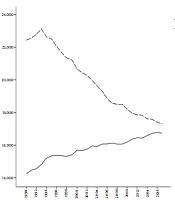
In the final step of the data analysis, to investigate the relationship between ASMR and HDI, the mean trend of these rates was depicted by HDI level (Figure 2).

Figure 2.
Mean trend of breast cancer ASMR by HDI level
According to the mean ASMR trends in Figure 2, countries in each HDI level have their own intercept and slope during the study time. Thus, we utilized four different marginal models to estimate the mean trend of ASMR in four levels of HDI. Because of the relatively linear nature of the mean trends, the described linear marginal model in the methods section was separately fitted for each HDI level. Table 3 displays the obtained estimates from this model.
Table 3.
Parameter Estimates from Modeling the Mean Trend of Breast Cancer ASMR for Different HDI Levels from 1990 to 2017
| HDI Level | Parameter | Estimate | SE | P Value |
|---|---|---|---|---|
| Low | Intercept | 14.39 | 0.69 | < 0.001 |
| Slope | 0.11 | 0.03 | < 0.001 | |
| Medium | Intercept | 14.77 | 0.83 | < 0.001 |
| Slope | 0.06 | 0.04 | 0.134 | |
| High | Intercept | 21.01 | 1.11 | < 0.001 |
| Slope | -0.16 | 0.06 | 0.008 | |
| Very high | Intercept | 24.79 | 1.12 | < 0.001 |
| Slope | -0.28 | 0.04 | < 0.001 | |
| Low/medium | Intercept | 14.67 | 0.59 | < 0.001 |
| Slope | 0.08 | 0.03 | 0.003 | |
| High/very high | Intercept | 23.04 | 0.94 | < 0.001 |
| Slope | -0.23 | 0.04 | < 0.001 |
According to Figure 2, the behavior of ASMRs for Low and medium HDI countries is rather identical and also the high and very high HDI countries have a nearly similar trend. Therefore, we combined the countries with low and medium HDI in a category and countries with high and very high levels of HDI in another category. Figure 3 shows the mean trend of breast cancer AMSR for these two categories. We also fitted the model (1) to these new categories and the results are shown in the end rows of Table 3.

Figure 3.
Mean trend of breast cancer ASMR for HDI level low/medium versus high/very high
The estimates of intercepts and slopes in Table 3 suggest that the countries with lower HDI (levels 1 and 2) have a lower mean value of breast cancer mortality rate than those with higher levels of HDI in the starting point of the study (about 14 per 100,000 for countries in HDI levels 1 and 2 versus about 21 for countries in HDI level 3 and about 25 for countries in HDI level 4 in 1990). Despite lower intercept estimates for the countries with lower levels of HDI, these countries experienced an increasing trend during these years (an annual increase of 0.11 per 100,000 for countries in HDI level 1 and an annual increase of 0.06 per 100,000 for countries in HDI level 2). However, the wealthier countries experienced downward trends in that period. For countries in the HDI levels 3 and 4, respectively, an annual decrease of 0.16 and 0.28 per 100,000 can be observed between 1990 and 2017.
5. Discussion
According to the recent reports from worldwide data sets, female breast cancer is one of the top three cancers in terms of incidence and the fifth in terms of mortality. Female breast cancer together with lung and colorectal cancers are responsible for about one-third of cancer mortality around the world. In addition, about 24% of all new cases of cancer in women are diagnosed with breast cancer throughout the world. Breast cancer is also the leading cause of female cancer mortality (about 15% of cancer deaths in women) (3, 12, 13).
In this study, we first investigated the global trend of female breast cancer mortality rate for the period 1990 - 2017 using the GBD 2017 data. Our findings have revealed that the global age standardized rate of death from breast cancer was relatively stable between 1990 and 2017 (around 17 per 100,000). A trend analysis of breast cancer burden by using the GLOBOCAN 2002 data has resulted in ASMR of 13.2 per 100,000 worldwide between 1993 and 2001 (ranging from 8.8 in Asia to 19.7 in Europe) (9). The reported findings from another study using GLOBOCAN 2012 data have revealed that the age standardized mortality rate of breast cancer for both sexes are 10.2, 16.1, 15.6, 17.3, and 12.9 per 100,000, respectively in Asia, Europe, Oceania, Africa, and the whole world (17). In a research conducted on the female breast cancer data from the GBD 2016 study for the period 1990 to 2016 for 102 countries, the results have indicated that deaths from this cancer increased from 336857 in 1990 to 535341 in 2016, however the breast cancer ASMR decreased from 17.2 in 1990 to 14.6 per 100,000 females in 2016 (5). In the last decades, simple and free accessibility to the data sets about the burden of different diseases in nearly all world countries has provided the opportunity for the researchers to report the point estimates of the burden statistics and analyze the trend of these statistics in different world regions and time periods. Nevertheless, geographical and temporal variations, differences in utilized indices, age or sex groups under the study, and discrepancy in statistical analyses make the reported results inconclusive. In general, it seems that increasing the mortality rate of breast cancer in countries with lower levels of HDI nearly compensates for the reduction of the rate in the countries with higher HDI levels and this makes the global trend of breast cancer ASMR rather stable in the recent decades (18).
The most important aim of the present study was to examine the longitudinal relationship between breast cancer ASMR and HDI. We have shown that while the countries with higher levels of development have a dramatically downward trend for breast cancer mortality rate, countries with lower levels of development experience an upward trend in these years. More specifically, our results have indicated that although more developed countries had higher levels of breast cancer mortality rates in the starting point of the study (in 1990) than those with lower HDI levels, the mean ASMR for all four levels of HDI were nearly close together in the ending point of the study (in 2017), because of decreasing slope of ASMR for countries with lower levels of HDI and increasing slope for those with higher HDI levels. An overview of the published literature about the relationship between HDI and breast cancer mortality rates in different parts of the world showed controversial findings. In most of these articles, the researchers have utilized simple statistics (such as Pearson’s correlation coefficient and simple linear regression) to assess the relationship between breast cancer mortality rate or breast cancer mortality-to-incidence ratio (MIR) and raw values of HDI. For instance, Ghoncheh et al. have evaluated the relationship between HDI and breast cancer mortality in 2012. They have reported a non-significant correlation of 0.091 and -0.051 between age-specific mortality rate and HDI, respectively in the whole world countries and Asia (10, 19). In another study in the Pan American region, Martinez-Mesa et al. have reported a positive correlation of 0.44 between natural log age-standardized breast cancer mortality rate and HDI in 2012 (20). As one of the most comprehensive studies in this field, Sharma has examined the relationship between HDI and the burden of breast cancer in 2016. Using the data from GBD study 2016 (1990 - 2016) for 102 countries, he has remarked that the deaths from breast cancer have doubled in 42% of the countries, while the incidence of this disease has more than doubled in 59% of 102 countries under the study in the period 1995 - 2016. Using the pairwise correlation coefficient, he has also concluded that increasing HDI has resulted in a lower mortality-to-incidence ratio in these countries. This latter finding shows the importance of development status in reducing the burden of breast cancer and increasing the survival rate of the patients (5). In another study conducted on GLOBOCAN database 2012 for 53 African countries, the researchers have demonstrated that cancer mortality-to-incidence rate inversely correlates with HDI (r = -0.897, P < 0.001). Using linear regression analysis, they have shown that more than 80% of the variation in cancer mortality-to-incidence could be explained by the variation in HDI (beta = -0.898, adjusted R-square = 0.801). The high value of the estimated R-square in the described study shows the importance of promoting the economic status in controlling the burden of cancer in this continent (21). Once again, these controversial findings about the relationship between the burden of breast cancer and HDI might be attributed to the differences in choosing the statistical approach, geographical variation, sample size, or time period of the study. Here, it should be noted that because both the breast cancer mortality rate (or mortality-to-incidence ratio) and HDI are time-varying indices, it is more convenient to utilize statistical approaches which enable us to study the association between them more efficiently. In the present study, we have used more advanced statistical methods to capture the longitudinal nature of the main outcome (breast cancer ASMR) and account for the correlation between the outcome observations (repeated measurements of ASMR for each country from 1990 to 2017). In other words, instead of summarizing the relationship between breast cancer ASMR and HDI using a simple univariate statistical index like Pearson’s or Spearman’s correlation coefficient, we have modeled the longitudinal behavior of the breast cancer ASMR, separately in each level of HDI and evaluated the relationship between these two statistics more formally. This advantage of our study makes our results more reliable than those studies which have used classic univariate statistical techniques for analyzing their data. Lack of access to potential confounding factors (such as the stage of breast cancer, age of cases, completeness of cancer registry, and utilization of health and treatment services) for all world countries during the study period is one of the main limitations of our work. Adjusting these confounders in the modeling process might lead to more reliable results and enhance the accuracy of the estimates.
5.1. Conclusions
In conclusion, the findings of the present study revealed a strong association between breast cancer mortality rate and development status, defined by HDI. In other words, our findings imply that while breast cancer mortality rates have been decreasing in high and very high HDI countries since the early 90s, these rates continue to increase in countries with low and medium HDI levels. The decline in the wealthier countries might be attributed to the diagnosis of the disease in the earlier stages, improve the level of care. and access to the proper treatment in these countries. On the other hand, the findings are a serious alarm for health policymakers in the countries with lower levels of development. To reduce the burden of breast cancer in these countries, there is an urgent need for promoting economic development, increasing awareness about this cancer, establishing enhanced health care systems for the diagnosis of patients in the early stages, and having access to necessary treatment.